Mine Clearance Systems Market Size, Share, Industry Analysis, and Russia-Ukraine War Impact Analysis, By Application (Military Operation, Humanitarian/Post-Conflict Demining, Infrastructure Development, and Border Security & Counter-Terrorism), By Type (Mechanical Systems, Electromagnetic/Detection Systems, Explosive Ordnance Disposal (EOD) Systems, and Chemical/Other Innovative Systems), By Platform (Tracked Vehicles/Armored Vehicles, Wheeled Vehicles, Unmanned Ground Vehicles (UGVs), Aerial Platforms/UAVs (Drones), and Manual/Handheld Tools), By End-Use, and Regional Forecast, 2026-2034
 Download Free Sample
KEY MARKET INSIGHTS
 Listen to Audio Version
The global mine clearance systems market size was valued at USD 71.3 million in 2025 and is projected to grow from USD 78.5 million in 2026 to USD 132.8 million by 2034, exhibiting a CAGR of 6.79% during the forecast period. Europe dominated the mine clearance systems market with a market share of 34.57% in 2025.
The mine clearance systems plays a crucial role in global security and post-conflict rehabilitation. It encompasses mechanical, robotic, and sensor-based technologies designed to detect, neutralize, and dispose of landmines and unexploded ordnance. The market serves dual purposes military operations for tactical clearance and humanitarian demining for civilian safety and land recovery. Technological innovation is a defining feature, with increasing adoption of autonomous systems, UAV-based mapping, and AI-enhanced detection sensors. Governments, defense agencies, and humanitarian organizations are collectively driving demand as they seek safer and faster methods of demining. With rising geopolitical tensions and international pressure to meet humanitarian targets, the sector is evolving rapidly. The market is projected to grow steadily through 2032, driven by technological advancements, increased funding, and a global emphasis on post-war reconstruction and land rehabilitation.
Prominent companies shaping the market include DOK-ING (Croatia), Pearson Engineering (U.K.), Armtrac (U.K.), Rheinmetall AG (Germany), BAE Systems (U.K.), Saab AB (Sweden), Hydrema (Denmark), MineWolf Systems (Switzerland), Milrem Robotics (Estonia), and FAE Group (Italy). These players focus on innovations in robotic automation, modular demining tools, and AI-assisted detection systems. Strategic collaborations between European defense firms and Eastern European governments are further accelerating system modernization and regional production capabilities.
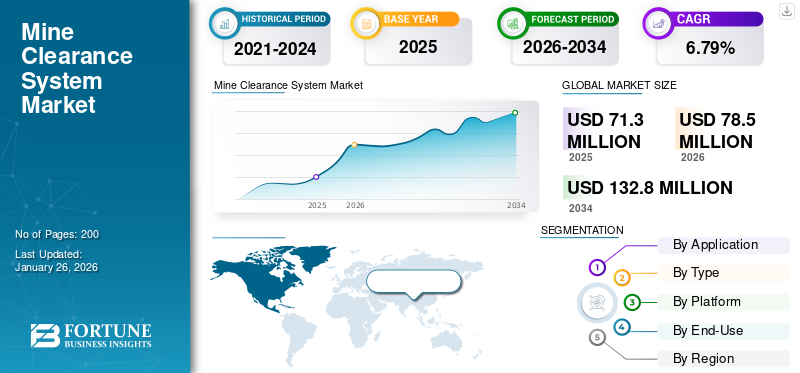
Download Free sample to learn more about this report.
Mine Clearance Systems Market Key Takeaways
 Global Market Size & Forecast
- 2025 Market Size: USD 71.3 million
- 2026 Market Size: USD 78.5 million
- 2034 Forecast Market Size: USD 132.8 million
- CAGR: 6.79% from 2026–2034
 Market Share
- Europe dominated the market with a 34.57% share in 2025.
- Military & Defense Forces held the largest share with 45.85% in 2025.
- Mechanical Systems accounted for the largest share with 59.07% in 2025.
 Key Regional Highlights
North America
Valued at USD 16.5 million in 2025; projected to reach USD 18.0 million in 2026.
Asia Pacific
Valued at USD 20.8 million in 2025; projected to reach USD 23.2 million in 2026.
Europe
Valued at USD 24.7 million in 2025; projected to reach USD 27.2 million in 2026.
U.S.
The market is projected to reach USD 11.1 million by 2026.
Japan
The market is projected to reach USD 4.7 million by 2026.
Read More

IMPACT OF RUSSIA-UKRAINE WAR
Russia-Ukraine War Accelerated Defense Modernization and Surveillance Investments Using Mine Clearance Systems
The ongoing Russia-Ukraine conflict has had a profound and multifaceted impact on the global mine clearance systems market. The large-scale use of anti-personnel and anti-tank mines across Ukrainian territories has led to one of the most heavily mined regions in the world, with millions of hectares of agricultural and residential land rendered unsafe. As a result, global demand for advanced mine detection and clearance technologies has surged. Ukraine’s reconstruction and humanitarian demining operations supported by NATO members, the EU, and international NGOs have accelerated the procurement of mechanical, robotic, and autonomous clearance systems. This conflict has also pushed Western defense contractors to ramp up R&D investments in remote-controlled demining platforms and AI-driven detection solutions. Beyond immediate needs, the war has underscored the strategic importance of supply chain security and regional manufacturing capabilities, prompting increased defense spending across Eastern Europe. Overall, the Russia-Ukraine war has become a pivotal catalyst, reshaping global priorities toward scalable, safe, and rapid mine clearance solutions.
MINE CLEARANCE SYSTEM MARKET TRENDS:
Rising Adoption of Autonomous and Robotic Mine Clearance Technologies to Accentuate Market Growth
The global mine clearance systems market share is witnessing a notable shift toward autonomous and robotic technologies. Governments and defense forces are increasingly investing in unmanned systems that reduce human risk and enhance operational efficiency in hazardous zones. Traditional manual or mechanical systems, though still in use, are being complemented by advanced AI-based detection and robotic neutralization units. Integration of sensor fusion technologies, combining ground-penetrating radar, metal detection, and hyperspectral imaging, is improving accuracy and reducing false positives.
Another prominent trend is the adoption of UAVs for minefield mapping, enabling real-time terrain analysis. Furthermore, humanitarian organizations are deploying eco-friendly demining approaches, such as biological and chemical neutralization methods, aligning with global sustainability goals. The trend also extends to the development of modular and multi-mission platforms, which can perform detection, clearance, and verification in a single deployment. Collectively, these innovations are redefining the operational landscape and improving the efficiency, precision, and safety of mine clearance globally.
Download Free sample to learn more about this report.
MARKET DYNAMICS
MARKET OPPORTUNITIES
Expansion of Humanitarian Demining and Smart Technology Integration to Accentuate Market Growth
The mine clearance systems market growth holds immense opportunity in the integration of smart technologies and the expansion of humanitarian demining operations. With more than 100 million mines estimated to be buried globally, international efforts to rehabilitate post-conflict regions present long-term prospects for equipment manufacturers and technology developers. The growing demand for autonomous mine clearance robots, AI-driven detection systems, and UAV-assisted terrain mapping opens opportunities for startups and defense contractors alike. Governments and NGOs are increasingly favoring systems that combine precision, cost-efficiency, and environmental sustainability, driving innovation in lightweight, hybrid, and solar-powered demining machines. Moreover, the development of dual-use systems capable of both military and civil demining creates new revenue streams. As nations push toward land reclamation for agriculture, infrastructure, and resettlement, the integration of advanced technologies and public-private partnerships will unlock significant growth potential in the coming decade.
MARKET DRIVERS
Increasing Global Humanitarian and Military Demining Initiatives to Boost Market Growth
One of the strongest market drivers is the growing international commitment to clearing landmines from conflict and post-conflict zones. Over 60 countries remain affected by active or buried mines, creating both a humanitarian and economic imperative for clearance operations. Governments, the UN Mine Action Service (UNMAS), and NGOs such as HALO Trust and MAG are increasing their funding and operational outreach, particularly in Africa, the Middle East, and Southeast Asia. Parallel to humanitarian efforts, defense modernization programs are emphasizing the acquisition of mine-resistant and clearance technologies for military operations. Rising geopolitical tensions and border security measures are fueling demand for rapid and efficient mine-clearing equipment. Additionally, technological integration such as advanced sensors, robotics, and autonomous systems is improving safety and efficiency, encouraging adoption by both defense and civil agencies. The increasing collaboration between defense contractors and technology startups further accelerates innovation and cost reduction, driving overall market growth globally.
MARKET RESTRAINTS
High Operational Costs and Limited Funding for Demining Activities to Hamper Market Growth
Despite technological advances, the market faces major restraints due to high operational costs and limited financial resources for large-scale deployment. Developing and maintaining autonomous or advanced mechanical systems involves substantial investment in engineering, materials, and field training. Many affected nations especially in Africa, Southeast Asia, and parts of the Middle East lack the financial capability to acquire or operate modern systems, relying instead on outdated manual techniques. Moreover, humanitarian demining projects often depend on international donor funding, which is inconsistent and politically influenced. The complexity of terrains and varying soil conditions also increase equipment wear and maintenance costs. Further, regulatory and safety certification processes prolong deployment timelines, increasing total project expenses. Collectively, these financial and logistical barriers slow down adoption, particularly in regions where mine contamination remains widespread but resources are limited, thus restricting the overall market expansion.
MARKET CHALLENGES
Technological Complexity and Harsh Operational Environments Are Major Market Challenges
A key challenge in the mine clearance system market is the technological and environmental complexity of clearing diverse and unpredictable minefields. Mines vary widely in size, composition, and sensitivity, making universal detection and neutralization difficult. Mechanical systems may fail in rocky, swampy, or heavily vegetated terrains, while electromagnetic sensors struggle with metallic debris interference. Moreover, the durability and reliability of robotic or unmanned systems are often tested under extreme temperatures, dust, and mechanical stress, leading to high maintenance requirements. The lack of standardized international testing and interoperability protocols further complicates system integration across different forces and agencies. Training operators to effectively manage advanced detection algorithms or remotely piloted clearance robots also poses a challenge. Additionally, balancing safety with operational speed remains a persistent issue. Overcoming these challenges requires constant R&D investment, cross-sector collaboration, and adaptive design innovations tailored to real-world demining conditions.
SEGMENTATION ANALYSIS
By End-Use
Rising Defense Modernization Driving Demand for Advanced Mine Clearance Solutions
By end-use, the market is segmented into military & defense forces, government & civil agencies, private contractors/OEMs, and international organizations.
The military & defense forces segment captured the largest share of 45.89% in 2026. In 2025, the segment is anticipated to dominate with 45.85% share. The military & defense forces segment holds the largest demand in the market, driven by the need for rapid battlefield clearance, base protection, and tactical mobility. Rising defense budgets and modernization programs are pushing armed forces to procure advanced, automated, and armored clearance platforms globally.
The government & civil agencies segment is expected to grow at a CAGR of 8.3% over the forecast period.
To know how our report can help streamline your business, Speak to Analyst
By Application
Operational Deployments Fueling Demand for Tactical Mine Clearance Capabilities
The application segment is classified into military operations, humanitarian/post-conflict demining, infrastructure development, and border security & counter-terrorism.
The military operations segment captured the largest share of 46.8% in 2026. In 2025, the segment is anticipated to dominate with 46.76% share. The military operations segment dominates due to the increasing deployment of mine clearance systems in active conflict zones and peacekeeping missions. Demand is propelled by border tensions, hybrid warfare threats, and the necessity to secure supply routes and forward operating bases with minimal human risk.
The humanitarian/post-conflict demining segment is expected to grow at a CAGR of 8.1% over the forecast period.
By Type
Mechanical Systems Preferred for Large-Scale and Reliable Mine Removal
The type segment is classified into mechanical systems, electromagnetic/detection systems, explosive ordnance disposal (EOD) systems, and chemical/other innovative systems.
The mechanical systems segment captured the largest share of 59.03% in 2026. In 2025, the segment is anticipated to dominate with 59.07% share. The mechanical systems segment commands strong demand owing to their high reliability, efficiency, and ability to clear large areas rapidly. Militaries and humanitarian agencies favor these systems for their proven effectiveness in removing anti-personnel and anti-tank mines across rugged terrains and post-conflict zones.
The chemical/other innovative systems segment is expected to grow at a CAGR of 8.2% over the forecast period.
By Platform
Tracked and Armored Platforms Dominate in High-Risk Combat Zones
By platform, the market is classified into tracked vehicles/armored vehicles, wheeled vehicles, unmanned ground vehicles (UGVs), aerial platforms/UAVs (drones), and manual/handheld tools.
The tracked vehicles/armored vehicles segment captured the largest share of 44.61% in 2026. In 2025, the segment is anticipated to dominate with 44.69% share. The tracked vehicles/armored vehicles segment remains in high demand due to their superior mobility, protection, and suitability for combat conditions. Defense forces utilize them for minefield breaching and safe route creation, particularly in heavily mined or hostile operational environments.
The unmanned ground vehicles (UGVs) segment is expected to grow at a CAGR of 8.6% over the forecast period.
MINE CLEARANCE SYSTEMS MARKET REGIONAL OUTLOOK
In terms of region, the market is divided into North America, Europe, Asia Pacific, and the rest of the world.
North America
The North America market generated USD 16.5 million in 2025, representing 23.19% of the global market landscape, and is expected to reach USD 18 million in 2026. The North American market for mine clearance systems is driven by robust defense spending, modernization initiatives, and U.S.-led support for global demining efforts. Advanced technologies such as autonomous clearance vehicles and sensor-based detection systems are witnessing high adoption, with strong procurement from both military and humanitarian agencies.
In the U.S., demand for mine clearance systems is strong due to continuous investments in defense modernization, counter-IED programs, and global humanitarian demining support. The U.S. military and defense contractors are pioneering AI-integrated and unmanned clearance platforms for both domestic training and international deployment. The U.S. market is projected to reach USD 11.1 million by 2026.
Europe
Europe Mine Clearance Systems Market Size, 2025 ( USD Million)
To get more information on the regional analysis of this market, Download Free sample
Europe contributed 34.57% to the global market in 2025, with a valuation of USD 24.7 million, and is projected to reach USD 27.2 million in 2026. In Europe, demand is accelerating due to regional security challenges, the Russia-Ukraine conflict, and NATO-led defense programs. Countries such as U.K., Germany, and France are heavily investing in mechanized and robotic mine clearance solutions to enhance both military readiness and post-conflict reconstruction capabilities. The UK market is projected to reach USD 5.3 million by 2026, while the Germany market is projected to reach USD 7.1 million by 2026.
Asia Pacific
Asia Pacific accounted for USD 20.8 million in 2025, representing 29.23% of the global market share, and is projected to reach USD 23.2 million in 2026. The Asia Pacific region shows rising demand, led by countries such as China, India, and Japan focusing on border security, defense modernization, and regional peacekeeping efforts. Ongoing territorial disputes and post-conflict rehabilitation in Southeast Asia further stimulate adoption of cost-effective and unmanned mine clearance systems. The Japan market is projected to reach USD 4.7 million by 2026, the China market is projected to reach USD 12.4 million by 2026, and the India market is projected to reach USD 3.8 million by 2026.
Rest of the World
In 2025, the Rest of the World market stood at USD 9.3 million, representing 13.01% of global demand, and is projected to grow to USD 10.1 million in 2026. The Middle East witnesses steady demand growth, primarily driven by post-war reconstruction in Iraq, Syria, and Yemen. Governments and international organizations are funding large-scale demining programs, emphasizing durable mechanical and armored clearance platforms to restore infrastructure and ensure civilian safety in previously mined territories. In Africa, demand is dominated by humanitarian and post-conflict demining programs supported by international NGOs and the UN. Countries such as Angola, Sudan, and Mozambique are key focus areas, with growing reliance on cost-efficient mechanical and manual clearance systems to reclaim agricultural and residential land. The Latin American market is expanding gradually, driven by Colombia and Peru’s ongoing efforts to clear landmines from decades-long internal conflicts. Increased cooperation with international organizations and the adoption of lightweight robotic and manual demining tools are contributing to the region’s steady demand growth.
COMPETITIVE LANDSCAPE
KEY INDUSTRY PLAYERS
Key Players Driving Innovation and Defense Modernization in Mine Clearance Systems
The mine clearance systems market is dominated by a mix of established defense contractors and specialized demining technology companies that are driving innovation and global adoption. DOK-ING (Croatia) is renowned for its autonomous mine clearance vehicles, combining mechanical efficiency with robotic precision. Pearson Engineering (U.K.) and Armtrac (U.K.) offer modular and adaptable clearance attachments for armored vehicles, widely used in military and humanitarian operations. Rheinmetall AG (Germany) and BAE Systems (U.K.) integrate advanced robotics and sensor technologies, enhancing operational safety and efficiency. Saab AB (Sweden), Hydrema (Denmark), and MineWolf Systems (Switzerland) focus on multi-terrain solutions, while Milrem Robotics (Estonia) pioneers unmanned ground vehicles with AI-based detection systems. FAE Group (Italy) provides durable mechanical systems for large-scale demining. These players emphasize research and development, collaboration with governments, and integration of autonomous and sensor-driven technologies to address global mine clearance challenges effectively. Their innovations continue to expand the market and improve demining safety and efficiency globally.
LIST OF KEY MINE CLEARANCE SYSTEMS COMPANIES PROFILED:
- DOK-ING d.o.o. (Croatia)
- Pearson Engineering Ltd (U.K.)
- Hydrema Holding ApS (Denmark)
- MineWolf Systems AG (Switzerland)
- Saab AB (Sweden)
- FAE Group S.p.A. (Italy)
- Milrem Robotics AS (Estonia)
- BAE Systems plc (U.K.)
- Armtrac Limited (U.K.)
- Rheinmetall AG (Germany)
KEY INDUSTRY DEVELOPMENTS:
- February 2025 - The U.S. Navy has recently granted a number of contracts through the Program Executive Office, Unmanned and Small Combatants (PEO USC), aimed at supporting the deployment of Littoral Combat Ship (LCS) Mine Countermeasures (MCM) Mission Packages (MP). Additionally, the Navy has awarded a production contract for the Minehunt Payload Delivery System (MH PDS) to Raytheon Technologies. This contract is worth USD 18.3 million for the production of five units, with expected deliveries by the conclusion of FY26.
- December 2024 - The Indian Army is investigating the use of robotics and artificial intelligence to enhance the safety and efficiency of mine clearance operations, and may consider collaborating with a private partner for further development.
- November 2024 - The UAE Navy has granted a contract to Exail, a French firm recognized for its expertise in robotics and maritime systems, to provide the UMIS 3rd generation unmanned Mine Countermeasures system. This cutting-edge technology is designed to enhance the UAE Navy's ability for remote mine clearance, thereby addressing significant security requirements in regional waters.
- February 2024 - The European Union has supplied Ukraine with a state-of-the-art mine-clearing machine. During the recent visit to Ukraine by High Representative/Vice-President (HR/VP) Josep Borrell, the State Special Transport Service of Ukraine was presented with a DOK-ING MV-10 mine-clearing system.
- June 2023 - BAE Systems has secured a contract to modify a new mine disposal system utilizing Archerfish for Korean Aerospace Industries, as part of the initiative to develop the Republic of Korea (ROK) Navy’s new anti-mine helicopter fleet.
REPORT COVERAGE
The research report regarding the expansion of the mine clearance systems market provides an in-depth analysis by identifying the key companies, product categories, and main applications within the industry. Additionally, the report highlights market trends and notable developments in this field. In conjunction with the aforementioned aspects, the report includes several factors that have contributed to the rapid market growth witnessed in recent years.
Request for Customization to gain extensive market insights.
REPORT SCOPE AND SEGMENTATION
| ATTRIBUTE | DETAILS |
| Study Period | 2021-2034 |
| Base Year | 2025 |
| Estimated Year | 2026 |
| Forecast Period | 2026-2034 |
| Historical Period | 2021-2024 |
| Growth Rate | CAGR of 6.79% from 2026-2034 |
| Unit | Value (USD Million) |
| Segmentation |
By Application
By Type
By Platform
By End-Use
By Region
|
Frequently Asked Questions
Fortune Business Insights says the market value stood at USD 78.5 million in 2026 and is estimated to reach USD 132.8 million by 2034.
The market is growing at a CAGR of 6.79% during the projection period.
The military & defense forces segment is estimated to be the leading segment in this market during the forecast period.
The mechanical systems segment is estimated to be the leading segment in this market during the forecast period.
DOK-ING d.o.o. (Croatia), Pearson Engineering Ltd (U.K.), Hydrema Holding ApS (Denmark), MineWolf Systems AG (Switzerland), Saab AB (Sweden), and FAE Group S.p.A. (Italy) are some of the leading players in the market.
Europe is projected to be the largest shareholder in the market.



- 2021-2034
- 2025
- 2021-2024
- 200
Get 30-60 hrs Free Customization
Expand Regional and Country Coverage, Segments Analysis, Company Profiles, Competitive Benchmarking, and End-user Insights.




















-
US +1 833 909 2966 ( Toll Free )
-
Get In Touch With Us