Mineral Oil Market Size, Share & Industry Analysis, By Product Type (Technical Mineral Oil, White Mineral Oil, and Others), By End-Use Industry (Industrial Manufacturing, Automotive & Transportation, Personal Care & Cosmetics, Pharmaceuticals, Food & Beverage, and Others), and Regional Forecast, 2026-2034
 Download Free Sample
Mineral Oil Market Size and Future Outlook
 Listen to Audio Version
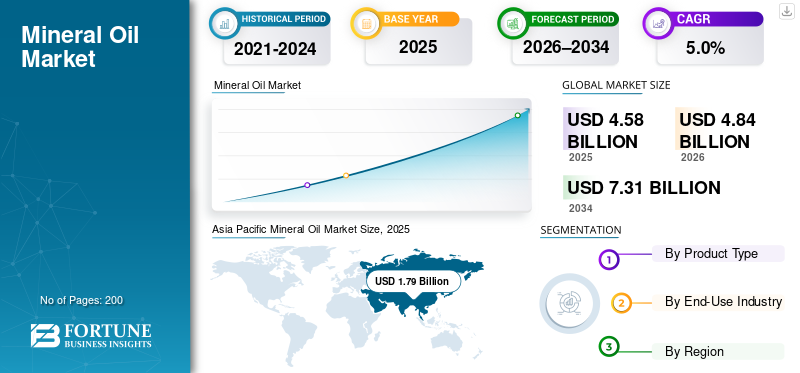
The global mineral oil market size was valued at USD 4.58 billion in 2025 and is projected to grow from USD 4.84 billion in 2026 to USD 7.31 billion by 2034, exhibiting a CAGR of 5.3% during the forecast period. Asia Pacific dominated the mineral oil market with a market share of 39.08% in 2025.
The market for mineral oil is supported by steady demand across industrial, automotive, personal care, pharmaceutical, and specialty applications that require reliable and cost-effective base fluids. Mineral oils are refined petroleum-based products valued for their stability, lubrication properties, chemical resistance, and ease of formulation. They are widely used in lubricants, hydraulic fluids, transformer oils, process oils, cosmetics and personal care, pharmaceuticals, and food-grade applications, where consistent quality and safe performance are important. In addition, rising infrastructure development, manufacturing output, and the need for dependable lubrication and process materials are driving the market growth.
Key market players such as Exxon Mobil Corporation, Shell plc, BP, Chevron, and Total Energies compete through large-scale production, integrated supply chains, and consistent product quality to serve a wide range of industrial, automotive, and specialty end-use applications.
Download Free sample to learn more about this report.
Mineral Oil Market Key Takeaways
 Global Market Size & Forecast
- 2025 Market Size: USD 4.58 billion
- 2026 Market Size: USD 4.84 billion
- 2034 Forecast Market Size: USD 7.31 billion
- CAGR: 5.3% from 2026–2034
 Market Share
- Asia Pacific dominated the mineral oil market with a 39.08% share in 2025.
- The technical mineral oil segment is expected to grow at a CAGR of 4.5% during the forecast period.
- The automotive & transportation segment is projected to expand at a CAGR of 5.4% over the forecast period.
 Key Regional Highlights
Asia Pacific
Asia Pacific led the market with USD 1.79 billion in 2025 and is projected to reach USD 1.90 billion in 2026.
North America
North America remained a key regional market, valued at USD 1.04 billion in 2025.
Europe
Europe recorded a market value of USD 1.13 billion in 2025 and is expected to witness moderate growth during the forecast period.
U.S.
The mineral oil market was valued at USD 0.84 billion in 2025, accounting for approximately 80.9% of North American revenue.
Japan
Rising demand from the automotive, industrial, and manufacturing sectors is supporting mineral oil market growth.
Read More

MINERAL OIL MARKET TRENDS
Rising Shift Toward High-Purity and Specialty-Grade Mineral Oils is a Key Market Trend
A key trend in the market is the growing shift toward high-purity and specialty-grade products, particularly for personal care, pharmaceutical, food, and sensitive industrial applications. End users are placing greater emphasis on product safety, consistency, and compliance with stricter quality and regulatory standards. This is increasing demand for highly refined mineral oils with low impurities, improved stability, and controlled performance characteristics. As a result, producers are focusing more on advanced refining processes, quality certification, and tailored formulations to meet the evolving requirements of regulated and value-added end-use industries.
According to the U.S. Food and Drug Administration (FDA), mineral oils used in food, pharmaceutical, and personal care applications must comply with strict purity and refining standards under federal regulations, driving demand for highly refined, specialty-grade mineral oils across regulated end-use industries.
MARKET DYNAMICS
MARKET DRIVERS
Expanding Infrastructure and Utility Networks Drive Product Demand
Demand for mineral oil is strongly driven by its widespread use across industrial manufacturing, automotive operations, and infrastructure-related activities. These oils are commonly used as lubricants, hydraulic fluids, transformer oils, and process oils as they provide reliable performance, thermal stability, and cost-effective operation. As industrial equipment usage increases and machinery-intensive sectors such as manufacturing, construction, power generation, and transportation continue to expand, the need for dependable lubrication and fluid solutions rises. This drives mineral oil market growth.
- According to the International Energy Agency (IEA), non-fuel uses of oil, including lubricants, process oils, and specialty products, represent a significant and growing share of global oil demand, driven by industrial activity, manufacturing output, and expanding use of machinery and equipment across various sectors.
MARKET RESTRAINTS
Exposure to Price Volatility and Environmental Regulations Restrains Market Growth
The market faces restraints due to its dependence on crude oil prices and rising regulatory pressure on environmental and sustainability concerns. Fluctuations in crude oil costs directly affect product pricing, making cost planning challenging for manufacturers and end users. Compliance requirements related to emissions, waste handling, and product safety can also increase operational costs, slowing adoption in markets that are shifting toward more sustainable fluid solutions.
- According to the U.S. Energy Information Administration (EIA), crude oil price volatility directly affects the cost structure of petroleum-derived products such as mineral oils and lubricants, while evolving environmental regulations and fuel quality standards are influencing downstream petroleum product demand and compliance costs.
MARKET OPPORTUNITIES
Rising Demand from Personal Care, Pharmaceuticals, and Specialty Applications Creates New Opportunities
The market presents strong growth opportunities as demand increases from personal care, pharmaceutical, and specialty industrial applications that require high-purity and consistent performance raw materials. Mineral oils are widely used in cosmetics, skin care products, medicinal formulations, and food-grade applications due to their stability, safety profile, and ease of formulation. As consumer spending on personal care products rises and pharmaceutical manufacturing expands globally, producers are investing in higher-quality, refined oils to meet stricter purity and regulatory standards.
- According to the Observatory of Economic Complexity (OEC), global trade in beauty and personal care products reached USD 67.9 billion, rising from USD 61.3 billion in 2022, which reflects strong growth in cosmetic product demand and supports increased consumption of formulation ingredients, including mineral oils, across the personal care market.
MARKET CHALLENGES
Growing Competition from Alternative Fluids and Sustainability Expectations Creates Market Challenges
The market faces challenges from increasing competition with synthetic and bio-based fluid alternatives, particularly in applications where sustainability, biodegradability, and lower environmental impact are becoming important purchasing criteria. End users in industries such as automotive, industrial manufacturing, and personal care are gradually evaluating alternative formulations to meet corporate sustainability goals and regulatory expectations.
- According to the European Commission, the growing emphasis on sustainability and circular economy practices is encouraging the use of bio-based and environmentally friendly alternatives, creating substitution pressure for traditional mineral oil products in certain applications.
Download Free sample to learn more about this report.
Segmentation Analysis
By Product Type
Broad Industrial Usage and Cost-Effective Performance Support the Dominance of White Mineral Oil Segment
Based on product type, the market is segmented into technical mineral oil, white mineral oil, and others.
White mineral oil holds the largest market share due to its broad use across pharmaceutical, personal care, and food-related applications where purity, safety, and consistent quality are essential. It is commonly used in cosmetics, skin care products, ointments, laxatives, and food-contact applications as it offers stable performance, low odor and color, and good compatibility with a wide range of formulations.
- According to Science Direct, mineral oil–based fluids are widely used in industrial and technical applications due to their good lubrication performance, thermal stability, and cost effectiveness, which makes technical type suitable for large-volume industrial and machinery-related uses.
The technical mineral oil segment is expected to grow at a CAGR of 4.5% over the forecast period.
By End-Use Industry
Personal Care & Cosmetics Anchor the Largest Share of Product Demand in Consumer Formulations
In terms of end-use industry, the market is categorized into industrial manufacturing, automotive & transportation, personal care & cosmetics, pharmaceuticals, food & beverage, and others.
To know how our report can help streamline your business, Speak to Analyst
The personal care & cosmetics segment holds the largest mineral oil market share, as manufacturers widely use it in high-volume consumer products where consistency, safety, and a smooth texture are essential. Mineral oils are commonly used in skin creams, lotions, baby care products, hair oils, makeup, and cleansing formulations due to their effective moisturization, a protective barrier feel, and good formulation stability at a competitive cost. Demand in this segment is strongly supported by frequent everyday use and large-scale production, as brands prioritize reliable ingredients that deliver consistent sensory performance, long shelf life, and broad consumer acceptance.
- According to the Observatory of Economic Complexity (OEC), Germany is the largest exporter of beauty products, with exports valued at USD 12.2 billion and a market share of 17.9%.
The automotive & transportation segment is expected to grow at a CAGR of 5.4% over the forecast period.
Mineral Oil Market Regional Outlook
By geography, the market is categorized into North America, Europe, Asia Pacific, Latin America, and the Middle East & Africa.
Asia Pacific
Asia Pacific Mineral Oil Market Size, 2025 (USD Billion)
To get more information on the regional analysis of this market, Download Free sample
Asia Pacific held the dominant position in the market in 2025, valued at USD 1.79 billion, and is expected to maintain its leading role in 2026, reaching USD 1.90 billion. The region’s leadership is supported by strong industrialization, large-scale manufacturing activity, and steady demand from automotive, personal care, pharmaceutical, and industrial sectors. Rapid growth in industrial production, expanding consumer goods manufacturing, and rising energy and infrastructure development across major economies continue to support high product consumption across technical and specialty applications.
China Mineral Oil Market
Based on Asia Pacific’s strong contribution and China’s extensive industrial base, the China market was valued at USD 0.79 billion in 2025, accounting for approximately 44.1% of regional revenues. Large-scale manufacturing operations, automotive production, chemicals processing, and a well-developed personal care and pharmaceutical industry drive demand. China also benefits from a strong domestic refining and supply ecosystem, supporting large-volume production and consumption of technical and specialty mineral oils across multiple end-use industries.
To know how our report can help streamline your business, Speak to Analyst
India Mineral Oil Market
The Indian market in 2025 was valued at USD 0.38 billion. Demand is supported by expanding industrial manufacturing, growth in automotive and machinery usage, and rising consumption of personal care and pharmaceutical products. Ongoing infrastructure development, increasing industrial output, and a growing domestic refining base continue to drive steady product consumption across industrial, technical, and specialty applications in both urban and industrial regions.
North America
North America remains an important regional market, with a valuation of USD 1.04 billion in 2025. Demand is supported by steady industrial activity, strong automotive and machinery usage, and continued consumption across personal care, pharmaceutical, and specialty manufacturing sectors. The region also benefits from a well-established refining and distribution base, which supports a reliable supply of technical and specialty mineral oils for industrial, commercial, and consumer applications.
U.S. Mineral Oil Market
The U.S. market in 2025 reached a valuation of USD 0.84 billion, accounting for approximately 80.9% of regional revenues. Demand is driven by extensive industrial manufacturing, high vehicle ownership and maintenance activity, and strong consumption of personal care & pharmaceutical products. The presence of major refiners, lubricant producers, and specialty oil suppliers further supports steady oil demand across the U.S. market.
Europe
Europe is expected to record moderate growth in the market. It recorded a valuation of USD 1.13 billion in 2025. The region is shaped by strict environmental regulations, strong sustainability expectations, and gradual shifts toward higher-quality and specialty-grade mineral oils. Demand is supported by steady industrial manufacturing activity, automotive production, and continued use of oils in personal care, pharmaceuticals, and industrial applications.
Germany Mineral Oil Market
Germany’s market reached a valuation of USD 0.34 billion in 2025, accounting for around 29.8% of regional demand. Consumption is supported by a strong industrial manufacturing base, high automotive production, and well-established chemical and pharmaceutical sectors.
Italy Mineral Oil Market
The Italy market in 2025 was valued at USD 0.17 billion, representing roughly 15.5% of regional revenues. Demand is driven by steady industrial activity, automotive maintenance and lubrication needs, and continued consumption of product in personal care and specialty manufacturing.
Latin America and Middle East, and Africa
Latin America and the Middle East & Africa regions are expected to witness moderate growth in the market during the forecast period. The Latin America market reached a valuation of USD 0.35 billion in 2025, supported by expanding industrial manufacturing, automotive activity, and growing demand from the personal care and pharmaceutical sectors. The Middle East & Africa market was valued at USD 0.28 billion in 2025, driven by industrial development, energy and infrastructure projects, and rising consumption of lubricants and process oils across construction, power generation, and industrial operations.
South Africa Mineral Oil Market
The South African market in 2025 was valued at USD 0.09 billion, accounting for approximately 33.5% of the Middle East & Africa revenues. Demand is supported by industrial manufacturing activity, automotive assembly and vehicle maintenance, and steady consumption in personal care and related downstream sectors. Ongoing investments in manufacturing capacity, along with consistent demand for lubricants, process oils, and industrial fluids across multiple industries, continue to underpin product consumption in the country.
COMPETITIVE LANDSCAPE
Key Industry Players
High Capital Intensity and Strategic Asset Management Shape Competition in the Market
The market is relatively consolidated and capital-intensive as large-scale production depends on access to refining assets, advanced processing units, and strict quality and regulatory compliance systems. Significant upfront investment in refining, purification, and distribution infrastructure, along with long qualification cycles for pharmaceutical, personal care, and industrial applications, limits the entry of new players.
Major companies such as Exxon Mobil Corporation, Shell plc, BP, Chevron, and Total Energies primarily focus on improving operational efficiency, optimizing refining and supply chains, and enhancing product quality and consistency rather than pursuing aggressive capacity expansion.
LIST OF KEY MINERAL OIL COMPANIES PROFILED
- Exxon Mobil Corporation.(U.S.)
- Shell plc (U.K.)
- BP (U.K.)
- Chevron (U.S.)
- Total Energies (France)
- Enilive S.p.A. (Italy)
- Calumet, Inc. (U.S.)
- Sonneborn LLC (U.S.)
- SAVITA Oil Technologies Limited (India)
- Gandhar Oil Refinery (India) Limited. (India)
KEY INDUSTRY DEVELOPMENTS
- October 2025: Sonneborn LLC (HF Sinclair brand) launched SonneNatural Fluidity and SonneNatural Synergy as new specialty ingredient product lines positioned as alternatives for low-viscosity oils in personal care formulations, reflecting ongoing product innovation in the broader specialty “oil” ingredients space adjacent to white mineral oil applications.
- September 2025: Exxon Mobil Corporation started up a new Singapore technology that converts lower-value streams into higher-value lubricant base stocks, including a new base stock grade, strengthening supply capabilities that sit upstream of many mineral-oil-based lubricant products.
- August 2025: Exxon Mobil Corporation made a final investment decision for a major reconfiguration at its Baytown complex to increase output of higher-demand products such as base stocks and diesel, a capacity/asset move that supports the mineral-oil/lubricant value chain through expanded base stock availability.
- July 2024: TotalEnergies acquired Tecoil (Finland), adding Re-Refined Base Oils (RRBOs) capability, a direct development in the base oil ecosystem that supports lubricant/mineral-oil supply with a circular-economy pathway.
REPORT COVERAGE
The global market analysis provides an in-depth study of the market size and forecast for all the market segments included in the report. It includes details on the market dynamics and market trends expected to drive the market over the forecast period. It offers information on the technological advancements, new product launches, key industry developments, and details on partnerships, mergers, and acquisitions. The market research report also encompasses detailed competitive landscape with information on the market share and profiles of key operating players.
Request for Customization to gain extensive market insights.
Report Scope & Segmentation
|
ATTRIBUTE |
DETAILS |
|
Study Period |
2021-2034 |
|
Base Year |
2025 |
|
Estimated Year |
2026 |
|
Forecast Period |
2026-2034 |
|
Historical Period |
2021-2024 |
|
Growth Rate |
CAGR of 5.0% from 2026-2034 |
|
Unit |
Value (USD Billion) Volume (Kiloton) |
|
Segmentation |
By Product Type, End-Use Industry, and Region |
|
By Product Type |
· Technical Mineral Oil · White Mineral Oil · Others |
|
By End-Use Industry |
· Industrial Manufacturing · Automotive & Transportation · Personal Care & Cosmetics · Pharmaceuticals · Food & Beverage · Others |
|
By Geography |
· North America (By Product Type, End-Use Industry, and Country) o U.S. (By End-Use Industry) o Canada (By End-Use Industry) · Europe (By Product Type, End-Use Industry, and Country/Sub-region) o Germany (By End-Use Industry) o U.K. (By End-Use Industry) o France (By End-Use Industry) o Italy (By End-Use Industry) o Rest of Europe (By End-Use Industry) · Asia Pacific (By Product Type, End-Use Industry, and Country/Sub-region) o China (By End-Use Industry) o India (By End-Use Industry) o Japan (By End-Use Industry) o South Korea (By End-Use Industry) o Rest of Asia Pacific (By End-Use Industry) · Latin America (By Product Type, End-Use Industry, and Country/Sub-region) o Brazil (By End-Use Industry) o Mexico (By End-Use Industry) o Rest of Latin America (By End-Use Industry) · Middle East & Africa (By Product Type, End-Use Industry, and Country/Sub-region) o Saudi Arabia (By End-Use Industry) o South Africa (By End-Use Industry) o Rest of the Middle East & Africa (By End-Use Industry) |
Frequently Asked Questions
Fortune Business Insights says that the global market size was valued at USD 4.58 billion in 2025 and is projected to reach USD 7.31 billion by 2034.
Recording a CAGR of 5.3%, the market is slated to exhibit steady growth during the forecast period of 2026-2034.
The personal care & cosmetics end-use industry segment is leading the market.
Asia Pacific held the highest market share in 2025.
Rising demand for lubricants, process oils, and specialty fluids across industrial manufacturing, automotive operations, power equipment, and personal care applications is the key factor driving the market.



- 2021-2034
- 2025
- 2021-2024
- 200
Get 30-60 hrs Free Customization
Expand Regional and Country Coverage, Segments Analysis, Company Profiles, Competitive Benchmarking, and End-user Insights.


















Related Reports
-
US +1 833 909 2966 ( Toll Free )
-
Get In Touch With Us