MLOps Market Size, Share & Industry Analysis, By Deployment (Cloud, On-premise, and Hybrid), By Enterprise Type (SMEs and Large Enterprises), By End-user (IT & Telecom, Healthcare, BFSI, Manufacturing, Retail, and Others), and Regional Forecast, 2026-2034
 Download Free Sample
(Offer valid till 30th Sep 2026)

MLOps Market Size and Future Outlook
 Listen to Audio Version
The global MLOps market size was valued at USD 2.98 billion in 2025 and is projected to grow from USD 4.39 billion in 2026 to USD 89.91 billion by 2034, exhibiting a CAGR of 45.8% during the forecast period. North America dominated the mlops market with a market share of 30.87% in 2025.
MLOps refers to Machine Learning Operations. It is an essential function of ML engineering, dedicated to simplifying the procedure of taking machine learning models to production and then monitoring and maintaining them. The prominent components of these solutions include model training, model testing and validation, deployment, automated model validatioan, and continuous delivery and deployment, among others.
Such prominent features and capabilities of these solutions provide engineers, data scientists, DevOps, and others with better scalability and efficiency, helping minimize risk. Hence, various market players are advancing their solutions to meet users' needs and demands.
Key players such as Microsoft, DataRobot, Dominic Labs, and IBM are expanding their MLOps offerings through cloud-based platforms, AI-powered automation, and strategic collaborations with enterprise clients and cloud infrastructure providers. Their focus is on delivering end-to-end machine learning lifecycle management solutions that enable automated deployment, monitoring, retraining, and model governance at scale.
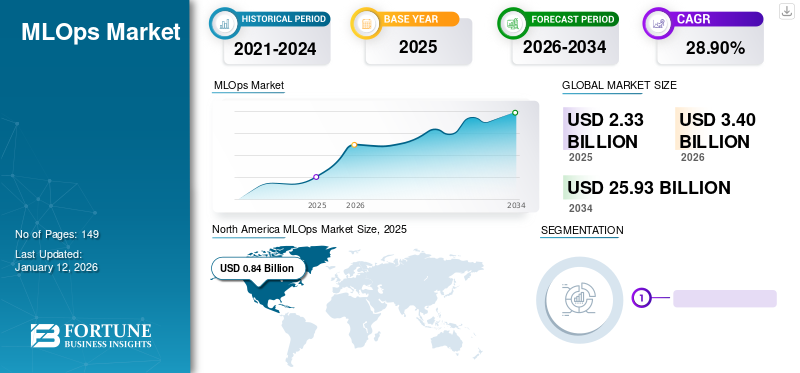
Download Free sample to learn more about this report.
MLOps Market KEY TAKEAWAYS
 Global Market Size & Forecast
- 2025 Market Size: USD 2.98 Billion
- 2026 Market Size: USD 4.39 Billion
- 2034 Forecast Market Size: USD 89.91 Billion
- CAGR: 45.8% from 2026–2034
 Market Share
- Regional Share North America dominated the market with a 30.87% share in 2025.
- Deployment Share Cloud segment is projected to hold a 51.0% market share in 2026.
- Enterprise Size Share Large Enterprises segment is expected to account for a 54.8% market share in 2026.
 Key Regional Highlights
Asia Pacific
Asia Pacific USD 0.76 Billion in 2025, driven by rapid AI adoption and cloud-first digital transformation.
North America
North America USD 0.92 Billion in 2025, supported by enterprise AI deployment and advanced cloud infrastructure.
Europe
Europe USD 0.88 Billion in 2025, fueled by responsible AI adoption and strong data governance.
U.S.
U.S. USD 0.49 Billion in 2025, driven by large-scale enterprise AI investments and MLOps adoption.
Japan
Japan USD 0.17 Billion in 2025, supported by AI integration across manufacturing and digital industries.
Read More

IMPACT OF GENERATIVE AI
Generative AI Enhances MLOps Efficiency Through Automated Model Lifecycle Management and Intelligent Workflow Optimization
Generative AI is transforming the market by embedding automation and intelligence directly into the model lifecycle. Tools powered by GPT and similar models can automatically generate deployment scripts, suggest optimized model architectures, write monitoring code, and even create anomaly detection rules for model performance. They can assist in data preprocessing, feature engineering, and documentation, reducing manual effort and accelerating time-to-production.
By enabling AI-driven decision support across experimentation, testing, deployment, and monitoring, generative AI enhances operational efficiency.
IMPACT OF RECIPROCAL TARIFFS
Reciprocal Tariffs Influence MLOps Adoption by Reshaping Cross-Border Technology Costs and Infrastructure Investments
Reciprocal tariffs can affect the market by influencing cross-border technology adoption, cloud infrastructure procurement, and enterprise software licensing costs. Higher tariffs between countries may increase the cost of imported hardware or cloud services used to run machine learning pipelines, slowing MLOps adoption for companies relying on foreign servers, GPUs, or software tools.
Overall, reciprocal tariffs create cost uncertainties and supply chain considerations that enterprises must factor into budgeting for AI operations, which can slightly moderate market growth in affected regions while fostering localized solutions.
MLOps Market Trends
Implementation of AutoML within MLOps Models to Upsurge Market Growth
Automating the entire machine learning pipeline, from data handling to installations, democratized ML makes it accessible to users with less expertise. AutoMl offers several simple, readily available solutions that do not require pre-defined machine learning expertise.
With ML automating most of the data labeling process, the risk of human error is considerably reduced. It minimizes personnel expenses, permitting enterprises to focus more on data analysis.
AutoML attempts to simplify the process by automating some manually intensive steps in training an ML model, including feature selection, model selection, model tuning, and model evaluation. Various cloud platforms, such as Amazon Sagemaker, Data Robot AI platform, and Microsoft Power BI, offer their own AutoML solutions. For instance,
- In July 2025, DataRobot launched its No-Code Time Series Platform, allowing users to build, validate, and deploy forecasting models without coding. The platform uses AutoML to automate feature engineering, model selection, and validation, making advanced time series forecasting accessible to both technical and non-technical users.
The advantages of combining AutoML with machine learning operations help enterprises create superior ML models more efficiently and at lower cost, while addressing the skillset gap.
Such factors propel the implementation of AutoML across such solutions, thereby augmenting the MLOps market growth.
MARKET DYNAMICS
Market Drivers
Download Free sample to learn more about this report.
Rising Need to Improve Machine Learning Model Performance to Drive Market Growth
The rapid advancement of machine learning mechanisms, the mainstreaming of ML-driven solutions, and large-scale production rollouts are gaining momentum. Various factors that affect the performance of machine learning models include the experimental and manual nature of ML testing, manual tracking of data dependencies, model complexity, and the accumulation of hidden ML mechanical debt. Such factors affect the efficiency of ML models, which they lack when executing ML projects. For instance,
- According to industry reports, Data scientists spend the majority of their time on non-model tasks, with 60-70 % of their effort focused on data preparation, cleaning, and management rather than on model development and maintenance.
Hence, enterprises and data professionals are moving toward these solutions for better efficiency and ensuring that these models operate optimally. For instance,
- According to Harvard Business Review, 49% of organizations use machine learning and AI to identify potential sales prospects, while 48% leverage these technologies to better understand their prospects and customers.
Such factors and the necessity to have enhanced performance drive the growth of these solutions in the market.
MARKET RESTRAINTS
Lack of Ability to Provide Security in MLOps Environment to Impede Market Growth
Machine learning is widely used on sensitive projects that involve highly critical data. Hence, ensuring the ecosystem is safe is crucial to the long-term success of the project.
Often, users are unaware that they have numerous vulnerabilities that signify an opportunity for mischievous attacks. Also, outdated libraries are the most common issue enterprises face.
Moreover, the security downside is associated with the model endpoints and data pipelines not being appropriately secured. These can expose publicly accessible, critical data to third parties, potentially impacting data security in the MLOps environment.
Thus, maintaining security for the machine learning operations environment can be a restraining factor. It can hamper the efficiency and productivity of machine-learning models, impacting enterprises' business.
MARKET OPPORTUNITIES
Rise of Low-code/No-code MLOps Platforms to Boost the Market Growth
The rise of low-code/no-code MLOps platforms is rapidly transforming the AI landscape, enabling organizations to build, deploy, and manage machine learning models without deep technical expertise. These platforms accelerate time-to-value by automating workflows such as data preprocessing, model training, deployment, and monitoring, while embedding best practices and compliance checks. For instance,
- In January 2026, the Electronics and Telecommunications Research Institute (ETRI) in Korea released TANGO. This no-code MLOps framework automatically generates neural networks and deploys them across cloud, Kubernetes, on-premises, and on-device environments.
By democratizing access to ML, reducing operational costs, and supporting scalable AI adoption across departments, low-code/no-code MLOps solutions are emerging as a high-growth segment within the broader market.
Segmentation Analysis
By Deployment
Cloud Segment Dominates Owing to Scalability, Flexibility, and Accelerated Model Operations
Based on deployment, the market is categorized into cloud, on-premise, and hybrid.
The cloud segment is projected to dominate the market with a share of 51.0% in 2026, due to the flexibility and scalability of cloud-based deployments, which make them the ideal choice for professionals. Multi-cloud deployment provides a strong foundation for machine learning operations as it offers built-in scalability, affordable storage, and a convenient environment for development.
The cloud segment is expected to record the highest CAGR of 50.0% during the forecast period, as organizations increasingly adopt AI, ML, and data-driven services that require massive, on-demand computing power. Additionally, cloud platforms streamline automation, compliance, and multi-region operations, driving faster innovation and cost-effective growth.
By Enterprise Type
Large Enterprises Dominates Due to Extensive AI Adoption and Complex Model Lifecycle Needs
By enterprise type, the market is bifurcated into SMEs and large enterprises.
The large enterprises segment is expected to lead the market, contributing 54.8% globally in 2026, as large enterprises need to handle greater volumes of data, leading to higher adoption of these solutions. It offers large enterprises in-depth analysis and corrections for large-scale machine learning projects. Moreover, it helps optimize production development through democratization and better decision-making on a larger scale.
The SMEs segment is expected to document the highest CAGR of 49.1% during the forecast period.
By End-user
To know how our report can help streamline your business, Speak to Analyst
BFSI Segment Dominates the Market Driven by Critical AI Workflows and Regulatory Compliance Needs
By end user, the market is classified into IT & telecom, healthcare, BFSI, manufacturing, retail, and others (advertising and transportation).
In 2025, the BFSI segment is projected to lead the market with a 25.9% share, as financial institutions rely heavily on machine learning models for mission-critical functions such as fraud detection, credit risk assessment, algorithmic trading, anti-money laundering monitoring, and customer personalization. These use cases require continuous model validation, real-time performance monitoring, regulatory compliance, and auditability, making structured MLOps frameworks essential rather than optional. For instance,
- In November 2024, a Singaporean digital bank partnered with Amdocs to implement an MLOps platform on AWS in Singapore, automating ML workflows and ensuring regulatory compliance. This reduced model deployment time from 3 months to 6 weeks, sped up security responses, and doubled data scientist productivity.
The healthcare segment is expected to record the highest CAGR of 50.7% during the forecast period.
MLOps MARKET REGIONAL OUTLOOK
Geographically, the market is studied across North America, South America, Europe, the Middle East & Africa, and Asia Pacific.
North America
North America MLOps Market Size, 2025 (USD Billion)
To get more information on the regional analysis of this market, Download Free sample
North America holds the largest market share, as organizations in the region have progressed beyond experimental artificial intelligence initiatives and are now focused on scaling machine learning systems across enterprise environments with measurable business accountability. Companies in sectors such as banking, insurance, healthcare, retail, and advanced manufacturing operate in data-intensive, highly regulated environments where model transparency, auditability, security, and continuous performance monitoring are mandatory rather than optional. This regulatory and operational pressure creates strong demand for structured model lifecycle management frameworks, automated validation processes, and real-time monitoring systems that define mature MLOps adoption.
In addition, enterprises in the region typically allocate larger IT budgets toward digital transformation and cloud modernization, enabling earlier migration to containerized, microservices-based architectures that naturally support continuous integration and continuous deployment pipelines for machine learning models. The presence of advanced research universities, strong venture capital funding for AI infrastructure startups, and early enterprise adoption of hybrid and multi-cloud strategies further accelerates the commercialization of MLOps platforms. The region held the largest market share with a valuation of USD 0.92 billion in 2025.
U.S. MLOps Market
Given North America’s strong contribution and the U.S. dominance in the region, the U.S. market was valued at USD 0.49 billion in 2025, accounting for roughly 16.4% of global sales.
Europe
Europe is projected to grow at 40.3% over the coming years. The region reached a valuation of USD 0.88 billion in 2025, driven by enterprise digital transformation imperatives that emphasize responsible, ethical, and interoperable AI rather than rapid, short-term deployment. European organizations are increasingly embedding data governance, cross-border data flow optimization, and compliance with stringent privacy frameworks into their machine learning initiatives, which creates demand for MLOps solutions that prioritize explainability, audit trails, and standardized model documentation.
U.K. MLOps Market
The U.K. market in 2025 was valued at USD 0.17 billion, representing roughly 5.7% of global revenues.
Germany MLOps Market
Germany’s market reached approximately USD 0.19 billion in 2025, equivalent to around 6.3% of global sales.
Asia Pacific
Asia Pacific is expected to grow at the highest CAGR during the forecast period. The region reached a valuation of USD 0.76 billion in 2025. It is experiencing an accelerated transition from basic digital adoption to large-scale implementation of artificial intelligence across both emerging and advanced economies. Many organizations are moving directly toward cloud-first, AI-driven business models, which increases the need for structured model deployment, monitoring, and lifecycle management capabilities. Rapid expansion of sectors such as e-commerce, fintech, telecommunications, smart manufacturing, and digital public services is generating vast volumes of data, requiring automated systems to manage model performance, scalability, and retraining.
Japan MLOps Market
The Japanese market in 2025 was valued at USD 0.17 billion, accounting for roughly 5.7% of global revenues.
China MLOps Market
China’s market is projected to be one of the largest worldwide, with 2025 revenues valued at USD 0.19 billion, representing roughly 6.4% of global sales.
India MLOps Market
The Indian market in 2025 was valued at USD 0.16 billion, accounting for roughly 5.4% of global market share.
South America and Middle East & Africa
The Middle East & Africa region is expected to grow at the second-highest CAGR during the forecast period, as it rapidly transforms its economic base from traditional resource dependency toward technology-driven, data-centric industries, creating a strong need for systems that can operationalize machine learning at scale. Governments and sovereign investment funds are strategically prioritizing AI as part of national economic diversification, leading to substantial funding for digital infrastructure, smart city initiatives, and advanced analytics projects. This state-led momentum, combined with partnerships between public institutions and global technology providers, accelerates enterprise adoption of MLOps frameworks that ensure models are scalable, secure, and aligned with governance expectations.
South America is expected to grow at a stable CAGR over the forecast period, driven by gradual yet consistent digital modernization across key industries, including banking, agriculture, retail, and telecommunications. Organizations are increasingly adopting cloud-based analytics and automation tools to improve operational efficiency and customer personalization, which is driving demand for structured model deployment and monitoring solutions.
GCC MLOps Market
The GCC market reached around USD 0.10 billion in 2025, representing roughly 3.4% of global revenues.
Competitive Landscape
Key Industry Players
Growing Investments and Collaborations Strengthen Key Players’ Market Position
The key players are keen to incorporate new ML technologies across healthcare, BFSI, IT, and telecom sectors, among others. Innovating with new mechanisms to serve numerous large enterprises and SMEs is one of the key strategies key players adopt. Moreover, market key players strategically form partnerships with new product launches and invest in several startups for business expansion globally.
List of Key MLOps Companies Profiled
- DataRobot, Inc.. (U.S.)
- Domino Data Lab, Inc. (U.S.)
- Amazon Web Services, Inc. (U.S.)
- Microsoft Corporation (U.S.)
- IBM Corporation (U.S.)
- Hewlett Packard Enterprise Development LP (U.S.)
- Databricks (U.S.)
- ClearML, Inc. (U.S.)
- Google LLC (U.S.)
- Cloudera, Inc. (U.S.)
KEY INDUSTRY DEVELOPMENTS
- June 2025: Domino Data Lab was named “MLOps Platform of the Year” in the 2025 AI Breakthrough Awards by AI Breakthrough. The award recognizes Domino’s enterprise MLOps platform, which supports AI development, deployment, and governance across hybrid and multi-cloud environments. The company was selected from over 5,000 global nominations for its ability to help regulated industries scale AI securely and efficiently.
- June 2025: Nebius and Saturn Cloud launched a first-of-its-kind AI MLOps cloud, combining Nebius’s AI cloud infrastructure with Saturn Cloud’s MLOps platform and NVIDIA Hopper GPUs. The solution provides enterprise-grade AI/ML capabilities with instant deployment, cost-efficient GPU access, and full security compliance, enabling organizations and teams to run scalable, GPU-accelerated AI workloads without heavy upfront investment.
- June 2025: Latent AI launched Latent Agent, the industry’s first agentic edge AI platform, designed to simplify and automate edge AI development and deployment. Built on its Efficient Inference Platform (LEIP), it eliminates the need for complex model-to-hardware optimization through intelligent automation and natural language interaction.
- April 2025: Onc.AI announced that it is accelerating the development of cancer biomarkers by using its Valohai MLOps platform on Oracle Cloud’s A10 GPUs, which has resulted in doubling the training speed and reducing costs by 50%. The upgrade ensures compliance and enables faster, secure AI-driven insights for clinicians and pharmaceutical research.
- January 2025: AI infrastructure startup Pipeshift raised USD 2.5 million in seed funding co-led by Y Combinator and SenseAI Ventures to enhance its modular PaaS for training, deploying, and scaling open-source generative AI models. The funding will support product development, talent acquisition, and expansion into the U.S. and Indian markets, helping enterprises simplify AI deployment, manage infrastructure, and reduce costs.
- June 2024: ClearML partnered with Carahsoft Technology to deliver its MLOps and AI platform to federal and state agencies. Through Carahsoft’s reseller network and government contract vehicles, agencies can access ClearML’s end-to-end AI platform for MLOps, LLMOps, and generative AI. The partnership aims to accelerate the adoption of secure AI in public-sector environments.
REPORT COVERAGE
The report provides a detailed analysis of the market and focuses on key aspects, including leading companies, product types, and the leading applications of the product. Besides, it offers insights into the market trends and highlights key industry developments. In addition to the factors above, the market's growth in recent years was driven by several other factors.
Request for Customization to gain extensive market insights.
Report Scope & Segmentation
| ATTRIBUTE | DETAILS |
| Study Period | 2021-2034 |
| Base Year | 2025 |
| Estimated Year | 2026 |
| Forecast Period | 2026-2034 |
| Historical Period | 2021-2024 |
| Growth Rate | CAGR of 45.8% from 2026-2034 |
| Unit | Value (USD Billion) |
| Segmentation | By Deployment, Enterprise Type, End-user, and Region |
| By Deployment |
|
| By Enterprise Type |
|
| By End-user |
|
| By Region |
|
Frequently Asked Questions
According to Fortune Business Insights, the global market value stood at USD 2.98 billion in 2025 and is projected to reach USD 89.91 billion by 2034.
The market is projected to grow at a CAGR of 45.8% during the forecast period.
Based on end-user, BFSI segment dominated the market in 2025.
Rising need to improve machine learning model performance is the key factor driving the market growth.
Microsoft, AWS, DataRobot, Inc., IBM, and Domino Data Lab, Inc., among others, are the top players in the market.
North America dominated the market in 2025 with the largest share.
By deployment, the cloud segment is expected to grow with a leading CAGR during the forecast period.



- 2021-2034
- 2025
- 2021-2024
- 119
-
(Offer valid till 30th Sep 2026)
Get 30-60 hrs Free Customization
Expand Regional and Country Coverage, Segments Analysis, Company Profiles, Competitive Benchmarking, and End-user Insights.




















Related Reports
-
US +1 833 909 2966 ( Toll Free )
-
Get In Touch With Us