Mobile Application Security Market Size, Share & Industry Analysis, By Solution (Code Hardening & Application Shielding, Runtime Application Self Protection, Mobile App Security Testing, Threat Monitoring, Cryptographic Key Protection, & Others), By Deployment (Cloud & On Premise), By Testing Method (Static Application Security Testing, Dynamic Application Security Testing, and Interactive Application Security Testing), By Industry (BFSI, Healthcare & Life Sciences, Retail & E-Commerce, Government & Defense, Telecommunication, Automotive, & Airlines), and Regional Forecast, 2026-2034
 Download Free Sample
MOBILE APPLICATION SECURITY MARKET SIZE
 Listen to Audio Version
The global mobile application security market size was valued at USD 571.14 million in 2025 and is projected to grow from USD 720.16 million in 2026 to USD 3,612.11 million by 2034, exhibiting a CAGR of 22.30% during the forecast period. North America dominated the mobile application security market with a market share of 49.90% in 2025.
Mobile app security involves defending mobile apps against data theft and cyberattacks using a variety of techniques, such as encryption, secure coding, and frequent upgrades. In order to ensure user privacy and the integrity of the program, it attempts to protect the code, data, and functioning of an application from potential threats including virus, tampering, and unauthorized access.
The market for mobile application security is expanding significantly due to the broad adoption of BYOD (Bring Your Own Device) rules, the rising use of mobile devices for a variety of purposes, and the growing risks of malware and hacking.
The main participants in the market include AppDome, Guardsquare, Verimatrix, Nowsecure, Promon, DataTheorem, and Protect,Ai.
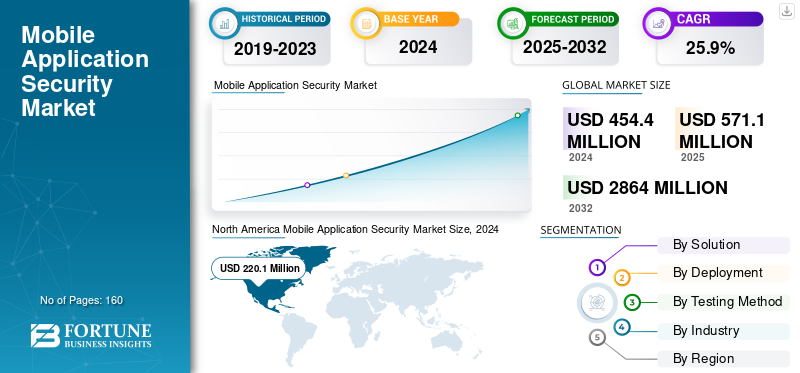
Download Free sample to learn more about this report.
Mobile Application Security Market Key Takeaways
 Global Market Size & Forecast
- 2025 Market Size: USD 571.14 Million
- 2026 Market Size: USD 720.16 Million
- 2034 Forecast Market Size: USD 3,612.11 Million
- CAGR: 22.30% from 2026–2034
 Market Share
- North America dominated the market with a 49.90% share in 2025.
- The Runtime Application Self Protection (RASP) segment led the market in 2026.
- The Cloud deployment segment dominated the market in 2026.
 Key Regional Highlights
North America
North America reached USD 284.59 million in 2025, accounting for 49.90% of the global market.
Asia Pacific
Asia Pacific generated USD 189.16 million in 2025, representing 33.13% of the global market.
Europe
Europe accounted for 12.94% of the global market in 2025, reaching USD 73.91 million.
U.S
The U.S. market is projected to reach USD 314.46 million by 2026.
Japan
The Japan market is projected to reach USD 51.43 million by 2026.
Read More

Impact of Gen AI
Gen AI Transforms Mobile App Security by Analyzing Vast Datasets to Predict Threats
Generative AI is transforming mobile app security by analyzing vast datasets to detect anomalies and predict threats, enhancing security posture through automation and proactive defense. It achieves this by identifying unusual patterns in app behavior that could signal a breach and by automating tasks such as threat detection and incident response, which allows human analysts to focus on more complex issues. This approach allows organizations to stay ahead of evolving threats by learning from and adapting to new data and attack patterns.
MARKET DYNAMICS
Market Drivers
Surge in Cyber Threats & Vulnerabilities Driving Market Growth
The surge in cyber threats and vulnerabilities is a primary driver for the mobile application security market growth, as businesses and users seek protection against increasing data breaches, malware, and other attacks. This growth is further fueled by the expanding "attack surface" from digital transformation and cloud adoption, new types of attacks like AI-driven threats, and stricter data privacy regulations such as GDPR. To combat these risks, companies are investing in mobile security solutions to protect their data and applications, leading to market expansion.
The increase in cybersecurity events from 10.29 lakh in 2022 to 22.68 lakh in 2024, as reported by the Indian Computer Emergency Response Team (CERT-In), is indicative of the growing scale and complexity of digital threats in India.
Market Restraints
Limited Awareness and Skill Gaps in SMEs and App Developers to Hinder Market Growth
The challenges that small and medium-sized businesses (SMEs) encounter, which are mostly associated with resource and capital limits, are impeding the growth of the mobile application security industry. SMEs lack the resources and knowledge required to integrate security and vulnerability management technologies into their mobile devices. They are unable to adequately protect their mobile applications from security risks because of this restriction. Additionally, capital problems further exacerbate the challenges faced by SMEs in investing in robust mobile application security solutions. As a result, the adoption of mobile application security solutions by SMEs is relatively low, hindering the overall market growth.
Market Opportunities
Leveraging Mobile Application Software to Secure IoT-Integrated Mobile Apps Creates Opportunities
The integration of Internet of Things (IoT) devices in mobile applications propels the market for mobile application security by introducing new vulnerabilities need strong security solutions. As more connected devices are managed through mobile applications, businesses are forced to make security investments to shield private information from risks such as malware and illegal access, resulting in high demand for security features such as strong encryption, multi-factor authentication, and frequent security upgrades.
MOBILE APPLICATION SECURITY MARKET TRENDS
Cloud-based Mobile Application Security Platforms Emerge as a Major Market Trend
Cloud-based mobile application security are becoming highly popular because of their affordability, scalability, and flexibility. They let developers secure apps with remote management and real-time upgrades without having to make significant infrastructure investments. With products such as threat defense (MTD) and runtime application self-protection (RASP), this cloud based approach is rapidly gaining traction and controlling the application security market. Governments' push for digitization and the rise in the use of mobile apps for sensitive transactions both increase the need for strong security.
Download Free sample to learn more about this report.
SEGMENTATION ANALYSIS
By Solution
Increasing Demand for Mobile and API/Microservices Boosts Runtime Application Self Protection (RASP) Segment Growth
Based on the solution, the market is segmented into code hardening & application shielding, Runtime Application Self Protection (RASP), mobile app security testing, threat monitoring, cryptographic key protection, and others.
The Runtime Application Self Protection (RASP) segment held the largest revenue share of USD 277.71 in the overall global market in the year 2026. The increase in revenue is driven by its ability to seamlessly integrate into the DevSecOps pipeline and throughout the mobile app lifecycle. This provides robust, real-time data protection by embedding security directly within the application itself, rather than relying solely on perimeter defenses such as firewalls.
At the same time, the segment also holds the highest CAGR of 28.5% in the global market. The growth is mainly due to the growth of mobile and API and microservices architectures.
By Deployment
Cloud Segment Dominates Market Owing to Ease of Deployment and Faster Updates
Based on deployment, the market is divided into cloud and on premise.
The cloud segment dominates with a market share of USD 560.44 million in 2026. The segment continues to generate the major revenue owing to the benefits such as the ease of deployment and faster updates offered by cloud solutions.
At the same time, the segment also holds the highest CAGR of 27.5% in the global market. The segment’s growth is mainly due to the rising adoption of BYOD (Bring Your Own Device) that pushes enterprises to rely on cloud-native solutions for secure, flexible, and mobile access to company data and applications.
By Testing Method
Early Integration in the SDLC Augments the Static Application Security Testing (SAST) Segment Growth
Based on the testing method, the market is divided into Static Application Security Testing (SAST), Dynamic Application Security Testing (DAST), and Interactive Application Security Testing (IAST).
The Static Application Security Testing (SAST) segment for accounted for the largest mobile application security market share at USD 336.9 million in 2026. The segment’s growth is owing to its early integration in the SDLC, enabling developers to detect and fix vulnerabilities in source code before deployment.
Dynamic Application Security Testing (DAST) represent the largest CAGR at 28.3% in the global market. Dynamic Application Security Testing (DAST) is growing faster primarily due to the increasing need for real-time vulnerability detection.
To know how our report can help streamline your business, Speak to Analyst
By Industry
Heavy Reliance on Mobile Apps Augments the BFSI Segment Growth
Based on the industry, the market is divided into BFSI, healthcare & life sciences, retail & e-commerce, government & defense, telecommunication, automotive, airlines, and others.
The BFSI segment for accounted for the largest market share at USD 266.4 million in 2026. The growth is owing to sector’s heavy reliance on mobile applications for digital banking, payments, and customer engagement.
BFSI sector represent the largest CAGR at 29.2% in the global market. The growth is owing to increasing cyberattacks, stringent regulatory mandates, and accelerated adoption of cloud-based and mobile financial services.
MOBILE APPLICATION SECURITY MARKET REGIONAL OUTLOOK
Geographically the market is segmented into North America, Europe, Asia Pacific, South America and Middle East & Africa.
North America Mobile Application Security Market Size, 2025 ( USD Million)
To get more information on the regional analysis of this market, Download Free sample
North America
The North America market generated USD 284.59 Million in 2025, representing 49.90% of the global market landscape, and is expected to reach USD 365.48 Million in 2026. The region’s leadership is driven by stringent cybersecurity regulations, widespread adoption of mobile banking and digital services, and strong enterprise investments in advanced application security solutions. The growing frequency of cyberattacks and the increasing use of mobile applications across industries continue to support market expansion. The U.S. market is projected to reach USD 314.46 Million in 2026.
Europe
Europe contributed 12.94% to the global market in 2025, with a valuation of USD 73.91 Million, and is projected to reach USD 88.28 Million in 2026. Market growth is supported by increasing cybersecurity concerns, strict data protection regulations, and rising adoption of digital platforms across enterprises. The U.K. market is projected to reach USD 17.72 Million in 2026, while the Germany market is projected to reach USD 25.37 Million in 2026.
Asia Pacific
Asia Pacific accounted for USD 189.16 Million in 2025, representing 33.13% of the global market share, and is projected to reach USD 239.33 Million in 2026. The region continues to witness rapid growth due to accelerating digital transformation, increasing smartphone penetration, expanding mobile payment ecosystems, and rising cybersecurity threats. Growing investments in application security technologies are further strengthening regional demand. The China market is projected to reach USD 80.90 Million in 2026, while the India market is projected to reach USD 48.08 Million in 2026 and the Japan market is projected to reach USD 51.43 Million in 2026.
Latin America
Latin America contributed approximately USD 13.89 Million to the global market in 2025, accounting for 2.43% share, and is expected to reach USD 16.20 Million in 2026. Rising mobile commerce activities, increasing digital banking adoption, and growing awareness of cybersecurity risks are supporting market growth across the region.
Middle East & Africa
In 2025, Middle East & Africa held 1.68% of the global market, reaching a valuation of USD 9.60 Million, and is projected to grow to USD 10.86 Million in 2026. Ongoing digital transformation initiatives, expanding mobile application usage, and increasing investments in cybersecurity infrastructure are contributing to the growth of the market across the region.
COMPETITIVE LANDSCAPE
Key Industry Players
Major Companies Focus On Alliances, Mergers, and Acquisitions to Lead the Industry
AppDome, Guardsquare, Verimatrix, Nowsecure, Promon, DataTheorem, and Protect,Ai are some of the major companies in the sector. By employing a range of inorganic growth strategies, including alliances, mergers, and acquisitions, these businesses aim to increase the range of products they offer. The major corporations creating technical solutions are forming strategic partnerships with top application security providers in response to the increasing demand for online availability of healthcare, retail, consumer products, and other product and service offerings.
LIST OF KEY MOBILE APPLICATION SECURITY COMPANIES PROFILED:
- AppDome (U.S.)
- Guardsquare (Belgium)
- Verimatrix (U.S.)
- Nowsecure (U.S.)
- Promon (Norway)
- DataTheorem (U.S.)
- Protect,Ai (India)
- F5, Inc. (U.S.)
- AppKonx (Singapore)
- Digital, Ai (U.S.)
- Zimperium (U.S.)
KEY INDUSTRY DEVELOPMENTS:
- October 2025- The entire Enterprise Agentic AI Security Platform was introduced by Protectt.ai, a well-known AI Native Mobile App Security & Fraud Control Platform. The platform allows businesses to innovate ethically and at scale by safeguarding corporate AI systems from development to production.
- June 2025- Quick Protect Agent, a no-code method of protecting mobile apps, was launched by Digital AI. The agent assists developers in protecting their apps with enterprise-grade, OWASP MASVS-aligned defenses including obfuscation, anti-tamper, and anti-analysis,
- April 2025- Appknox, a leading provider of cutting-edge mobile app security solutions, launched Storeknox, a groundbreaking continuous store monitoring platform designed to protect enterprises from evolving mobile app threats.
- March 2025- Protectt.ai, an Indian cybersecurity firm specializing in mobile application security, raised USD 8.6 million in its Series A funding round. The round was led by Bessemer Venture Partners. The company will be able to improve customer experience, speed up product creation, and increase its global presence in in key markets.
- September 2024- Guardsquare, unveiled a cutting-edge, guided strategy for mobile application security that enables teams to attain the greatest level of protection. Mobile development teams will be able to achieve a fully protected app in less than a day. Guardsquare’s new product capability provides a seamless implementation experience increasing developer productivity, visibility for enhanced security, and collaboration across development and security teams.
- February 2024- Appdome unveiled its new Geo Compliance feature set, allowing mobile brands to trust the user’s location and detect location spoofing, fake GPS apps, VPN use, SIM swaps and other methods used to circumvent geo restrictions in mobile applications.
REPORT COVERAGE
The global report provides a detailed analysis of the market and focuses on key aspects such as prominent companies, deployment modes, types, and end users of the product. Besides this, it offers insights into the mobile application security market trends and highlights key industry developments and market share analysis for key companies. In addition to the aforementioned factors, the report encompasses several factors that have contributed to the growth of the market over recent years.
Request for Customization to gain extensive market insights.
Report Scope & Segmentation
| ATTRIBUTE | DETAILS |
| Study Period | 2021-2034 |
| Base Year | 2025 |
| Estimated Year | 2026 |
| Forecast Period | 2026-2034 |
| Growth Rate | CAGR of 22.30% from 2026-2034 |
| Historical Period | 2021-2024 |
| Unit | Value (USD Million) |
| Segmentation |
By Solution
By Deployment
By Testing Method
By Industry
By Region
|
Frequently Asked Questions
Fortune Business Insights says that the global market stood at USD 571.14 million in 2025 and is projected to reach USD 3,612.11 million by 2034.
The market is expected to exhibit steady growth at a CAGR of 22.30% during the forecast period (2026-2034).
A surge in cyber threats and vulnerabilities is speeding up the market growth.
AppDome, Guardsquare, Verimatrix, Nowsecure, Promon, DataTheorem, and Protect,Ai are some of the top players in the market.
The North America region held the largest market share.
North America was valued at USD 284.59 million in 2025.



- 2021-2034
- 2025
- 2021-2024
- 160
Get 30-60 hrs Free Customization
Expand Regional and Country Coverage, Segments Analysis, Company Profiles, Competitive Benchmarking, and End-user Insights.




















-
US +1 833 909 2966 ( Toll Free )
-
Get In Touch With Us