Molded Fiber Packaging Market Size, Share & Industry Analysis, By Pulp Type (Thick Wall, Transfer Molded, Thermoformed Fiber, and Processed Pulp), By Product Type (Trays, Boxes & Cartons, Clamshells, Inserts & Dividers, Cups & Bowls, and Others), By Application (Food & Beverage, Electrical & Electronics, Automotive, Healthcare, Industrial, and Others), and Regional Forecast, 2026-2034
 Download Free Sample
(Offer valid till 30th Sep 2026)

Molded Fiber Packaging Market Size and Future Outlook
 Listen to Audio Version
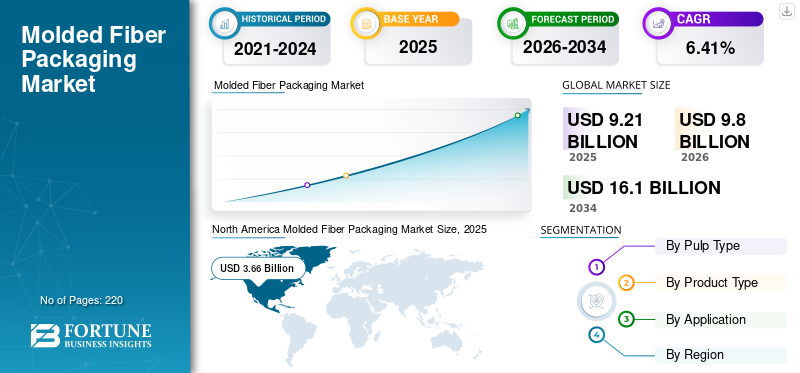
The global molded fiber packaging market size was valued at USD 9.10 billion in 2025. The market is projected to grow from USD 9.54 billion in 2026 to USD 16.38 billion by 2034, exhibiting a CAGR of 6.79% during the forecast period. Asia Pacific dominated the molded fiber packaging market with a market share of 39.01% in 2025.
Molded fiber packaging is a versatile, sustainable, and environmentally friendly packaging solution made from recycled paper materials. It offers excellent cushioning protection and sustainability, making it the best choice for several industries. The market growth in the last few years, driven by factors such as strict regulations on plastic waste, rising demand for eco-friendly packaging, and increasing focus on sustainable practices.
Furthermore, many key industry players, such as Sonoco Products Company, Robert Cullen Ltd., and Hartmann, operating in the market, are focusing on developing innovative products, conducting R&D, and contributing to the global market share.
Download Free sample to learn more about this report.
Molded Fiber Packaging Market KEY TAKEAWAYS
 Global Market Size & Forecast
- 2025 Market Size: USD 9.10 billion
- 2026 Market Size: USD 9.54 billion
- 2034 Forecast Market Size: USD 16.38 billion
- CAGR: 6.79% from 2026–2034
 Market Share
- Asia Pacific dominated the molded fiber packaging market with a 39.01% share in 2025.
- The thermoformed segment is projected to grow at a CAGR of 6.26% during the forecast period.
- The clamshells segment is projected to grow at a CAGR of 6.66% during the forecast period.
 Key Regional Highlights
Asia Pacific
Asia Pacific reached USD 3.55 billion in 2025, driven by strong demand for sustainable packaging and expanding manufacturing activities.
North America
North America reached USD 3.02 billion in 2025, supported by increasing adoption of eco-friendly packaging and plastic reduction initiatives.
Europe
Europe reached USD 1.63 billion in 2025, driven by strict environmental regulations and growing demand for recyclable packaging.
U.S.
The U.S. market reached USD 2.62 billion in 2025, fueled by rising demand for sustainable foodservice and retail packaging.
Japan
Japan reached USD 0.44 billion in 2025, supported by advanced recycling practices and demand for high-quality molded fiber packaging.
Read More

MOLDED FIBER PACKAGING MARKET TRENDS
Growing Preference for Consuming Sustainable and Eco-Friendly Packaging is an Emerging Trend
As global environmental challenges intensify, sustainability has become a focus for consumers across several industries. Driven by ethical consumerism, rising awareness, and the influence of younger generations, this shift in consumer behavior has pushed producers to create sustainable products. For sustainable packaging, molded fibers made from quickly renewable fibers are often suitable as they are made from highly sustainable packaging materials. Continuous efforts are aimed at reducing or eliminating the single use plastic for packaging. This anti-plastic sentiment benefits the industry by promoting biodegradable alternatives. Moreover, government agencies and health-conscious consumers actively support the transition to environmentally friendly options. In addition, the pervasive problem of plastic waste presents significant opportunities for the major players operating in this market. Molded fibers will continue to play an important role globally. Even though changes have occurred due to technological advancements, this industry is likely to flourish during the forecast period.
MARKET DYNAMICS
MARKET DRIVERS
Download Free sample to learn more about this report.
Surging Food & Beverage Industry to Drive Market Growth
The swift growth of the global food and beverage sector is driving increased demand for molded fiber packaging, especially in foodservice disposables, takeaway containers, egg cartons, and protective food packaging. The transition toward food delivery and takeaway services has further escalated the demand for packaging. Such service formats heavily depend on single-use, compostable containers, with molded fiber increasingly favored over expanded polystyrene due to sustainability concerns. The combination of increasing global food production, the expansion of foodservice channels, rising egg production, and regulatory pressures on plastics is driving the adoption of molded fiber packaging. As food systems expand and sustainability requirements become more stringent, molded fiber is increasingly recognized as a renewable, recyclable, and compostable option that meets the changing needs of the food and beverage industry.
Thriving E-commerce Industry to Enhance Market Growth
The swift growth of the e-commerce industry has led to increased demand for sustainable and innovative packaging solutions. This type of packaging provides excellent protection for products from food & beverage, electrical and electronics, and industrial sectors during shipping and handling. Its shock-absorbing properties and structural integrity helps to minimize the risk of damage during transport. The ongoing growth of the global e-commerce industry is significantly increasing the demand for protective, lightweight, eco-friendly and sustainable packaging solutions. This consistent increase in parcel shipments underscores the need for protective packaging inserts, cushioning components, and void-fill alternatives, areas where molded fiber is increasingly replacing plastic foam. Molded fiber packaging is increasingly favored for its compostability and fiber-based composition. The structural growth in e-commerce, the surge in parcel volumes, and the push for sustainability collectively drive market expansion.
MARKET RESTRAINTS
High Production Costs and Material Sourcing Constraints May Limit Market Expansion
Despite a strong demand driven by sustainability, the molded fiber packaging market growth continues to face significant challenges due to high production costs and difficulties in sourcing raw materials. The production of molded fiber is heavily dependent on recovered paper and virgin pulp, both of which have seen fluctuations in supply and price in recent years. On the global scale, the Confederation of European Paper Industries (CEPI) reported in 2022 that European pulp and paper manufacturers faced unprecedented cost challenges, particularly in energy costs. CEPI emphasized significant surges in natural gas and electricity prices throughout 2022, which considerably elevated the manufacturing costs of paper-based products. Given that molded fiber production is energy-intensive, involving pulping, forming, and drying processes, fluctuations in energy prices have a direct effect on profit margins.
Furthermore, the Food and Agriculture Organization of the United Nations stated in 2022 that the global paper pulp production and trade dynamics were influenced by supply chain disruptions and geopolitical tensions, which tightened fiber markets in various regions. The combination of increasing fiber costs, energy volatility, and competition for raw materials raises production costs for molded fiber manufacturers, thereby limiting profitability and hindering adoption in price-sensitive end-use markets.
MARKET OPPORTUNITIES
Stringent Plastic Reduction Policies and Circular Economy Targets to Unlock High-Growth Opportunities
The rapid global shift toward circular economy frameworks and mandates for plastic reduction offers a substantial long-term growth opportunity for market players. Governments and packaging organizations are increasingly advocating the use of fiber-based, recyclable, and compostable materials to mitigate plastic waste. From a regulatory perspective, the Organization for Economic Co-operation and Development (OECD) highlighted in its 2022 Global Plastics Outlook that plastic waste generation doubled from 2000 to 2019 and continues to increase, thereby heightening the regulatory scrutiny of single-use plastics. This escalating policy momentum is driving a shift toward fiber-based alternatives in the packaging of foodservice, electronics, and consumer goods. The combination of stricter plastic regulations, elevated paper recovery rates, and growing commitments to a circular economy presents a significant structural opportunity for industry players. As brands increasingly align with goals for recyclability and compostability, molded fiber is well-positioned to capitalize on the rising demand across various end-use sectors.
MARKET CHALLENGES
Performance Limitations Compared to Plastics to Create Major Challenges for Market Growth
A notable limitation is the performance constraint of molded fiber packaging when compared to traditional plastics. Although molded fiber provides biodegradability and recyclability, it frequently faces challenges with moisture resistance, grease barrier capabilities, and structural precision for high-end uses. While advanced coatings can enhance functionality, they may also raise costs or complicate recyclability assertions. In sectors such as electronics, medical devices, and premium food packaging, maintaining consistent dimensional accuracy and durability continues to be a challenge. These constraints hinder the adoption of molded fiber in applications that demand high strength-to-weight ratios or extended shelf life, impeding its entry into markets that have been historically dominated by plastic thermoforms and rigid packaging formats.
Segmentation Analysis
By Pulp Type
Increasing Use of Transfer Molded Pulp in Various Applications to Boost Transfer Molded Segment Growth
Based on pulp type, the market is divided into thick wall, transfer molded, thermoformed fiber, and processed pulp.
The transfer molded segment holds the largest molded fiber packaging market share. It is slightly thinner compared to the other pulp types. Both sides are finished properly, offering a polished look and texture. The most common applications include fruit and vegetable trays, egg trays, wine shippers, slipper pans, and end caps. The increasing demand for these products globally is leading to high demand for transfer molded pulp, contributing to the growth of this segment.
The thermoformed segment is expected to grow at a CAGR of 6.26% over the forecast period.
By Product Type
Excellent Functionality and Convenience to Drive Trays Segmental Dominance
Based on product type, the market is segmented into trays, boxes & cartons, clamshells, inserts & dividers, cups & bowls, and others.
The trays segment is the dominating segment in this market. The excellent functionality and convenience offered by trays are bolstering the growth of this segment. The increased consumption of dairy products such as eggs and fruits & vegetables, drive the demand for trays, with their ease of handling during transportation further enhancing the growth of this segment.
The clamshells segment is projected to grow at a CAGR of 6.66% over the forecast period.
By Application
To know how our report can help streamline your business, Speak to Analyst
Rising Demand for Eggs, Fruits, and Vegetables Led to Dominance of the Food & Beverage Segment
Based on application, the market is segmented into food & beverage, electrical & electronics, automotive, healthcare, industrial, and others.
The food & beverage segment is the leading segment of this market, driven by a rising demand for eggs, fruits, and vegetables. The porous fiber material of molded fiber provides better ventilation and shock absorption, safeguarding eggs from breaking during rough handling and keep products free from infections. Apart from providing continuous ventilation through the micropores, the porous nature of the molded fiber absorbs moisture from fruits and vegetables. Thus, molded pulp packaging products can keep their freshness intact for longer, leading to a reduction in food waste. In the period of supermarkets, attractive packaging is also necessary for fruit and vegetables. Colored and printed molded pulp trays have proven to be beneficial in packaging goods attractively, contributing to the growth of this segment.
The electrical & electronics segment is projected to grow at a CAGR of 6.52% over the forecast period.
Molded Fiber Packaging Market Regional Outlook
By geography, the market is categorized into Europe, North America, Asia Pacific, Latin America, and the Middle East & Africa.
Asia Pacific
Asia Pacific Molded Fiber Packaging Market Size, 2025 (USD Billion)
To get more information on the regional analysis of this market, Download Free sample
Asia Pacific dominated the market and reached a valuation of USD 3.55 billion in 2025. The growth in the region is propelled by the expanding food delivery markets, swift urbanization, and increasing environmental impacts. China and India play significant roles as major contributors to volume, largely due to their plastic restrictions and extensive manufacturing capabilities. The region's production scalability is bolstered by cost competitiveness and the availability of abundant pulp resources.
Japan Molded Fiber Packaging Market
The Japanese market was valued at around USD 0.44 billion in 2025, accounting for roughly 4.48% of global revenues. Japan's market expansion is driven by exceptional recycling efficiency and superior packaging standards. The demand primarily centers on precision-molded fiber utilized in electronics and food bento packaging. Innovations in lightweight, high-strength pulp solutions are in harmony with Japan's objectives for a circular economy.
China Molded Fiber Packaging Market
The China market is projected to be one of the largest markets globally. The 2025 revenues were valued at around USD 1.50 billion, representing roughly 16.52% of global sales.
India Molded Fiber Packaging Market
The India market was valued at around USD 0.59 billion in 2025, accounting for roughly 6.49% of global sales.
North America
North America held the second-dominant share in 2024, valued at USD 2.845 billion, and maintained its third-leading position in 2025, with a value of USD 3.02 billion. In North America, the primary drivers of growth are strict bans on single-use plastics and a robust consumer preference for sustainable packaging. Leading foodservice chains and electronics companies are shifting toward compostable molded fiber options. Additionally, the expansion of e-commerce, and growing disposable incomes is fueling the need for protective fiber packaging alternatives to expanded polystyrene.
U.S. Molded Fiber Packaging Market
Based on North America’s strong contribution and the U.S. dominance within the region, the U.S. market was valued at around USD 2.62 billion in 2025, accounting for roughly 28.83% of global sales. The U.S. market is influenced by state-specific plastic prohibitions, robust demand from the foodservice sector, and corporate commitments to Environmental, Social, and Governance (ESG) principles. Prominent retailers and fast-food establishments are transitioning to molded fiber trays, clamshell containers, and cup carriers in order to fulfill sustainability objectives and align with consumer expectations.
Europe
The Europe market reached a valuation of USD 1.63 billion in 2025 and is projected to grow at a CAGR of 6.64% over the analysis period. The market in Europe is driven by stringent circular economy regulations and frameworks for Extended Producer Responsibility (EPR). Nations prioritize standards for recyclability and compostability, fostering innovation in high-performance molded fiber. Additionally, sustainability-focused procurement practices by retailers further promote the adoption of these standards in food and personal care packaging.
U.K. Molded Fiber Packaging Market
The U.K. market was valued at USD 0.12 billion in 2025, representing approximately 1.29% of global revenues.
Germany Molded Fiber Packaging Market
The Germany market reached a valuation of USD 0.39 billion in 2025, equivalent to around 4.31% of global sales.
Latin America
The Latin America region is expected to witness moderate growth in this market during the forecast period. The Latin America market reached a valuation of USD 0.62 billion in 2025. The regional product demand is bolstered by advancements in waste management policies and food industries focused on exports. Brazil and Mexico are progressively embracing environmentally friendly packaging as a result of retailers' commitments to sustainability, although sensitivity to costs continues to temper a swift transition.
Middle East & Africa
The growth of the Middle East & Africa region is on the rise, bolstered by sustainability initiatives in the GCC nations and an expanding foodservice industry. Nevertheless, the limited recycling infrastructure and elevated production costs hinder widespread adoption when compared to developed markets.
Saudi Arabia Molded Fiber Packaging Market
The Saudi Arabia market reached approximately USD 0.11 billion in 2025, accounting for roughly 1.18% of global revenues.
South Africa Molded Fiber Packaging Market
The South Africa market reached a valuation of USD 0.06 billion in 2025.
COMPETITIVE LANDSCAPE
Key Industry Players
Focus on Expanding Product Launch and Acquisitions by Key Players to Propel Market Progress
The global market has a semi-consolidated structure, with prominent players including Sonoco Products Company, Robert Cullen Ltd., and Hartmann. The significant market shares of these packaging companies are due to numerous strategic initiatives, including collaborations among operating entities to advance research.
- For instance, in September 2024, Huhtamäki Oyj increased its molded fiber production capacity in Europe to address the growing demand for eco-friendly foodservice The firm has made investments in cutting-edge fiber molding technology to improve barrier performance without the use of plastic lamination.
Other notable players in the global market include CKF Inc., FiberCel Packaging LLC, and Huhtamaki Oyj. These companies are expected to prioritize new product launches, strategic partnerships, and collaborations to increase their global market shares during the forecast period.
LIST OF KEY MOLDED FIBER PACKAGING COMPANIES PROFILED
- Sonoco Products Company (U.S.)
- Robert Cullen Ltd (U.K.)
- Hartmann (Denmark)
- CKF Inc. (Canada)
- FiberCel Packaging LLC (U.S.)
- Huhtamäki Oyj (Finland)
- Wynalda Packaging (U.S.)
- Dongguan City Luheng Papers Company Ltd. (China)
- Keiding, Inc. (U.S.)
- Pacific Pulp Molding, LLC (U.S.)
- Pactiv Evergreen (U.S.)
- Prima Pack (Egypt)
- Dynamic Fibre Moulding (PTY) Ltd. (South Africa)
KEY INDUSTRY DEVELOPMENTS
- July 2024: Sonoco Products Company unveiled improvements to its sustainable packaging offerings, incorporating molded fiber solutions specifically designed for protective packaging of electronics. This initiative aims to substitute EPS foam with recyclable fiber options, catering to the manufacturers of consumer electronics and appliances who are in search of eco-friendly cushioning materials.
- May 2024: Hartmann launched a new range of high-quality molded fiber egg cartons that feature improved moisture resistance and printability. This introduction aids European retailers in their pursuit of entirely recyclable and plastic-free egg packaging, further solidifying Hartmann's position as a leader in sustainable molded fiber solutions.
- March 2024: Pactiv Evergreen broadened its operations in North America concerning fiber-based foodservice packaging. This investment encompasses enhancements to production lines aimed at boosting the output of compostable molded fiber trays and clamshells, in response to state-level plastic prohibitions and the rising demand from quick-service restaurant chains.
- January 2024: CKF Inc. introduced a new line of compostable molded fiber takeout containers that are engineered to withstand high temperatures and resist grease. This product is aimed at Canadian foodservice operators who are moving away from polystyrene and polypropylene containers in favor of fiber-based options that adhere to the latest sustainability regulations.
- November 2023: FiberCel Packaging LLC declared the expansion of its production facility in the U.S. to accommodate the rising demand from manufacturers of electronics and medical devices. The company has enhanced its tooling capabilities to provide tailored protective molded fiber components.
REPORT COVERAGE
The molded fiber packaging market report analysis includes a comprehensive study of market size and forecast across all market segmentation included in the report. It contains details on the market dynamics and market trends expected to drive the market over the forecast period. It provides information on key aspects, including technological advancements, pipeline candidates, the regulatory environment, and product launches. Additionally, it details partnerships, mergers, and acquisitions, and key industry developments, along with their prevalence by region. The global market research report also provides a detailed competitive landscape, including market share and profiles of key operating players.
Request for Customization to gain extensive market insights.
Report Scope & Segmentation
| ATTRIBUTE | DETAILS |
| Study Period | 2021-2034 |
| Base Year | 2025 |
| Estimated Year | 2026 |
| Forecast Period | 2026-2034 |
| Historical Period | 2021-2024 |
| Growth Rate | CAGR of 6.79% from 2026-2034 |
| Unit | Value (USD Billion) |
| Segmentation | By Pulp Type, Product Type, Application, and Region |
| By Pulp Type |
|
| By Product Type |
|
| By Application |
|
| By Region |
|
Frequently Asked Questions
According to Fortune Business Insights, the global market value stood at USD 9.10 billion in 2025 and is projected to reach USD 16.38 billion by 2034.
In 2025, the Asia Pacific market value stood at USD 3.55 billion.
The market is expected to grow at a CAGR of 6.79% over the forecast period of 2026-2034.
By pulp type, the transfer molded segment leads the market.
Thriving e-commerce industry and the surging food & beverage industry are key factors driving market growth.
Sonoco Products Company, Robert Cullen Ltd, Hartmann, CKF Inc., and FiberCel Packaging LLC are the key players operating in the global market.
The Asia Pacific region held the largest market share in 2025.



- 2021-2034
- 2025
- 2021-2024
- 200
-
(Offer valid till 30th Sep 2026)
Get 30-60 hrs Free Customization
Expand Regional and Country Coverage, Segments Analysis, Company Profiles, Competitive Benchmarking, and End-user Insights.









Related Reports
-
US +1 833 909 2966 ( Toll Free )
-
Get In Touch With Us