Motion Control Market Size, Share & Industry Analysis, By Component (Controllers, Drives, Motors, Actuators, Software & Services, and Others), By System Type (Open-loop Motion Control and Closed-loop Motion Control), By Technology (Servo-based System, Stepper-based System, Linear Motor System, and Variable Frequency Drive System), By Industry (Semiconductor & Electronics, Automotive, Healthcare, Aerospace & Defense, and Others), and Regional Forecast, 2026-2034
 Download Free Sample
Motion Control Market Size & Industry Overview
 Listen to Audio Version
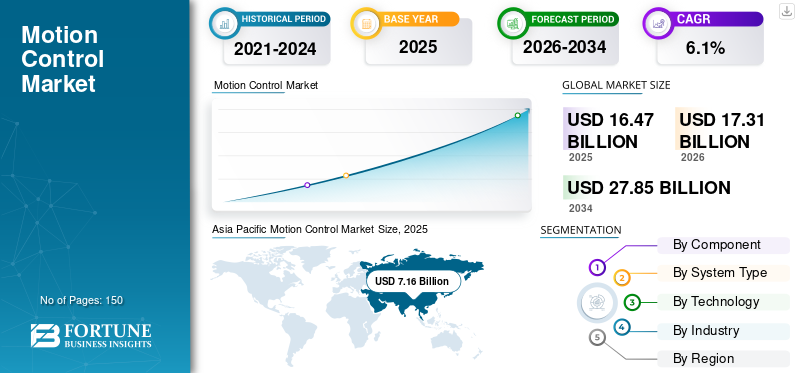
The global motion control market size was valued at USD 16.47 billion in 2025 and is projected to grow from USD 17.31 billion in 2026 to USD 27.85 billion by 2034, exhibiting a CAGR of 6.1% during the forecast period. Asia Pacific dominated the global motion control market with a market share of 43.47% in 2025.
Motion control encompasses hardware, software, and integrated systems used to control motion in industrial equipment precisely. It enhances the levels of automation, accuracy, and productivity in manufacturing, robotics, and process industries globally. The market growth is driven by rising industrial automation, a growing level of robotics use and smart manufacturing processes, and the increasing demand for precision and efficiency in manufacturing, as well as the expanding number of applications for motion systems in industries such as electronics, healthcare, and logistics.
Furthermore, many key players, such as Siemens AG, ABB Ltd., Schneider Electric SE, Rockwell Automation, Inc., and Mitsubishi Electric Corporation, operating in the market, are focusing on continuous product innovation, expansion of integrated hardware and software portfolios, strategic partnerships and acquisitions, localization of manufacturing, and focus on high-growth automation-intensive industries.
Download Free sample to learn more about this report.
Motion Control Market Key Takeaways
 Market Size & Forecast
- 2025 Market Size: USD 16.47 billion
- 2026 Market Size: USD 17.31 billion
- 2034 Forecast Market Size: USD 27.85 billion
- CAGR: 6.1% from 2026–2034
 Market Share
- Asia Pacific dominated the motion control market with a 43.47% share in 2025.
- The software & services segment is expected to register the fastest growth with a CAGR of 8.0% during the forecast period.
- The open-loop motion control segment is projected to grow at a CAGR of 5.2% over the forecast period.
 Key Regional Highlights
Asia Pacific
Asia Pacific remained the leading regional market, reaching USD 7.16 billion in 2025.
North America
North America is projected to become the second-largest market, reaching USD 4.38 billion by 2026.
Europe
Europe is expected to grow steadily, reaching a market value of USD 3.51 billion by 2026.
U.S.
The motion control market is estimated to reach USD 3.26 billion by 2026.
Japan
The motion control market is estimated to reach USD 1.44 billion by 2026.
Read More

IMPACT OF GENERATIVE AI
Growing Adoption of Generative AI-Powered Engineering Workflows Reshaping Market Growth
The market is being driven by the adoption of generative AI, which reduces the amount of engineering time spent on motion programming, increases the speed at which machines can be commissioned and troubleshot, and simplifies complex automation projects by providing natural language copilots within software suites used to program those projects. In addition to improving machine uptime by enabling quick fault diagnosis and adjusting optimal operational conditions using operational context, generative AI also supports increased utilization of motion equipment. Leading automation providers are incorporating generative AI into the edge to enable motion and machinery decisions to be made with lower latency and greater control over how the data is used. As a result, this increases the value of integrated motion control systems, i.e., controllers, drives, motors, and software, along with the number of software, service, and upgrade attachments made to these systems. For instance,
- In November 2024, Rockwell Automation announced its plan to integrate the edge-optimized generative AI model, NVIDIA Nemotron Nano, into its FactoryTalk-related workstreams, demonstrating its clear commitment to deploying generative AI directly into the engineering space for industrial applications.
MOTION CONTROL MARKET TRENDS
Growing Deployment of Collaborative and Autonomous Robots is Fueling Market Growth
The expansion of the motion control industry is being driven by a growing number of collaborative robots and autonomous robots, which require accurate, safe, and repeatable control of speed, torque, and position when operating in environments where humans work alongside them, as well as in dynamic environments such as warehouses. Cobots are becoming increasingly popular for a range of flexible applications, including machine tending, small-lot assembly, and welding, resulting in increased demand for servo drives, servo motors, encoders, and safety-rated motion functions.
Simultaneously, autonomous mobile robots and logistics robots also create a demand for compact drive systems and feedback sensors, allowing for improved navigation, the ability to accelerate and decelerate, and handling payloads with a high rate of uptime. As more customers integrate robots into their facilities and increase the scale of deployment, many are standardizing on single-source, integrated motion platforms that simplify programming, commissioning, and maintenance of multiple robot fleets. For instance,
- In October 2024, according to the International Federation of Robotics (IFR) press release, the number of professional service robot sales increased by 30% to over 205,000 units in 2023, representing a rapidly growing segment of robots that rely on motion subsystems.
Download Free sample to learn more about this report.
MARKET DYNAMICS
MARKET DRIVERS
Increasing Adoption of Smart and Connected Motion Systems Drives Market Growth
Smart and connected motion systems are gaining adoption as manufacturers seek to integrate motion devices, such as controllers, drives, motors, and encoders, that continuously share health and performance data over industrial networks. This enables faster commissioning, remote diagnostics, and higher uptime. As manufacturers adopt high-speed industrial Ethernet communication and standard, interoperable connectivity among their motion devices, the integration of motion platforms across multi-site operations will be simplified. This connectivity also supports condition monitoring and predictive maintenance for servo drives and motors, helping reduce unplanned downtime and improve overall equipment effectiveness (OEE). Over time, the shift has increased demand for network-ready motion components, as well as software and services that can analyze, visualize, and act on motion data. For instance,
- In June 2024, according to HMS Networks’ study, the adoption of Industrial Ethernet increased from 68% of newly installed industrial networks to 71% in factory automation, as of 2023.
This factor plays an important role in fueling the motion control market growth.
MARKET RESTRAINTS
High Upfront Costs Requirement for Servo and Precision Components May Hinder Market Growth
The high initial investment costs for motion control solutions limit the market growth, as the servo motors, precision drives, and feedback devices require expensive materials, precision-built components, and advanced power electronics, which causes the total capital expenditure (CapEx) of the project to be higher when compared to simpler pneumatic or open-loop systems. For many smaller and mid-sized manufacturing operations, it is challenging to make a payback case when there is uncertainty around budget availability and utilization levels. Therefore, motion control upgrades typically occur in phases or are delayed until the businesses are more financially stable. There can also be significant fluctuations in costs associated with changing raw material prices, such as those for magnets, metals, and electronics, making quotations and total cost of ownership much harder to predict for both original equipment manufacturers (OEMs) and end-users.
MARKET OPPORTUNITIES
Rising Adoption of Foldable and Flexible Displays to Create New Opportunities for Market Growth
The rapid growth in global capital for semiconductor and electronics manufacturing is driving unprecedented growth in the motion control industry. As new semiconductor fabs, OSATs, and electronic manufacturing lines are being built, there is an increased need for highly accurate, high uptime motion control platforms, including servos, servo motors, encoders, and multi-axis controllers across a variety of processes, including wafer handling, lithography, adjacent to automation, packaging, and testing. As capacity additions accelerate, factories also invest heavily in robotics, cleanroom automation, and advanced material handling, which increases motion content per tool and per line.
In addition, continued pressure for domestic and regional supply chain resilience increases a further number of greenfield opportunities for motion control products and systems. This results in the demand for integrated motion control hardware and software for commissioning, diagnosing problems, and providing predictive maintenance. Overall, more fabs and electronics plants mean more installed base, more replacements and retrofits, and higher recurring services tied to motion systems. For instance,
- In November 2024, the U.S. Department of Commerce awarded Intel Corporation a CHIPS incentive of up to USD 7.865 billion to support multiple U.S. projects, including those in Arizona, New Mexico, Ohio, and Oregon, reinforcing the scale of new domestic buildouts that require automation and precision motion systems.
Motion Control Market Segmentation Analysis
By Component
High Installed Base and Universal Requirement Led to Motors Segment Dominance
Based on component, the market is divided into controllers, drives, motors, actuators, software & services, and others (sensors and feedback devices).
Motors dominated the global market in 2025. This is due to the fact that every motion control system utilizes at least one or several motors, and the increasing deployment of robots, automated equipment, and material handling systems results in a higher demand for motor units than for any other motion control component. Moreover, the increased adoption of high-accuracy precision servo motors used in electronic devices, semiconductor devices, and automobile production, among other applications, raises the average selling prices of these motors and further establishes that motors represent the majority of revenue for motion control systems.
Software & services are expected to grow at the highest CAGR of 8.0% over the forecast period, as manufacturers are increasingly adopting software-driven motion optimization, AI-assisted commissioning, predictive maintenance, and lifecycle services to improve uptime, flexibility, and return on automation investments.
By System Type
Growing Popularity of Precision and Feedback Capabilities Fueled Closed-Loop Motion Control Dominance
Based on system type, the market is bifurcated into open-loop motion control and closed-loop motion control.
The closed-loop motion control segment dominated the global market in 2025 and is expected to grow at the highest CAGR of 6.6% during the forecast period. It delivers higher accuracy, repeatability, and real-time feedback, which are essential for robotics, semiconductor, and high-speed manufacturing applications. In addition, growing demand for safety, quality consistency, and adaptive performance in smart factories favors closed-loop systems over simpler open-loop alternatives.
The open-loop motion control segment is expected to grow at a moderate CAGR of 5.2% over the forecast period, as it offers a cost-effective and simple solution for emerging automation applications, particularly in small machines, low-precision tasks, and price-sensitive industries adopting entry-level automation.
By Technology
Rising Demand for Accuracy and Speed Boosted Servo-based System Leadership
Based on technology, the market is categorized into servo-based system, stepper-based system, linear motor system, and variable frequency drive system.
In 2025, the servo-based system segment accounted for the largest market share, as it provides superior precision, speed control, and dynamic response required in robotics, semiconductor manufacturing, and advanced industrial automation. Additionally, the increasing use of multi-axis machines and closed-loop systems continues to benefit servos over steppers and basic drive systems.
The linear motor system segment is expected to grow at the highest CAGR of 7.9% over the forecast period. As they enable direct drive motion with higher speed, accuracy, and reduced mechanical wear, they are increasingly attractive for semiconductor, electronics, and high-precision automation applications.
To know how our report can help streamline your business, Speak to Analyst
By Industry
High Precision and Quality Demands Boosted Motion Control Adoption in Semiconductor & Electronics
Based on industry, the market is classified into semiconductor & electronics, automotive, healthcare, aerospace & defense, and others.
The semiconductor & electronics segment witnessed a dominating market share in 2025. These industries rely heavily on high-precision, multi-axis motion systems across wafer handling, assembly, packaging, and testing processes. In addition, sustained capacity expansion, automation intensity, and stringent quality requirements drive higher motion control content per tool compared to most other industries.
The healthcare segment is expected to grow at the highest CAGR of 8.1% over the forecast period. This is owing to the increasing automation in medical device manufacturing, diagnostics, and laboratory workflows, which is driving demand for precise, reliable, and compact motion control systems.
Motion Control Market Regional Outlook
By geography, the market is categorized into North America, South America, Europe, the Middle East & Africa, and Asia Pacific.
Asia Pacific
Asia Pacific Motion Control Market Size, 2025 (USD Billion)
To get more information on the regional analysis of this market, Download Free sample
Asia Pacific held the largest motion control market share in 2024, valued at USD 6.78 billion, and also maintained the leading share in 2025, with USD 7.16 billion. The market in Asia Pacific is expected to increase, as it concentrates the majority of global manufacturing activity, particularly in electronics, semiconductors, automotive, and industrial machinery, which are highly motion control-intensive. Additionally, the rapid growth of factory automation in China, Japan, South Korea, and Southeast Asian countries has contributed to an increase in demand for motors, drives, and integrated motion systems. In the region, India and China are both estimated to reach USD 1.02 billion and USD 1.62 billion, respectively, in 2026. For instance,
- September 2024, according to the International Federation of Robotics press release, 70% of all newly deployed industrial robots were installed in Asia in 2023, reinforcing Asia Pacific’s dominance in new automation deployments.
These factors play a crucial role in fueling the market growth.
China Motion Control Market
China’s market is projected to be one of the largest globally, with 2026 revenues estimated at around USD 1.62 billion, representing roughly 9.4% of global motion control sales.
To know how our report can help streamline your business, Speak to Analyst
Japan Motion Control Market
The Japanese market in 2026 is estimated to be around USD 1.44 billion, accounting for roughly 8.3% of global motion control revenues. This is due to the strong adoption of robotics and factory automation, the high demand for precision manufacturing in the electronics and automotive industries, and ongoing investments to offset labor shortages through advanced motion control technologies.
India Motion Control Market
The Indian market in 2026 is estimated at around USD 1.02 billion, accounting for roughly 5.9% of global motion control revenues.
North America
North America is projected to reach USD 4.38 billion by 2026 and secure the position of the second-largest market region. This is owing to increasing investments in advanced manufacturing, semiconductor fabrication, and warehouse automation, all of which require high-precision motion control systems. In addition, increased use of robotics, reshoring initiatives, and a strong emphasis on productivity and energy efficiency are helping sustain demand for motors, drives, and integrated motion platforms.
U.S. Motion Control Market
Based on North America’s significant contribution and the U.S. dominance within the region, the U.S. market can be analytically approximated at around USD 3.26 billion in 2026, accounting for roughly 18.8% of global motion control sales.
Europe
Europe is projected to record a growth rate of 5.3% in the coming years, which is the third highest among all regions, and reach a valuation of USD 3.51 billion by 2026. The intense use of factory automation across various sectors, including automotive, machinery & process, as well as an established infrastructure of advanced manufacturing facilities in Europe, has propelled the expansion of the European market. Meanwhile, growing regulatory pressures & increasing investment in smart factories & robotics have driven demand for superior and efficient motion control systems.
U.K Motion Control Market
The U.K. market in 2026 is estimated to be around USD 0.68 billion, representing approximately 3.9% of global motion control revenues.
Germany Motion Control Market
Germany’s market is projected to reach approximately USD 0.71 billion in 2026, equivalent to around 4.1% of global motion control sales.
South America
South America is expected to witness moderate growth in this market space during the forecast period. The South America market is set to reach a valuation of USD 0.69 billion in 2026. This is due to the gradual adoption of industrial automation in manufacturing and logistics, along with investments aimed at improving productivity and competitiveness in the automotive, food processing, and packaging industries.
Middle East & Africa
The Middle East & Africa is estimated to reach USD 1.13 billion in 2026 and is expected to grow at a prominent growth rate in the coming years. This is due to rising industrialization and diversification initiatives that promote automation in manufacturing, logistics, and energy-related industries. These developments, coupled with additional infrastructure-related investments and the establishment of more advanced smart factories, are driving an increase in motion control system sales within GCC countries, which have traditionally relied on relatively low-cost labor to sustain their productivity growth. In the Middle East & Africa, the GCC is set to reach a value of USD 0.36 billion in 2026.
COMPETITIVE LANDSCAPE
Key Industry Players
Focus on Expanding Product Portfolio by Key Players to Propel Market Progress
The global motion control market holds a semi-consolidated market structure, with prominent players such as Siemens AG, ABB Ltd., Schneider Electric SE, Rockwell Automation, Inc., and Mitsubishi Electric Corporation holding significant positions. These companies continue to strengthen their leadership by expanding integrated motion portfolios that combine controllers, drives, motors, software, and digital services, along with investments in AI-assisted commissioning, energy-efficient drives, and safety-integrated motion solutions. Market players are also collaborating with OEMs and system integrators to deliver application-specific motion platforms for robotics, semiconductor manufacturing, packaging, and logistics. For instance,
- In March 2025, Siemens expanded its SINAMICS and SIMATIC Motion Control portfolio with enhanced digital twin and Industrial Copilot capabilities, enabling faster engineering and optimization of complex motion applications across smart factories.
Other notable players in the global market include Yaskawa Electric Corporation, OMRON Corporation, FANUC Corporation, Bosch Rexroth AG, and Beckhoff Automation GmbH & Co. KG. These companies are focusing on high-speed servo systems, software-centric motion platforms, and expanded global service networks to improve performance, flexibility, and lifecycle support, strengthening their competitive positioning over the forecast period.
LIST OF KEY MOTION CONTROL COMPANIES PROFILED
- Siemens AG (Germany)
- ABB Ltd. (Switzerland)
- Schneider Electric SE (France)
- Rockwell Automation, Inc. (U.S.)
- Mitsubishi Electric Corporation (Japan)
- Yaskawa Electric Corporation (Japan)
- OMRON Corporation (Japan)
- FANUC Corporation (Japan)
- Bosch Rexroth AG (Germany)
- Beckhoff Automation GmbH & Co. KG (Germany)
KEY INDUSTRY DEVELOPMENTS
- October 2025: Rockwell Automation, Inc. planned to showcase more than 30 new automation technologies and solutions at Automation Fair 2025, including updated controllers, integrated drive motors, and smart networking tools, reinforcing its motion and control portfolio.
- October 2025: OMRON expanded its compact drive portfolio by launching the M1-EMP AC Drive, which features multi-protocol Ethernet support, aimed at enhancing connectivity for motion and motor control applications.
- June 2025: Schneider Electric opened a Robotics and Motion Center of Excellence in Raleigh, focused on innovation in AI, digitalization, and automation. The center is positioned to accelerate the development of robotics and motion solutions and customer validation.
- November 2024: ABB announced the acquisition of Aurora Motors, adding a pump motor product portfolio and expanding ABB Motion’s offering and supply chain support. This complements ABB’s motors business, which feeds into the broader demand for motion and drive systems.
- June 2024: Beckhoff expanded its AX8000 multi-axis servo system with a silicon carbide axis module, targeting higher robustness and energy efficiency in demanding motion applications.
REPORT COVERAGE
Request for Customization to gain extensive market insights.
Report Scope & Segmentation
|
ATTRIBUTE |
DETAILS |
|
Study Period |
2021-2034 |
|
Base Year |
2025 |
|
Estimated Year |
2026 |
|
Forecast Period |
2026-2034 |
|
Historical Period |
2021-2024 |
|
Growth Rate |
CAGR of 6.1% from 2026-2034 |
|
Unit |
Value (USD Billion) |
|
Segmentation |
By Component, System Type, Technology, Industry, and Region |
|
By Component |
· Controllers · Drives · Motors · Actuators · Software & Services · Others (Sensors and Feedback Devices) |
|
By System Type |
· Open-loop Motion Control · Closed-loop Motion Control |
|
By Technology |
· Servo-based System · Stepper-based System · Linear Motor System · Variable Frequency Drive System |
|
By Industry |
· Semiconductor & Electronics · Automotive · Healthcare · Aerospace & Defense · Others (Food & Beverages, Machinery, etc.) |
|
By Region |
· North America (By Component, System Type, Technology, Industry, and Country) o U.S. (By Technology) o Canada (By Technology) o Mexico (By Technology) · South America (By Component, System Type, Technology, Industry, and Country) o Brazil (By Technology) o Argentina (By Technology) o Rest of South America · Europe (By Component, System Type, Technology, Industry, and Country) o U.K. (By Technology) o Germany (By Technology) o France (By Technology) o Italy (By Technology) o Spain (By Technology) o Russia (By Technology) o Benelux (By Technology) o Nordics (By Technology) o Rest of Europe · Middle East & Africa (By Component, System Type, Technology, Industry, and Country) o Turkey (By Technology) o Israel (By Technology) o GCC (By Technology) o North Africa (By Technology) o South Africa (By Technology) o Rest of Middle East & Africa · Asia Pacific (By Component, System Type, Technology, Industry, and Country) o China (By Technology) o India (By Technology) o Japan (By Technology) o South Korea (By Technology) o ASEAN (By Technology) o Oceania (By Technology) o Rest of Asia Pacific |
Frequently Asked Questions
According to Fortune Business Insights, the global market value stood at USD 16.47 billion in 2025 and is projected to reach USD 27.85 billion by 2034.
In 2025, the market value stood at USD 7.16 billion.
The market is expected to exhibit a CAGR of 6.1% during the forecast period of 2026-2034.
By technology, the servo-based system segment is expected to lead the market.
The increasing adoption of smart and connected motion systems drives market growth.
Siemens AG, ABB Ltd., Schneider Electric SE, Rockwell Automation, Inc., and Mitsubishi Electric Corporation are the major players in the global market.
Asia Pacific dominated the market in 2025.



- 2021-2034
- 2025
- 2021-2024
- 150
Get 30-60 hrs Free Customization
Expand Regional and Country Coverage, Segments Analysis, Company Profiles, Competitive Benchmarking, and End-user Insights.




















Related Reports
-
US +1 833 909 2966 ( Toll Free )
-
Get In Touch With Us