Multichannel Analytics Market Size, Share & Industry Analysis, By Component (Solution and Services), By Deployment (Cloud and On-premises), By Enterprise Type (Large Enterprises and Small & Medium-sized Enterprises (SMEs)), By Application (Customer Retention & Acquisition, Cross-Selling & Up-Selling, Loyalty & Customer Experience Management, Campaign Management, and Sales Performance Management) By Industry (BFSI, IT and Telecommunication, Healthcare, Retail & E-commerce, Media & Entertainment, Travel & Hospitality, and Others), and Regional Forecast, 2026-2034
 Download Free Sample
Multichannel Analytics Market Size & Future Outlook
 Listen to Audio Version
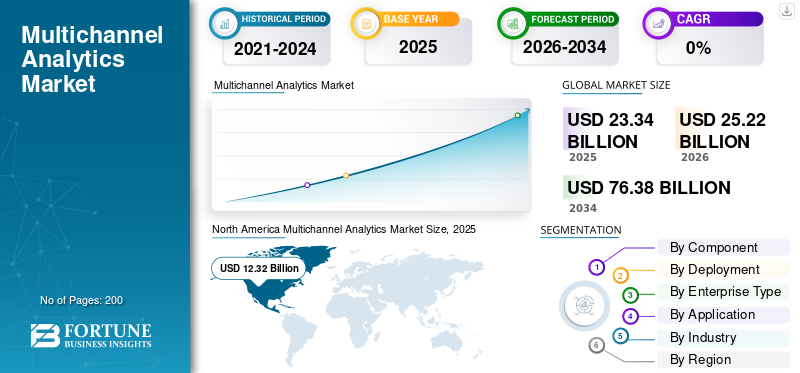
The global multichannel analytics market size was valued at USD 23.34 billion in 2025. The market is projected to grow from USD 25.22 billion in 2026 to USD 76.38 billion by 2034, exhibiting a CAGR of 14.9% during the forecast period. North America dominated the multichannel analytics market with a market share of 52.78% in 2025.
The multichannel analytics market comprises software, data pipelines, and decision intelligence layers that capture customer signals from paid, owned, and earned touchpoints and convert them into a single, comparable measurement and optimization framework. It typically ingests clickstream and in-app events, campaign and ad platform data, CRM and loyalty records, commerce and POS transactions, customer support interactions (voice, chat, tickets), and product usage telemetry, then standardizes identities and metrics to map journeys across channels. These solutions are critical for use cases such as cross-channel conversion and funnel optimization, retention and churn diagnostics, customer lifetime value modeling, audience segmentation, personalization, content and offer effectiveness, and budget allocation across channels.
Leading vendors such as Adobe, Salesforce, Google, Microsoft, and Oracle are defending and expanding their positions by tightening integration across analytics, CRM, marketing automation, and data cloud environments, while embedding AI copilots that translate questions into queries, generate insights narratives, and recommend next best actions. Product investment is increasingly focused on privacy-resilient measurement (consent-aware data flows, aggregated reporting, and secure collaboration patterns), more durable data-collection approaches (server-side and event-based instrumentation), and stronger identity capabilities that work across web, app, and offline systems.
Download Free sample to learn more about this report.
Multichannel Analytics Market Key Takeaways
 Global Market Size & Forecast
- 2025 Market Size: USD 23.34 billion
- 2026 Market Size: USD 25.22 billion
- 2034 Forecast Market Size: USD 76.38 billion
- CAGR: 14.9% from 2026-2034
 Market Share
- North America dominated the multichannel analytics market with a 52.78% share in 2025.
- The solution segment accounted for the largest revenue share of 77.9% in 2025.
- The retail & e-commerce segment held a 22.8% market share in 2025.
 Key Regional Highlights
North America
North America reached USD 12.32 billion in 2025, maintaining its position as the largest regional market.
Europe
Europe was valued at USD 4.85 billion in 2025 and is projected to grow at a CAGR of 14.5% during the forecast period.
Asia Pacific
Asia Pacific reached USD 3.49 billion in 2025 and is expected to register the highest CAGR over the forecast period.
U.S.
The market was valued at USD 10.46 billion in 2025, accounting for approximately 44.8% of global sales.
Japan
The market reached USD 0.42 billion in 2025, representing around 1.79% of global revenues.
Read More

IMPACT OF GENERATIVE AI
Advancing Intelligent Insights and Automated Decision Driving the Integration of Generative AI
Generative AI is transforming the space industry by accelerating design, development, and data analysis. It enables the automatic creation of optimized spacecraft components, reducing design cycles and costs, while improving in-orbit operations through autonomous navigation and anomaly detection.
In satellite data applications, generative AI enhances Earth observation, predictive analytics, and real-time decision-making across industries such as agriculture, defense, and logistics. By enabling faster innovation, more effective data use, and more efficient mission planning, generative AI is becoming a key driver of competitiveness and technological advancement in the space market. For instance,
- In August 2024, Booz Allen Hamilton successfully deployed a generative AI tool aboard the International Space Station for the first time, using Hewlett Packard Enterprise’s Spaceborne Computer-2. The AI application enables on-orbit data processing, retrieval, and problem-solving without relying on Earth-based internet, paving the way for edge AI capabilities in space missions.
MULTICHANNEL ANALYTICS MARKET TRENDS
Growing Demand for Industry-Specific Analytics Solutions Shaping the Market Trend
The growing demand for industry-specific analytics solutions is emerging as a prominent trend in the multichannel analytics market, as organizations increasingly seek platforms tailored to their sector-specific operational models, customer journeys, and regulatory requirements. Industries such as retail, BFSI, telecom, media, and healthcare require customized key performance indicators, predefined dashboards, and workflows aligned with their unique engagement patterns, revenue structures, and compliance obligations. For instance,
- In December 2025, Cvent acquired Goldcast to bring AI-powered video creation and analytics to the media and entertainment sector. The platform enables marketers to repurpose live and virtual events into video content across web, email, social, and sales channels, while tracking engagement metrics across all touchpoints. This allows entertainment brands to leverage multichannel analytics to measure audience behavior, optimize content strategies, and drive more effective event-led marketing campaigns.
Download Free sample to learn more about this report.
MARKET DYNAMICS
MARKET DRIVERS
Expansion of Digital Commerce and Online Service Delivery Drives Market Growth
The rapid expansion of digital commerce and online service delivery is driving major growth in the multichannel analytics market, as organizations increasingly operate through digital-first engagement models. For instance,
- According to Shopify, e-commerce is expected to make up 20.5% of global retail sales in 2025, and that share is projected to grow to 22.5% by 2028.
The proliferation of e-commerce platforms, mobile commerce applications, digital banking services, streaming media, and subscription-based offerings has significantly increased the volume, velocity, and variety of customer interactions and transaction data.
This surge in digital touchpoints generates complex behavioral datasets that require advanced analytical capabilities to extract meaningful insights. Enterprises are therefore investing in multichannel analytics solutions to monitor user journeys, optimize conversion funnels, personalize digital experiences, and improve customer retention across platforms.
MARKET RESTRAINTS
Privacy Regulations and Consent Constraints Restrain the Market Growth
Stringent privacy regulations and evolving consent frameworks present a significant restraint for the multichannel analytics market, as they directly limit the scope, depth, and usability of customer data across channels. Regulatory requirements such as explicit user consent, purpose limitation, data minimization, defined retention periods, and restrictions on cross-border data transfers reduce the volume and granularity of information that organizations can lawfully collect and process.
These obligations compel enterprises to redesign data architectures, implement consent management platforms, anonymize or pseudonymize datasets, and maintain detailed audit trails, increasing operational complexity and compliance costs. In addition, frequent regulatory updates and varying regional standards create uncertainty for global deployments, delaying implementation cycles and discouraging aggressive, data-driven strategies.
MARKET OPPORTUNITIES
Integration of Artificial Intelligence in Multichannel Analytics to Boost the Market Growth
The integration of artificial intelligence-driven predictive and prescriptive analytics represents a significant opportunity for the multichannel analytics market growth, as enterprises increasingly shift from descriptive reporting to proactive, automated decision-making. For instance,
- In August 2025, Flexential leveraged ON24 AI-powered ACE to scale its multichannel marketing campaigns, tripling audience reach and accelerating campaign creation by 4X. By automating content generation from webinars and on-demand programming, Flexential improved efficiency, enriched customer insights, and delivered consistent, high-quality engagement across channels.
By embedding machine learning algorithms into analytics platforms, organizations can identify patterns across customer journeys, predict churn probabilities, forecast demand fluctuations, and determine next-best-action strategies in real time. These capabilities enable dynamic personalization across channels, allowing businesses to tailor offers, messaging, and engagement timing based on individual behavioral signals rather than relying solely on historical summaries.
Segmentation Analysis
By Industry
Fragmented Customer Journeys and Intense Competition Strengthening Retail & E-commerce Segment Dominance
Based on the industry, the market is classified into BFSI, IT and telecommunication, healthcare, retail & e-commerce. media & entertainment, travel & hospitality, and others.
Retail & e-commerce held the largest share of the industry in 2024. In 2025, the segment dominated with a 22.8% of market share, as customer journeys are highly fragmented across apps, websites, marketplaces, social media, and physical stores, making unified tracking essential. High transaction frequency and fast decision cycles push retailers to continuously optimize conversion funnels, pricing, promotions, and inventory-driven campaigns using real-time insights. In addition, intense competition and low switching costs make personalization, churn reduction, and loyalty analytics critical to protect margins and improve repeat purchases across channels.
The healthcare sector is expected to witness the highest CAGR of 18.8% during the forecast period.
To know how our report can help streamline your business, Speak to Analyst
By Component
Solution Segment Leads to Dominance Owing to Advanced Capabilities in Data Visualization
Based on the component, the market is bifurcated into solutions and services.
The solution segment held the majority of the market share in 2024. In 2025, the segment led the market with a 77.9% of revenue, driven by its critical role in enabling data unification, analysis, and actionable insights across diverse customer touchpoints. As businesses increasingly prioritize a single, integrated platform to capture, process, and interpret customer data, solutions offering advanced capabilities in data visualization, real-time reporting, predictive analytics, and AI-driven insights have become essential.
The solution segment is expected to witness the highest CAGR of 15.9% during the forecast period, driven by the growing need for real-time, data-driven decision-making in an increasingly fragmented customer landscape. As businesses push for deeper personalization, targeted marketing, and improved customer retention, demand for analytics solutions that provide cross-channel visibility, predictive insights, and seamless integration with other enterprise systems is growing exponentially.
By Deployment
Ease of Integration with Various Data Sources Supporting the Cloud Segment Leadership
Based on deployment, the market is bifurcated into cloud and on-premises.
Cloud led the majority share by deployment in 2024. In 2025, the segment led with a 67.9%,driven by its scalability, cost-efficiency, and ease of integration with various data sources. Cloud platforms enable businesses to access powerful analytics tools without the need for heavy infrastructure investments, allowing for faster deployment, real-time data processing, and continuous updates.
Cloud is expected to witness the highest CAGR of 16.9% during the forecast period, driven by the growing shift toward digital transformation and the increasing reliance on data-driven decision-making. As more businesses migrate to the cloud for its accessibility, security, and integration capabilities, the demand for cloud-based analytics platforms is expanding rapidly.
By Enterprise Type
Complex Data Ecosystems and High Budget Allocation of Large Enterprises Drive Segmental Dominance
Based on the enterprise type, the market is segmented into large enterprises and Small & Medium-sized Enterprises (SMES).
Large Enterprises held the majority share by enterprise type in 2024. In 2025, the segment held the dominant share of 71.2%, due to its complex customer ecosystems, high data volumes, and presence across multiple geographic and digital channels. These organizations require advanced analytics to manage large-scale marketing budgets, diverse customer segments, and integrated online and offline operations. In addition, they possess the financial resources, technical infrastructure, and skilled personnel necessary to deploy and operationalize enterprise-grade analytics platforms effectively across departments.
Small & Medium-sized Enterprises are expected to witness the highest CAGR of 17.7% during the forecast period.
By Application
Continuous Need for Performance Tracking and Rapid Optimization Leads to Campaign Management Segment’s Growth
Based on the application, the market is segmented into customer retention & acquisition, cross-selling & up-selling, loyalty & customer experience management, campaign management, and sales performance management.
Campaign management held the majority share by application in 2024. In 2025, the segment held 26.7% of the market share, as marketing teams need continuous performance tracking and rapid optimization across channels such as search, social, email, apps, and marketplaces. Analytics is used daily to monitor KPIs, refine targeting, adjust creatives, and reallocate budgets based on what delivers the best conversions and ROI.
Loyalty & customer experience management is expected to witness a CAGR of 17.0% during the forecast period.
Multichannel Analytics Market Regional Outlook
By region, the market is categorized into North America, South America, Europe, the Middle East & Africa, and Asia Pacific.
North America
North America holds the majority of the multichannel analytics market share due to the region's advanced digital infrastructure, high adoption of data-driven decision-making, and the presence of leading technology companies. With a strong focus on e-commerce, retail, and digital marketing, businesses in North America heavily rely on multichannel analytics to optimize customer experiences and maximize ROI. The region also benefits from early technological adoption, a well-established ecosystem of analytics platforms, and a large number of enterprises investing in AI-driven solutions, further cementing its market dominance.
This mix of private innovation, public backing, and well-established supply chains allows North America to capture the largest market share and stay ahead in both commercial and strategic space initiatives.
The North American market held the largest share at USD 12.32 billion in 2025.
North America Multichannel Analytics Market Size, 2025 (USD Billion)
To get more information on the regional analysis of this market, Download Free sample
U.S. Multichannel Analytics Market
Based on North America’s strong contribution and the U.S. dominance within the region, the U.S. market was valued at USD 10.46 billion in 2025, accounting for roughly 44.8% of sales.
Europe
Europe is projected to grow at 14.5% over the coming years and reached a valuation of USD 4.85 billion in 2025, driven by increased emphasis on digital transformation across industries such as retail, BFSI, and manufacturing. The region is poised for growth in e-commerce and omnichannel strategies, driving demand for advanced analytics to optimize customer journeys and personalize experiences. Additionally, Europe's regulatory environment, particularly around data privacy with GDPR, is pushing businesses to adopt more sophisticated, privacy-compliant analytics solutions.
U.K Multichannel Analytics Market
The U.K. market in 2025 held the value of USD 0.74 billion, representing roughly 3.17% of global revenues.
Germany Multichannel Analytics Market
Germany’s market was valued at USD 0.82 billion in 2025, equivalent to around 3.49% of global sales.
Asia Pacific
Asia Pacific is expected to grow with the highest CAGR and reached a valuation of USD 3.49 billion in 2025. The region is rapidly expanding due to rapid digitalization, the rise of e-commerce, and an increasing number of businesses investing in customer experience optimization. As companies in countries such as China, India, and Japan adopt omnichannel strategies, demand for advanced analytics solutions to manage and analyze vast amounts of customer data is skyrocketing. Additionally, the region's growing focus on AI and machine learning, coupled with expanding internet penetration and mobile usage, is further driving market growth.
Additionally, governments are supporting public-private partnerships and technology transfer initiatives, enabling faster innovation and cost-effective solutions. This combination of strategic investment, market demand, and emerging entrepreneurial ecosystems positions the Asia Pacific for the quickest growth in the global market.
Japan Multichannel Analytics Market
Japan’s market in 2025 was calculated at USD 0.42 billion, accounting for roughly 1.79% of global revenues.
China Multichannel Analytics Market
China’s market is expected to be one of the largest worldwide, with 2025 revenues at USD 1.37 billion, representing roughly 5.84% of global sales.
India Multichannel Analytics Market
India’s market in 2025 reached USD 0.56 billion, accounting for roughly 2.38% of the global market share.
South America and the Middle East & Africa
The Middle East and Africa region is expected to grow at the second-highest CAGR in the market. It is due to rapid digitalization, the rise of e-commerce, and an increasing number of businesses investing in customer experience optimization. As companies in countries such as China, India, and Japan adopt omnichannel strategies, demand for advanced analytics solutions to manage and analyze vast amounts of customer data is skyrocketing. Additionally, the region's growing focus on AI and machine learning, coupled with expanding internet penetration and mobile usage, is further driving market growth.
South America is expected to experience stable growth in the market as businesses increasingly recognize the value of data-driven insights to improve customer experiences and optimize marketing efforts.
GCC Multichannel Analytics Market
The GCC market reached around USD 0.46 billion in 2025, representing roughly 1.96% of global revenues.
COMPETITIVE LANDSCAPE
Key Industry Players
Expanding Product Portfolios by the Key Players to Meet the Increasing Demand for AI-driven Insights
Key players in the multichannel analytics market are expanding their product portfolios to meet the increasing demand for real-time, AI-driven insights. They are adopting strategies such as partnerships, mergers, and acquisitions to enhance their capabilities and reach. By integrating with CRM and marketing automation platforms, these companies are strengthening their market position while focusing on innovations such as predictive analytics and customer segmentation to stay competitive.
LIST OF KEY MULTICHANNEL ANALYTICS COMPANIES PROFILED
- Adobe Inc. (U.S.)
- Salesforce (U.S.)
- Google LLC (U.S.)
- IBM Corporation (U.S.)
- SAP SE (Germany)
- Oracle Corporation (U.S.)
- Microsoft Corporation (U.S.)
- Teradata Corporation (U.S.)
- MicroStrategy Incorporated (U.S.)
- Funnel (Sweden)
- MoEngage (U.S.)
- Zeta Global (U.S.)
KEY INDUSTRY DEVELOPMENTS
- February 2026: Google introduced AI-powered “Generated insights” to the Home page of Google Analytics, automatically highlighting key performance changes, trends, and configuration updates since a user’s last visit. The company also launched cross-channel budgeting (beta), allowing marketers to track and optimize paid media spend across multiple platforms. Together, these updates aim to streamline reporting and enable faster, more strategic budget decisions.
- February 2026: Interface.ai launched Smart Collections, a multi-channel AI-powered collections agent designed for credit unions and community banks. The solution automates early-stage delinquency outreach across voice, SMS, and email, helping institutions increase payments and improve cure rates while maintaining compliance and member relationships. It includes product-specific playbooks, policy-based controls, and the ability to escalate to human agents, helping smaller financial institutions manage rising delinquencies more efficiently.
- September 2025: Improvado unveiled a major upgrade to its AI Agent, enhancing its ability to deliver business-aware insights, instant visualizations, and automated reporting through natural language. The updated agent offers deeper reasoning, scheduled workflows, and integrations with tools such as Asana and Jira, helping marketing teams reduce manual analysis time by over 30 hours per week. The new AI Agent is now available to all customers.
- July 2025: Contentsquare agreed to acquire Loris AI to combine digital experience analytics with AI-powered conversation intelligence. The deal will enable businesses to connect web and app interaction data with customer service conversations, including sentiment, intent, and agent performance insights. The move reflects a broader industry shift toward unifying marketing, digital experience, and conversational AI to deliver a more complete view of the customer journey.
- February 2025: Versium announced a partnership with Resulticks to integrate Resulticks’ Marketing Star platform into Versium’s REACH solution. The collaboration gives SMBs a single, data-driven multichannel marketing solution, enabling them to cleanse, enrich, and activate customer data while launching and tracking campaigns in a single platform. Marketing Star’s Essentials plan is now included in all REACH subscriptions, helping small and mid-sized businesses streamline tools, reduce tech stack complexity, and improve audience engagement.
- March 2024: Adobe Inc. updated its Adobe Experience Platform to focus on multichannel analytics, helping brands unify and analyze customer data across web, mobile, email, and streaming. The AI Assistant automates insights and journey creation, while federated audience composition and Real-Time CDP Collaboration enable secure use of first-party data across channels.
REPORT COVERAGE
The report provides a detailed analysis of the market and focuses on key aspects such as leading companies, product types, and leading applications of the product. Besides, it offers insights into the market trends and highlights key industry developments. In addition to the factors above, the market's growth in recent years was driven by several other factors.
Request for Customization to gain extensive market insights.
Report Scope & Segmentation
| ATTRIBUTE | DETAILS |
| Study Period | 2021-2034 |
| Base Year | 2025 |
| Forecast Period | 2026-2034 |
| Historical Period | 2021-2024 |
| Growth Rate | CAGR of 14.9% from 2026-2034 |
| Unit | Value (USD Billion) |
| Segmentation | By Component, Deployment, Enterprise Type, Application, Industry, and Region |
| By Component |
|
| By Deployment |
|
| By Enterprise Type |
|
| By Application |
|
| By Industry |
|
| By Region |
|
Frequently Asked Questions
According to Fortune Business Insights, the global market value stood at USD 23.34 billion in 2025 and is projected to reach USD 76.38 billion by 2034.
In 2025, the market value stood at USD 12.32 billion.
The market is expected to exhibit a CAGR of 14.9% during the forecast period.
By industry, the retail & e-commerce segment is expected to lead the market.
Expansion of digital commerce and online service delivery drives market growth.
Adobe Inc., Salesforce, Google, Microsoft, and Oracle are the major players in the global market.
North America dominated the market in 2025.



- 2021-2034
- 2025
- 2021-2024
- 200
Get 30-60 hrs Free Customization
Expand Regional and Country Coverage, Segments Analysis, Company Profiles, Competitive Benchmarking, and End-user Insights.




















Related Reports
-
US +1 833 909 2966 ( Toll Free )
-
Get In Touch With Us