Next-Generation Autonomous Combat Aircraft Market Size, Share & Industry Analysis, By Aircraft Size (Small, Medium, and Large), By Platform Type (Collaborative Combat Aircraft, Unmanned Combat Aerial Vehicle, Remote Carrier, Autonomous Strike Aircraft), By System Component (Autonomy & AI Software, Communications & Datalinks, Sensors & Payloads, Weapons Integration & Mission Systems, & Airframe & Propulsion System), By Combat Role (Electronic Warfare, Decoy & Attritable Operations, Air-to-Air Combat Support, SEAD/DEAD, ISR & Targeting, & Strike) and Regional Forecast, 2026-2034
 Download Free Sample
Next-Generation Autonomous Combat Aircraft Market Size and Future Outlook
 Listen to Audio Version
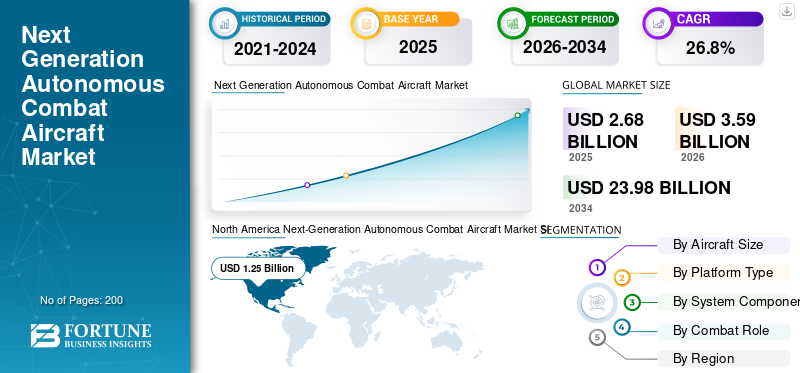
The next-generation autonomous combat aircraft market size was valued at USD 2.68 billion in 2025. The market is projected to grow from USD 3.59 billion in 2026 to USD 23.98 billion by 2034, exhibiting a CAGR of 26.8% during the forecast period. North America dominated the next generation autonomous combat aircraft market with a market share of 46.64% in 2025.
The market represents a rapidly evolving segment within the global aerospace and defense industry, driven by the convergence of artificial intelligence, advanced sensor systems, and autonomous flight technologies. Governments and defense establishments worldwide are increasingly prioritizing unmanned and optionally piloted combat platforms to execute high-risk missions while minimizing human exposure. The market encompasses a broad spectrum of platforms from loyal wingmen and collaborative combat aircraft to fully autonomous strike systems. Demand for these platforms is driven by growing investments in defense modernization, AI-driven decision-making, and manned-unmanned teaming doctrines that are reshaping modern air combat strategies.
Key players in the market include General Atomics Aeronautical Systems, Anduril Industries, Boeing, Northrop Grumman, Lockheed Martin, Kratos Defense & Security Solutions, and BAE Systems. These companies compete through advanced AI-powered autonomy architectures, low-observable stealth designs, modular open-system platforms, loyal wingman and collaborative teaming capabilities, and integrated sensor-fusion technologies. These are tailored for strike operations, ISR missions, electronic warfare, and contested-airspace penetration across defense and national security applications.
Download Free sample to learn more about this report.
NEXT GENERATION AUTONOMOUS COMBAT AIRCRAFT MARKET KEY TAKEAWAYS
 Market Size & Forecast
- 2025 Market Size: USD 2.68 billion
- 2026 Market Size: USD 3.59 billion
- 2034 Forecast Market Size: USD 23.98 billion
- CAGR: 26.8% from 2026–2034
 Market Share
- North America dominated the next generation autonomous combat aircraft market with a market share of 46.64% in 2025.
- The small segment is anticipated to rise with a CAGR of 26.9% over the forecast period.
- The remote carrier segment is projected to grow at a CAGR of 27.2% over the forecast period.
 Key Regional Highlights
North America
North America held the dominant share in 2024, valued at USD 0.93 billion, and also maintained the leading share in 2025, with USD 1.25 billion revenue.
Europe
Europe is estimated to reach USD 0.88 billion in 2026.
Asia Pacific
Asia Pacific is projected to record a CAGR of 27.6% during the forecast period, which is the highest among all regions, and reach a valuation of USD 0.79 billion by 2026.
U.S.
The U.S. market can be analytically approximated at around USD 1.54 billion in 2026, representing roughly 26.7% CAGR of the forecast period.
Japan
The Japan market share in 2026 is estimated at around USD 0.15 billion, accounting for roughly 28.7% of CAGR during the forecast period.
Read More

NEXT-GENERATION AUTONOMOUS COMBAT AIRCRAFT MARKET TRENDS
Accelerating Integration of AI and Manned-Unmanned Teaming (MUM-T) is Reshaping Autonomous Combat Aviation
The most defining trend in the market is the rapid operationalization of AI-enabled manned-unmanned teaming. Defense forces are transitioning from conceptual frameworks to active acquisition contracts, embedding autonomous wingmen alongside crewed fighters for force multiplication. The integration of AI-powered autonomous wingmen for adaptive mission execution and networked force multiplication and development of stealthy unmanned platforms with collaborative low-observable capabilities in contested airspaces is driving market expansion. Additionally, implementation of secure high-bandwidth data links for real-time collaborative targeting and sensor fusion is also a leading trend shaping the market.
MARKET DYNAMICS
MARKET DRIVERS
Download Free sample to learn more about this report.
Escalating Geopolitical Tensions and Defense Modernization Mandates Drive Market Development
Rising geopolitical instability and evolving multi-domain threat environments are driving next-generation autonomous combat aircraft market growth. Modernization is being emphasized in emerging economies, with considerable resources being dedicated to the development of unmanned aerial combat. This is due to the increase in military expenditures allowing the acquisition of high-tech drone systems and the maintenance of technological balance with major powers. Concurrently, increased government investment in defense equipment, particularly autonomous military aircraft and Unmanned Aerial Vehicles (UAVs), to enhance military operational efficiency is a significant driver of market. Moreover, the U.S. Department of Defense are also requesting substantial funding for procurement and research, development, test, and evaluation in recent fiscal years. These combined fiscal and strategic imperatives are creating sustained demand across the autonomous combat aircraft value chain.
MARKET RESTRAINTS
High Development Costs, Regulatory Complexity, and Export Control Restrictions Limit Market Expansion
Despite strong demand signals, the market faces restraints rooted in program economics and international trade governance. Development expenses scale quickly as integrating AI flight computers, multi-modal sensor suites, and redundant actuation can surpass USD 100 million before first revenue. Moreover, chip shortages and export controls have elevated avionics bill-of-materials costs, weighing on early-stage builders. Additionally, the Missile Technology Control Regime (MTCR) bars systems with a range beyond 300 km and a payload over 500 kg, fragmenting demand and steering some governments toward indigenous suppliers. The U.S. regulations further restrict the use of components of Chinese origin, adding redesign costs for integrators. These barriers collectively slow international program timelines and constrain the addressable export market.
MARKET OPPORTUNITIES
Expanding Defense Modernization Programs and Collaborative Combat Aircraft Procurement Present Significant Growth Potential
The market offers substantial opportunities tied to global defense procurement cycles and the push for affordable attritable platforms. The U.S. has set the initial pace through its Collaborative Combat Aircraft (CCA) program, awarding parallel April 2024 contracts to Anduril and General Atomics that call for more than 1,000 autonomous wingmen by 2028. Beyond the U.S., allied nations are pursuing similar capability development pathways. Australia's MQ-28 Ghost Bat is evolving from demonstrator to operational asset, while Europe's Franco-German-Spanish Future Combat Air System (FCAS) and the U.K.'s Autonomous Collaborative Platform (ACP) concept confirm that manned-unmanned teaming has become a core element of Tier-1 air-power planning. These programs collectively represent long-term, high-value procurement opportunities for platform developers, AI software integrators, and subsystem suppliers.
MARKET CHALLENGES
Cybersecurity Vulnerabilities, Autonomous Decision-Making Ethics, and Interoperability Gaps Pose Operational and Policy Hurdles
The deployment of next-generation autonomous combat aircraft is complicated by a set of technical, ethical, and interoperability challenges that the industry must resolve before widespread operational adoption. The focus on electronic warfare integration and cyber resilience in collaborative combat aircraft platforms, and the need for adoption of digital twin simulations for predictive maintenance and mission planning of manned-unmanned teams, underscores the complexity of fielding reliable autonomous systems in contested environments. Beyond technical gaps, the high cost of integrating next-generation capabilities such as AI-enabled autonomous navigation, EO/IR and radar-based ISR payloads, electronic warfare systems, secure SATCOM communication links, and modular plug-and-play mission architectures is limiting rapid fleet modernization. Issues aligned with rules of engagement, human-on-the-loop requirements, and allied interoperability standards further complicate procurement decisions across coalition partners.
Segmentation Analysis
By Aircraft Size
Growing Demand for Persistent, Long-Range Strike and Surveillance Missions is Fueling Medium Aircraft Segment Growth
Based on aircraft size, the market is segmented into small, medium, and large.
The medium segment accounted for the largest next-generation autonomous combat aircraft market share in 2025. Demand for medium-class autonomous combat aircraft is rising as armed forces seek platforms that balance payload capacity, operational range, and mission endurance without the cost burden of larger systems. Medium aircraft occupying the critical space between tactical small drones and heavy MALE platforms are increasingly valued for their ability to carry diverse sensor and weapons payloads across extended sorties. This makes them well-suited for border patrol, maritime surveillance, and precision strike in contested environments.
The small segment is anticipated to rise with a CAGR of 26.9% over the forecast period.
By Platform Type
Expanding Manned-Unmanned Teaming Doctrines Drives Collaborative Combat Aircraft/Loyal Wingman Segment Growth
Based on platform type, the market is segmented into collaborative combat aircraft/loyal wingman, unmanned combat aerial vehicle, remote carrier, autonomous strike aircraft, and optionally crewed combat aircraft.
In 2025, the collaborative combat aircraft/loyal wingman segment dominated the global market. The segment is redefining modern defense strategies, as decision-makers worldwide seek integrated platforms that balance manned capabilities and autonomous advancements. This momentum is shaped by innovation in artificial intelligence, resilient communications, and advanced sensor fusion to address complex global threats and optimize force effectiveness. Loyal wingman platforms reduce risk related to crewed aircraft while exponentially expanding mission coverage and strike capacity, driving sustained procurement interest globally.
The remote carrier segment is projected to grow at a CAGR of 27.2% over the forecast period.
To know how our report can help streamline your business, Speak to Analyst
By System Component
Rising Multi-Domain Operational Requirements Drives Demand for Sensors & Payloads Segment
Based on system component, the market is segmented into autonomy & AI software, communications & datalinks, sensors & payloads, weapons integration & mission systems, and airframe & propulsion system.
The sensors & payloads segment is anticipated to witness a dominating market share over the forecast period. The shift toward loyal wingman concepts, in which drones collaborate with manned aircraft using shared intelligence networks, underscores the strategic importance of payloads designed for communication relays, targeting, and electronic warfare countermeasures. Additionally, the integration of AI and machine learning is revolutionizing payload capabilities, enabling drones to autonomously identify and classify objects, detect threats, and analyze data streams in real-time. Miniaturization trends and modular architectures are further expanding the addressable mission set for next-generation payloads.
The autonomy & AI software segment is projected to grow at a high CAGR of 27.8% over the forecast period.
By Combat Role
Escalating Battlefield Intelligence Demand is Driving ISR & Targeting Segment Growth
Based on combat role, the market is segmented into electronic warfare, decoy & attritable operations, air-to-air combat support, SEAD/DEAD, ISR & targeting, and strike/deep strike.
The ISR & targeting segment dominated the market in 2025. As autonomous platforms become primary ISR assets across military theaters, demand for advanced targeting systems including laser designators, synthetic aperture radars, and AI-enabled object classification continues to intensify across all major defense programs.
In addition, electronic warfare segment is projected to grow at a CAGR of 28.0% during the study period.
Next-Generation Autonomous Combat Aircraft Market Regional Outlook
By geography, the market is categorized into North America, Europe, Asia Pacific, and Rest of the World.
North America
North America Next-Generation Autonomous Combat Aircraft Market Size, 2025 (USD Billion)
To get more information on the regional analysis of this market, Download Free sample
North America held the dominant share in 2024, valued at USD 0.93 billion, and also maintained the leading share in 2025, with USD 1.25 billion revenue. This is driven by large-scale U.S. programs such as the collaborative combat aircraft procurement plan and robust Pentagon investment in AI-enabled autonomous systems, sustaining the region's dominant global market position.
U.S. Next-Generation Autonomous Combat Aircraft Market
Based on North America’s strong contribution, the U.S. market can be analytically approximated at around USD 1.54 billion in 2026, representing roughly 26.7% CAGR of the forecast period. The U.S. ranks first globally for autonomous aerial vehicles due to its robust defense modernization programs, AI-based drone adoption, and leading aerospace OEMs including Boeing, Lockheed Martin, and Northrop Grumman, sustaining unmatched market leadership.
Europe
Europe is estimated to reach USD 0.88 billion in 2026 and secure the position of second largest region in the market. Europe's market is estimated to grow at a significant rate owing to increasing demand from the military sector for combat operations and surveillance applications, with key players such as BAE Systems driving growth across the region. FCAS and Tempest programs further anchor regional momentum.
U.K. Next-Generation Autonomous Combat Aircraft Market
The U.K. market in 2026 is estimated at around USD 0.22 billion, representing roughly 27.4% CAGR of the forecast period. The U.K. Ministry of Defense allocated a record USD 403.5 million in June 2025 to reinforce drone supply, and is advancing its Autonomous Collaborative Platform concept, reinforcing the U.K.'s commitment to next-generation autonomous combat capabilities.
Germany Next-Generation Autonomous Combat Aircraft Market
Germany’s market is projected to reach approximately USD 0.18 billion in 2026. Germany is a key stakeholder in the FCAS program alongside France and Spain, channeling European Defense Fund investments into next-generation autonomous combat platforms and counter-drone systems as part of broader EU defense integration.
Asia Pacific
Asia Pacific is projected to record a CAGR of 27.6% during the forecast period, which is the highest among all regions, and reach a valuation of USD 0.79 billion by 2026. Asia Pacific's market expansion mirrors rapid force modernization in China, India, and South Korea, making it the fastest-growing regional market globally.
China Next-Generation Autonomous Combat Aircraft Market
China’s market is projected to be one of the largest in Asia Pacific, with 2026 revenues estimated at around USD 0.35 billion. China is aggressively developing indigenous autonomous combat aircraft, including stealth UCAVs and loyal wingman prototypes, backed by state-led defense programs and a rapidly expanding domestic aerospace industrial base driving regional competition.
Japan Next-Generation Autonomous Combat Aircraft Market
The Japan market share in 2026 is estimated at around USD 0.15 billion, accounting for roughly 28.7% of CAGR during the forecast period. Japan's market is shaped by the need to improve response capabilities, situational awareness, and communication security in a rapidly evolving regional security landscape, driving investment in autonomous combat aircraft alongside allied interoperability programs.
India Next-Generation Autonomous Combat Aircraft Market
The India market in 2026 is estimated at around USD 0.12 billion. In India, the demand for next-generation military systems is driven by a growing need to enhance defense preparedness and reduce dependency on foreign systems, with a rising defense budget accelerating indigenous autonomous aircraft development and procurement.
Rest of the World
The rest of the world include Middle East & Africa and Latin America. These regions are expected to witness moderate growth during the forecast period. The Middle East & Africa and Latin America market is set to reach a valuation of USD 0.19 billion and USD 0.07 billion in 2026. Emerging markets across the Middle East, Latin America, and Africa are increasingly investing in autonomous combat platforms for border security and counterterrorism, with Turkey's Baykar Technologies serving as a key export driver to developing nations.
COMPETITIVE LANDSCAPE
Key Industry Players
Growing Focus on Loyal Wingman Platforms, AI-Enabled Autonomy, and Affordable Combat Mass by Key Players Propels Market Competition
The next-generation autonomous combat aircraft market is being strengthened by key players that are shifting airpower from crewed-platform dominance toward networked, autonomous, and attritable combat formations. Companies such as General Atomics, Anduril Industries, Boeing, Lockheed Martin, Northrop Grumman, Kratos, BAE Systems, Airbus Defence and Space, Dassault Aviation, and Baykar Technologies are focusing on collaborative combat aircraft, loyal wingman systems, autonomous mission software, open-architecture payloads, secure datalinks, electronic warfare packages, and manned-unmanned teaming. General Atomics and Anduril are advancing U.S. CCA prototypes through YFQ-42A and YFQ-44A flight testing, while Boeing’s MQ-28 Ghost Bat is positioned as an autonomous force multiplier for crewed aircraft. Airbus is strengthening Europe’s future combat-air ecosystem through FCAS remote carriers and combat cloud integration, while Kratos and Lockheed Martin are pushing affordable, survivable CCA concepts such as Valkyrie and Vectis. These strategies are accelerating market growth by reducing pilot risk, expanding combat mass, improving mission flexibility, and enabling faster deployment of autonomous aircraft in contested airspace.
LIST OF KEY NEXT-GENERATION AUTONOMOUS COMBAT AIRCRAFT COMPANIES PROFILED
- General Atomics Aeronautical Systems (U.S.)
- Anduril Industries (U.S.)
- Boeing (U.S.)
- Northrop Grumman (U.S.)
- Lockheed Martin (U.S.)
- Kratos Defense & Security Solutions (U.S.)
- BAE Systems (U.K.)
- Airbus Defence and Space (Europe)
- Dassault Aviation (France)
- Baykar Technologies (Türkiye)
KEY INDUSTRY DEVELOPMENTS
- February 2026: Shield AI and Collins Aerospace confirmed as contractors for AI mission autonomy "brains" to be retrofitted onto prototypes, with testing ongoing.
- September 2025: Boeing and the Royal Australian Air Force completed flight tests involving two MQ-28A drones controlled by an E-7A Wedgetail, preparing for an air-to-air weapon shot.
- July 2025: General Atomics partnered with its German affiliate, GA-ATS, to develop a "European CCA" based on the YFQ-42A platform for European defense needs.
- March 2025: The USAF awarded Boeing a contract for the F-47 manned fighter, which serves as the core of the "system of systems," commanding autonomous CCAs.
- April 2024: USAF down selected Anduril and General Atomics to advance to detailed design and build production-representative test aircraft.
REPORT COVERAGE
This research report offers a detailed analysis of emerging trends and rapidly adopted technologies in the industry across key regions. The report outlines key drivers of market growth and challenges to expansion, delivering a detailed overview of the maritime industry landscape. The study highlights recent advancements to boost industry insights and support stakeholders in making well-informed decisions.
Request for Customization to gain extensive market insights.
Report Scope & Segmentation
| ATTRIBUTE | DETAILS |
| Study Period | 2021-2034 |
| Base Year | 2025 |
| Estimated Year | 2026 |
| Forecast Period | 2026-2034 |
| Historical Period | 2021-2024 |
| Growth Rate | CAGR of 26.8% from 2026-2034 |
| Unit | Value (USD Billion) |
| Segmentation | By Aircraft Size, By Platform Type, By System Component, By Combat Role and Region |
| By Aircraft Size |
|
| By Platform Type |
|
| By System Component |
|
| By Combat Role |
|
| By Region |
|
Frequently Asked Questions
According to Fortune Business Insights, the global market value stood at USD 2.68 billion in 2025 and is projected to reach USD 23.98 billion by 2034.
In 2025, North America the market value stood at USD 1.25 billion.
The market is expected to exhibit a CAGR of 26.8% during the forecast period of 2026-2034.
By aircraft size, medium segment is expected to dominate the market.
Escalating geopolitical tensions and defense modernization mandates drive market growth.
General Atomics Aeronautical Systems, Anduril Industries, Boeing, Northrop Grumman, Lockheed Martin, and Kratos Defense & Security Solutions are few major players in the global market.
North America held the largest market share in 2025.



- 2021-2034
- 2025
- 2021-2024
- 200
Get 30-60 hrs Free Customization
Expand Regional and Country Coverage, Segments Analysis, Company Profiles, Competitive Benchmarking, and End-user Insights.




















Related Reports
-
US +1 833 909 2966 ( Toll Free )
-
Get In Touch With Us