Non-Directional Beacon (NDB) Market Size, Share & Industry Analysis, By Frequency Range (190 kHz to 535 kHz, 500 kHz to 1250 kHz, and 1500 kHz to 1800 kHz), By Component (Beacon Transmitter, Monitoring Equipment, and Antenna System), By Application (Commercial Aviation, Helicopters, and Offshore Marines), and Regional Forecast, 2026-2034
 Download Free Sample
KEY MARKET INSIGHTS
 Listen to Audio Version
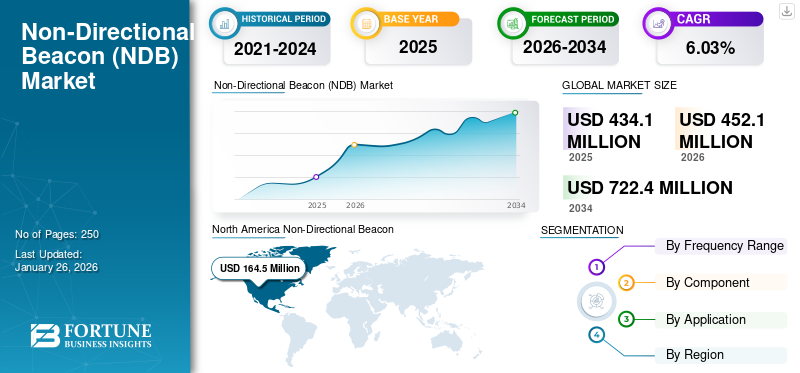
The global Non-Directional Beacon (NDB) market size was valued at USD 434.10 million in 2025 and is projected to grow from USD 452.10 million in 2026 to USD 722.40 million by 2034, exhibiting a CAGR of 6.03% during the forecast period. North America dominated the NBD market with a market share of 37.89% in 2025.
A Non-Directional Beacon (NDB) is a radio beacon that emits signals uniformly in every direction, majorly serving navigational needs in aviation and maritime settings. Functioning in the Medium Frequency (MF) and Low Frequency (LF) bands, NDBs are vital navigational tools used in regions where trustworthy alternative systems are unavailable. These are recognized by Morse code signals and play an important role in Automatic Direction Finding (ADF) systems found on aircraft.
The market for non-directional beacons is rapidly growing due to the increasing demand for efficient, reliable navigation by the aviation and maritime industries. Additionally, advancements in technology enhancing signal precision and dependability, a rise in air and sea traffic, and government efforts aimed at modernizing navigation systems, ensuring safety, and boosting operational efficiency are the key elements driving the market.
The influence of major market players in the growth of the market is essential for various reasons, including innovation in technology and the ability to adjust to changing navigation requirements. Leading companies, such as Honeywell International Inc., Nautel Ltd., and Systems Interface Ltd., are pioneering advancements in NDB systems. Moreover, firms, including Vector InfoTech, have broadened their capabilities through acquisitions, improving their product lines, and expanding their market presence. These strategic moves allow them to address customer needs and technological challenges effectively.
Download Free sample to learn more about this report.
Non-Directional Beacon (NDB) Market KEY TAKEAWAYS
 Market Size & Forecast
- 2025 Market Size: USD 434.10 million
- 2026 Market Size: USD 452.10 million
- 2034 Forecast Market Size: USD 722.40 million
- CAGR: 6.03% from 2026–2034
 Market Share
- North America dominated the Non-Directional Beacon (NDB) market with a 37.89% share in 2025.
- The segment accounted for the largest market share of 48.67% in 2026.
- The monitoring equipment segment is projected to hold a 46.24% share in 2026.
 Key Regional Highlights
North America
North America accounted for USD 164.5 million in 2025 and is projected to reach USD 171.7 million in 2026.
Europe
Europe recorded a market size of USD 120 million in 2025 and is expected to reach USD 126.4 million in 2026.
Asia Pacific
Asia Pacific was valued at USD 95.6 million in 2025 and is projected to grow to USD 98.8 million in 2026.
U.S.
U.S. The market is projected to reach USD 126.7 billion by 2026.
Japan
Japan The market is projected to reach USD 18.5 billion by 2026.
Read More

MARKET DYNAMICS
Market Drivers
Increasing Amount of Global Air Traffic Propels the Growth of the Market
The Non-Directional Beacon (NDB) market growth is driven by several key factors that influence the demand and development of the product. The increasing amount of global air traffic is a major contributor to the growth of the NDB market. With more flights taking to the skies, there is an escalating demand for dependable navigation that ensures safety and efficiency in aviation.
The installation of additional NDB systems supports both commercial and private flight operations. NDBs play a crucial role as backup navigation systems, especially in regions where satellite-based navigation may not be reliable or accessible. Their ability to provide omnidirectional signals makes them vital for maintaining navigation safety, particularly in isolated areas or during poor weather conditions. The aviation sector's strict safety regulations further highlight the necessity for strong backup systems such as NDBs.
For instance, in January 2024, the U.K.-based Systems Interface installed a new Non-Directional Beacon (NDB) at Tuzla International Airport in Bosnia and Herzegovina. Roaming Networks d.o.o gave them a comprehensive contract for the supply, installation, and commissioning. Banja Luka on behalf of the Bosnia and Herzegovina Air Navigation Service Agency (BHANSA).
Furthermore, ongoing advancements in technology are improving the precision, dependability, and efficiency of NDB systems. New developments in radio technology enhance signal strength and minimize interference, thereby increasing the effectiveness of NDBs as navigational tools.
Market Restraints
Technological Shift toward Satellite-Based Navigation Hampers Market Growth
The primary limitation of the market is the global shift toward more sophisticated, satellite-based navigation systems, such as GPS and Performance-Based Navigation (PBN). Numerous countries are opting for these modern technologies due to their enhanced accuracy, broader coverage, and greater long-term cost-effectiveness as compared to traditional ground-based navigation aids, such as NDBs. This shift limits new investments in NDB infrastructure and hampers the market's growth potential.
The swift progress in satellite technology leads to the belief that NDBs are losing relevance. This transition could lower the demand for NDB systems, as aviation stakeholders favor modern solutions that offer greater performance and dependability. Over time, satellite navigation systems deliver superior features such as enhanced accuracy, broader coverage, and improved cost-effectiveness. This competition makes it difficult for NDBs to retain their market presence since operators may opt to invest in more advanced technologies that are in line with current aviation trends.
Market Opportunities
Evolving Trends in Aviation and Maritime Navigation Provide Huge Opportunities for Market Growth
Modernization of Existing Infrastructure – Numerous countries, particularly in developing areas, continue to depend largely on NDBs for aviation navigation. This offers a considerable opportunity for manufacturers to enhance current NDB systems and improve their signal strength, dependability, and compatibility with contemporary avionics. Upgrading these systems can support the preservation or advancement of aviation navigation infrastructure without necessitating expensive shifts to satellite-based solutions.
Growing Air Traffic – The ongoing increase in global air traffic leads to a heightened necessity for dependable navigation aids. With the rise in flight operations, the requirement for NDBs as backup systems is becoming more critical, especially in areas where satellite signals might be poor or inconsistent. This need can stimulate expansion in both the establishment of new systems and the enhancement of current ones.
Increased Demand for Offshore Navigation – NDBs play a vital role in navigation within offshore settings, especially in assisting helicopter operations and crew transfers to oil rigs and platforms. With the ongoing growth of offshore exploration and production activities, the demand for dependable navigation aids such as NDBs is increasing to ensure safe operations under difficult conditions.
Market Challenges
Scarcity of Investments, Specialized Knowledge, and Funding Options Challenge Market Growth
The challenges of NDB can be categorized into technological, regulatory, and operational issues.
Technological Challenges – Numerous current NDB systems rely on outdated technology, which may not be as dependable as compared to contemporary navigation systems. Upgrading these systems to align with modern standards demands significant investment and specialized knowledge. As the aviation and maritime industries progressively embrace satellite-based navigation such as GPS, NDB operators must seek methods to combine their systems with these technologies to stay pertinent and effective.
Regulatory Challenges – NDBs are required to follow strict international regulations concerning safety and environmental effects. Dealing with these regulations can be challenging, especially as global standards change. The geopolitical issues also affect the regulatory systems in place. For example, conflicts among member nations of groups, such as the intergovernmental organization BRICS (Brazil, Russia, India, China, South Africa), can hinder teamwork and regulatory adherence for NDBs functioning in those areas.
Operational Challenges – The financial sustainability of NDB initiatives can be obstructed by the scarcity of funding options. Major stakeholders depend on external financial resources, which can be influenced by worldwide economic circumstances and investors' confidence levels. Political instability within member nations can impact the processes of decision-making and the allocation of funds for projects. For instance, issues between significant economies such as China and India create challenges for collaborative endeavors under the NDB framework.
Non-Directional Beacon (NDB) Market Trends
Advancements in Technology, Changes in Regulatory Frameworks, and Evolving Demands in the Aviation and Maritime Sectors Catalyze Market Growth
Adoption of Digital NDB Systems – Digital Non-Directional Beacon radio systems are increasingly becoming popular as they deliver superior signal processing abilities and greater reliability than conventional analog systems. Digital NDBs offer enhanced performance concerning accuracy and resistance to interference, which makes them more attractive to operators seeking dependable navigation aids.
Download Free sample to learn more about this report.
Integration with Other Navigation Aids – The combination of Non-Directional Beacons (NDBs) with other navigation technologies, including GPS and Automatic Identification Systems (AIS), is becoming more prevalent. This hybrid strategy provides enhanced functionality and redundancy, thereby improving overall navigational safety. By merging conventional NDB systems with contemporary technologies, operators can offer a more thorough navigation solution.
Focus on Modernization and Upgrades – With a large number of current NDB infrastructures becoming outdated, there is a need for attention to modernization and enhancements. This involves improving the signal strength, dependability, and efficiency of NDB systems to align with modern aviation and maritime requirements. Investments aimed at upgrading the current infrastructure are anticipated to promote market expansion as operators seek to sustain operational efficiency without completely shifting to satellite-based systems.
Sustainability and Energy Efficiency – There is a growing focus on sustainability in the market, resulting in the creation of energy-efficient NDB systems. Producers are concentrating on developing solutions that reduce environmental impact while ensuring high performance. This trend is in line with wider industry objectives aimed at lowering carbon footprints and encouraging eco-friendly practices.
SEGMENTATION ANALYSIS
By Frequency Range
Adherence to Regulatory Standards and Technological Advancements of 190 kHz to 535 kHz Propelled Segment Growth
By frequency range, the market is segmented into 190 kHz to 535 kHz, 500 kHz to 1250 kHz, and 1500 kHz to 1800 kHz.
Within the frequency range of 190 kHz to 535 kHz, the segment accounted for the largest market share of 48.67% in 2026, and is estimated to be the fastest-growing segment during the forecast period. This Non-Directional Beacon frequency range adheres to the regulatory guidelines established by entities such as the International Civil Aviation Organization (ICAO). The focus on following these guidelines stimulates the need for NDBs functioning within this range, especially in emerging regions, where the majority of NDBs are found between 190 kHz and 535 kHz.
The recent regulatory updates from the Federal Communications Commission (FCC) also aid in the modernization of NDBs operating in this frequency range, improving their efficiency and reliability. Moreover, technological advancements are enhancing the effectiveness of NDBs in this frequency spectrum. New developments in signal processing and modulation methods improve precision and minimize interference, resulting in greater reliability for both aviation and maritime uses.
The 500 kHz to 1250 kHz segment is estimated to grow at the second-fastest rate during the forecast period of 2025-2032. The increasing adoption of long range capacity frequency ranges for better coverage anticipates segmental growth.
By Component
Rising Safety Demands in Aviation and Maritime Sectors to Fuel Monitoring Equipment Segment Growth
Based on component, the market is segmented into beacon transmitter, monitoring equipment, and antenna system.
The monitoring equipment segment is projected to dominate the market with a share of 46.24% in 2026. With the aviation and maritime sectors focusing on safety, the demand for monitoring devices to verify the efficacy and functionality of NDB systems is increasing. These monitoring tools assist in identifying immediate problems, facilitating preemptive maintenance, and reducing downtime, which is essential for maintaining operational safety.
Moreover, regulatory agencies are progressively demanding the implementation of monitoring systems to verify adherence to safety standards. This is fueling the need for monitoring equipment as operators aim to satisfy regulatory obligations while improving their navigational skills.
Beacon transmitter is estimated to be the second-fastest growing segment during the forecast period. Beacon transmitters such as NDBs serve as vital components in navigational systems by providing omnidirectional signals. Their simplicity, low cost, and ability to operate continuously make them indispensable in certain scenarios that anticipate segmental growth.
By Application Analysis
To know how our report can help streamline your business, Speak to Analyst
Growing Air Traffic and Infrastructure Expansion Propelled Commercial Aviation Segment Growth
By application, the market is segmented into commercial aviation, helicopters, and offshore marines.
Within the application, the commercial aviation segment accounted for the largest Non-Directional Beacon (NDB) market share of 60.61% in 2026 and is estimated to be the fastest-growing segment during the forecast period. The global growth in air travel significantly fuels the need for a non-directional beacon aviation sector. As air travel expands, there is a requirement to install and upgrade navigational infrastructure, including NDBs, to maintain safety and efficiency in operations. With more airports being built globally to handle increasing passenger volumes, the demand for dependable navigation aids, such as NDBs, rises. New airports typically include NDB systems to guarantee safe operations from the start.
Helicopters segment is estimated to be the second-fastest growing segment during the forecast period. Helicopter operations are evolving rapidly with the integration of advanced navigation technologies such as PBN. However, NDBs maintain relevance as a cost-effective solution for navigation in remote areas and as a backup system. The growth of helicopter services driven by EMS, tourism, SAR missions, and government initiatives ensures continued demand for reliable navigation aids like NDBs alongside modern systems.
Non-Directional Beacon (NDB) Market Regional Outlook
The market is studied across various regions, including North America, Europe, Asia Pacific, and the rest of the world.
North America
North America Non-Directional Beacon (NDB) Market Size, 2025 (USD Million)
To get more information on the regional analysis of this market, Download Free sample
The North America market accounted for USD 164.5 million in 2025, representing 37.89% of the global industry, and is expected to reach USD 171.7 million in 2026. The Non-Directional Beacon market share in North America is witnessing considerable expansion as the region dominates the global market, influenced by various elements that reflect the region's distinct aviation and maritime environment. Furthermore, ongoing advancements in NDB technology improve signal precision and dependability, making them more desirable for commercial aviation applications. Innovations, including digital signal processing, are likely to propel the adoption of NDB. Additionally, the U.S. boasts a robust aviation infrastructure that necessitates reliable navigation aids. The high volume of flights and varied operational contexts boost the demand for NDB systems in the region, especially in areas where satellite navigation might prove less effective. The U.S. market is projected to reach USD 126.7 billion by 2026.
Europe
Europe is estimated to be the fastest-growing region during the forecast period. The rise in passenger and aircraft movements across Europe necessitates reliable navigation aids. Additionally, the growing number of flights increases the demand for NDB systems to ensure safe and efficient operations, particularly in areas with challenging weather conditions or limited satellite coverage. European aviation authorities maintain stringent safety regulations that require robust navigation systems. NDBs serve as essential backup systems, especially in low visibility conditions, ensuring compliance with safety standards and enhancing overall operational reliability in the region. The UK market is projected to reach USD 36.4 billion by 2026, and the Germany market is projected to reach USD 18.3 billion by 2026. Europe recorded a market size of USD 120 million in 2025, capturing 27.65% of the global market share, and is projected to reach USD 126.4 million in 2026.
Asia Pacific
The NDB market in the Asia Pacific region is anticipated to experience significant growth due to the swift development of aviation infrastructure. China and India are making substantial investments in their aviation industries with the intention of establishing new airports to meet increasing passenger demand. For instance, China plans to construct 200 new airports in the upcoming 15 years, which will greatly enhance the need for NDB systems. Government programs throughout Asia Pacific nations are encouraging the development of the market. For instance, in October 2024, India introduced initiatives aimed at boosting regional connectivity and upgrading airport facilities, which involve investments of more than USD 60 million for new airport constructions by 2035. These advancements are anticipated to cultivate a supportive environment for the implementation of NDBs. The Japan market is projected to reach USD 18.5 billion by 2026, the China market is projected to reach USD 29.9 billion by 2026, and the India market is projected to reach USD 21.7 billion by 2026. In 2025, Asia Pacific represented USD 95.6 million, accounting for 22.02% of the worldwide market, and is projected to grow to USD 98.8 million in 2026.
Rest of the World
In the rest of the world, particularly in the Middle East & Africa moderate growth is projected. Nations within the Gulf Cooperation Council (GCC), including the UAE and Saudi Arabia, are making substantial investments to reduce their reliance on oil by diversifying their economies. This effort involves a considerable focus on aviation infrastructure, which requires dependable navigation aids such as NDBs to facilitate the growth of air travel and logistics systems. The Latin American NDB market is witnessing notable growth, driven by increasing investments in aviation and maritime infrastructure. Brazil, Mexico, Argentina, and Colombia are focusing on enhancing their navigational capabilities to support rising air traffic and maritime activities. In 2025, Rest of the World held 12.44% of the global market, reaching a valuation of USD 54 million, and is projected to grow to USD 55.2 million in 2026.
Competitive Landscape
Key Industry Players
Leading Companies Focus on R&D Investments to Maintain Their Dominance
Major players in the market play a crucial role in shaping the NDB sector through their commitment to innovation, expansion into new regions, adherence to regulatory standards, and competitive tactics. Their initiatives help ensure that NDB technology continues to be relevant and effective for both the aviation and maritime industries. Ongoing investments in research and development allow these companies to stay ahead in the market, creating compact and energy-efficient NDB systems that comply with contemporary aviation requirements while tackling operational issues. A number of firms are concentrating on the maintenance and upgrade of existing NDB infrastructure instead of focusing on new installations. This change demonstrates a strategic adjustment to current market conditions, where redundancy and reliability are of utmost importance.
LIST OF KEY NON-DIRECTIONAL BEACON (NDB) COMPANIES PROFILED:
- Southern Avionics Company (U.S.)
- Thales (France)
- FLUGCOM GmbH (Germany)
- Systems Interface Limited (U.K.)
- TELERAD (France)
- Elcome Marine Services Pvt. Ltd. (India)
- Honeywell International Inc. (U.S.)
- Lambda Electronics TR CO LLC. (UAE)
- Vector InfoTech Pte Ltd. (Singapore)
- Systems Interface Ltd. (SIL) (U.K.)
KEY INDUSTRY DEVELOPMENTS
- December 2023: SIL received the contract from Roaming Networks d.o.o. Banja Luka for the Bosnia and Herzegovina Air Navigation Service Agency (BHANSA). SIL upgraded the airport's outdated equipment with a dependable Nautel Vector 250W NDB Transmitter and a 375W Antenna Tuning Unit (ATU), including comprehensive Remote Control and Monitoring to minimize worker exposure to Radio Frequency (RF) fields.
- May 2023: The Foundation, along with Air Traffic Control the Netherlands (LVNL) and the Zambia Airports Company (ZACL), collaborated to enhance flight safety in Zambia while also promoting the reuse of high-quality materials instead of disposing of them. This collaboration involved donating 12 Non-Directional Beacons (NDB) to ZACL.
- June 2022: Systems Interface announced plans to upgrade the airport’s outdated gear by installing a dependable Nautel Vector 125W NDB Transmitter along with an Antenna Tuning Unit (ATU) that includes complete Remote Control and Monitoring features, reducing worker exposure to Radio Frequency (RF) fields. Additionally, Systems Interface will manage the project overall, participate in the Flight Check, and offer thorough training for the airport's engineers.
- August 2021: NAV CANADA, which is responsible for civil air navigation services in the country, carried out an aeronautical analysis that assessed the need for Non-Directional Beacons (NDBs) and Very-High Frequency Omnidirectional Rangefinders (VORs).
- April 2020: Systems Interface (SIL) carried out construction work at the site to replace the outdated equipment with a Nautel Vector 125-Watt Solid State Dual NDB Transmitter and an Antenna Tuning Unit, which includes a SIL Self Supporting 10-meter Mast equipped with a mast lighting transformer kit. The NDB was installed alongside a Normarc Dual System 1000 Watt High Power DME. Both systems featured comprehensive remote control and monitoring capabilities to two off-site locations, and all equipment was housed in a new Equipment Shelter and designated compound area.
REPORT COVERAGE
The Non-Directional Beacon (NDB) market research report provides an in-depth market analysis. It comprises all major aspects, such as R&D capabilities, supply chain management, competitive landscape, and optimization of the manufacturing capabilities and operating services. Moreover, the report offers insights into global market trends, growth analysis, and size, as well as highlights key industry developments. In addition to the factors mentioned earlier, it mainly focuses on several factors that have contributed to the growth of the global market in recent years.
Request for Customization to gain extensive market insights.
REPORT SCOPE & SEGMENTATION
|
ATTRIBUTE |
DETAILS |
|
Study Period |
2021-2034 |
|
Base Year |
2025 |
|
Estimated Year |
2026 |
|
Forecast Period |
2026-2034 |
|
Historical Period |
2021-2024 |
|
Growth Rate |
CAGR of 6.03% from 2026 to 2034 |
|
Unit |
Value (USD Million) |
|
Segmentation |
By Frequency Range
|
|
By Component
|
|
|
By Application
|
|
|
By Region
|
Frequently Asked Questions
As per a study by Fortune Business Insights, the market size was USD 434.10 million in 2025.
The market is likely to grow at a CAGR of 6.03% over the forecast period (2026-2034).
The commercial aviation segment is expected to lead the market due to the growing tourism.
The market size in North America stood at USD 164.5 million in 2025.
An increasing amount of global air traffic fuels market growth.



- 2021-2034
- 2025
- 2021-2024
- 250
Get 30-60 hrs Free Customization
Expand Regional and Country Coverage, Segments Analysis, Company Profiles, Competitive Benchmarking, and End-user Insights.




















-
US +1 833 909 2966 ( Toll Free )
-
Get In Touch With Us