Nootropic Ingredients Market Size, Share & Industry Analysis, By Ingredient Type (Botanical & Herbal Extracts, Lipids & Fatty Acids, Amino Acids & Derivatives, Vitamins & Minerals, Probiotics, Stimulants & Natural Energy Ingredients, Choline & Cholinergic Ingredients, and Specialty Nootropic Compounds), By Source (Plant-Derived, Synthetic / Chemically Synthesized, and Others), By Form (Powder, Liquid, and Others), By Application (Dietary Supplements, Functional Beverages, Sports, Active & Gaming Nutrition, Functional Foods, and Others), and Regional Forecast, 2026-2034
 Download Free Sample
(Offer valid till 31st Aug 2026)
Nootropic Ingredients Market Size and Future Outlook
 Listen to Audio Version
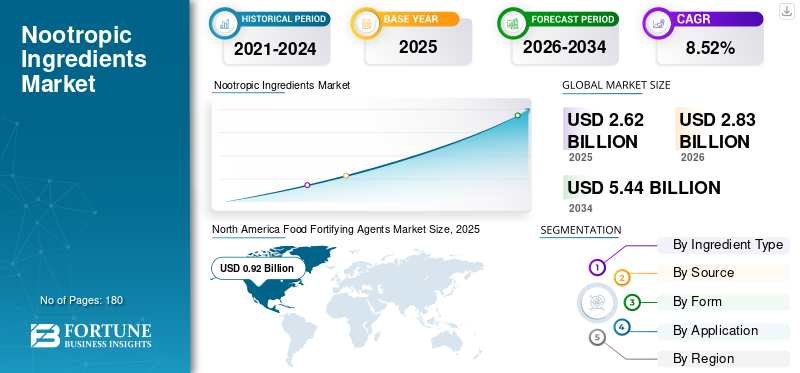
The nootropic ingredients market size was valued at USD 2.62 billion in 2025. The market is projected to grow from USD 2.83 billion in 2026 to USD 5.44 billion by 2034, exhibiting a CAGR of 8.52% during the forecast period.
The market includes plant extracts, synthetic compounds, amino acids, fatty acids, vitamins, minerals, and specialty nutrients. These ingredients support cognitive performance, focus, memory, alertness, stress, and reduce age related cognitive decline and are primarily used in dietary supplements, functional beverages and fortified foods. The market is growing rapidly as consumers are increasingly seeking non-prescription solutions for stress management, sleep-quality support, and healthy aging. Growth is further fueled by innovations in botanical extracts, adaptogen blends, omega-3 ingredients, and convenient products that are ready to use.
Companies such as dsm-firmenich, International Flavors & Fragrances Inc., Glanbia Nutritionals, Kerry Group plc and others are some key players operating in this market. New product launch and partnership is the key strategy boosting market expansion and supporting the market growth.
Download Free sample to learn more about this report.
Nootropic Ingredients Market Key Takeaways
 Global Market Size & Forecast
- 2025 Market Size: USD 2.62 billion
- 2026 Market Size: USD 2.83 billion
- 2034 Forecast Market Size: USD 5.44 billion
- CAGR: 8.52% from 2026–2034
 Market Share
- North America dominated the market with a 35.11% share, valued at USD 0.92 billion in 2025.
- Plant-derived segment held the largest market share in 2025.
- Botanical & Herbal Extracts segment held the largest market share in 2025.
 Key Regional Highlights
North America
The market reached USD 0.92 billion in 2025, driven by strong demand for dietary supplements and functional beverages.
Asia Pacific
The market reached USD 0.64 billion in 2025, supported by rising demand for cognitive wellness and healthy aging products.
Europe
The market reached USD 0.78 billion in 2025, driven by increasing demand for clean-label cognitive support products.
U.S.
The market reached USD 0.77 billion in 2025, supported by growing adoption of productivity-focused nootropic products.
Japan
The market reached USD 0.12 billion in 2025, driven by rising demand for science-backed cognitive wellness products.
Read More

NOOTROPIC INGREDIENTS MARKET TRENDS
Clean-Label Botanicals, Microencapsulation, and Hybrid Cognitive Claims Reshape Nootropic Product Development
The market is transitioning toward plant-based, multifunctional products that can be used in different formats. Consumers now prefer familiar botanicals such as ashwagandha, bacopa, lion’s mane, ginkgo, rhodiola, saffron, and green tea extracts instead of strong synthetic stimulants. Brands are also mixing nootropics with adaptogens, electrolytes, probiotics, collagen, protein, and nutrients that support sleep to offer more complete wellness products. As nootropic ingredients are added to gummies, shots, stick packs, and drinks, inclusion of advanced technology to make the final product effective is on the rise.
MARKET DYNAMICS
MARKET DRIVERS
Download Free sample to learn more about this report.
Rising Cognitive Workload and Preventive Brain-Health Priorities Increase Demand for Nootropic Ingredients
In recent years’ functional beverage and supplement brands are using nootropics to differentiate products in wellness categories. More consumers are opting for nootropic ingredients that boost cognitive performance. Such products are now a daily wellness goal for professionals, students, gamers, athletes, and older adults. Several clinical studies have also found that nootropic products prioritize on improving focus, memory, alertness, calm energy, stress response, and mental stamina. The market is growing fastest among people who prefer cognitive support without relying on stimulants or needing a prescription. Hybrid products that mix botanicals, adaptogens, amino acids, and fatty acids are also supporting nootropic ingredients market growth. These blends aim to boost both short-term productivity and brain function.
MARKET RESTRAINTS
Evidence Gaps, Regulatory Claim Limits, and Formulation Challenges Slower Market Growth
The market has to deal with issues such as mixed clinical evidence, non-uniform regulations across countries and regions, and consumer skepticism about bold “brain booster” promises. Many ingredients look promising due to traditional use or early studies, but brands still need strong evidence to back up claims about memory, focus, stress, or mental energy. Regulatory frameworks differ across the U.S., Europe, Asia Pacific, and other regions, making global product positioning difficult. Formulation is also challenging as several nootropic ingredients have bitter taste, poor solubility, odor issues, or stability concerns in beverages and gummies. These challenges lead to higher costs for testing, paperwork, and reformulation, which makes it difficult for the mainstream food and beverage companies to use such ingredients.
MARKET OPPORTUNITIES
Adaptogen Blends, Personalized Nutrition, and Beverage-Compatible Formats Create New Growth Pathways
As consumers prefer products with multiple benefits companies have the opportunity to develop new products which are different from single-ingredient capsules to products that target specific cognitive needs. Brands have the opportunity to create formulas that support focus, productivity, calm energy, exam performance, gaming stamina, sports cognition, stress management, better sleep, and healthy aging. There is a growing adoption of advanced technology such as microencapsulation, beadlets, and premix systems which makes it easier to add nootropic ingredients to gummies, shots, powders, and ready-to-drink products. Suppliers who offer ready-to-use blends, along with documentation, sensory support, and guidance for local regulations, are expected to boost their sales in the future.
Segmentation Analysis
By Source
Demand for Natural, Clean-Label, and Traditional Wellness Supports Plant-Derived Segment Dominance
The market is segmented, by source, into plant-derived, synthetic / chemically synthesized, microbial / fermentation-derived, and animal / marine-derived.
The plant-derived segment held the largest nootropic ingredients market share in 2025 and is popular as they offer what consumers looking for natural, clean-label, and traditional wellness options. Ashwagandha, bacopa, ginkgo biloba, lion’s mane, rhodiola, green tea extract, turmeric, and saffron are often used in cognitive supplements, stress-support blends, drinks, gummies, and powders. These ingredients are popular as people are familiar with them, they have a long history of use, and are seen as adaptogens. They are also more easily accepted in mainstream wellness products than synthetic options.
The synthetic / chemically synthesized holds the second-largest market share, and is expected to grow at a CAGR of 8.58% during the forecast period. They offer consistent dosages, reliable potency, and better control over formulations than most botanical extracts. Brands use ingredients such as synthetic caffeine, choline compounds, amino acid derivatives, and some B-vitamin forms to develop formulations that boost focus, alertness, mental energy, and performance.
By Ingredient Type
Growing Demand for Familiar Plant-Based Ingredients Leads to Botanical & Herbal Extracts Segment Growth
Based on ingredient type, the market is segmented into botanical & herbal extracts, lipids & fatty acids, amino acids & derivatives, vitamins & minerals, probiotics, prebiotics & postbiotics, stimulants & natural energy ingredients, choline & cholinergic ingredients, and specialty nootropic compounds.
Botanical & herbal extracts segment accounted for the largest market share in 2025. This is the leading segment as consumers prefer familiar plant-based ingredients and brands that promote clean-label brain health. These extracts also allow companies to build differentiated blends across productivity, study support, gaming, active lifestyle, and healthy aging. Such products appeal to consumers seeking better wellness stories than technical nutrients or synthetic options.
Lipids & fatty acids make up the second-largest share of the market is expected to grow at a CAGR of 8.77% during the forecast period. These are strongly linked to long-term brain-health, neuronal membrane support, and aging populations. Ingredients such as omega-3 DHA, EPA, phosphatidylserine, medium-chain triglycerides, and other specialty lipids are widely used in cognitive supplements, senior nutrition products, children’s brain-development formulations, and functional foods. These ingredients are also valued in premium nootropic blends as they complement botanicals, choline, vitamins, and amino acids.
By Application
Easy Delivery of Concentrated Ingredients that Support Cognitive Function Leads to Dietary Supplements Segment Dominance
The market is segmented, by application, into dietary supplements, functional beverages, sports, active & gaming nutrition, functional foods, infant, child & maternal nutrition, and medical / clinical nutrition.
The dietary supplements segment led the global market in 2025 as they are the most common way to deliver concentrated ingredients that support cognitive function. Brands use capsules, tablets, gummies, powders, softgels, and sachets to combine botanicals, amino acids, lipids, vitamins, minerals, caffeine, choline, and adaptogens in effective amounts. This format is especially suitable for claims around focus, memory, stress resilience, mental clarity, sleep-linked recovery, and healthy aging.
Functional beverages is another major segment that has a CAGR of 8.59% during the forecast period. They convert cognitive support into an easy, on-the-go consumption occasion. Ready-to-drink beverages, shots, powdered drink mixes, sparkling drinks, and energy beverages increasingly use ingredients such as L-theanine, caffeine, green tea extract, lion’s mane, ashwagandha, B vitamins, electrolytes, and adaptogens to position products around focus, calm energy, productivity, and support consumers opting for products that support mental health awareness. This application benefits from consumer preference for convenient formats that feel less medicinal than capsules or tablets.
By Form
To know how our report can help streamline your business, Speak to Analyst
Superior Stability, Flexible Dosing, and Broad Formulation Compatibility Drive Leadership of Powder Nootropic Ingredients
The market is segmented, by form, into powder, liquid, encapsulated/ beadlet/ microencapsulated, and others.
The powder form segment led the market in 2025. This form last longer on the shelf, blend easily, cost less to ship, and can be used in many products such as supplements, stick packs, sachets, capsules, tablets, gummies, drink mixes, and functional foods. Powders are also easier to produce in larger quantities than liquids or more complex delivery systems. They offer the optimal mix of cost savings, stability, and flexibility in making different formulas.
Encapsulated/beadlet/microencapsulated form segment accounted for the second largest market share in 2025 and are expected to register a CAGR of 9.24% during the forecast period. They solve key formulation problems that standard powders cannot fully address. Encapsulation technologies help protect active compounds, improve shelf life, mask unpleasant taste, and enable controlled or delayed release. This makes them especially useful in gummies, functional beverages, stick packs, tablets, and premium cognitive formulations.
Nootropic Ingredients Market Regional Outlook
By geography, the market is categorized into Europe, North America, Asia Pacific, South America, and the Middle East & Africa.
Asia Pacific
North America Nootropic Ingredients Market Size, 2025 (USD Billion)
To get more information on the regional analysis of this market, Download Free sample
The Asia Pacific market was valued at USD 0.64 billion in 2025. Asia Pacific is one of the fastest-growing regions for nootropic ingredients as cognitive wellness is increasingly linked with education performance, work productivity, gaming, stress management, and healthy aging. China, Japan, South Korea, India, Australia, and Southeast Asia each meet demand with their own product approaches. In China and India nootropic ingredients are majorly used in capsules, powders, gummies, and functional drinks. In contrast, Japan and South Korea prefer functional foods, beauty and wellness products, and cognitive supplements backed by science. Some of the most popular ingredients include bacopa, ashwagandha, ginkgo, green tea extract, lion’s mane, DHA, phosphatidylserine, L-theanine, caffeine, and B vitamins. Regional growth is additionally influenced by local flavor preferences, different price levels, e-commerce availability, and meeting country specific regulations.
India Nootropic Ingredients Market
The India market, in 2025, was valued around USD 0.08 billion, accounting for roughly 3.38% of global market revenues.
China Nootropic Ingredients Market
China’s market in 2025 was valued around USD 0.19 billion, representing roughly 7.14% of global market share. China’s market for nootropic ingredients is growing, with more products such as functional drinks, dietary supplements, learning aids for children, and wellness brands sold online. Urban consumers are driving demand as they look for ways to improve focus, memory, reduce eye and brain fatigue, manage stress, and boost energy.
Japan Nootropic Ingredients Market
The Japan market in 2025 reached a valuation of around USD 0.12 billion, accounting for roughly 4.40% of global market revenues.
North America
The market in North America reached a valuation of USD 0.92 billion in 2025 and is the leading region in the world. In North America, consumers are opting for nootropic ingredients to help with productivity, stress relief, active lifestyles, and healthy aging. The U.S. is leading the way in using nootropics, especially in products such as dietary supplements, functional drinks, gummies, stick packs, and blends made for performance. Some common ingredients are ashwagandha, bacopa, lion’s mane, L-theanine, caffeine, choline, phosphatidylserine, omega-3s, and B vitamins. Suppliers who offer standardized extracts, branded ingredients, clinical proof, and ready-to-use premixes have the opportunity to form partnership with major nutraceutical manufacturers in this region.
U.S. Nootropic Ingredients Market
In 2025, the U.S. market reached USD 0.77 billion. It is highly developed, driven by productivity-focused consumers, sports nutrition users, gamers, students, and aging adults seeking memory and focus support. Dietary supplements remain the core application, but functional beverages, shots, gummies, stick packs, and RTD energy-focus products are expanding quickly.
Europe
The European market reached a valuation of USD 0.78 billion in 2025. Europe’s market is shaped by strong demand for stress resilience, mental wellbeing, healthy aging, and clean-label cognitive support. Germany, the U.K., France, Italy, Spain, and the Nordic countries are important markets, but adoption is more cautious than in North America as regulatory scrutiny around cognitive and health claims is stricter. Botanical and herbal extracts such as bacopa, ashwagandha, ginkgo, rhodiola, saffron, green tea, and lion’s mane are gaining traction in supplements, powders, gummies, and functional beverages. Demand is supported by omega-3s, phosphatidylserine, magnesium, B vitamins, and choline for memory and nervous-system support.
Germany Nootropic Ingredients Market
The market in Germany in 2025 reached around USD 0.16 billion, representing roughly 6.23% of global market revenues. In Germany, consumers are opting for nootropic ingredients that helps with stress, mental wellbeing, healthy aging, and clean-label cognitive support. Products that focus on supporting the nervous system, concentration, balance, and resilience are a better fit for the consumer’s need in this region.
U.K. Nootropic Ingredients Market
The U.K. market reached approximately USD 0.13 billion in 2025, equivalent to around 3.89% of global market sales.
South America and Middle East & Africa
Over the forecast period, South America is expected to experience significant growth in this market. The South America market in 2025 recorded USD 0.17 billion. South America’s market is developing through dietary supplements, functional beverages, sports nutrition products, and stress-support formulations. Plant-derived ingredients such as guarana, yerba mate, ashwagandha, bacopa, ginkgo, green tea extract, and lion’s mane are gaining attention as they align with natural energy and cognitive wellness positioning. Middle East & Africa region reached a valuation of USD 0.12 billion in 2025 and vary widely with the Gulf countries and South Africa seeing more interest than other African regions. In the UAE and Saudi Arabia, premium nootropic supplements, functional drinks, and stress-relief products are popular. These are sold in modern stores, pharmacies, gyms, online, and are often chosen by expatriates focused on wellness. South Africa has growth potential in supplements and sports nutrition. Market growth in this region relies on halal-compliant ingredients, import approvals, strong distributor partnerships, and drinks designed for hot climates and city convenience stores.
UAE Nootropic Ingredients Market
UAE market is set to grow at a CAGR of 7.28% during the forecast period. The market focuses on premium products and the growth is driven by wellness trends among expatriates, modern pharmacies, gyms, e-commerce, and a growing interest in nutrition. Consumers are increasingly interested in stress management, calm energy, sleep-linked recovery, and mental clarity, particularly among working professionals and fitness-oriented buyers.
COMPETITIVE LANDSCAPE
Key Industry Players
Rising Demand for Cognitive Performance and Stress-Response Support Intensifies Competition Among Botanical, Nutrient, and Specialty Ingredient Suppliers
The nootropic ingredients market is fragmented with several companies competing with each other for better market share. Companies compete based on ingredient credibility, clinical proof, how well ingredients work in formulas, and how much consumers trust them. Suppliers of botanical extracts compete by offering ingredients such as ashwagandha, bacopa, ginkgo, rhodiola, lion’s mane, and green tea and they are increasing investment in research and development of advanced formulations. Major ingredient manufacturers gain advantages from using standardized extracts, meeting regulatory requirements, earning quality certifications, and having global distribution networks. Market entrants set themselves apart in the nootropics industry by offering branded ingredients, adaptogen blends, mushroom extracts, clean-label products, and ready-to-use premixes for supplements and drinks.
LIST OF NOOTROPIC INGREDIENTS COMPANIES PROFILED
- dsm-firmenich (Switzerland)
- International Flavors & Fragrances Inc. (U.S.)
- Glanbia Nutritionals (U.S.)
- Kerry Group plc (Ireland)
- Sabinsa Corporation (U.S.)
- Kyowa Hakko Bio Co., Ltd. (Japan)
- Nektium Pharma S.L. (Spain)
- Indena S.p.A. (Italy)
- Nutriventia (India)
- AIDP, Inc. (U.S.)
KEY INDUSTRY DEVELOPMENTS
- May 2026: Sepic forayed into the cognitive health ingredients market and launched Sepibright which supports healthy aging.
- October 2024: Monteloeder, S.L., a subsidiary of SUANNUTRA, announced the launch of MINDREVIVE, a botanical compound in the U.S. market. The product is specifically designed to improve short-term memory and cognitive performance in adults.
- September 2023: Nutrition21 LLC, an Everwell Health Company, launched its nootropic ingredient nooLVL into the cognitive health space. Such ingredients provide multiple cognitive benefits, including focus, concentration, improved memory, and energy.
- February 2023: PLT Health Solutions launched a new botanical ingredient in the market, which helps to improve mental performance. The product named Nutricog Cognitive Performance Complex is manufactured using a patented combination of haritaki and boswellia (Boswellia serrata).
- February 2023: Thorne HealthTech Inc. announced the acquisition of formulation partner PreCon Health Inc. for USD 5 million. The cooperation is expected to support the development of two brain health formulas, which are aimed at helping armor brains against traumatic injuries and aiding injured individuals.
REPORT COVERAGE
The global nootropic ingredients market research provides an in-depth study of market size & forecast by all the market segments included in the report. The market analysis includes details on the market dynamics and trends expected to drive the market during the forecast period. It offers information on the technological advancements, new product launches, key industry developments, and details on partnerships, mergers & acquisitions. The market forecast also encompasses detailed competitive landscape with information on the market segmentation, market share and profiles of key operating players.
Request for Customization to gain extensive market insights.
Report Scope & Segmentation
| ATTRIBUTE | DETAILS |
| Study Period | 2021-2034 |
| Base Year | 2025 |
| Estimated Year | 2026 |
| Forecast Period | 2026-2034 |
| Historical Period | 2021-2024 |
| Growth Rate | CAGR of 8.52% from 2026-2034 |
| Unit | Value (USD Billion) |
| Segmentation | By Ingredient Type, By Source, By Form, By Application and Region |
| By Ingredient Type |
|
| By Source |
|
| By Form |
|
| By Application |
|
| By Region |
|
Frequently Asked Questions
Fortune Business Insights says that the global market value stood at USD 2.62 billion in 2025 and is projected to reach USD 5.44 billion by 2034.
In 2025, the North America’s market value stood at USD 0.92 billion.
The market is expected to exhibit a CAGR of 8.52% during the forecast period.
By application, dietary supplements segment led the global market.
Rising cognitive workload and preventive brain-health priorities increase demand for nootropic ingredients.
dsm-firmenich, International Flavors & Fragrances Inc., and Glanbia Nutritionals are a few of the players in the market.
North America held the largest market share in 2025.
Clean-Label botanicals, microencapsulation, and hybrid cognitive claims reshape nootropic product development.



- 2021-2034
- 2025
- 2021-2024
- 180
-
(Offer valid till 31st Aug 2026)
Get 30-60 hrs Free Customization
Expand Regional and Country Coverage, Segments Analysis, Company Profiles, Competitive Benchmarking, and End-user Insights.


















Related Reports
-
US +1 833 909 2966 ( Toll Free )
-
Get In Touch With Us