North America Trenchless Pipe Rehabilitation Market Size, Share & Industry Analysis, By Size (Small (<36 Inch Pipe), Medium (36-60 Inch Pipe), and Large (>60 Inch Pipe)), By Application (Sewers, Storm Water, and Others), and Country Forecast, 2025-2032
 Download Free Sample
KEY MARKET INSIGHTS
 Listen to Audio Version
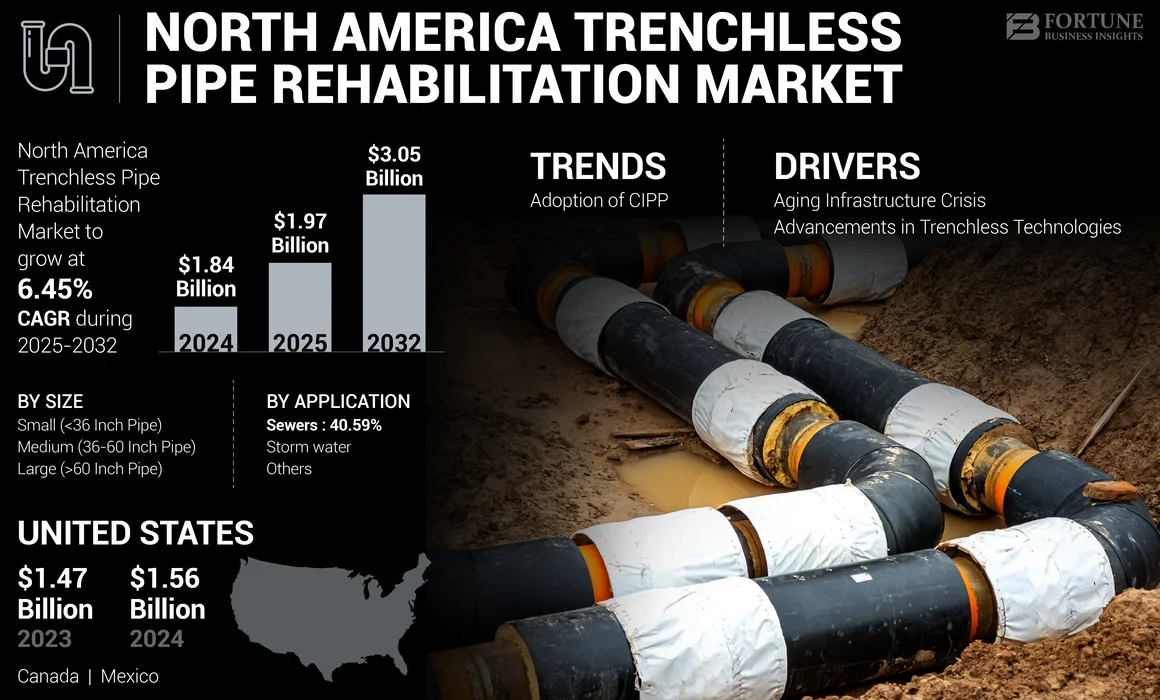
The North America trenchless pipe rehabilitation market size was valued at USD 1.84 billion in 2024. It is projected to be worth USD 1.97 billion in 2025 and reach USD 3.05 billion by 2032, exhibiting a CAGR of 6.45% during the forecast period.
Trenchless pipe rehabilitation is a method for repairing pipes without excavating large areas of land. As countries seek to reduce their reliance on traditional pipe repair methods, the demand for trenchless pipe rehabilitation methods is rising, thus driving market growth.
The combination of rapid urbanization, aging infrastructure, the cost-effectiveness of trenchless technologies, and the rising need for sustainable infrastructure solutions are driving the growth of the trenchless pipe rehabilitation market in North America.
Stantec is one of the major companies in the global trenchless pipe rehabilitation and North American market. It has successfully delivered several trenchless technology solutions for utility rehabilitation of existing infrastructure.
MARKET DYNAMICS
MARKET DRIVERS
Aging Infrastructure Crisis to Drive Market Growth
Numerous current underground pipelines, especially in advanced economies, are nearing or surpassing their planned service durations. Aging infrastructure presents considerable dangers to public health due to the risk of water supply contamination.
According to the U. S. Environmental Protection Agency (EPA), there are more than 80,000 miles of public sewers and between 23,000 to 75,000 sanitary sewer overflows annually; in drinking water, over 240,000 water main breaks occur every year, resulting in the waste of 6 billion gallons of treated water daily. As stated by the EPA (Environmental Protection Agency), USD 271 billion is needed for wastewater infrastructure over the next 25 years, and the American Water Association (AWWA) estimates that satisfying the drinking water requirements of a growing population will require at least USD 1 trillion. Thus, the aging infrastructure crisis serves as a crucial catalyst for the North America trenchless pipe rehabilitation market growth.
Advancements in Trenchless Technologies to Drive Market Growth
CIPP (Cured-in-Place Pipe) has emerged as a fundamental element of trenchless rehabilitation. This technique includes placing a resin-impregnated liner into current pipes, which is subsequently cured to create a new pipe inside the old one. Recent developments, such as UV-cured CIPP technology, enable quicker curing times and enhanced durability, making it especially efficient in urban environments where reducing disruption is essential.
The implementation of sensor technologies allows for immediate monitoring and evaluation of pipeline conditions. These intelligent solutions promote preventive maintenance, enabling utilities to tackle possible problems prior to their escalation, thereby enhancing the durability and dependability of infrastructure systems. For instance, vendors such as Vortex offer VeriCure, which is an innovative Curing Monitoring System (CMS) centered on Fiber-Optic Distributed Temperature Sensing (DTS) technology intended to enhance the CIPP curing process. Its capability to constantly oversee the temperature during the liner installation aids in verifying a more thorough cure along the entire length of the host pipe.
MARKET RESTRAINTS
Availability of Alternative Methods to Restrain Market Growth
Even with the benefits of trenchless technologies, conventional excavation methods continue to be a prevalent option for numerous municipalities. These techniques, although frequently intrusive, are well-known to contractors and those making decisions. The belief in the dependability and simplicity of open-cut methods can result in a tendency to favor these techniques, particularly when budgets permit complete replacement instead of rehabilitation.
The open-cut replacement method entails excavating the complete segment of the pipeline for substitution. While it is frequently regarded as a simple method, it is disruptive and may result in considerable downtime and restoration expenses, rendering it less appealing in comparison to trenchless alternatives.
While trenchless techniques such as Cured-In-Place Pipe (CIPP) and Spray-In-Place Polymer Lining (SIPP) provide economical options, the initial expenditure may still exceed that of conventional methods in certain instances. Local governments might choose lower initial expenses linked with traditional excavation and replacement methods, especially if they are without long-term financing or face budget limitations. This economic factor can hinder the implementation of trenchless options despite their long-term advantages. Thus, trenchless pipe rehabilitation presents numerous benefits, but the presence of alternative methods, particularly traditional excavation techniques, poses significant restraints on market growth in North America.
MARKET OPPORTUNITIES
Urbanization and Population Growth to Create Opportunity for Market Growth
Rapid urban development is resulting in a rise in the number of individuals residing in urban centers. The United Nations forecasts that by 2050, roughly 68% of the worldwide population will inhabit city environments, exerting significant stress on current infrastructure systems, especially concerning water and wastewater management. A huge part of North America's subterranean infrastructure is weakening, with numerous systems attaining or surpassing their designed operational lifespans. Trenchless technologies present a remedy that reduces disturbance while efficiently resolving these aging infrastructures.
Overloaded sewer systems, along with aged and deteriorating pipes, result in a formula for catastrophe in numerous urban locations. These elements elevate the likelihood of Sanitary Sewer Overflow (SSO) and Combined Sewer Overflow (CSO) occurrences, which pose significant risks to public health and ecological well-being. Aging pipes are also more prone to fractures and ruptures. The U.S. Environmental Protection Agency (EPA) announced USD 3.6 billion in new funding as part of the Biden-Harris Administration's Bipartisan Infrastructure Law to improve water infrastructure and ensure community safety. Along with the USD 2.6 billion disclosed earlier, this total of USD 6.2 billion in investments for fiscal year 2025 will assist communities nationwide in enhancing water infrastructure that is critical for properly managing wastewater, safeguarding local freshwater resources, and providing safe drinking water to residences, schools, and businesses.
MARKET CHALLENGES
Technical Challenges of Trenchless Pipe Rehabilitation is Hindering Market Growth
Cured-In-Place Pipe Lining (CIPP) is one of the major trenchless pipe rehabilitation methods, but it has some challenges as well, such as the release of pollutants. The CIPP method creates a new pipe inside an old one by inserting a soft, resin-soaked liner into the existing construction, filling it with air, then heating it so it toughens. It is a quicker and cheaper method than conventional pipe rehabilitation and cities are turning to cured-in-place contractors to repair their old underground lines. Hazardous air pollutants released during the heating process can enter schools and homes and nauseate the individuals inside.
For instance, in June 2023, staff and students at Merrimack Valley High School were sent back after or during the fourth period when a bad odor infiltrated classrooms and hallways all over the two-story brick building nestled along a wooded area bordering New Hampshire's capital city, Concord. Several teenagers flooded into the school health office complaining of watering eyes, headaches, sore throats, and others. Around six staff members and 40 students fell ill, and 50 were dismissed early as school officials scrambled to find the source of the smell. They soon found out that it came from a nearby sewer project that used a method called cured-in-place pipe lining.
NORTH AMERICA TRENCHLESS PIPE REHABILITATION MARKET TRENDS
Adoption of CIPP is one of the Key Trends in the market
Cured-in-place-pipe lining/Cured-in-place pipe (CIPP) is one of the most extensively utilized pipe rehabilitation methods, as it is a minimally disrupting substitute to total pipe replacement. CIPP not only reduces costs but also provides a broad diameter installation range and a wide choice of liners and resins. As installation requirements become increasingly diverse and incorporate environmental considerations, the industry is witnessing new CIPP curing methods, such as UV CIPP, emerge to provide contractors, engineers, and asset owners new options to customize a repair for a project's unique specifications.
Download Free sample to learn more about this report.
IMPACT OF COVID-19
The COVID-19 pandemic led to equipment shortages and logistical issues, impacting the availability of necessary materials and technologies for trenchless rehabilitation. Labor shortages became a notable problem during the pandemic, as numerous workers were unable to engage in projects DUE TO health fears or limitations. This additionally created difficulties in completing projects and impacted productivity in the sector. The U. S. Department of Homeland Security also indicated that infrastructure is an essential business with significant importance. The upkeep of infrastructure, including utility pipelines, was vital during the COVID-19 period.
SEGMENTATION ANALYSIS
By Size
Large (> 60-inch pipe) dominates the market owing to the large number of projects across the U.S.
The market is segmented into small (<36 inch pipe), medium (36-60 inch pipe), and large (>60 inch pipe) based on size.
The large (> 60-inch pipe) segment dominates in terms of market share due to rising projects for large pipes across the U.S. Many municipalities face challenges with aging water and wastewater infrastructure, particularly in urban areas where large-diameter pipes are crucial for handling high volumes of water and sewage. The need to rehabilitate these critical assets drives demand for trenchless solutions that can efficiently restore functionality with minimal disruption.
The medium (36-60 inch pipe) segment is also one of the major segments in the U.S. trenchless pipe rehabilitation market. For instance, in July 2023, with the help of Federal grant funds, the city of Okeechobee took a project to line 3100 feet of 36-to-48-inch stormwater drain line under Southeast and Southwest 4th Street. The project is being done to rehabilitate the 50 to 60-year-old pipe using a cured-in-place pipe lining (CIPP) method. The pipe being lined is the backbone of the stormwater system in the SE and SW sections of the city.
By Application
To know how our report can help streamline your business, Speak to Analyst
Continuous Exposure to Waste Water Leads to a Risk of Wear and Tear Attributes to Sewer Segment Growth
The market is divided by application into sewers, stormwater, and others.
Among these, the sewer segment dominated the market and held the largest North America trenchless pipe rehabilitation market share. Many sewer systems in the U.S. are old that are generally repaired more often than water mains as they are exposed to a more destructive environment, such as waste, which can lead to corrosion, clogs, and damage more easily. In contrast, water mains carry clean water, leading to less frequent problems and a longer life.
The storm water is also an important application in the market. As municipalities increasingly recognize the importance of effective stormwater management, this segment is poised for continued expansion in the coming years.
NORTH AMERICA TRENCHLESS PIPE REHABILITATION COUNTRY OUTLOOK
The market has been studied across the U.S., Canada, and Mexico.
U.S. is one of the Key Market Due to Factors such as Ageing Water Pipeline Infrastructure
The U.S. is the dominating country in the North American trenchless pipe rehabilitation market. The trenchless pipe rehabilitation market in the U. S. is experiencing considerable progress and expansion fueled by aging pipeline infrastructure, along with the rising need for sustainable pipe repairing methods. Trenchless pipe rehabilitation is a sustainable solution as there is no need for digging, which saves resources and time. It is also ideal for urbanized nations such as the U.S.
Canada and Mexico
Canada is one of the emerging markets in North America. Mexico is lagging in adopting the trenchless rehabilitation method. This might be due to a lack of literacy regarding the trenchless pipe rehabilitation method.
COMPETITIVE LANDSCAPE
KEY INDUSTRY PLAYERS
Stantec, Jacob, and Vortex Companies, among others, are some of the major firms in the market. Stantec is one of the leading companies in the market and has successfully delivered thousands of trenchless technology solutions for existing infrastructure rehabilitation. Stantec brings the appropriate trenchless technology to develop an advanced solution. The company has expertise in numerous methods/processes such as cured-in-place pipe, pipe bursting, pipe jacking, slip lining, and others.
List of Key Trenchless Pipe Rehabilitation Companies in North America:
- HK Solutions Group (U.S.)
- Azuria Water Solutions (U.S.)
- SAK Construction (U.S.)
- Waterline Renewal Technologies (U.S.)
- NuFlow Technologies (U.S.)
- SEKISUI SPR Americas, LLC (U.S.)
- Stantec (Canada)
- Vortex Companies (U.S.)
- Internal Pipe Technologies (U.S.)
- Spiniello Companies (U.S.)
- Michels Corporation (U.S.)
- HydraTech, LLC (U.S.)
- Flow Technologies Inc (U.S.)
- J. Fletcher Creamer & Son, Inc (U.S.)
- Jacobs Solutions Inc (U.S.)
- Frenzelit Inc. (U.S.)
- Hammerhead Trenchless Equipment (U.S.)
- U.S. Pipelining, LLC. (U.S.)
- Clean Water Works Inc. (Canada)
- Lafontaine Inc. (Canada)
KEY INDUSTRY DEVELOPMENTS
- In May 2024, Vortex Companies announced UNITED FELTS as the outcome of acquiring Applied Felts Inc., FerraTex Solutions, and MaxLiner. UNITED FELTS represents the ongoing legacy of a prominent provider of Cured-In-Place Pipe (CIPP) throughout America, indicating a fresh approach to trenchless infrastructure solutions.
- In March 2024, Nu Flow South Pacific will provide its advanced trenchless pipe lining service, utilizing the latest Nu Flow technology across the Hawaiian Islands. This groundbreaking solution transforms conventional pipe repair, tackling common challenges encountered by property owners while delivering a range of unparalleled advantages. Nu Flow's trenchless pipe lining approach is a non-destructive, environmentally friendly method that revitalizes existing pipes without the need for excavation.
- In January 2024, Vortex Companies acquired Applied Felts Ltd., a company located in the U.K. that assists clients beyond America. The purpose of the acquisition is to deliver a comprehensive range of trenchless rehabilitation solutions. The purchase of Applied Felts Inc., which includes top brands MaxLiner and FerraTex Solutions, signifies a significant step for Vortex Companies. This collaborative effort enables Vortex to provide a comprehensive, direct solution to the market in an all-in-one location.
- In July 2023, Stantec was selected by the Region of Peel to deliver the design of the Queensway East-Cawthra Trunk Sewer and upgrades to the Pressure Zone 2 Water System in Mississauga City, Ontario, Canada. Stantec will provide professional engineering services and construction management for the project, which is designed to ensure that the local community is well-served for decades to come. Tunneled sewers are expected to provide additional capacity for the growing community in the next 20 years.
- In December 2020, The Vortex Companies LLC declared its purchase of North American Pipeline Services LLC (NAP). This agreement will greatly enhance its trenchless infrastructure service capabilities in the Mid-Atlantic Region. The finalization of this acquisition is an important advancement toward a vision of offering trenchless services in this area where the demand for infrastructure rehabilitation has never been more significant.
INVESTMENT ANALYSIS AND OPPORTUNITIES
According to the U.S. Environmental Protection Agency, the U.S. has not adequately invested in water infrastructure. Lack of water infrastructure is a danger to America's security, and it risks people's health, peace of mind, jobs, and others. The Bipartisan Infrastructure Law delivers USD 50 billion to EPA to enhance the nation's stormwater, wastewater, and drinking water infrastructure. This investment is the single largest investment in water that the federal government has ever made.
REPORT COVERAGE
The North America trenchless pipe rehabilitation market report delivers a detailed insight into the market. It focuses on key aspects, such as leading companies and their operations in providing services related to trenchless pipe rehabilitation. Besides, the report offers insights into market trends and technology and highlights key industry developments. In addition to the factors above, the report encompasses several factors and challenges that contributed to the growth of the market in recent years.
Request for Customization to gain extensive market insights.
Report Scope & Segmentation
|
ATTRIBUTE |
DETAILS |
|
Study Period |
2019-2032 |
|
Base Year |
2024 |
|
Estimated Year |
2025 |
|
Forecast Period |
2025-2032 |
|
Historical Period |
2019-2023 |
|
Growth Rate |
CAGR of 6.45% from 2025 to 2032 |
|
Unit |
Value (USD Billion) |
|
Segmentation |
By Size
|
|
By Application
|
|
|
By Country
|
Frequently Asked Questions
As per the Fortune Business Insights study, the market size was USD 1.84 billion in 2024.
The market is likely to grow at a CAGR of 6.45% over the forecast period (2025-2032).
Sewer application segment is expected to lead the market in the forecast period.
The market size of the U.S. stood at USD 1.56 billion in 2024.
The aging infrastructure crisis is a key factor driving the market growth.
Some of the top players in the market are Jacob, Stantec, Vortex Companies, and others.
The North American market size is expected to reach USD 3.05 billion by 2032.



- 2019-2032
- 2024
- 2019-2023
- 140
Get 30-60 hrs Free Customization
Expand Regional and Country Coverage, Segments Analysis, Company Profiles, Competitive Benchmarking, and End-user Insights.



















-
US +1 833 909 2966 ( Toll Free )
-
Get In Touch With Us