 Download Free Sample



Get a Quote
Receive a tailored pricing based on your needs.
- Choose license type
- Multiple user options
- Custom scope & coverage
- Fast turnaround
"Designing Growth Strategies is in our DNA"
 Listen to Audio Version
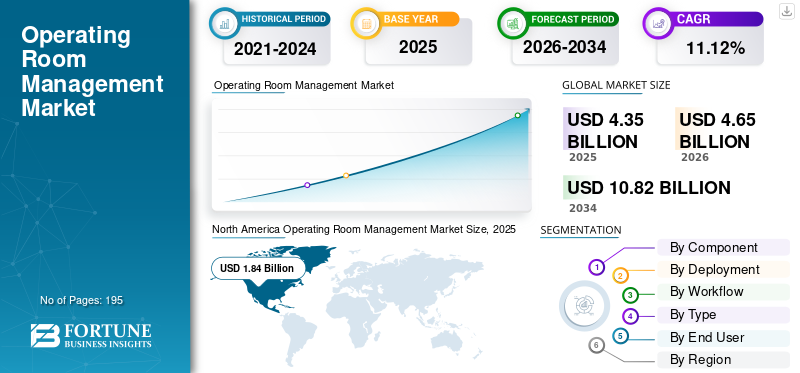
The global operating room management market size was valued at USD 4.35 billion in 2025 and is projected to grow from USD 4.65 billion in 2026 to USD 10.82 billion by 2034, exhibiting a CAGR of 11.12% during the forecast period. North America dominated the global operating room management market with a market share of 42.3% in 2025.
Operating Room (OR) management refers to the planning, coordination, and day-to-day control needed to run surgical operating rooms efficiently, safely, and on schedule. This market is witnessing strong growth owing to more predictable schedules, fewer cancellations/delays, better patient outcomes, and higher OR utilization, along with other factors.
The market comprises various key industry players, such as Oracle, Epic Systems Corporation, and Surgical Information Systems. These companies are focusing on innovative product offerings to maintain their market presence.
Download Free sample to learn more about this report.
 Market Size & Forecast
 Market Share
 Key Regional Highlights
North America
The region led the market in 2025, driven by advanced operating room technologies and rising surgical volumes.
Europe
Europe is expected to grow due to healthcare digitization, hospital infrastructure investments, and demand for workflow management solutions.
Asia Pacific
Asia Pacific is expected to grow strongly, driven by healthcare infrastructure expansion, rising surgical procedures.
U.S.
Demand for workflow optimization, operating room efficiency, and advanced surgical management platforms is driving market growth.
Japan
Healthcare digitalization, rising surgical volumes, and efforts to improve operating room efficiency are supporting market growth.
Read More

Shift Toward Cloud and Hybrid Deployment is a Prominent Trend Observed in the Market
The shift toward cloud and hybrid deployment is a prominent market trend in the OR management market. This trend can be attributed to increasing demand from hospitals for faster rollouts, easier multi-site scaling, and remote-access analytics without fully replacing mission-critical on-premise perioperative systems. Owing to this, many providers are adopting a hybrid model, retaining core perioperative/EHR workflows on-premise while moving optimization, coordination, and analytics layers to the cloud to improve agility and operational resilience. This approach also supports continuous updates, easier integration via APIs, and quicker onboarding of new facilities or surgery centers. At the same time, cloud deployments help operational leaders access real-time dashboards from anywhere and standardize workflows across networks, critical when staffing and OR capacity are tight, thereby supporting the overall global operating room management market growth.
Download Free sample to learn more about this report.
Increasing Need to Improve Operating Room Efficiency KPIs is Propelling Market Growth
The increasing need to improve operating room efficiency KPIs, especially first-case on-time starts, room turnover time, block utilization, and instrument turnaround, is a key driver of the global operating room management market growth. Even modest performance improvement can results into more surgical capacity, fewer cancellations, and better margin protection. As a result, hospitals are increasingly treating the OR as a controlled production system, prompting investment in OR management tools that standardize governance, reduce day-of delays, and give teams real-time visibility into bottlenecks. Thus, all these factors are driving the demand for operating room management solutions.
High Upfront Implementation Costs to Hamper Market Growth
High upfront implementation costs are a major market restraint on the growth of the operating room management market. Hospitals often require investment in workflow redesign, interface development, data migration, training, and go-live support, all of which add substantial investment costs. These costs are especially burdensome for multi-site health systems, where standardizing perioperative processes across facilities increases consulting and change-management intensity. Capital constraints can delay procurement decisions, push providers toward phased deployments, or limit adoption to only the highest-ROI modules. Additionally, high upfront costs also raise the risk of longer payback periods if surgical volumes fluctuate or staffing shortages prevent full utilization gains.
Rising Adoption of AI/analytics for Capacity and Block-Time Optimization to Offer Market Growth Opportunities
Rising adoption of AI and advanced analytics for OR capacity, case-duration prediction, and block-time optimization represents a major market opportunity. Hospitals and ASCs are under pressure to create capacity without adding ORs or staff, through data-driven optimization. AI models can forecast case durations, late starts, turnover delays, and underutilized blocks, enabling perioperative leaders to proactively reallocate time, smooth schedules, and reduce cancellations. This evolution expands the value proposition of QR management solutions from basic scheduling to prescriptive recommendations, which increases willingness to pay and drives upsell of optimization modules. It also opens opportunities for vendors to introduce AI teammates/automation that coordinate tasks across pre-op readiness, intra-day OR adjustments, and post-op flow.
Data Security and Patient Privacy Concerns Pose a Critical Challenge to Market Growth
Data security and patient privacy concerns remain a significant challenge in this operating room management market, as these systems handle sensitive patient and procedural data. As hospitals move toward cloud/hybrid models and multi-site data flows, they must meet strict privacy and security requirements, which can slow procurement, lengthen vendor due diligence, and increase total cost. In addition, there is also a risk of ransomware on healthcare IT systems affecting operating systems and patient safety risks, including cancellations.
Rising Number of Deployments to Propel Segmental Growth
Based on component, the market is divided into software and services.
The software segment is expected to hold the largest global operating room management market share. The dominance can be attributed to the increasing number of deployments, rising licensing and subscription revenues, and technological advancements in the products. Moreover, new product launches by operating players are also aimed at propelling the segmental revenue generation.
The services segment is anticipated to rise with a CAGR of 9.39% over the forecast period.
To know how our report can help streamline your business, Speak to Analyst
High Demand from Hospitals & ASCs Boosted On-premise Segment Growth
On the basis of deployment, the market is divided into on-premise, cloud-based, and hybrid.
The on-premise segment dominated the global market in 2025. Key factors supporting the dominance of the segment include high demand from hospitals & ASCs, advantages offered by these solutions such as very high uptime, low latency, and deterministic performance, and others. The segment is set to hold 57.3% share in 2026.
The cloud-based segment is anticipated to rise with a CAGR of 13.67% over the forecast period.
Intra-Operative Segment Dominated due to its Ability to Support Patient Safety
On the basis of workflow, the market is divided into pre-operative, intra-operative, and post-operative.
The intra-operative segment captured the highest share of the global market in 2025. The dominance of this segment is mainly driven by the fact that intra-op is the most time-critical and compliance-intensive phase, requiring real-time coordination between surgeons, anesthesia, and nursing teams. Hospitals prioritize intra-op solutions as they directly support patient safety protocols, anesthesia and nursing documentation, device data capture, medication/implant usage capture, and immediate visibility into case progress, all of which are essential for clinical governance and billing completeness. In addition, intra-op systems are deeply embedded into core perioperative platforms and interoperable device ecosystems, creating high switching costs and strong recurring software demand. Furthermore, the segment is set to hold 45.8% share in 2026.
The pre-operative segment is anticipated to rise with a CAGR of 12.21% over the forecast period.
Increasing Focus on Measurable ROI to Propel Performance Management Segment Growth
Based on type, the market is divided into anesthesia information management, data management & communication, operating room scheduling management, operating room supply management, performance management, and others.
The performance management segment is expected to account for the largest global operating room management market share. The dominance is driven by increasing focus of hospitals on measurable ROI, improvement in utilization, on-time starts, turnover time, cancellations, and staffing productivity. Furthermore, the segment is set to hold 27.2% share in 2026.
The operating room scheduling management segment is anticipated to rise with a CAGR of 12.58% over the forecast period.
Hospitals & ASCs Segment Dominated due to Higher Surgical Procedures Volumes
Based on end user, the market is segmented into hospitals & ASCs, specialty surgical centers, and others.
The hospitals & ASCs segment captured the dominating position in the global market. These settings have the highest number of operating rooms, surgical procedure volumes, and perioperative complexity, which results in higher demand for operating room management solutions by them. Additionally, their larger scale also results in enterprise-wide deployments across multiple rooms and sites, increasing adoption rates and contract sizes compared to others. Furthermore, the segment is set to hold 83.5% share in 2026.
The specialty surgical centers segment is projected to grow at a CAGR of 14.97% during the study period.
By geography, the market is categorized into North America, Europe, Asia Pacific, Latin America, and the Middle East & Africa.
North America Operating Room Management Market Size, 2025 (USD Billion)
To get more information on the regional analysis of this market, Download Free sample
North America captured the dominating position in 2024, with a revenue generation of USD 1.73 billion, and also maintained its dominance in 2025, with USD 1.84 billion. The regional dominance is supported by the region’s advanced healthcare infrastructure and high adoption of digital health solutions in the region. In particular, the U.S. benefits from well-equipped hospitals and developed infrastructure for integration of these solutions, which supports the country’s market growth.
The U.S. market captured the highest share of the North American market and is expected to reach approximately around USD 1.81 billion in 2026, representing around 39.0% of the global market.
Europe is projected to witness a CAGR of 10.77% in the coming years. The region is anticipated to become the second-highest among all regions. The region would reach a valuation of USD 1.24 billion by 2026. The market growth is driven by increasing hospital modernization initiatives and a rising number of government healthcare investments.
The U.K. operating room management market in 2026 is estimated at around USD 0.28 billion, representing roughly 6.0% of global revenues.
Germany’s operating room management market is projected to reach approximately USD 0.25 billion in 2026, equivalent to around 5.5% of global sales.
The Asia Pacific region is projected to be valued at USD 1.09 billion in 2026 and secure the position of the third-largest region in the global operating room management industry. Expanding hospital networks and increasing healthcare expenditure have majorly driven market growth.
The Japan operating room management market in 2026 is estimated at around USD 0.33 billion, accounting for roughly 7.0% of global revenues.
China’s operating room management market is projected to reach revenues of around USD 0.20 billion in 2026, representing roughly 4.3% of global sales.
The India operating room management market in 2026 is estimated at around USD 0.19 billion, accounting for roughly 4.2% of global revenues.
The Latin America and Middle East & Africa regions would witness a slower growth rate in this market. The Latin America market is set to reach a valuation of USD 0.21 billion in 2026. Increasing healthcare IT investments in the region, especially in Gulf countries, coupled with rising initiatives for digital health infrastructure, is driving market growth.
The operating room management market in Saudi Arabia is projected to reach around USD 0.05 billion in 2026, representing roughly 1.5% of global revenues.
Growing Strategic Initiatives by Leading Companies to Strengthen Their Market Position
The global market for operating room management is semi-consolidated in structure. Leading companies such as Oracle, Epic Systems Corporation, and Surgical Information Systems account for the dominating shares in the global market. These players are adopting various strategic initiatives such as new product launches, partnerships & collaborations, and others to maintain their market positions.
Other key players in the operating room management market include LeanTaas, Getinge AB, and others. During the forecast period, these companies are focusing on offering innovative solutions and collaborations with end users to gain market share.
Request for Customization to gain extensive market insights.
| ATTRIBUTE | DETAILS |
| Study Period | 2019-2034 |
| Base Year | 2025 |
| Estimated Year | 2026 |
| Forecast Period | 2026-2034 |
| Historical Period | 2019-2024 |
| Growth Rate | CAGR of 11.12% from 2026-2034 |
| Unit | Value (USD Billion) |
| Segmentation |
By Component
By Deployment
By Workflow
By Type
By End User
By Region
|
According to Fortune Business Insights, the global market value stood at USD 4.35 billion in 2025 and is projected to reach USD 10.82 billion by 2034.
In 2025, the market value stood at USD 1.84 billion.
The market is expected to exhibit a CAGR of 11.12% during the forecast period (2026-2034).
By component, the software segment is expected to lead the market.
The shift toward cloud and hybrid deployment is the key factor driving the market.
Oracle, Surgical Information Systems, and Epic Systems Corporation are the major players in the global market.
North America dominated the market in 2025.

Get 30-60 hrs Free Customization
Expand Regional and Country Coverage, Segments Analysis, Company Profiles, Competitive Benchmarking, and End-user Insights.













.webp)






Get In Touch With Us
US +1 833 909 2966 ( Toll Free )
Receive a tailored pricing based on your needs.
Discuss your questions with our industry experts.
Have questions? Get quick answers before you purchase.

