Food Bleaching Agents Market Size, Share & Industry Analysis, By Product Type (Benzoyl Peroxide, Hydrogen Peroxide, Chlorine Dioxide, Azodicarbonamide, and Others), By Form (Powder and Liquid), By Application (Flour Processing, Bakery Products, Sugar & Sweetener Processing, Oils & Fats Processing, and Others), and Regional Forecast, 2026-2034
 Download Free Sample
(Offer valid till 30th Sep 2026)

Food Bleaching Agents Market Overview
 Listen to Audio Version
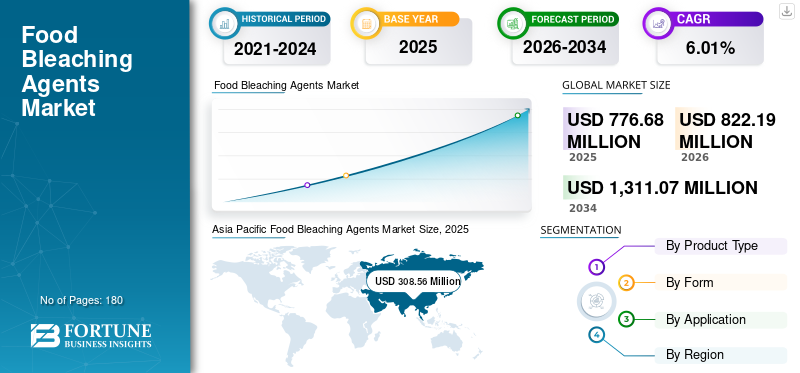
The global food bleaching agents market size was valued at USD 776.68 million in 2025. The market is projected to grow from USD 822.19 million in 2026 to USD 1,311.07 million by 2034, exhibiting a CAGR of 6.01% during the forecast period. Asia Pacific dominated the food bleaching agents market with a market share of 39.73% in 2025.
Food bleaching agents are food-grade additives used to standardize, lighten, or whiten the color of food components. They majorly function through oxidation by breaking down natural pigments such as color-forming compounds and carotenoids. These substances are commonly utilized in oils, flour, processed foods, and whey. Common agents include hydrogen peroxide, benzoyl peroxide, chlorine dioxide, and calcium peroxide. Among regional consumers, North America and the Asia Pacific are the largest consumers of bleaching agents, mainly due to the flourishing bakery sector and increased use in industrial applications.
Companies such as Evonik Industries AG, Solvay S.A., and Arkema Group are prominent players in the market. New product offerings are a pivotal strategy adopted by key players to improve their position.
Download Free sample to learn more about this report.
Food Bleaching Agents Market Key Takeaways
 Global Market Size & Forecast
- 2025 Market Size: USD 776.68 million
- 2026 Market Size: USD 822.19 million
- 2034 Forecast Market Size: USD 1,311.07 million
- CAGR: 6.01% from 2026–2034
 Market Share
- Asia Pacific dominated the food bleaching agents market with a 39.73% share in 2025.
- The hydrogen peroxide segment is projected to grow at a CAGR of 7.86% over the forecast period.
- The liquid segment is projected to grow at a CAGR of 7.00% over the forecast period.
 Key Regional Highlights
Asia Pacific
Asia Pacific led the market with a valuation of USD 308.56 million in 2025, driven by rising adoption of food-grade bleaching agents.
North America
North America ranked second with a market valuation of USD 186.16 million in 2025, supported by growing flour treatment and food processing demand.
Europe
Europe ranked third at USD 132.49 million in 2025 and is projected to grow at a CAGR of 4.93%.
U.S.
The market was valued at USD 134.43 million in 2025, accounting for approximately 17.31% of global sales.
Japan
The market was valued at USD 34.29 million in 2025, representing approximately 4.42% of global revenues.
Read More

FOOD BLEACHING AGENTS MARKET TRENDS
Increasing Demand for Non-Halogenated Bleaching Agents is a Prominent Trend
The global market is witnessing a remarkable shift toward non-halogenated agents. Food processors are gradually minimizing their reliance on chlorine-based systems owing to residue concerns and regulatory pressure. This scenario is driving the adoption of peroxide-based substitutes, such as hydrogen peroxide/calcium peroxide, in bakery and flour applications. These components, when added, enhance the final product’s color while providing additional advantages such as controlled oxidation and dough conditioning. Moreover, it minimizes the risk of undesirable chemical by-products and is compatible with modern food safety standards. Additionally, it has minimal impact on odor and taste and can be easily integrated with advanced processing systems. As a result, such advantages escalate the use of non-halogenated bleaching agents in the food sector.
Download Free sample to learn more about this report.
MARKET DYNAMICS
MARKET DRIVERS
Expansion of the Packaged Food Products Sector Bolsters Use of Bleaching Agents
The flourishing packaged food products industry is a major driver fueling the use of bleaching agents. Processed and packaged sauces, bakery items, and convenience snacks need standardized raw components to assure texture and uniform color across batches. To address this, producers are opting for bleaching agents that lower the natural color differences in starches and flour. This allows producers to attain uniform texture and color in end products. Moreover, appropriate color is important as most consumers assess a product by freshness and appearance. In large-scale manufacturing, even a minimal color difference can negatively hamper consumer acceptance and brand consistency. Thus, seeing such benefits, firms are trying to launch new bleaching agents specifically for food products.
MARKET RESTRAINTS
Limited Adoption of Bleaching Agents in Organic Food Impedes Market’s Potential
One of the key obstacles in the market is the restricted acceptance of bleaching agents in natural food items. In organic food production, manufacturers avoid the use of bleaching agents as these products rely heavily on minimal processing and clean-label positioning. The majority of individuals purchase organic baked goods and flour since they perceive them as free of artificial additives or chemical treatments. The utilization of food bleaching components can raise concerns about the product’s naturalness, even when the agent is approved for use in production. Moreover, companies eliminate their use to improve retailer acceptance and maintain organic certification. As a result, the above-mentioned factors can hinder the global food bleaching agents market share.
MARKET OPPORTUNITIES
Utilization of Advanced Technologies in Bleaching Agents Sector Creates Growth Chances
The integration of modern technologies in the bleaching agents industry opens growth opportunities. To minimize the risk of over-treatment, producers are using advanced dosing systems. This controlled dosing also enhances color without hampering the end product’s quality. Encapsulation technologies are another method gaining popularity globally, as they help preserve agents from premature decomposition, heat, and moisture. Moreover, manufacturers are exploring residue-reduction technologies which assure that bleaching components are decomposed/neutralized after processing. In addition, controlled oxidation technologies are being utilized to enhance the appearance of food ingredients and flour, without substantially hampering nutritional quality or taste.
Segmentation Analysis
By Product Type
Benzoyl Peroxide Segment Dominated Market Due to Improved Suitability for Flour Bleaching
Based on product type, the market is distributed into benzoyl peroxide, hydrogen peroxide, chlorine dioxide, azodicarbonamide, and others.
The benzoyl peroxide segment dominated the market in 2025. Benzoyl peroxide provides a strong benefit in flour bleaching as it is widely adopted to lower natural yellowish tones in flour. In comparison with chlorine based agents and hydrogen peroxide, it is directly linked to dry flour treatment. Moreover, it enhances dispersion in flour and helps producers attain uniform bleaching across the batch. Additionally, this agent is effective even at low application levels, further propelling the segment’s growth.
The hydrogen peroxide segment is projected to grow at a high CAGR of 7.86% over the forecast period.
By Form
Powder Segment Dominated Market Owing to Prolonged Shelf Life
Depending on form, the market is distributed into powder and liquid.
In 2025, the powder segment led the global market. Compared with liquid agents, powdered components are easy to incorporate into dry ingredient blends and bakery premixes, making them ideal for baking applications. The powdered form has a longer shelf life than liquid systems, which supports transportation and bulk handling. Moreover, it offers controlled dosing in dry food and flour production, further enhancing processing consistency. As a result, these factors boost the global food bleaching agents market growth.
The liquid segment is projected to grow at a high CAGR of 7.00% over the forecast period.
By Application
To know how our report can help streamline your business, Speak to Analyst
Flour Processing Segment Dominated Market Owing to High Industrial-Scale Consumption
Based on application, the market is distributed into flour processing, bakery products, sugar & sweetener processing, oils & fats processing, and others.
Flour processing segment led the global market in 2025. Compared with baked goods and sweeteners, bleaching agents are widely used in flour to enhance whiteness and improve flour maturation. Ingredient processors and flour mills adopt these agents in bulk quantities in higher levels than in beverage and dairy applications. Moreover, better processing efficiency and improved compatibility with large-scale automated production further strengthen the segment’s momentum.
The bakery products segment is projected to grow at a high CAGR of 7.98% over the forecast period.
Food Bleaching Agents Market Regional Outlook
By geography, the market is categorized into Europe, North America, Asia Pacific, South America, and the Middle East & Africa.
Asia Pacific
Asia Pacific Food Bleaching Agents Market Size, 2025 (USD Million)
To get more information on the regional analysis of this market, Download Free sample
Asia Pacific dominated and reached a valuation of USD 308.56 million in 2025. The rising inclination toward food grade bleaching agents and the adoption of advanced technology are propelling regional growth.
India Food Bleaching Agents Market
The Indian market was valued at USD 76.94 million in 2025, accounting for roughly 9.91% of the global market revenues.
China Food Bleaching Agents Market
China's market is projected to be one of the largest globally, with revenues valued at USD 119.44 million in 2025, accounting for roughly 15.38% of the global market sales.
Japan Food Bleaching Agents Market
The Japanese market was valued at USD 34.29 million in 2025, accounting for approximately 4.42% of the global market revenues.
North America
The North America’s market reached a valuation of USD 186.16 million in 2025 and ranked second. The market in North America is expected to grow due to the rising demand for bleaching agents in flour treatment and the expanding food processing industry.
U.S. Food Bleaching Agents Market:
Based on North America's strong contribution and the U.S. dominance within the region, the U.S. market was valued at USD 134.43 million in 2025, accounting for roughly 17.31% of global sales.
Europe
Europe reached a valuation of USD 132.49 million in 2025, with a growth rate of 4.93% during the forecast period, and secured the third position. The surging inclination toward cost effective agents and a high focus on food safety are responsible for market expansion.
Germany Food Bleaching Agents Market
The German market was valued at USD 31.94 million in 2025, representing roughly 4.11% of the global market revenues.
U.K. Food Bleaching Agents Market
The U.K. market reached a valuation of USD 21.16 million in 2025, equivalent to around 2.72% of the global market sales.
South America, the Middle East, and Africa
The South America and Middle East & Africa regions are expected to witness moderate growth in this market during the forecast period. The South America market reached a valuation of USD 84.85 million in 2025. The robust supply chain network and improved use of ascorbic acid to enhance end product quality are expected to drive demand. The Middle East and Africa market reached USD 64.62 million in 2025.
South Africa Food Bleaching Agents Market
The South African market reached a valuation of USD 20.62 million in 2025, representing roughly 2.66% of global revenues.
COMPETITIVE LANDSCAPE
Key Industry Players
Key Players are Entering into Partnerships and Expanding their Business Units to Strengthen their Market Share
The food bleaching agents market is moderately consolidated, majorly driven by local specialty suppliers and prominent chemical producers. Companies such as Evonik Industries AG, Solvay S.A., and Arkema Group are competing in the market and are focusing on introducing reformulated product portfolios, specifically low-residue formulations. Moreover, the players are entering into partnerships with dominant firms and expanding their business units to improve their market position.
LIST OF KEY FOOD BLEACHING AGENTS COMPANIES PROFILED IN REPORT
- Evonik Industries AG (Germany)
- Solvay S.A. (Belgium)
- Spectrum Chemical Mfg. Corp. (U.S.)
- Arkema Group (France)
- Nouryon (Netherlands)
- Muby Chemicals (India)
- REPCO (U.S.)
- P D Navkar Bio-Chem Pvt. Ltd. (India)
- Taekwang Industrial Co., Ltd. (South Korea)
- Graham Chemical Corporation (U.S.)
KEY INDUSTRY DEVELOPMENTS
- January 2025: Evonik Industries AG, a chemicals enterprise in Germany, collaborated with Fuhua Tongda Chemicals Company, a Chinese agrochemical firm, to build a joint venture to market and produce hydrogen peroxide. This product is available in China and can be used in the food packaging and solar panel sectors.
- October 2022: Indian Peroxide Ltd., a chemicals producer in India, revealed its first food-grade hydrogen peroxide solution at the International Dairy Federation Summit held in Greater Noida, India.
REPORT COVERAGE
The global food bleaching agents market provides an in-depth study of the market size & forecast by all the market segments included in market report. The global market forecast analysis includes details on the market dynamics and market trends expected to drive the market during the forecast period. The global market analysis also offers information on the technological advancements, new product launches, key industry developments, and details on partnerships, mergers & acquisitions. The industry forecast also encompasses a detailed competitive landscape with information on the market segmentation, market share, and profiles of key operating players.
Request for Customization to gain extensive market insights.
Report Scope & Segmentation
| ATTRIBUTE | DETAILS |
| Study Period | 2021-2034 |
| Base Year | 2025 |
| Estimated Year | 2026 |
| Forecast Period | 2026-2034 |
| Historical Period | 2021-2024 |
| Growth Rate | CAGR of 6.01% from 2026-2034 |
| Unit | Value (USD Million) |
| Segmentation | By Product Type, Form, Application, and Region |
| By Product Type |
|
| By Form |
|
| By Application |
|
| By Region |
|
Frequently Asked Questions
Fortune Business Insights says that the global market value stood at USD 776.68 million in 2025 and is projected to reach USD 1,311.07 million by 2034.
In 2025, the Asia Pacifics market value stood at USD 308.56 million.
The market is expected to exhibit a CAGR of 6.01% during the forecast period of 2026-2034.
By form, the powder segment led the global market in 2025.
Expansion of the packaged food products sector bolsters the use of bleaching agents.
Evonik Industries AG, Solvay S.A., and Arkema Group are the top players in the market.
Asia Pacific held the largest market share in 2025.
Increasing demand for non-halogenated bleaching agents is a prominent trend.



- 2021-2034
- 2025
- 2021-2024
- 180
-
(Offer valid till 30th Sep 2026)
Get 30-60 hrs Free Customization
Expand Regional and Country Coverage, Segments Analysis, Company Profiles, Competitive Benchmarking, and End-user Insights.




















Related Reports
-
US +1 833 909 2966 ( Toll Free )
-
Get In Touch With Us