Contract Development & Manufacturing Organization (CDMO) Market Size, Share & Industry Analysis, By Service (Contract Manufacturing {API Manufacturing, Finished Product [Solid Dosage Forms, Injectables, and Others], and Packaging}, and Contract Development {Formulation Development, Process Development & Scale-up, Analytical Method Development & Validation, Stability Testing, CMC & Regulatory Development Support, and Others}), By Molecule Type, By Therapeutic Area (Oncology, Infectious Diseases, Neurology, Cardiology, Metabolic Disorders, and Others) and Regional Forecast, 2026-2034
 Download Free Sample
Contract Development & Manufacturing Organization (CDMO) Market Size and Future Outlook
 Listen to Audio Version
The Contract Development & Manufacturing Organization (CDMO) market size was valued at USD 199.27 billion in 2025. The market is projected to grow from USD 214.95 billion in 2026 to USD 419.93 billion by 2034, exhibiting a CAGR of 8.7% during the forecast period. North America dominated the contract development & manufacturing organization (CDMO) market with a market share of 34.66% in 2025.
CDMO is an organization that specializes in providing outsourced drug development, formulation, clinical and commercial manufacturing, analytical testing, fill-finish, packaging, and regulatory support services to pharmaceutical and biotechnology companies. The market is witnessing significant growth driven by increasing demand for outsourcing complex, capital-intensive activities to reduce fixed costs, accelerate development timelines, and access specialized technologies.
Furthermore, Lonza, Thermo Fisher Scientific Inc., and Catalent, Inc. held the majority of market share due to their strong footprints, specialized service capabilities, and global brand reputations.
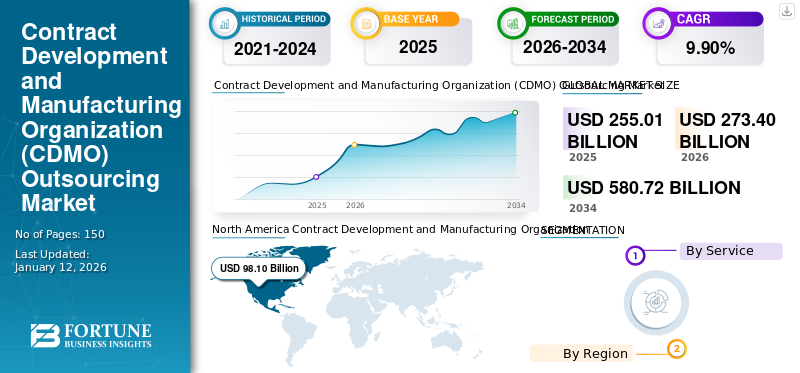
Download Free sample to learn more about this report.
contract development and manufacturing organization outsourcing market Key Takeaways
 Global Market Size & Forecast
- 2025 Market Size: USD 199.27 billion
- 2026 Market Size: USD 214.95 billion
- 2034 Forecast Market Size: USD 419.93 billion
- CAGR: 8.7% from 2026–2034
 Market Share
- North America dominated the market with a 34.66% share, valued at USD 69.06 billion in 2025.
- Small Molecules will account for 52.50% market share in 2026.
- Oncology segment is projected to account for 25.50% of the market in 2026.
 Key Regional Highlights
North America
The market reached USD 69.06 billion in 2025, driven by strong pharmaceutical presence and CDMO investments.
Asia Pacific
The market is projected to reach USD 56.30 billion by 2026, driven by biologics production and cost-effective manufacturing.
Europe
The market is projected to reach USD 56.47 billion by 2026, supported by GMP compliance and advanced biologics capabilities.
U.S.
The market is projected to reach USD 66.78 billion by 2026, driven by expanding pharmaceutical manufacturing.
Japan
The market is projected to reach USD 11.00 billion by 2026, supported by growing pharmaceutical manufacturing investments.
Read More

CONTRACT DEVELOPMENT & MANUFACTURING ORGANIZATION (CDMO) MARKET TRENDS
Shift Toward Integrated, End-To-End CDMO Platforms to Emerge as a Key Trend
Currently, there has been a significant shift from single-service outsourcing toward integrated, end-to-end platforms covering development, manufacturing, clinical supply, testing, fill-finish, packaging, and regulatory support. This is influencing key players to advance their services and expand their capabilities to meet global demand, combining development, manufacturing, and regulatory expertise to shorten timelines for clinical trials and market approval.
- For instance, in November 2024, Thermo Fisher Scientific, Inc. launched its branded Accelerator Drug Development suite, expanding its integrated CRO and CDMO services to offer 360-degree end-to-end drug development support from preclinical to commercialization.
MARKET DYNAMICS
MARKET DRIVERS
Download Free sample to learn more about this report.
Rising Outsourcing by Pharma and Biotech Companies to Fuel Market Growth
Over the past few years, there has been a growing preference among pharmaceutical and biotechnology companies to outsource development and manufacturing rather than build expensive in-house infrastructure, which allows them to save costs and focus more on research and development. This outsourcing demand is also rising due to drug pipelines becoming more diverse, with increasing volumes of biologics, sterile injectables, mRNA products, and high-potency APIs requiring specialized facilities, trained staff, and validated quality systems. This is anticipated to drive the Contract Development & Manufacturing Organization (CDMO) market growth.
- For instance, Tonix Pharmaceuticals Holding Corp. selected two Contract Manufacturing Organizations (CMOs) to launch and commercially manufacture Tonmya for the treatment of fibromyalgia.
MARKET RESTRAINTS
High Capital Investment and Long Facility Setup Timelines to Restrict Market Growth
Despite growing demand for outsourced drug development and manufacturing services, the high cost of setting up pharmaceutical production facilities is expected to restrict market expansion upto certain extent as it involves facility design, equipment installation, process validation, supply-chain development, regulatory approvals, quality-system implementation, and scale-up activities. Even expanding an existing plant or transferring a single product to a new manufacturing site can take several years. This is anticipated to limit market expansion over the forecast period.
- For instance, according to the Pharmaceutical Research and Manufacturers of America, as of May 2026, building one pharmaceutical production facility can cost up to USD 2.00 billion. It may take 5–10 years to become fully operational.
MARKET OPPORTUNITIES
Emergence of Advanced Biologics, Cell & Gene Therapy, and Specialty Modalities to Offer Lucrative Growth Opportunities
Recently, there has been an increasing demand for advanced biologics, viral vectors, cell and gene therapies, mRNA, ADCs, peptides, and high-potency APIs due to the growing burden of chronic and viral diseases. These therapies require sophisticated development, analytics, aseptic processing, and scale-up expertise, creating lucrative opportunities for specialist CDMOs. As a result, there has been an increasing number of strategic initiatives for acquisitions and partnerships to expand capabilities in contract development and manufacturing, which is expected to contribute to the market growth.
- For instance, in May 2023, Siegfried AG acquired a majority stake in DINAMIQS to build a cell and gene therapy CDMO platform, expanding its footprint in the biologics space.
MARKET CHALLENGES
High Regulatory Burden and Quality-Compliance Risk to Challenge Market Expansion
In the U.S., Europe, and Japan, CDMOs must comply with cGMP, data integrity, sterility assurance, validation, environmental monitoring, and regulatory inspection requirements, which increases operating costs and project complexity. Moreover, contamination events, batch failures, warning letters, technology-transfer delays, or documentation deficiencies are expected to disrupt client programs and impact CDMOs' reputation. This is anticipated to challenge the market growth.
Segmentation Analysis
By Service
High Demand for Contract Manufacturing Due to Complex Part Handling Boosts Segment’s Growth
Based on service, the market is segmented into contract manufacturing and contract development. The contract manufacturing is further sub-segmented into API manufacturing, finished product, and packaging. On the other hand, the contract development segment is further sub-divided into formulation development, process development & scale-up, analytical method development & validation, stability testing, CMC & regulatory development support, and others. Additionally, the finished product is further segmented into solid dosage forms, injectables, and other dosage forms.
To know how our report can help streamline your business, Speak to Analyst
The contract manufacturing segment accounted for the largest Contract Development & Manufacturing Organization (CDMO) market share in 2025. Commercial-scale production remains the most capital-intensive and operationally complex part of the pharmaceutical value chain, prompting key players to outsource API manufacturing, biologics drug substance, drug product, sterile fill-finish, and packaging to avoid large facility investments and access specialized capacity. This is expected to drive the segment’s growth.
- For instance, in November 2023, SwiftPharma BV and PlantForm entered into a contract manufacturing agreement to produce antibodies and proteins for PlantForm's product pipeline.
Additionally, the contract development segment is projected to grow at a 11.2% CAGR during the forecast period.
By Molecule Type
Large Portion of Approved Small Molecules Drives the Segment’s Dominance
On the basis of molecule type, the market is segmented into small molecules, biologics, cell & gene therapies, and others.
In 2025, small molecules dominated the market as end users. The segment’s growth is driven by a large number of approved and pipeline drugs, including generics, specialty drugs, oncology therapies, and high-potency APIs, which require expertise in API synthesis, solid-state chemistry, formulation, analytical testing, scale-up, and regulatory support. Furthermore, the segment is set to hold a 52.5% share in 2026.
In addition, the biologics segment is projected to grow at a 9.6% CAGR over the forecast period.
By Therapeutic Area
Large Pipeline of Oncology Drugs With Complex Requirements Drive Segment Growth
On the basis of therapeutic area, the market is segmented into oncology, infectious diseases, neurology, cardiology, immunology & inflammation, metabolic disorders, and others.
In 2025, the oncology segment dominated the market. The segment’s growth is driven by a large and active drug pipeline, including small molecules, biologics, antibody-drug conjugates, cell & gene therapies, and more. These often require specialized CDMO capabilities for complex formulations, controlled manufacturing conditions, potent compounds, and strict quality requirements. Furthermore, the segment is set to hold a 25.5% share in 2026.
In addition, the infectious diseases segment is projected to grow at a 6.7% CAGR over the forecast period.
Contract Development & Manufacturing Organization (CDMO) Market Regional Outlook
Based on geography, the market is classified into North America, Europe, Asia Pacific, and Rest of the World.
North America
North America CDMO Market Size, 2025 (USD Billion)
To get more information on the regional analysis of this market, Download Free sample
North America accounted for the largest revenue share in 2024, valued at USD 64.46 billion and reached USD 69.06 billion by 2025. The growth is attributed to the large presence of pharmaceutical companies, which are influencing CDMOs to enter into partnerships, acquisitions, and investments to expand capabilities.
- For instance, in February 2022, Recipharm AB acquired Arranta Bio, a CDMO specializing in Advanced Therapy Medicinal Products (ATMPs), to expand its biologics manufacturing services in the U.S.
U.S. Contract Development & Manufacturing Organization (CDMO) Market
In 2026, the U.S. is projected to reach USD 66.78 billion, accounting for approximately 31.1% of the global market.
Europe
Europe is projected to record a 8.7% growth rate during the projection period, the second-highest globally, reaching USD 56.47 billion by 2026. The growth is attributed to strong GMP compliance standards, advanced biologics capabilities, and a large base of specialized CDMOs offering key services to pharmaceutical and biotechnology companies.
U.K. Contract Development & Manufacturing Organization (CDMO) Market
The U.K. market is expected to reach USD 11.20 billion by 2026, accounting for roughly 5.2% of global revenues.
Germany Contract Development & Manufacturing Organization (CDMO) Market
Germany market is projected to reach USD 13.72 billion by 2026, accounting for approximately 6.4% of global revenue.
Asia Pacific
By 2026, the Asia Pacific's market is expected to reach USD 56.30 billion, ranking third globally. The growth is attributed to increasing focus on expanding biologics production capacity, cost-effective manufacturing, growing domestic pharmaceutical demand, and increasing investments in countries such as India, South Korea, China, Japan, and Singapore.
Japan Contract Development & Manufacturing Organization (CDMO) Market
Japan is projected to generate USD 11.00 billion in revenue by 2026, accounting for approximately 5.1% of the global market.
China Contract Development & Manufacturing Organization (CDMO) Market
China’s market is expected to reach nearly USD 17.55 billion by 2026, accounting for 8.2% of global revenues.
India Contract Development & Manufacturing Organization (CDMO) Market
India’s market is projected to reach USD 14.43 billion by 2026, accounting for around 6.7% of global market revenue.
Rest of the World
The Rest of the World is expected to grow moderately, with the market to reach USD 28.08 billion by 2026. The growth is attributed to increased investments and the relocation of global CDMO facilities to countries such as Mexico, Argentina, the GCC, South Africa, and others, driven by rising demand for drug manufacturing and development.
COMPETITIVE LANDSCAPE
Key Industry Players
Specialized Capabilities and Key Focus on Facility Expansions to Enhance the Market Share of Key Players
In 2025, Lonza, Thermo Fisher Scientific Inc., and Catalent, Inc., held the majority of market share. This share is attributed to their specialized capabilities, including biologics, high-potency APIs, mRNA, viral vectors, sterile injectables, and integrated development-to-commercial manufacturing platforms. Moreover, other prominent players are focusing on key strategies, such as expanding their manufacturing capabilities through new facility launches and through upgrades to existing facilities. They are also shifting toward emerging countries to capture the demand and expand market presence in the coming years.
LIST OF KEY CONTRACT DEVELOPMENT & MANUFACTURING ORGANIZATION (CDMO) COMPANIES PROFILED
- Lonza (Switzerland)
- Thermo Fisher Scientific Inc. (U.S.)
- Catalent, Inc (U.S.)
- Samsung Biologics (South Korea)
- WuXi Biologics (China)
- Siegfried Holding AG (Switzerland)
- FUJIFILM Holdings Corporation (Japan)
- Boehringer Ingelheim International GmbH (Germany)
- Recipharm AB (Sweden)
- Cambrex Corporation (U.S.)
KEY INDUSTRY DEVELOPMENTS
- September 2025: FUJIFILM Biotechnologies, a part of FUJIFILM Holdings Corporation expanded its global partnership with immunology company argenx to include U.S. manufacturing, producing drug substance for argenx's efgartigimod (Vyvgart) at its Holly Springs, North Carolina facility starting in 2028.
- May 2025: Recipharm AB announced strategic partnership to accelerate development projects and regulatory pathways.
- April 2025: FUJIFILM Diosynth Biotechnologies and Regeneron Pharmaceuticals signed a 10-year manufacturing supply agreement valued at over USD 3.0 billion for U.S.-based production of Regeneron's biologic medicines, including monoclonal antibodies.
- December 2024: Cambrex Corporation signed a strategic agreement with Eli Lilly to provide accelerated access to clinical development capabilities for Lilly's biotech collaborators through Lilly Catalyze360-ExploR&D.
- October 2024: Samsung Biologics signed a USD 1.24 billion contract manufacturing deal with an Asia-based pharmaceutical company, the largest single-client contract in the CDMO's history.
- February 2022: Recipharm AB acquired Vibalogics to expand advanced therapy medicinal product and virotherapy CDMO capabilities.
- October 2021: Lonza announced the expansion of its mammalian development services in Singapore to support demand for biologics manufacturing.
REPORT COVERAGE
The report offers a comprehensive evaluation of all market segments, covering the major drivers, emerging trends, growth opportunities, restraints, and challenges influencing the industry. It also includes insights into technological advancements, manufacturing regulations, key industry developments, market share analysis, and detailed profiles of leading companies.
Request for Customization to gain extensive market insights.
Report Scope & Segmentation
| ATTRIBUTE | DETAILS |
| Study Period | 2021-2034 |
| Base Year | 2025 |
| Estimated Year | 2026 |
| Forecast Period | 2026-2034 |
| Historical Period | 2021-2024 |
| Growth Rate | CAGR of 8.7% from 2026-2034 |
| Unit | Value (USD Billion) |
| Segmentation | By Service, Molecule Type, Therapeutic Area, and Region |
| By Service |
|
| By Molecule Type |
|
| By Therapeutic Area |
|
| By Region |
|

Frequently Asked Questions
Fortune Business Insights says that the global market value stood at USD 199.27 billion in 2025 and is projected to reach USD 419.93 billion by 2034.
In 2025, the North America market value stood at USD 69.06 billion.
The market is expected to grow at a CAGR of 8.7% over the forecast period of 2026-2034.
The contract manufacturing segment led the market in terms of service.
The key driver of the market is the rising outsourcing by pharma and biotech companies.
Lonza, Thermo Fisher Scientific Inc., and Catalent, Inc., are among the prominent players in the market.
North America held the largest share of the market.



- 2021-2034
- 2025
- 2021-2024
- 150
Get 30-60 hrs Free Customization
Expand Regional and Country Coverage, Segments Analysis, Company Profiles, Competitive Benchmarking, and End-user Insights.













.webp)






Related Reports
-
US +1 833 909 2966 ( Toll Free )
-
Get In Touch With Us