Pain Management Drugs Market Size, Share & Industry Analysis, By Drug Class (Opioids, Nonsteroidal Anti-inflammatory, Local Anesthetics, Anticonvulsants, Antidepressants, Anti-migraine, Non-opioid/Non-narcotic Analgesics, Muscle Relaxants), By Pain Type (Acute Pain & Chronic Pain), By Drug Type (Prescription & OTC), By Disease Indication (Neuropathic Pain, Cancer Pain, Post-operative Pain), By Route of Administration (Oral, Injectable/Parenteral, Transdermal, Topical), By Age Group (Pediatric & Adults), By Type (Branded & Generic), By Distribution Channel and Regional Forecast, 2026-2034
 Download Free Sample
Pain Management Drugs Market Size and Future Outlook
 Listen to Audio Version
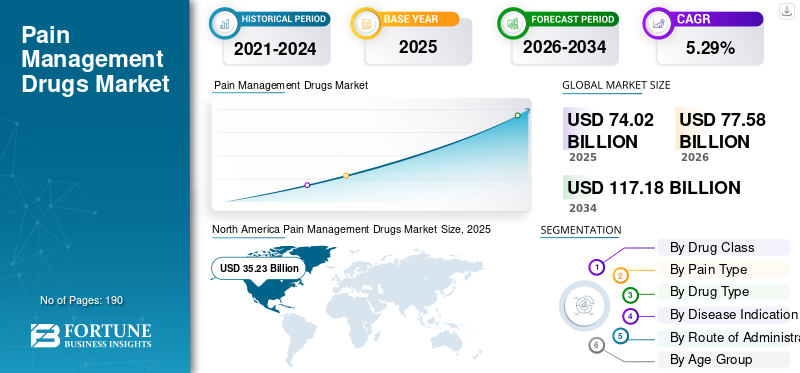
The global pain management drugs market size was valued at USD 74.02 billion in 2025 and is projected to grow from USD 77.58 billion in 2026 to USD 117.18 billion by 2034, exhibiting a CAGR of 5.29% during the forecast period. North America dominated the pain management drugs market with a market share of 47.59% in 2025.
The global market includes medicines used to reduce, control, or manage pain caused by numerous conditions such as arthritis, neuropathic pain, and cancer pain, among others. The market is growing as pain remains one of the most common reasons for medical treatment, while aging populations, higher chronic disease burden, rising surgical procedures, and demand for safer non-opioid options are increasing the need for effective pain therapies. At the same time, opioid-related safety concerns are shifting company pipelines and healthcare use toward targeted, non-opioid, and multimodal pain management drugs.
- For instance, in January 2025, Vertex Pharmaceuticals Incorporated received approval from the U.S. FDA for JOURNAVX (suzetrigine), a non-opioid oral medicine for adults with moderate-to-severe acute pain. The development marked a significant milestone in acute pain management.
Furthermore, major players, such as AbbVie Inc., Haleon plc, Bayer AG, and Kenvue Inc., are focusing on research and development.
Download Free sample to learn more about this report.
Pain Management Drugs Market Key Takeaways
 Global Market Size & Forecast
- 2025 Market Size: USD 74.02 billion
- 2026 Market Size: USD 77.58 billion
- 2034 Forecast Market Size: USD 117.18 billion
- CAGR: 5.29% (2026–2034)
 Market Share
- North America dominated the market with a 47.59% share in 2025.
- The anti-migraine drugs segment is projected to witness the fastest growth, expanding at a 8.14% CAGR during the forecast period.
- The acute pain segment is expected to grow at a 4.15% CAGR during the forecast period.
 Key Regional Highlights
Asia Pacific
Asia Pacific market is projected to reach USD 10.56 billion by 2026.
North America
North America generated USD 35.23 billion in 2025, maintaining its leading market position after recording USD 33.70 billion in 2024.
Europe
Europe is projected to reach USD 20.03 billion by 2026, growing at a 4.35% CAGR during the forecast period.
U.S.
U.S. market is projected to reach USD 33.77 billion by 2026.
Japan
Japan market is projected to reach USD 2.61 billion by 2026.
Read More

PAIN MANAGEMENT DRUGS MARKET TRENDS
Growing Use of Multimodal Pain Treatment Approaches is an Emerging Trend
The global market is moving toward multimodal treatment as a single drug class often does not provide adequate pain control across complex conditions. As a result, physicians are increasingly combining therapies such as NSAIDs, acetaminophen, local anesthetics, anticonvulsants, antidepressants, opioids, and newer non-opioid analgesics to target different pain pathways. The approach helps to improve pain relief, reduce dependence on high-dose opioids, and manage patients with different safety needs. Therefore, the rising clinical preference for opioid-sparing and mechanism-based treatment is supporting the demand for a broader mix of pain management drugs across hospital, outpatient, and retail settings.
- For instance, in October 2025, Pacira BioSciences, Inc. announced new real-world evidence for EXPAREL (bupivacaine liposome injectable suspension) evaluating its clinical and economic benefits in non-opioid postsurgical pain management. EXPAREL is used as part of opioid-sparing pain control strategies, helping hospitals and surgical centers manage post-operative pain while reducing reliance on traditional opioid-heavy treatment approaches.
MARKET DYNAMICS
MARKET DRIVERS
Download Free sample to learn more about this report.
Rising Global Burden of Chronic Pain Disorders to Drive Market Growth
The global market is growing steadily as the prevalence of conditions causing chronic pain continues to affect a large patient population worldwide. As these conditions often require repeated or long-term treatment, the demand for analgesics, anti-inflammatory drugs, migraine therapies, neuropathic pain medicines, and opioid-sparing alternatives continues to rise. This creates a sustained need for both high-volume generic pain medicines and newer branded therapies that can offer safer or more targeted pain control. These factors support prescription volumes, OTC analgesic use, and pharmaceutical innovation, propelling pain management drugs market growth. Key companies are focusing on new product launches to meet this growing demand.
- For instance, in April 2026, Cumberland Pharmaceuticals Inc. received the U.S. FDA approval for an expanded indication for its Caldolor (ibuprofen) Injection product. The indication includes postoperative pain management and the approval coincides with the launch of a newly designed website for healthcare professionals, highlighting this advancement and the evolving role of non-opioid pain management.
MARKET RESTRAINTS
Opioid Safety Concerns and Long-term Analgesic Risks May Hamper Market Growth
The global market continues to face restraints given that several widely used pain medicines are linked with safety, dependency, and misuse concerns. Opioids are effective for severe pain, cancer pain, and post-operative pain, but the risk of dependence, misuse, overdose, and strict prescribing control limits their long-term growth. At the same time, commonly used NSAIDs also face caution in long-duration use as regulators have warned about increased risks of heart attack and stroke. As a result, physicians and payers are becoming more selective in prescribing high-risk analgesics, which slows volume growth in traditional pain drug classes and increases pressure on companies to prove stronger safety benefits for newer therapies.
- For instance, in July 2025, the U.S. FDA required major safety labeling changes for all opioid pain medications to more clearly highlight the risks linked with long-term use, including misuse, addiction, and fatal or non-fatal overdose. Such stronger safety warnings and tighter prescribing guidance can reduce long-term opioid use, increase physician caution and limit growth for opioid-based pain management drugs.
MARKET OPPORTUNITIES
Expansion of Topical and Localized Pain Therapies to Create Safer Treatment Opportunities
The global market is creating strong growth opportunities through topical and localized therapies, as patients and physicians increasingly prefer treatments that act directly at the pain site with lower systemic exposure. Oral pain medicines such as NSAIDs and opioids are widely used, but long-term use can raise concerns related to gastrointestinal, cardiovascular, kidney, sedation, dependence, and misuse risks. Due to this, topical gels, patches, creams, sprays, and localized non-opioid therapies are gaining importance for arthritis, musculoskeletal, neuropathic, neck, and post-injury pain. This shift allows companies to expand differentiated OTC and prescription products that offer convenience, targeted relief, and better suitability for elderly patients or patients taking multiple medicines.
- For instance, in September 2024, Mankind Pharma Limited launched Nimulid Strong gel and spray for neck pain. The development supports the opportunity as it shows that companies are expanding localized pain-relief formats to meet the demand for convenient, non-invasive, and targeted pain management options.
MARKET CHALLENGES
Regulatory Scrutiny and Safety Concerns around Opioid-Based Pain Drugs to Act as a Market Challenge
The global market faces a major challenge as opioid-based medicines remain clinically important for severe pain, cancer pain, and post-operative pain. Still, their long-term use is closely linked with misuse, addiction, overdose, and dependence risks. Due to these safety concerns, regulators are tightening labeling requirements, physicians are becoming more cautious with prescribing, and payers are encouraging opioid-sparing treatment pathways. This creates pressure on companies with opioid portfolios and slows growth in one of the traditional high-use pain drug categories. At the same time, developing safer alternatives is costly and clinically challenging, making innovation necessary but commercially challenging for the market.
- For instance, in July 2025, the U.S. FDA required major safety labeling changes for all opioid pain medications to explain better the risks associated with long-term use, including misuse, addiction, and fatal or non-fatal overdose.
Segmentation Analysis
By Drug Class
Increasing Use of NSAIDs to Propel NSAIDs Segment Growth
Based on drug class, the market is categorized into opioids, nonsteroidal anti-inflammatory drugs (NSAIDs), local anesthetics, anticonvulsants, antidepressants, anti-migraine drugs, non-opioid/non-narcotic analgesics, muscle relaxants, and others.
The NSAIDs segment dominates the market as they are widely used across arthritis pain, back pain, musculoskeletal pain, post-operative pain, menstrual pain, and mild-to-moderate acute pain. Their broad availability in both Prescription and OTC formats increases patient access, while physicians often prefer NSAIDs before opioids as they support non-opioid and opioid-sparing treatment pathways. As a result, high treatment volume, low cost, and wide clinical familiarity keep NSAIDs ahead of more specialized pain drug classes.
- For instance, in June 2025, Azurity Pharmaceuticals, Inc. announced the FDA approval of XIFYRM (meloxicam injection), an IV NSAID for the management of moderate-to-severe pain in adults, alone or with non-NSAID analgesics. This supports NSAID leadership as it expands non-opioid pain treatment into hospital and acute-care settings.
The anti-migraine drugs segment is expected to grow at a CAGR of 8.14% over the forecast period.
To know how our report can help streamline your business, Speak to Analyst
By Pain Type
High Prescription Volume to Support Chronic Pain Segment Dominance
Based on pain type, the market is segmented into acute pain and chronic pain.
In 2025, the chronic pain segment dominated the market due to conditions such as arthritis, neuropathic pain, chronic back pain, migraine, Fibromyalgia, and cancer-related pain, which often require long-term or repeated treatment. Unlike acute pain, which is usually treated for a short period, chronic pain creates recurring prescriptions, OTC purchases, follow-up care, and therapy switching. Therefore, the larger treated patient pool and longer treatment duration make chronic pain the higher-value segment in the market.
- For instance, in August 2025, Tonix Pharmaceuticals Holding Corp. announced the FDA approval of TONMYA (cyclobenzaprine HCl sublingual tablets) for the treatment of Fibromyalgia in adults. This supports chronic pain growth as it introduced a new non-opioid option for a long-term pain condition with persistent unmet treatment needs.
The acute pain segment is projected to grow at a CAGR of 4.15% during the forecast period.
By Drug Type
Higher Prices of Prescription Medicine to Boost Prescription Segment Growth
Based on drug type, the market is segmented into prescription and OTC.
The prescription segment dominates the market given that moderate-to-severe pain, cancer pain, neuropathic pain, post-operative pain, migraine, and chronic pain often require physician-directed treatment. These products generally carry higher prices than OTC drugs and include branded migraine therapies, opioids, injectable analgesics, anticonvulsants, antidepressants, local anesthetics, and newer non-opioid drugs. As a result, prescription products capture a larger share of revenue even though OTC analgesics maintain high consumer volume.
- For instance, in May 2023, Cumberland Pharmaceuticals Inc. received approval from the U.S. FDA for expanded labeling for Caldolor, an intravenously delivered formulation of ibuprofen, to include use in infants. The non-narcotic agent may now be administered for the treatment of pain and fever in patients three months to six months of age. This supports the dominance of the prescription segment as newer branded pain therapies are entering physician-managed treatment pathways.
The OTC segment is projected to grow at a CAGR of 3.79% during the forecast period.
By Disease Indication
Core Disease Indication of Data Exchange to Boost Migraine Segmental Growth
Based on disease indication, the market is segmented into neuropathic pain, cancer pain, post-operative pain, arthritis pain, chronic back pain, migraine, fibromyalgia, and others.
In 2025, the migraine segment dominated the global pain management drugs market share given that it has a large diagnosed patient base and increasingly uses higher-value prescription therapies compared with many conventional pain indications. Patients with recurrent migraine often need both acute treatment and preventive therapy, which creates repeat demand for triptans, gepants, ditans, CGRP monoclonal antibodies, DHE products, and combination therapies. As a result, the segment benefits from strong branded innovation, specialist prescribing, and broader patient awareness, making migraine one of the most commercially attractive pain indications.
- For instance, in October 2025, Amneal Pharmaceuticals, Inc. launched BREKIYA, the first ready-to-use DHE autoinjector for adults with migraine with or without aura and cluster headaches in the U.S. This development supports Migraine’s leading position as it expands convenient, self-administered acute treatment options in a high-value recurring pain indication.
The fibromyalgia segment is projected to grow at a CAGR of 7.93% during the forecast period.
By Route of Administration
Ease of Administration of Oral Medications to Boost Oral Drugs Segment Growth
Based on route of administration, the market is segmented into oral, injectable/parenteral, transdermal, topical, and others.
In 2025, the oral drugs dominated the market as tablets, capsules, and oral liquids are convenient, easy to prescribe, easy to purchase, and suitable for repeated use in both acute and chronic pain. Most major pain categories have strong oral product availability. This makes oral therapy the first-line and most scalable route across retail, outpatient, and home-care settings.
- For instance, in January 2025, Axsome Therapeutics, Inc. received the U.S. FDA approval for SYMBRAVO (meloxicam and rizatriptan), an oral therapy for the acute treatment of migraine with or without aura in adults. The development supports oral-route dominance as companies continue to launch convenient oral pain therapies for high-volume conditions such as migraine.
The injectable/parenteral segment is projected to grow at a CAGR of 6.33% over the forecast period.
By Age Group
High Treatment Frequency to Support the Dominance of the Adults Segment
Based on the age group, the market is segmented into pediatric and adults.
By age group, the adults segment dominates the market given that chronic back pain, arthritis, migraine, neuropathic pain, cancer pain, Fibromyalgia, and post-operative pain are more frequently treated in adult populations than in pediatric groups. Adult patients also have higher use of prescription analgesics, OTC pain relievers, migraine therapies, topical products, and hospital-administered pain drugs. As a result, the larger eligible patient base and broader approved drug use make adults the dominant age group.
- For instance, in April 2025, Satsuma Pharmaceuticals, Inc. received the approval of the U.S. FDA for ATZUMI (dihydroergotamine) nasal powder for the acute treatment of migraine with or without aura in adults. This supports the dominance of the adult segment as many new pain and migraine therapies are approved and commercialized first for adult patients.
The pediatric segment is projected to grow at a CAGR of 3.32% over the forecast period.
By Type
Drug Availability at Low Prices to Boost Generics Segment Growth
Based on type, the market is segmented into branded and generic.
The generic drugs segment dominates the market as many commonly used pain medicines, including NSAIDs, opioids, acetaminophen combinations, anticonvulsants, antidepressants, and muscle relaxants, are available at lower prices after patent expiry. Payers and healthcare systems often prefer generics to reduce treatment cost, while pharmacies and hospitals use them in high volumes for routine pain management. Therefore, generics lead the market by volume and continue to contribute strongly to revenue across mature pain drug categories.
- For instance, in February 2026, Hikma Pharmaceuticals PLC launched an authorized generic version of NUCYNTA (tapentadol) in the U.S. for acute pain severe enough to require an opioid analgesic when alternatives are inadequate.
The branded segment is projected to grow at a CAGR of 6.48% over the analysis period.
By Distribution Channel
Vast Distribution Network of Drug Stores and Retail Pharmacies to Support the Segment Dominance
Based on distribution channel, the market is segmented into hospital pharmacies, drug stores & retail pharmacies, and online pharmacies.
The drug stores and retail pharmacies segment dominates the market as pain medicines are frequently purchased or refilled close to the patient, especially for OTC analgesics, oral prescriptions, migraine therapies, arthritis pain products, and localized pain relief products. Retail pharmacies also support repeat chronic pain prescriptions and provide broad access to branded and generic products. As a result, their high patient footfall, convenience, and role in both OTC and prescription fulfillment keep this channel ahead of hospital and online pharmacies.
- For instance, in August 2025, Bayer introduced Aspirina to the U.S. pain market, making the product available for purchase and targeting Hispanic consumers familiar with the brand. This supports retail pharmacy dominance given that OTC pain-relief launches rely heavily on broad consumer access through pharmacy and retail channels.
The online pharmacies segment is projected to grow at a CAGR of 8.85% over the analysis period.
Pain Management Drugs Market Regional Outlook
By geography, the market is categorized into Europe, North America, Asia Pacific, Latin America, and the Middle East & Africa.
North America
North America Pain Management Drugs Market Size, 2025 (USD Billion)
To get more information on the regional analysis of this market, Download Free sample
North America held the dominant share in 2024 with a value of USD 33.70 billion and maintained its leading position in 2025 with a valuation of USD 35.23 billion. The market is growing due to high chronic pain prevalence, strong access to prescription and OTC analgesics, and the faster adoption of non-opioid and migraine-specific therapies.
U.S. Pain Management Drugs Market
Given North America's substantial contribution and the U.S. dominance in the region, the U.S. market is estimated to reach around USD 33.77 billion in 2026, accounting for roughly 43.53% of the global market.
Europe
The Europe market is projected to grow at CAGR of 4.35% over the forecast period, the second-highest among all regions, and reach a valuation of USD 20.03 billion by 2026. The regional market growth is supported by an aging population, a high burden of musculoskeletal disorders, and the wider use of guideline-based pain management in primary and specialty care. The region is also shifting toward safer opioid-sparing and localized pain therapies.
U.K. Pain Management Drugs Market
The U.K. market is estimated to reach around USD 2.97 billion in 2026, representing roughly 3.83% of the global market.
Germany Pain Management Drugs Market
The Germany market is projected to reach approximately USD 3.78 billion in 2026, equivalent to around 4.87% of the global market.
Asia Pacific
The Asia Pacific market is estimated to reach USD 10.56 billion in 2026 and secure the position of the third-largest region in the market. The market is expanding due to large patient pools, rising diagnoses of arthritis, back pain, migraine, and neuropathic pain, and improving access to branded and generic pain medicines.
China Pain Management Drugs Market
The China market is estimated to reach around USD 3.91 billion in 2026, accounting for approximately 5.03% of the global market.
Japan Pain Management Drugs Market
The Japan market is projected to be one of the largest markets worldwide, with 2026 revenues estimated at around USD 2.61 billion, representing approximately 3.37% of the global sales.
India Pain Management Drugs Market
The India market is estimated to touch around USD 1.31 billion in 2026, accounting for roughly 1.69% of global revenue.
Latin America and the Middle East & Africa
The Latin America and Middle East & Africa regions are expected to witness moderate growth during the forecast period. The market in Latin America is estimated to reach a valuation of USD 5.94 billion. The product demand is increasing as access to pain medicines improves and chronic conditions such as arthritis, cancer, and musculoskeletal disorders become more frequently treated. In the Middle East & Africa, the GCC market is set to reach USD 1.47 billion in 2026.
South Africa Pain Management Drugs Market
The South Africa market is projected to reach approximately USD 1.26 billion by 2026, accounting for roughly 1.63% of global revenue.
COMPETITIVE LANDSCAPE
Key Industry Players
Established Portfolios and Rising Investment of Companies in Safer and Targeted Pain Therapies to Bolster their Industry Positions
The global pain management drugs market is moderately fragmented, with companies such as Haleon plc, Kenvue Inc., Bayer AG, AbbVie Inc., Eli Lilly and Company, Teva Pharmaceutical Industries Ltd., Viatris Inc., Vertex Pharmaceuticals Incorporated, Grünenthal GmbH, and Hikma Pharmaceuticals PLC holding important positions across OTC analgesics, prescription pain drugs, migraine therapies, localized pain relief products, and hospital-use analgesics. These companies maintain their presence through strong consumer brands, established prescription portfolios, broad retail and hospital distribution, and growing investment in safer, non-opioid, and targeted pain therapies. The market is also shaped by high generic penetration in conventional analgesics, while branded growth is increasingly coming from migraine biologics, localized pain products, and novel non-opioid mechanisms.
- For instance, in May 2025, Eli Lilly and Company acquired SiteOne Therapeutics, Inc. The transaction included STC-004, a Phase 2 ready Nav1.8 inhibitor being studied for the treatment of pain. STC-004 may represent a next-generation, non-opioid treatment for patients suffering from chronic pain. The development strengthened company’s position in the market.
Other notable participants in the global market include Pacira BioSciences, Inc., Pfizer Inc., Endo, Inc., Assertio Holdings, Inc., Amneal Pharmaceuticals, Inc., Dr. Reddy’s Laboratories Ltd., Sun Pharmaceutical Industries Ltd., and Lupin Limited. These companies are expected to focus on product launches, generic expansion, licensing deals, hospital pain portfolios, and differentiated formulations to strengthen their positions during the forecast period. Regional generic manufacturers hold the remaining market share.
LIST OF KEY PAIN MANAGEMENT DRUGS COMPANIES PROFILED
- AbbVie Inc. (U.S.)
- Haleon plc (U.K.)
- Bayer AG (Germany)
- Kenvue Inc. (U.S.)
- Pfizer Inc. (U.S.)
- Eli Lilly and Company (U.S.)
- Teva Pharmaceutical Industries Ltd. (Israel)
- Viatris Inc. (U.S.)
- Sanofi (France)
- Grünenthal GmbH (Germany)
KEY INDUSTRY DEVELOPMENTS
- June 2026: AbbVie received approval from the European Commission for AQUIPTA (atogepant) for the acute treatment of migraine in adults with or without aura, to be taken as needed (PRN). This approval is the second indication in the European Union for AQUIPTA, an oral calcitonin gene-related peptide (CGRP) receptor antagonist (gepant).
- April 2026: Elite Pharmaceuticals, Inc. launched Elite's generic version of methadone hydrochloride 10 mg and 5 mg tablets. Methadone tablets are indicated for managing persistent and severe pain requiring an opioid analgesic. The tablets are developed for cases that cannot be adequately treated by using alternative options, including immediate-release opioids.
- February 2026: Hikma Pharmaceuticals PLC launched a generic version of Nucynta (tapentadol) for U.S. patients.
- November 2025: Tonix Pharmaceuticals Holding Corp. launched TONMYA (cyclobenzaprine HCl sublingual tablets) in the U.S. TONMYA is a first-in-class treatment for Fibromyalgia in adults as a non-opioid analgesic taken once daily at bedtime.
- June 2025: Azurity Pharmaceuticals, Inc. received approval from the U.S. FDA for XIFYRMTM (meloxicam injection), an IV non-steroidal anti-inflammatory drug (NSAID) for the management of moderate-to-severe pain, alone or in combination with non-NSAID analgesics.
REPORT COVERAGE
The report provides a comprehensive global pain management drugs market analysis. It covers a detailed market assessment across drug class, pain type, disease indication, route of administration, distribution channel, end user, and geography. It examines the demand for prescription and OTC drugs used to manage acute and chronic pain conditions, including arthritis pain, neuropathic pain, cancer pain, post-operative pain, migraine, chronic back pain, Fibromyalgia, and musculoskeletal pain. The study also evaluates the role of opioids, NSAIDs, acetaminophen, anticonvulsants, antidepressants, corticosteroids, local anesthetics, migraine-specific therapies, and emerging non-opioid analgesics across different treatment settings. In addition, the report provides regional insights across key regions, competitive landscape analysis, company profiling, recent developments, product launches, regulatory approvals, and an evaluation of the major factors driving, restraining, and shaping future opportunities in the market.
Request for Customization to gain extensive market insights.
Report Scope & Segmentation
| ATTRIBUTE | DETAILS |
| Study Period | 2021-2034 |
| Base Year | 2025 |
| Estimated Year | 2026 |
| Forecast Period | 2026-2034 |
| Historical Period | 2021-2024 |
| Growth Rate | CAGR of 5.29% from 2026 to 2034 |
| Unit | Value (USD Billion) |
| Segmentation | By Drug Class, Pain Type, Drug Type, Disease Indication, Route of Administration, Age Group, Type, Distribution Channel, and Region |
| By Drug Class |
|
| By Pain Type |
|
| By Drug Type |
|
| By Disease Indication |
|
| By Route of Administration |
|
| By Age Group |
|
| By Type |
|
| By Distribution Channel |
|
| By Region |
|
Frequently Asked Questions
According to Fortune Business Insights, the global market value stood at USD 74.02 billion in 2025 and is projected to reach USD 117.18 billion by 2034.
In 2025, the North America market value stood at USD 35.23 billion.
The market is expected to grow at a CAGR of 5.29% over the forecast period of 2026-2034.
The NSAIDs segment leads the market by drug class.
The rising prevalence of chronic pain conditions is a key factor driving the market growth.
AbbVie Inc., Haleon plc, Inc., Bayer AG, Inc., Kenvue Inc., and Pfizer Inc. are the major players in the global market.
North America dominated the market in 2025.



- 2021-2034
- 2025
- 2021-2024
- 190
Get 30-60 hrs Free Customization
Expand Regional and Country Coverage, Segments Analysis, Company Profiles, Competitive Benchmarking, and End-user Insights.













.webp)






-
US +1 833 909 2966 ( Toll Free )
-
Get In Touch With Us