Panoramic Sunroof Market Size, Share & Industry Analysis, By Product Type (Fixed Panoramic Sunroof, Sliding Panoramic Sunroof, Tilt & Slide Panoramic Sunroof, and Multi-Panel Panoramic Sunroof), By Vehicle Type (Hatchback/Sedan, SUVs, LCVs, and HCVs), By Glass Type (Tempered Glass, Laminated Glass, Tinted Glass, Electrochromic / Smart Glass, and UV-Protected Glass), By Sales Channel (OEM and Aftermarket), and Regional Forecast, 2026-2034
 Download Free Sample
(Offer valid till 30th Sep 2026)

Panoramic Sunroof Market Size and Future Outlook
 Listen to Audio Version
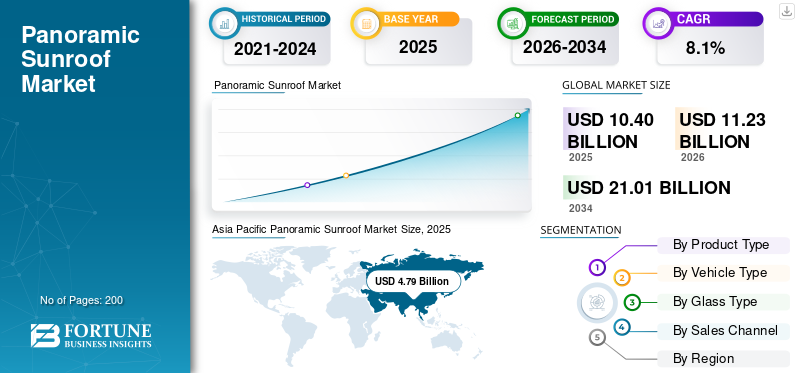
The global panoramic sunroof market size was valued at USD 10.40 billion in 2025. The market is projected to grow from USD 11.23 billion in 2026 to USD 21.01 billion by 2034, exhibiting a CAGR of 8.1% during the forecast period. Asia Pacific dominated the panoramic sunroof market with a market share of 46.06% in 2025.
The global market is experiencing steady growth as the automotive industry shifts toward comfort-focused, stylish, and technology-rich vehicles. A panoramic sunroof is a large glass roof system that allows more natural light into the cabin and improves the vehicle’s aesthetic appeal. It is widely used in SUVs, hatchback/sedans, premium cars, and selected commercial vehicles where interior openness and passenger comfort are important purchase factors.
The market is mainly driven by increasing consumer demand for luxury features, rising SUV sales, and the growing demand for premium vehicles across developed and emerging markets. Changing consumer preferences are encouraging automakers to offer panoramic roofs not only in luxury cars but also in mid-range SUVs and crossovers. This has made the feature an important market segment in modern vehicle design.
In future, the market will evolve through technological advancements such as lightweight glass, coated glass, electrochromic dimming, heat-control glazing, and attempts to integrate solar roof functions for better energy efficiency. Electric vehicles are also supporting growth as many EV manufacturers use fixed panoramic roofs to create a spacious cabin feel and improve brand differentiation.
Asia Pacific is expected to hold the largest market share, led by China, India, Japan, and South Korea. Europe will remain a key market, especially across Germany, France, and the U.K., due to premium vehicle production and strong luxury-brand presence. Key players such as Webasto Group, Renault and Hyundai Mobis are focusing on lightweight roof systems, coated glass partnerships, smart roof technologies, and OEM collaborations to strengthen their position.
Download Free sample to learn more about this report.
Panoramic Sunroof Market Key Takeaways
 Global Market Size & Forecast
- 2025 Market Size: USD 10.40 billion
- 2026 Market Size: USD 11.23 billion
- 2034 Forecast Market Size: USD 21.01 billion
- CAGR: 8.1% from 2026–2034
 Market Share
- Asia Pacific dominated the panoramic sunroof market with a 46.06% share in 2025.
- The fixed panoramic sunroof segment is expected to grow at a CAGR of 9.8% over the forecast period.
- The hatchback/sedan segment is expected to grow at a CAGR of 7.9% over the forecast period.
 Key Regional Highlights
Asia Pacific
Asia Pacific led the market with a valuation of USD 4.79 billion in 2025.
Europe
Europe is estimated to reach USD 2.77 billion in 2026, securing the position of the second-largest regional market.
North America
North America is projected to record a CAGR of 6.1% and reach USD 5.31 billion.
U.S.
The market was estimated at approximately USD 1.45 billion in 2025, representing roughly 19.4% of the global market.
Japan
The market is supported by strong automotive manufacturing capabilities and growing adoption of premium vehicle features.
Read More

PANORAMIC SUNROOF MARKET TRENDS
Fixed Glass Roofs and Smart Glazing are Reshaping Vehicle Interiors
A major trend is the shift from traditional opening sunroofs toward fixed panoramic glass roofs, especially in EVs and premium SUVs. These systems provide more natural light, reduce mechanical complexity, and support futuristic cabin design. Smart glass, ambient lighting, and dimmable roof technologies are also gaining attention as automakers use roof systems to improve passenger experience and create stronger brand differentiation.
- For instance, in September 2025, Mercedes-Benz showcased the electric GLC with optional Sky Control Panoramic Roof, allowing the glass roof to switch ambience and improve cabin comfort.
MARKET DYNAMICS
MARKET DRIVERS
Download Free sample to learn more about this report.
Rising Premiumization and SUV Adoption Accelerate Panoramic Sunroof Demand
The market is growing as automakers use panoramic roofs to enhance comfort, cabin openness, and aesthetic appeal in SUVs and premium passenger cars. Rising demand for premium vehicles, higher disposable income, and changing consumer preferences are encouraging OEMs to offer panoramic roofs across more trims. This supports higher fitment rates and strengthens market value across both developed and emerging automotive markets.
- For instance, in July 2024, Hyundai released pricing for the refreshed 2025 Tucson SUV, highlighting design, cabin, and convenience upgrades across multiple powertrain choices.
MARKET RESTRAINTS
High Replacement Cost and Safety Complexity Limit Mass-Market Adoption
Panoramic roofs require large glass panels, advanced sealing, electronic controls, structural reinforcement, and strict safety validation. These requirements raise vehicle cost and make the feature less common in entry-level models. Repairs are also expensive after glass damage, leakage, motor failure, or crash-related defects. As a result, cost-sensitive buyers and low-price vehicle categories may delay adoption, limiting penetration in developing markets.
- For instance, in June 2025, Mercedes-Benz USA recalled 92,851 vehicles over panoramic sunroof-related safety concerns, with dealers required to modify roof lining and trim.
MARKET OPPORTUNITIES
Smart and Energy-Efficient Roof Technologies Create New Growth Opportunities
The market has strong opportunities in smart glazing, solar roof concepts, and coated panoramic glass that improves comfort and energy efficiency. EVs especially need better thermal management as air-conditioning and heating directly affect driving range. This creates demand for glass roofs that block heat, reduce UV exposure, dim automatically, or integrate solar functions, opening premium opportunities for roof and glass suppliers.
- For instance, in June 2024, Guardian Glass and Webasto announced coated glass supply for high-performance panoramic sunroofs designed to improve comfort in modern vehicles.
MARKET CHALLENGES
Thermal Management and Cabin Heat Gain to Remain Key Technical Challenges
Large panoramic glass areas can increase cabin heat, glare, and air-conditioning load, especially in hot countries. This creates challenges for passenger comfort and EV range, as more energy may be needed to cool the cabin. Suppliers must balance transparency, weight, UV protection, acoustic comfort, safety, and cost. This makes product development complex for mass-market vehicles, further creating challenges for the panoramic sunroof market growth.
- For instance, in December 2023, AGC developed a thermal comfort panoramic roof with Low-E and IR coatings for the Toyota C-HR to manage cabin heat.
Segmentation Analysis
By Product Type
Sliding Panoramic Sunroofs Dominate Due to Comfort and Functionality
On the basis of product type, the market is segmented into fixed panoramic sunroof, sliding panoramic sunroof, tilt & slide panoramic sunroof, and multi-panel panoramic sunroof.
Sliding panoramic sunroofs dominate as they combine wide roof visibility with open-air ventilation, making them attractive in SUVs, sedans, and premium models. Unlike fixed roofs, sliding systems offer both natural light and fresh-air functionality, further supporting stronger perceived value. Their use across upper trims makes them a leading market segment, especially where buyers prefer comfort-oriented features.
- For instance, in 2025, Mercedes-Benz listed automatic operation and reversing protection for sliding sunroofs in its GLE SUV owner information.
The fixed panoramic sunroof segment is expected to grow at a CAGR of 9.8% over the forecast period.
By Vehicle Type
SUVs Dominate Due to Premium Cabin Space and High Fitment
On the basis of vehicle type, the market is segmented into hatchback/sedan, SUVs, LCVs, and HCVs.
SUVs dominate the market as they offer larger roof areas, higher average selling prices, and stronger demand for comfort features. Consumers buying SUVs often expect premium interiors, better visibility, and strong aesthetic appeal. Automakers therefore use panoramic roofs to differentiate mid-size, luxury, and electric SUVs, making SUVs the leading vehicle type globally.
- For instance, in 2025, Kia stated that Sportage remained its best-selling SUV in the U.K., Europe, and globally, supporting SUV-led feature adoption.
The hatchback/sedan segment is expected to grow at a CAGR of 7.9% over the forecast period.
To know how our report can help streamline your business, Speak to Analyst
By Glass Type
Tempered Glass Dominates Due to Cost Control and Durability
On the basis of glass type, the market is segmented into tempered glass, laminated glass, tinted glass, electrochromic / smart glass, and UV-protected glass.
Tempered glass dominates as it provides strength, safety, cost efficiency, and proven manufacturing scalability for automotive roof applications. It is widely used by OEMs where durability and price control are important. While laminated, coated, and smart glass are growing, tempered glass remains the preferred high-volume solution due to established supply chains and compatibility with mass-market panoramic roof systems.
- For instance, in December 2023, AGC’s laminated Low-E and IR-coated panoramic roof for Toyota C-HR showed how advanced glass technologies are expanding beyond basic roof glass.
The electrochromic / smart glass segment is expected to grow at a CAGR of 13.9% over the forecast period.
By Sales Channel
OEMs Dominate Due to Factory Integration Requirements
On the basis of sales channel, the market is bifurcated into OEM and aftermarket.
OEMs dominate the panoramic sunroof market share, as such roofs require structural integration, crash validation, electrical wiring, sealing, drainage, and warranty coverage during vehicle manufacturing. Aftermarket installation is limited due to safety risks and high modification costs. Automakers increasingly include panoramic roofs in factory trims and packages, helping OEMs hold the largest market share in the sales channel segment.
- For instance, in July 2024, Hyundai priced the 2025 Tucson with broader feature and trim upgrades, showing how OEMs package comfort features at factory level.
The aftermarket segment is expected to grow at a CAGR of 9.7% over the forecast period.
Panoramic Sunroof Market Regional Outlook
By region, the global market is categorized into North America, Europe, Asia Pacific, Latin America, and the Middle East & Africa.
Asia Pacific
Asia Pacific Panoramic Sunroof Market Size, 2025 (USD Billion)
To get more information on the regional analysis of this market, Download Free sample
Asia Pacific held the dominant share in 2025, valuing at USD 4.79 billion, and also maintained the leading share in 2024, with USD 4.37 billion. The region’s dominance is due to China’s large vehicle production base, fast EV adoption, rising SUV demand, and expanding premium vehicle ownership. The region benefits from strong OEM manufacturing in China, Japan, South Korea, India, and Thailand. Local suppliers also support cost-effective roof and glass production. In China and India, buyers increasingly associate panoramic roofs with luxury, comfort, and modern design, making Asia Pacific the largest key market.
- For instance, in 2025, OICA listed China, Japan, India, and South Korea among the world’s largest vehicle-producing countries.
China Panoramic Sunroof Market
China’s market is projected to be one of the largest worldwide, with 2025 revenues estimated at around USD 3.20 billion, representing roughly 30.7% of the global market.
India Panoramic Sunroof Market
The Indian market value in 2025 was estimated at around USD 0.28 billion, accounting for roughly 2.7% of global revenues.
Europe
Europe is estimated to reach USD 2.77 billion in 2026 and secure the position of the second-largest region in the market. Europe is likely to grow steadily as premium brands and luxury SUVs continue integrating panoramic roofs as comfort and design features. Germany, France, and the U.K. remain important markets due to premium car sales, strict quality standards, and interest in coated and smart glass. The region is also anticipated to benefit from high-value systems rather than only volume growth.
Germany Panoramic Sunroof Market
The Germany market value in 2025 was estimated at around USD 0.85 billion, accounting for roughly 8.1% of global revenues.
U.K. Panoramic Sunroof Market
The U.K. market growth in 2025 was estimated at around USD 0.48 billion, accounting for roughly 4.6% of global revenues.
North America
North America is projected to record a growth rate of 6.1% in the coming years and reach a valuation of USD 5.31 billion by 2026. The region’s growth is supported by strong SUV, crossover, and pickup-based lifestyle vehicle demand. The U.S. market appears mature but valuable, as panoramic roofs are popular in upper trims and premium SUVs. Further, the growth is also driven by feature packaging, EV models, and consumer preference for larger cabins with better visibility.
U.S. Panoramic Sunroof Market
Based on North America’s strong contribution and the U.S. dominance within the region, the U.S. market was analytically approximated at around USD 1.45 billion in 2025, representing roughly 19.4% of the global market.
Latin America
Latin America is estimated to grow gradually as Brazil and Argentina recover vehicle production and consumers shift toward SUVs. Panoramic roofs will remain concentrated in premium trims as price sensitivity is high. Brazil is expected to lead regional demand due to its larger automotive base and rising appetite for comfort-oriented passenger vehicles.
Middle East & Africa
The Middle East & Africa region is estimated to remain a smaller but premium-oriented market. The growth is supported by UAE luxury imports, SUV preference, and South Africa’s developed vehicle market. Hot climate conditions may increase demand for coated, tinted, and UV-protected panoramic glass, especially in premium models where comfort and thermal control are important.
COMPETITIVE LANDSCAPE
Key Industry Players
Innovation and OEM Partnerships by Key Players to Shape Supplier Competition
The competitive landscape of the global panoramic sunroof market is moderately consolidated, with global roof-system specialists, automotive glass producers, and Tier-1 suppliers competing through design, weight reduction, safety, thermal comfort, and smart-glass integration. Key players such as Webasto, Inalfa Roof Systems, CIE Automotive, Yachiyo, Inteva Products, AGC, Saint-Gobain Sekurit, Fuyao Glass, and Magna International focus on OEM contracts as factory-fitted panoramic roofs dominate market value.
Companies are developing competitive advantage through advanced coated glass, modular roof systems, acoustic insulation, improved sealing, anti-pinch mechanisms, and EV-compatible fixed-glass roof designs. Suppliers are also investing in regional manufacturing near automaker plants to reduce logistics costs and improve responsiveness. Glass specialists are becoming increasingly important as thermal comfort, UV protection, and cabin temperature control are now major differentiators.
The market is also witnessing stronger cooperation between roof-system suppliers and glass companies. This is as automakers want lighter roofs that improve comfort without compromising safety, crash performance, or energy efficiency. Future competition will depend on how well suppliers combine mechanical roof systems with functional glazing, smart dimming, solar integration, and premium interior experience. The companies that can supply reliable, lightweight, and thermally efficient panoramic roof modules at scale are likely to gain long-term contracts from global OEMs.
- For instance, in June 2024, Guardian Glass agreed to supply its SilverGuard coated glass solution for Webasto’s high-performance panoramic sunroofs, improving cabin comfort and thermal control.
LIST OF KEY PANORAMIC SUNROOF COMPANIES PROFILED
- Webasto Group (Germany)
- Inalfa Roof Systems Group B.V. (Netherlands)
- CIE Automotive S.A. (Spain)
- Aisin Corporation (Japan)
- Hyundai Mobis (South Korea)
- Magna International (Canada)
- Valmet Automotive (Finland)
- Motherson Group (India)
- AGC Inc. (Japan)
- Saint-Gobain Sekurit (France)
KEY INDUSTRY DEVELOPMENTS
- July 2025: Gauzy and Research Frontiers announced serial production of SPD smart glass for General Motors’ Cadillac Celestiq luxury EV. The panoramic roof features four independently controlled dimmable glass zones, allowing passengers to adjust light transmission individually. The development highlights growing adoption of smart panoramic glazing technologies in premium electric vehicles, supporting thermal comfort, cabin personalization, and advanced luxury interior experiences.
- July 2025: Peugeot opened orders for E-3008 and E-5008 Dual Motor variants. The Launch Edition added a panoramic opening sunroof, ambient lighting, and premium cabin equipment.
- March 2025: Webasto and Mahindra introduced the “Infinity Roof” panoramic sunroof system for Mahindra’s BE 6 and XEV 9e electric SUVs. The roof integrates customizable ambient lighting with a large panoramic glass design to improve cabin openness and passenger comfort. The launch reflects increasing OEM focus on premium panoramic roof systems in EVs to enhance aesthetic appeal and interior differentiation.
- March 2025: Leapmotor entered the U.K. market through Stellantis with high-spec electric vehicles. The T03 included a 42-inch panoramic sunroof with electric sunshade as standard.
- February 2025: Stellantis introduced expanded Ram 1500 variants with premium interior features. The Laramie trim included a dual-pane panoramic sunroof and Harman Kardon audio system.
- January 2025: Hyundai introduced the CRETA Electric with a voice-enabled smart panoramic sunroof. The feature supports connected-cabin positioning in India’s growing electric SUV segment.
- November 2024: Hyundai unveiled the IONIQ 9 electric SUV, highlighting natural light from the Panoramic Sunroof package. The model strengthens panoramic roof adoption in three-row EV SUVs.
REPORT COVERAGE
The global panoramic sunroof market analysis provides an in-depth study of market size & forecast by all the market segments included in the report. It includes details on the market dynamics and market trends expected to drive the market in the forecast period. It offers information on the technological advancements, new product launches, key industry developments, and details on partnerships, mergers & acquisitions. The research report also encompasses detailed competitive landscape with information on the market share and profiles of key operating players.
Request for Customization to gain extensive market insights.
Report Scope & Segmentation
| ATTRIBUTE | DETAILS |
| Study Period | 2021-2034 |
| Base Year | 2025 |
| Estimated Year | 2026 |
| Forecast Period | 2026-2034 |
| Historical Period | 2021-2024 |
| Growth Rate | CAGR of 8.1% from 2026-2034 |
| Unit | Value (USD Billion) |
| Segmentation | By Product Type Vehicle Type, Glass Type, By Sales Channel, and Region |
| By Product Type |
|
| By Vehicle Type |
|
| By Glass Type |
|
| By Sales Channel |
|
| By Region |
|
Frequently Asked Questions
Fortune Business Insights says that the global market value stood at USD 10.40 billion in 2025 and is projected to reach USD 21.01 billion by 2034.
In 2025, the market value stood at USD 4.79 billion.
The market is expected to exhibit a CAGR of 8.1% during the forecast period.
SUVs segment led the market by vehicle type.
Rising premiumization and SUV adoption is driving the global market.
Webasto Group, CIE Automotive, Hyundai Mobis, and Peugeot are some of the top players in the market.
Asia Pacific dominated the market in 2025.



- 2021-2034
- 2025
- 2021-2024
- 200
-
(Offer valid till 30th Sep 2026)
Get 30-60 hrs Free Customization
Expand Regional and Country Coverage, Segments Analysis, Company Profiles, Competitive Benchmarking, and End-user Insights.




















Related Reports
-
US +1 833 909 2966 ( Toll Free )
-
Get In Touch With Us