Paraffin Wax Emulsion Market Size, Share & Industry Analysis, By Type (Natural and Synthetic), By Application (Leather, Construction, Agriculture, Paper, Paints & Coatings, and Others), and Regional Forecast, 2026-2034
 Download Free Sample
KEY MARKET INSIGHTS
 Listen to Audio Version
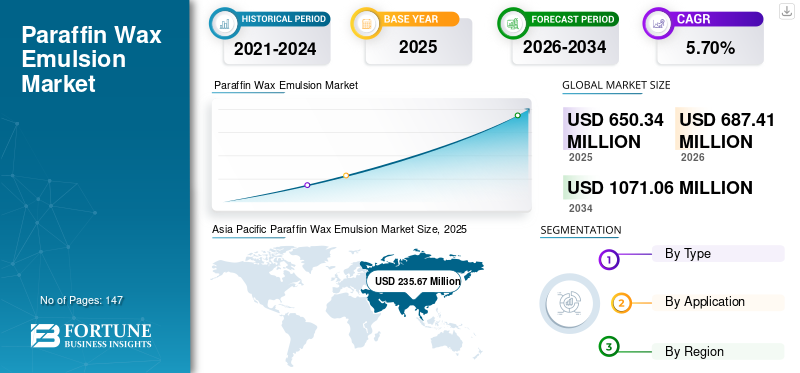
The global paraffin wax emulsion market size was valued at USD 650.34 million in 2025. The market is projected to grow from USD 687.41 million in 2026 to USD 1071.06 million by 2034, exhibiting a CAGR of 5.70% during the forecast period. Asia Pacific dominated the paraffin wax emulsion market with a market share of 36.24% in 2025.
The global COVID-19 pandemic has been unprecedented and staggering, with paraffin wax emulsion experiencing lower-than-anticipated demand across all regions compared to pre-pandemic levels. Based on our analysis, the global market exhibited a decline of 5.6% in 2020 as compared to 2019.
Wax emulsion is a mixture of one or more types of waxes in water, usually immiscible under normal conditions. However, they are blended together using specific processes and surfactants. The method of emulsifying paraffin wax involves heating the wax along with a surfactant or emulsifying agent and an adequate quantity of water to make a viscous paste, which is further transformed into the emulsion. The emulsion is primarily employed in coatings, paints, inks, paper and paperboards, gypsum board, and waterproofing formulations. The market growth is associated with the increasing demand for woodworking applications.
Download Free sample to learn more about this report.
PARAFFIN WAX EMULSION MARKET KEY TAKEAWAYS
 Global Market Size & Forecast
- 2025 Market Size: USD 650.34 million
- 2026 Market Size: USD 687.41 million
- 2034 Forecast Market Size: USD 1,071.06 million
- CAGR: 5.70% from 2026–2034
 Market Share
- Asia Pacific dominated the paraffin wax emulsion market with a 36.24% share in 2025.
- The natural segment is projected to account for 77.2% of the market in 2025.
- The paper segment is projected to generate USD 49.1 million in revenue in 2025.
 Key Regional Highlights
Asia Pacific
The market reached USD 235.67 million in 2025, driven by expanding construction, leather, agriculture, and paints & coatings industries.
North America
The market is expected to witness steady growth, supported by strong demand from paper manufacturing, agriculture, and residential construction.
Europe
The market is projected to grow at a 4.6% CAGR, driven by expanding manufacturing industries and rising investments in agriculture.
U.S.
The market is projected to expand steadily, supported by strong manufacturing capabilities, innovation, and growing investments in advanced technologies.
Japan
The market is projected to reach USD 22.8 million in 2025, supported by growing industrial and manufacturing activities.
Read More

Paraffin Wax Emulsion Market Trends
Adoption of Paraffin Wax Emulsion in Flexible Packaging Solutions to Boost Growth
The increasing technological advancement by manufacturers to expand their offerings for various applications in several industries will flourish the market growth throughout the forecast period. For instance, technologically advanced high solids paraffin wax emulsions are gaining traction for cosmetic and flexible packaging applications, film coatings, and barrier coatings due to their water repellent properties. Additionally, food manufacturers prefer adequate flexible packaging to decrease the possibility of food contamination and quality degradation. The ability of the emulsion to act as a barrier between food products and the external environment is surging the product demand. Asia Pacific witnessed a paraffin wax emulsion market growth from USD 181.1 million in 2020 to USD 188.8 million in 2021.
Download Free sample to learn more about this report.
DRIVING FACTORS
Rising Demand for Paraffin Wax from Paints & Coatings and Wood Working to Augment Growth
Paraffin wax emulsion is significantly consumed in paints & coatings and woodworking applications. The increasing demand for paints & coatings from several industries, including automotive, construction, industrial manufacturing, and electrical & electronics is responsible for product adoption. Furthermore, the growth is also attributed to the ability of wax paraffin emulsion to protect substances or materials from rusting and wear & tear. Moreover, the rising demand for wood from the furniture industry will augment the consumption of wax paraffin emulsion, as woodworking is one of the critical applications of this emulsion. The growing demand for beds, sofas, tables, and chairs from the residential and commercial sectors, increasing interior and exterior design of homes, and rising consumer spending on premium furniture products are the major factors boosting the consumption of wax emulsion in the furniture industry.
RESTRAINING FACTORS
Presence of Alternatives to Limit Market Growth
Various other wax emulsions are present in the market, including carnauba, polypropylene and polyethylene. Some of these substitutes offer similar characteristics to paraffin wax emulsion, and some provide eco-friendly properties. For instance, carnauba wax is extracted from carnauba palm leaves and offers eco-friendly features. On the other hand, polyethylene wax emulsion is one of the most widely used types of wax, owing to its easy availability and economical price. In addition, it also offers slip control, lubrication, water-repellency, abrasion resistance, and anti-blocking characteristics. Hence, increasing adoption of substitutes, their awareness amongst consumers, and fluctuation in raw material prices are expected to hinder product consumption and restrain the market growth.
SEGMENTATION ANALYSIS
By Type Analysis
Natural Segment to Hold Key Share Due to Easy Production
Based on type, the market is bifurcated into natural and synthetic. The natural type of the product is obtained by distillation of crude oil, which is then further fractionated, dewaxed, and crystallized to obtain paraffin wax. The final product is then emulsified to obtain natural paraffin wax emulsion. This emulsion is mainly used as there are several crude oil processing facilities, and the paraffin wax is received after processing byproducts. By type, the natural segment is expected to hold a 77.2% share in 2025.
Synthetic paraffin wax emulsion is produced by converting natural gas, biomass, or gasified coal into synthetic lubricating oil through the Fischer-Tropsch process. Even though the process is comparatively complicated, recent changes in the oil & gas industry, growing concerns over the environment, and increasing regulations are shifting the view of consumers toward synthetic wax emulsion.
By Application Analysis
To know how our report can help streamline your business, Speak to Analyst
Paints & Coatings Segment to Account for Largest Share Owing to High Demand from Several Industries
On the basis of application, the market is segmented into leather, agriculture, construction, paper, paints & coatings, and others. In the leather industry, paraffin wax emulsion is largely used as an additive for leather finishing, matting agent, and brightening. The increasing consumption of leather by the clothing and consumer goods companies propels the segment growth. By application, the paper segment is projected to generate USD 49.1 million in revenue by 2025.
Paraffin wax emulsion is considered an essential raw material in paints & coatings and inks formulations, as it aids suspension and dispersion of other additives, improves the appearance of pigment, enhances the luster, and ensures a better finish, thereby leading to the high demand from paints & coatings manufacturing.
In the construction industry, paraffin wax emulsion is commonly used as a curing agent to protect concrete against corrosion and rust. Increasing residential and commercial construction activities propel the demand for the product from the construction segment. The leather segment is expected to hold a 4% share in 2021.
REGIONAL Analysis
Asia Pacific
Asia Pacific Paraffin Wax Emulsion Market Size, 2025 (USD Million)
To get more information on the regional analysis of this market, Download Free sample
The market size in Asia Pacific was valued at USD 235.67 million in 2025. The exponential population growth and increasing urbanization activities are contributing to the development of several industries, such as construction, agriculture, leather manufacturing, and paints & coatings, which are augmenting product consumption in Asia Pacific. According to the State Council of the People's Republic of China, the operating revenue of major manufacturers of leather, footwear, feather, fur, and related products will reach USD 52.49 billion by 2022, with a growth rate of 7.9%.
- The paraffin wax emulsion market in Japan is expected to reach USD 22.8 million by 2025.
- India is projected to witness a strong CAGR of 6.80% during the forecast period.
Europe
The manufacturing industries in Europe, including automobiles, machinery & equipment building, chemicals, electrical engineering and electronics, and food processing activities are proliferating, thereby leading to the development of infrastructures and increased product demand. Additionally, the rising investments of the countries toward advancement of the agriculture sector will further fuel the product demand.
- Europe is anticipated to grow at a CAGR of 4.6% during the forecast period.
North America
North America held a substantial share in the market. Paper manufacturing and agriculture are the leading industries that played an essential part in the market’s growth and development. Moreover, expanding residential construction activities in the region will result in higher product adoption in medium-density fiberboard and oriented strand board.
South America
South America is estimated to show considerable growth in the market owing to increasing consumption in several industries such as automotive, textile, and cement. The rising demand for leather in the automotive industry coupled with the growing adoption of construction chemicals from the real estate industry will propel the use of wax paraffin emulsion.
Middle East & Africa
The Middle East & Africa is a prominent region for the petrochemicals industry, which dominates the overall economy of Saudi Arabia and the UAE. The Organization of the Petroleum Exporting Countries (OPEC) says that Saudi Arabia accounts for approximately 17% of the world's proven petroleum reserves and is the largest exporter of crude oil globally. This is expected to drive the regional market.
KEY INDUSTRY PLAYERS
Formation of Strategic Alliances to Improvise Business
The paraffin wax emulsion market is relatively consolidated and competitive, with many regional and international manufacturers. Some of the key players operating in the industry are PMC Crystal, Sasol Ltd, Altana AG, Lubrizol Corporation, and BASF, accounting for a major market share in 2021.
Strategic alliance with other players is one of the prime strategies of the key players. For instance, in 2022, Awax Group, one of Europe's leading wax manufacturers, acquired Sasol Wax GmbH, the wax division of Sasol Ltd.
LIST OF KEY COMPANIES PROFILED:
- PMC Crystal (U.S.)
- Sasol (South Africa)
- Altana AG (Germany)
- Lubrizol Corporation (U.S.)
- Nippon Seiro Co., Ltd (Japan)
- Michelman, Inc. (U.S.)
- TIANSHI WAX (China)
- BASF SE (Germany)
- Repsol (Spain)
KEY INDUSTRY DEVELOPMENTS:
- May 2021 - Michelman announced a new agreement with Omya, a producer of calcium carbonate and a universal distributor of specialty chemicals for its products. The agreement states that Omya will be the exclusive distributor for Michelman’s wax emulsion and surface modifiers product line to Canada’s paints and coating markets.
- August 2020– DKSH moved into an exclusive distribution contract with Sasol Wax GmbH, the Wax Division of Sasol Chemicals, a dedicated company in innovative wax technology, for four crucial markets in Europe. The agreement between DKSH and Sasol Chemicals waxes is to market and sell paraffin waxes, emulsions, and microcrystalline waxes.
REPORT COVERAGE
The paraffin wax emulsion market research report provides an analysis of the market and focuses on crucial aspects such as leading companies, products, and applications. It also offers insights into market trends and highlights industry developments. In addition, the report encompasses various factors contributing to the market's growth in recent years. It includes historical data & forecasts revenue growth at global, regional, and country levels, and analyzes the industry's latest market dynamics and opportunities.
Request for Customization to gain extensive market insights.
REPORT SCOPE & SEGMENTATION
|
ATTRIBUTE |
DETAILS |
|
Study Period |
2021-2034 |
|
Base Year |
2025 |
|
Estimated Year |
2026 |
|
Forecast Period |
2026-2034 |
|
Historical Period |
2021-2024 |
|
Unit |
Value (USD Million) and Volume (Kiloton) |
|
Segmentation |
By Type, Application, and Region |
|
By Type |
|
|
By Application |
|
|
By Region |
|
Frequently Asked Questions
Fortune Business Insights says that the global market size was USD 650.34 million in 2025 and is projected to reach USD 1,071.06 million by 2034.
In 2025, Asia Pacific stood at USD 235.67 million.
Registering a CAGR of 5.70%, the market will exhibit steady growth during the forecast period (2026-2034).
The paints & coatings segment is leading the market during the forecast period.
The rising demand from the paints & coatings industry is the key factor driving the market.
PMC Crystal, BASF, Sasol, Altana, and Lubrizol are the major players present in the market.
Asia Pacific dominated the market share of 36.24% in 2025.
Growing demand for flexible packaging and increasing technological advancements shall drive product adoption.



- 2021-2034
- 2025
- 2021-2024
- 147
Get 30-60 hrs Free Customization
Expand Regional and Country Coverage, Segments Analysis, Company Profiles, Competitive Benchmarking, and End-user Insights.


















-
US +1 833 909 2966 ( Toll Free )
-
Get In Touch With Us