 Download Free Sample



Get a Quote
Receive a tailored pricing based on your needs.
- Choose license type
- Multiple user options
- Custom scope & coverage
- Fast turnaround
"Smart Strategies, Giving Speed to your Growth Trajectory"
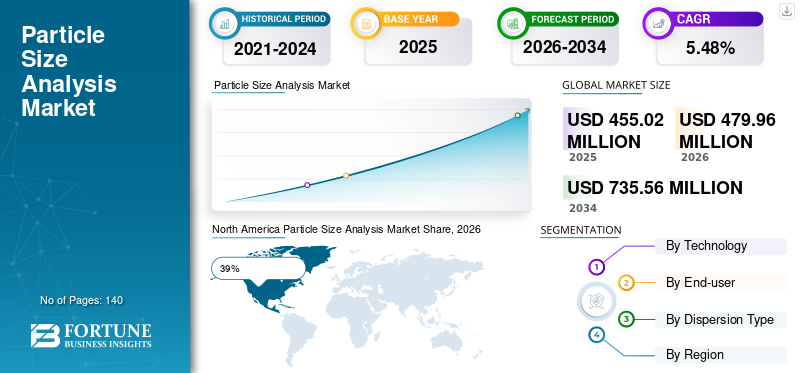
The particle size analysis market size was valued at USD 455.02 million in 2025. The market is projected to grow from USD 479.96 million in 2026 to USD 735.56 million by 2034, exhibiting a CAGR of 5.48% during the forecast period.

The particle size analysis market is experiencing significant expansion due to rising demand for precision measurement technologies across pharmaceuticals, healthcare, chemicals, food processing, and nanotechnology industries. Particle size analysis systems help manufacturers maintain product quality, improve formulation consistency, and optimize industrial processing efficiency. Growing emphasis on material characterization and quality control is driving adoption of advanced particle measurement technologies such as laser diffraction, nanoparticle tracking analysis, and imaging systems. The particle size analysis market report highlights increasing utilization of automated analytical instruments in research laboratories and manufacturing facilities. Technological advancements in real-time particle monitoring and digital analytics continue to strengthen particle size analysis market growth globally.
The USA particle size analysis market is witnessing robust growth because of increasing pharmaceutical manufacturing activities, strong biotechnology research infrastructure, and rising investment in nanotechnology development. Research laboratories, pharmaceutical companies, and industrial manufacturers across the United States increasingly rely on advanced particle characterization systems to improve product quality and regulatory compliance. The particle size analysis market analysis in the USA highlights strong demand for laser diffraction systems and nanoparticle tracking technologies within healthcare and material science applications. Expansion of drug formulation research and increasing focus on precision manufacturing continue to support the particle size analysis market outlook in the United States.
Download Free sample to learn more about this report.
 Global Market Size & Forecast
 Market Share
 Key Regional Highlights
North America
North America led the market with a 39% share, supported by advanced pharmaceutical and healthcare research infrastructure.
Europe
Europe accounted for 30% of the market, driven by strong pharmaceutical manufacturing and analytical testing activities.
Asia-Pacific
Asia-Pacific held a 23% share, supported by expanding healthcare, biotechnology, and nanotechnology research.
U.S
The U.S. remains a key market, supported by advanced pharmaceutical research and growing adoption of particle characterization technologies.
Japan
Japan accounted for approximately 25% of the Asia-Pacific market, supported by advanced healthcare infrastructure and growing nanotechnology research.
Read More

The particle size analysis market trends are increasingly shaped by rising adoption of automated analytical systems and artificial intelligence-based particle characterization technologies. Manufacturers and research institutions are integrating advanced software platforms with particle size analyzers to improve data accuracy, real-time monitoring, and laboratory productivity. Automation is becoming increasingly important within pharmaceutical manufacturing and nanotechnology research because it reduces manual errors and improves testing efficiency. Real-time inline particle measurement systems are also gaining popularity across industrial processing environments.
Download Free sample to learn more about this report.
Another important trend identified in the particle size analysis market research report is the growing demand for nanoparticle analysis technologies in biotechnology, healthcare, and advanced materials research. Nanoparticle tracking analysis and high-resolution imaging systems are increasingly utilized for drug delivery research, vaccine development, and environmental testing applications. Portable and compact particle size analyzers are also gaining traction among field researchers and quality control laboratories. The particle size analysis market forecast further highlights increasing integration of cloud-based analytics and digital laboratory management systems to improve data accessibility and collaborative research workflows.
Rising Demand for Precision Quality Control in Pharmaceutical Manufacturing
The increasing demand for precision quality control in pharmaceutical manufacturing is one of the primary factors driving particle size analysis market growth. Pharmaceutical companies rely heavily on particle characterization technologies to ensure formulation consistency, improve drug dissolution performance, and maintain regulatory compliance. Accurate particle size measurement is essential for optimizing drug bioavailability, powder flow properties, and manufacturing stability across oral solid dosage forms, inhalation products, and injectable formulations.
The particle size analysis market analysis highlights increasing utilization of advanced analytical systems across biotechnology research laboratories and pharmaceutical production facilities. Healthcare companies are emphasizing precision medicine development and advanced drug delivery systems, increasing the need for nanoparticle characterization technologies. Regulatory agencies are also encouraging strict quality assurance standards, driving adoption of automated particle measurement systems globally. Technological advancements in laser diffraction and nanoparticle tracking analysis are improving analytical accuracy and operational efficiency. Rising investment in pharmaceutical research and expansion of biologics manufacturing continue to strengthen the particle size analysis industry report worldwide.
High Equipment Costs and Operational Complexity
High equipment costs and operational complexity remain major restraints affecting the particle size analysis market share. Advanced particle characterization systems often require substantial investment, making adoption challenging for smaller laboratories and budget-sensitive manufacturing facilities. High-resolution imaging systems, laser diffraction analyzers, and nanoparticle tracking technologies involve expensive hardware components and specialized software platforms, increasing procurement and maintenance costs.
The particle size analysis market outlook also highlights challenges related to technical expertise and instrument calibration requirements. Particle size analysis systems require skilled laboratory professionals capable of interpreting complex analytical data and maintaining testing accuracy. Frequent calibration, software updates, and maintenance procedures may increase operational burdens for research institutions and industrial users. Additionally, integration challenges between laboratory information systems and analytical platforms can affect workflow efficiency. Regulatory compliance requirements and evolving testing standards further contribute to operational complexity within the particle size analysis market size.
Expansion of Nanotechnology and Advanced Material Research
The expansion of nanotechnology and advanced material research presents substantial particle size analysis market opportunities. Nanoparticle characterization is becoming increasingly important across biotechnology, electronics, cosmetics, and environmental sciences because particle dimensions directly influence product functionality and performance. Research institutions and manufacturers are investing heavily in analytical technologies capable of measuring nanoscale particles with high precision and reproducibility.
The particle size analysis market insights highlight increasing demand for advanced characterization systems within vaccine development, targeted drug delivery, and semiconductor manufacturing applications. Manufacturers are developing next-generation particle analysis instruments with improved sensitivity, faster processing speeds, and AI-driven data interpretation capabilities. Rising government support for nanotechnology innovation and increasing industrial automation are also creating strong market opportunities globally. Expansion of advanced materials research and increasing focus on sustainable manufacturing continue to strengthen the long-term outlook of the particle size analysis Iindustry analysis.
Maintaining Analytical Accuracy Across Complex Sample Types
Maintaining analytical accuracy across diverse and complex sample types remains one of the major challenges within the particle size analysis market forecast. Different materials require customized analytical approaches because variations in particle shape, density, transparency, and dispersion characteristics can significantly affect measurement accuracy. Laboratories and manufacturers often face difficulties selecting the appropriate particle analysis technology for highly specialized applications.
The particle size analysis market research report further highlights challenges related to standardization and cross-platform compatibility. Different analytical methods may produce varying results for identical sample materials, creating concerns regarding testing consistency and quality assurance. Manufacturers must continuously improve instrument calibration, software algorithms, and sample preparation methodologies to maintain analytical precision. Additionally, rapid technological evolution and increasing demand for high-throughput testing capabilities are placing pressure on companies to accelerate innovation while ensuring reliability within the particle size analysis market.
Imaging technologies contribute approximately 29% to the particle size analysis market because they provide detailed visualization of particle morphology, shape distribution, and structural characteristics. Imaging-based particle analysis systems are increasingly utilized within pharmaceutical research, material science laboratories, and environmental testing facilities because they offer high-resolution particle characterization capabilities. These systems are particularly valuable for irregularly shaped particles and complex sample materials. The particle size analysis market report highlights increasing demand for automated imaging systems integrated with AI-powered software capable of improving analytical precision and laboratory productivity. Manufacturers are developing advanced optical imaging platforms with enhanced digital processing features and real-time visualization capabilities. Rising utilization of microscopy-based particle analysis in biotechnology and nanomaterial research continues to strengthen the Imaging segment within the overall particle size analysis market growth landscape.
Nanoparticle Tracking Analysis (NTA) accounts for approximately 24% of the particle size analysis market share because it is highly effective for measuring nanoparticle size distribution and concentration in liquid suspensions. NTA technologies are widely utilized in biotechnology, vaccine development, and nanomedicine applications where precise nanoparticle characterization is essential. Healthcare and pharmaceutical research institutions increasingly rely on NTA systems for exosome analysis and biologics development. The particle size analysis market trends indicate growing adoption of nanoparticle characterization technologies within advanced drug delivery and gene therapy research programs. Manufacturers are introducing highly sensitive NTA instruments with automated sample handling and cloud-based data analysis capabilities. Expansion of nanotechnology applications and increasing biotechnology research investments continue to support growth within the NTA segment globally.
Laser Diffraction dominates the particle size analysis market with approximately 47% market share because it provides fast, accurate, and highly reproducible particle size measurement across a broad particle size range. Pharmaceutical manufacturers, chemical companies, and food processing industries extensively utilize laser diffraction systems for quality control and formulation optimization applications. The particle size analysis market analysis highlights increasing demand for automated laser diffraction systems integrated with real-time industrial process monitoring technologies. Manufacturers are developing compact instruments with enhanced sensitivity and advanced software analytics to improve testing efficiency. Rising emphasis on precision manufacturing and industrial automation continues to strengthen the Laser Diffraction segment globally.
To know how our report can help streamline your business, Speak to Analyst
Healthcare applications account for approximately 38% of the particle size analysis market because particle characterization plays a critical role in drug formulation, vaccine development, and biomedical research. Healthcare laboratories and pharmaceutical companies increasingly utilize particle size analyzers to improve therapeutic efficacy and ensure regulatory compliance. Nanoparticle analysis is particularly important within targeted drug delivery and biologics manufacturing applications. The particle size analysis market research report highlights rising investment in precision medicine and advanced pharmaceutical manufacturing technologies. Healthcare organizations are emphasizing analytical accuracy and quality assurance throughout drug development processes. Expansion of biotechnology innovation and increasing demand for nanoparticle therapeutics continue to strengthen the healthcare segment within the global market landscape.
Pharmaceuticals dominate the particle size analysis market with approximately 62% market share because pharmaceutical manufacturing heavily depends on precise particle characterization for formulation consistency and product performance optimization. Particle size directly influences dissolution rates, absorption efficiency, and stability of pharmaceutical products, making analytical testing essential throughout manufacturing processes. The particle size analysis market forecast highlights increasing adoption of automated analytical systems and real-time process monitoring technologies within pharmaceutical production facilities. Drug manufacturers are investing heavily in advanced characterization technologies to improve formulation precision and maintain compliance with strict regulatory standards. Rising biologics manufacturing and increasing focus on personalized medicine continue to support strong market growth within pharmaceutical applications globally.
Wet Dispersion contributes approximately 58% to the particle size analysis market because it is widely utilized for analyzing particles suspended in liquid media. Wet dispersion systems are commonly used in pharmaceutical, food processing, and chemical manufacturing applications because they provide accurate measurement for fine and cohesive particles. Laboratories prefer wet dispersion methods for nanoparticle characterization and biologics research applications.
The particle size analysis market Industry Analysis highlights increasing demand for automated wet dispersion systems capable of improving sample stability and analytical reproducibility. Manufacturers are developing advanced liquid handling technologies and integrated dispersion units optimized for high-throughput testing environments. Rising nanotechnology research activities continue to support growth within the Wet Dispersion segment globally.
North America Particle Size Analysis Market Share, 2026 (%)
To get more information on the regional analysis of this market, Download Free sample
North America dominates the particle size analysis market because of strong pharmaceutical manufacturing infrastructure, advanced research laboratories, and rising investment in nanotechnology development. Healthcare companies, biotechnology firms, and industrial manufacturers across the region increasingly rely on particle characterization technologies to improve product quality and research precision. North America represents approximately 39% of the global market.
The particle size analysis market Industry Analysis highlights growing adoption of automated analytical systems and AI-powered laboratory technologies throughout the region. Pharmaceutical companies are emphasizing precision manufacturing and advanced biologics research to maintain regulatory compliance and improve therapeutic outcomes. Expansion of biotechnology innovation and digital laboratory transformation continues to support regional market growth.
Europe remains a major contributor to the particle size analysis market because of increasing pharmaceutical research activities, advanced industrial manufacturing capabilities, and strong regulatory focus on quality assurance standards. Research laboratories and pharmaceutical companies across the region are investing in advanced particle characterization systems to improve product consistency and material performance. Europe contributes approximately 30% of the global market.
The particle size analysis market report highlights increasing demand for nanoparticle analysis technologies and automated quality control systems throughout European industries. Manufacturers are emphasizing sustainable production methods and precision analytical testing to improve operational efficiency. Expansion of biotechnology research and nanomaterial innovation continues to strengthen market growth across Europe.
Germany accounts for approximately 34% of the European particle size analysis market because of its advanced pharmaceutical manufacturing sector and strong industrial automation ecosystem. Research laboratories and industrial manufacturers across Germany increasingly utilize laser diffraction systems and imaging technologies for precision material characterization and process optimization.
The Germany particle size analysis market outlook highlights rising investment in nanotechnology research and digital laboratory infrastructure. Pharmaceutical companies are emphasizing analytical accuracy and automated quality assurance systems to improve manufacturing reliability. Germany’s strong engineering capabilities and innovation-driven industrial environment continue to support expansion of the particle size analysis market.
The United Kingdom contributes approximately 22% to the European particle size analysis market because of increasing biotechnology research and growing pharmaceutical development activities. Academic research institutions, healthcare laboratories, and industrial manufacturers are increasingly adopting nanoparticle characterization systems for advanced analytical applications.
The United Kingdom particle size analysis market forecast indicates rising demand for AI-integrated analytical instruments and cloud-based laboratory management technologies. Pharmaceutical companies are investing in precision formulation development and biologics manufacturing infrastructure. Expansion of life science innovation continues to strengthen the particle size analysis industry report within the United Kingdom.
Asia-Pacific is witnessing rapid expansion within the particle size analysis market because of increasing industrialization, growing pharmaceutical manufacturing capacity, and rising nanotechnology research investments. Healthcare organizations and manufacturing industries across the region increasingly rely on particle characterization technologies to improve quality control and product consistency. Asia-Pacific contributes approximately 23% of the global market.
The particle size analysis market trends indicate increasing demand for affordable automated analytical systems and advanced nanoparticle measurement technologies throughout Asia-Pacific. Government support for biotechnology innovation and expansion of industrial automation initiatives are supporting regional market development. Rising pharmaceutical exports and growing material science research activities continue to accelerate market growth.
Japan represents approximately 25% of the Asia-Pacific particle size analysis market because of its advanced electronics manufacturing sector and strong focus on precision analytical technologies. Pharmaceutical companies and research laboratories across Japan increasingly utilize high-resolution particle characterization systems for nanomaterial analysis and formulation optimization.
The Japan particle size analysis market analysis highlights rising investment in automated laboratory systems and advanced material science innovation. Manufacturers are emphasizing precision engineering and high-performance analytical technologies to maintain global competitiveness. Japan’s strong technological ecosystem continues to support growth within the particle size analysis market.
China accounts for approximately 41% of the Asia-Pacific particle size analysis market because of rapid pharmaceutical industry expansion and increasing investment in advanced manufacturing technologies. Industrial manufacturers, healthcare laboratories, and biotechnology firms are increasingly adopting particle characterization systems to improve production quality and research capabilities.
The China particle size analysis market research report highlights growing domestic manufacturing of analytical instruments and rising government support for nanotechnology innovation. Pharmaceutical companies are investing heavily in biologics development and automated quality control infrastructure. Expansion of industrial research activities and precision manufacturing initiatives continues to accelerate particle size analysis market growth across China.
The Rest of World particle size analysis market is gradually expanding as healthcare institutions, industrial manufacturers, and research organizations across Latin America, the Middle East, and Africa increasingly adopt advanced analytical technologies. Growing awareness regarding product quality optimization and precision manufacturing is supporting demand for particle characterization systems across emerging economies. Rest of World contributes approximately 8% of the global market.
Industrial modernization initiatives and expansion of pharmaceutical manufacturing activities are increasing adoption of automated particle analysis systems throughout developing regions. Healthcare laboratories and material science researchers are investing in advanced analytical infrastructure to improve research capabilities and product consistency. Rising industrial automation and biotechnology investments continue to create additional particle size analysis market opportunities globally.
The particle size analysis market opportunities segment is attracting strong investment from analytical instrument manufacturers, pharmaceutical companies, and nanotechnology research organizations. Investors are focusing on AI-powered analytical systems, real-time industrial monitoring technologies, and high-resolution nanoparticle characterization platforms. Growing demand for precision manufacturing and advanced pharmaceutical research is creating significant commercial opportunities across global industries.
The particle size analysis market insights highlight increasing investment in digital laboratory infrastructure and cloud-based data analytics systems. Manufacturers are developing automated particle analyzers with enhanced sensitivity, improved processing speed, and advanced software integration capabilities. Strategic collaborations between analytical instrument companies and research institutions are accelerating product innovation and market expansion. Rising emphasis on biologics manufacturing, nanotechnology research, and industrial automation continues to strengthen long-term investment potential within the particle size analysis Iindustry analysis.
The particle size analysis market trends highlight continuous innovation in automated analytical technologies and AI-driven particle characterization systems. Manufacturers are developing compact instruments with enhanced optical resolution, cloud connectivity, and automated sample handling capabilities. Advanced software platforms capable of real-time data interpretation and predictive analytics are improving laboratory productivity and analytical precision.
Analytical instrument companies are also introducing hybrid systems combining laser diffraction, imaging, and nanoparticle tracking technologies within single platforms to improve operational flexibility. The particle size analysis market research report highlights increasing innovation in portable analytical systems optimized for field testing and industrial quality control applications. Rising demand for precision testing and high-throughput laboratory automation continues to accelerate product development globally.
The particle size analysis market report provides comprehensive analysis of industry trends, technological developments, competitive landscape factors, and analytical innovation influencing global market expansion. The report evaluates major technologies including imaging systems, nanoparticle tracking analysis, laser diffraction, and automated analytical platforms. It also examines segmentation based on end-user industries, dispersion types, and regional industrial developments.
Request for Customization to gain extensive market insights.
The particle size analysis market research report further covers investment activities, product innovation trends, regulatory developments, and strategic collaborations among leading analytical instrument manufacturers. Company profiling sections analyze product portfolios, technological expertise, and operational strategies of major market participants. Regional analysis highlights pharmaceutical manufacturing expansion, nanotechnology research activities, and industrial automation trends across North America, Europe, Asia-Pacific, and Rest of World markets.
Fortune Business Insights says that the global market value stood at USD 455.02 million in 2025 and is projected to reach USD 735.56 million by 2034.
The market is expected to exhibit a CAGR of 5.48% during the forecast period of 2026-2034.
Laser Diffraction led the technology segment with approximately 47% market share, supported by its fast, accurate, and highly reproducible particle-size measurements across a broad size range.
Key players include Malvern Panalytical Ltd., Horiba Ltd., Agilent Technologies Inc., Microtrac Inc., Beckman Coulter Inc., and Anton Paar GmbH.
Major trends include growing adoption of automated and AI-based particle characterization systems and rising demand for nanoparticle analysis technologies. North America led with approximately 39% market share.


(Offer valid till 31st Oct 2026)
Get 30-60 hrs Free Customization
Expand Regional and Country Coverage, Segments Analysis, Company Profiles, Competitive Benchmarking, and End-user Insights.




















Get In Touch With Us
US +1 833 909 2966 ( Toll Free )
Receive a tailored pricing based on your needs.
Discuss your questions with our industry experts.
Have questions? Get quick answers before you purchase.

