Post Consumer Recycled Packaging Market Size, Share & Industry Analysis, By Material (PCR PET, PCR HDPE, PCR PP, PCR LDPE, and Others), By Packaging Type (Bottles, Boxes & Cartons, Bags & Pouches, Trays & Clamshells, and Others), By End-use Industry, (Food & Beverages, Healthcare, Personal Care & Cosmetics, Household, and Others), and Regional Forecast, 2026 – 2034
 Download Free Sample
(Offer valid till 30th Sep 2026)

KEY MARKET INSIGHTS
 Listen to Audio Version
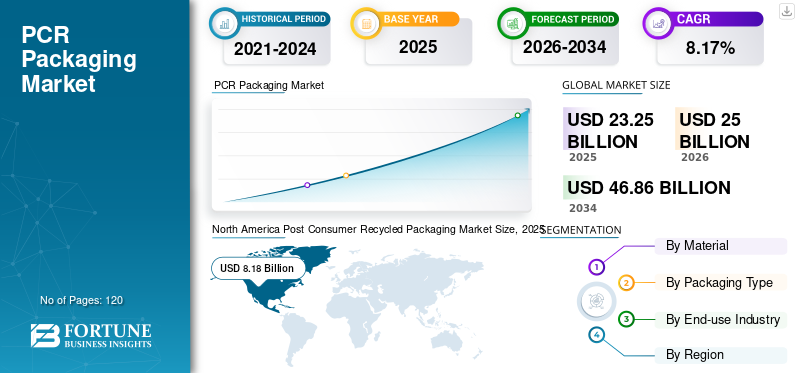
The global post consumer recycled packaging market size was valued at USD 23.25 billion in 2025. The market is projected to grow from USD 25.00 billion in 2026 to USD 46.86 billion by 2034, exhibiting a CAGR of 8.17% during the forecast period. North America dominated the global post consumer recycled packaging market with a market share of 35.18% in 2025.
Post-consumer recycled (PCR) packaging refers to packaging materials that are entirely or partially composed of plastics or fibers previously used by consumers. Improvements in curbside collection, optical sorting, and advanced recycling techniques are enhancing both the quantity and quality of available post-consumer recycled (PCR) feedstock. This progress minimizes contamination levels and enables the use of PCR in food-grade and high-value packaging applications, thereby boosting the growth of the global post-consumer recycled packaging market.
Key industry players, such as Amcor Plc, Mondi, and Novolex, are actively reducing the environmental impact and focusing on developing various innovative products that boost the global post consumer recycled packaging market.
Download Free sample to learn more about this report.
Post Consumer Recycled Packaging Market Takeaways
 Global Market Size & Forecast
- 2025 Market Size: USD 23.25 billion
- 2026 Market Size: USD 25.00 billion
- 2034 Forecast Market Size: USD 46.86 billion
- CAGR: 8.17% from 2026–2034
 Market Share
- North America dominated the post consumer recycled packaging market with a 35.18% share in 2025.
- The PCR PP segment is projected to grow at a 8.18% CAGR during the forecast period.
- The boxes & cartons segment is expected to register the highest growth with a 8.37% CAGR over the forecast period.
 Key Regional Highlights
North America
North America maintained its leading position with a market value of USD 8.18 billion in 2025.
Europe
Europe reached USD 3.77 billion in 2025 and is projected to record the second-highest regional CAGR of 8.64%.
Asia Pacific
Asia Pacific generated USD 6.75 billion in 2025, making it the third-largest regional market.
U.S.
The U.S. post consumer recycled packaging market was valued at approximately USD 6.19 billion in 2025.
Japan
The Japan post consumer recycled packaging market stood at approximately USD 206.52 million in 2025, accounting for around 2.83% of global market revenue.
Read More

POST CONSUMER RECYCLED PACKAGING MARKET TRENDS
Adoption of Minimum-PCR Purchase Commitments by Brands Emerges as a Key Trend
A notable trend influencing the PCR packaging market is the transition by leading brand owners from voluntary sustainability goals to explicit commitments for minimum purchases of PCR. Rather than articulating general objectives such as "enhance recycled content," brands are now delineating specific thresholds, typically 25%, 30%, or 50% PCR, for particular packaging formats such as beverage bottles, shampoo containers, and household product packages. These commitments are progressively integrated into long-term procurement agreements and supplier evaluation metrics, transforming PCR from an optional selection into a required component.
Download Free sample to learn more about this report.
MARKET DYNAMICS
MARKET DRIVERS
Growing Regulatory Push & Recycled-Content Mandates to Propel Market Growth
Governments and regions are progressively mandating the inclusion of recycled content in plastic packaging or enhancing Extended Producer Responsibility (EPR) regulations, compelling brand owners to procure additional post-consumer recycled (PCR) materials and to redesign packaging for improved recyclability; these legislative measures (along with proposals such as the EU’s Packaging and Packaging Waste Regulation (PPWR) and the expansion of EPR frameworks) represent some of the most evident immediate demand catalysts for PCR packaging. Thus, the increasing regulatory push and recycled-content mandates drive the global post consumer recycled packaging market growth.
MARKET RESTRAINTS
Price Volatility and Margin Pressure for Recyclers to Impede Market Growth
Fluctuations significantly influence the financial aspects of PCR recycling in the prices of virgin resin, energy expenses, and waste collection costs, which collectively contribute to considerable margin unpredictability for recyclers. Moreover, recyclers are confronted with increasing and frequently unpredictable input expenses. The processes of collection, sorting, washing, and decontamination require significant energy and labor, and inflation in electricity, water, transportation, and wages directly reduces profit margins.
MARKET OPPORTUNITIES
Investment in Advanced Recycling & Food-Grade Processes Provides Market Growth Opportunities
Investments in technology, such as enhanced washing, decontamination, and chemical recycling, present an opportunity to transform a greater number of waste streams into food-grade post-consumer recycled (PCR) materials, thereby facilitating high-value applications such as beverage containers and flexible food packaging. Collaborations between major players, including resin manufacturers, brand owners, and recycling companies, are expediting commercialization by feedstock quality. Thus, the growing investment in advanced recycling & food-grade processes offers market growth opportunities.
MARKET CHALLENGES
Infrastructure, Collection Gaps, and Regulatory Fragmentation Are Major Challenges to Market Expansion
Efficient PCR supply depends on strong collection, sorting, and logistics systems. In numerous countries, the infrastructure is disjointed, with informal collection prevailing; the integration of informal collectors, enhancement of returns systems, and financing of collection continue to pose considerable and time-intensive challenges. Various countries, along with subnational jurisdictions, establish differing regulations regarding recycled content, labeling requirements, and permissible uses for PCR; navigating this complex landscape increases compliance expenses and complicates global product introductions.
Segmentation Analysis
By Material
PET Segment to Dominate owing to Its Scalable Recycling Infrastructure
Based on material, the market is divided into PCR PET, PCR HDPE, PCR PP, PCR LDPE, and others.
The PCR PET segment is expected to account for the largest post consumer recycled packaging market share. PCR PET leads the worldwide PCR packaging sector due to its advantage of having the most developed and scalable recycling infrastructure among all plastics. This is bolstered by high collection rates, established bottle-to-bottle recycling systems, and robust consumer demand from end-users. Beverage bottles made from PET are extensively gathered through deposit return initiatives and municipal recycling programs, which yield cleaner and more uniform post-consumer feedstock in comparison to other polymers. This consistency enables converters and brand owners to procure PCR PET at a commercial scale, establishing it as the favored recyclable material for packaging uses.
The PCR PP segment is expected to grow at a CAGR of 8.18% over the forecast period.
By Packaging Type
High Consumption Boosted the Bottle Segment Growth
Based on packaging type, the market is segmented into bottles, boxes & cartons, bags & pouches, trays & clamshells, and others.
In 2025, the bottles segment dominated the global market. The bottles segment leads the global PCR packaging market, as bottles constitute the largest and most consistently collected rigid plastic format, particularly in applications related to beverages, personal care, and household products. PET and HDPE bottles are utilized in substantial volumes across the globe, generating a steady and dependable flow of post-consumer waste that can be effectively recovered and recycled into PCR materials. This robust collection-recycling cycle renders bottles the most feasible and scalable format for integrating post-consumer recycled content.
The boxes & cartons segment is projected to grow at a CAGR of 8.37% over the forecast period.
By End-use Industry
To know how our report can help streamline your business, Speak to Analyst
High Volumes, Regulatory Focus, and Brand Sustainability Commitments Drive Food & Beverages Dominance
Based on the end-use industry, the market is segmented into food & beverages, healthcare, personal care & cosmetics, household, and others.
The food & beverages segment is expected to hold a dominant market share over the forecast period. The food & beverage end-use sector leads the global PCR packaging market as it represents the largest volume consumer of plastic packaging, especially in the forms of bottles, containers, and rigid packaging. The substantial consumption of packaged water, soft drinks, dairy items, sauces, and ready-to-eat meals creates a considerable demand for packaging, meaning that even slight increases in consumer recycled PCR content can result in substantial material volumes. This phenomenon positions the food & beverage industry as a leader in the adoption of PCR.
The personal care & cosmetics segment is projected to grow at a CAGR of 7.65% over the forecast period.
Post Consumer Recycled Packaging Market Regional Outlook
By geography, the market is categorized into Europe, North America, Asia Pacific, Latin America, and the Middle East & Africa.
North America
North America Post Consumer Recycled Packaging Market Size, 2025 (USD Billion)
To get more information on the regional analysis of this market, Download Free sample
North America held the dominant share in 2024, valued at USD 7.65 billion, and maintained its leading position in 2025, with a value of USD 8.18 billion. In North America, the market for PCR packaging is mainly influenced by corporate sustainability commitments supported by changing state-level regulations, rather than by consistent federal mandates. Major FMCG brands and retailers, particularly in the food, beverage, and personal care sectors, are pledging to incorporate a minimum amount of PCR content to fulfill their ESG objectives and satisfy retailer scorecards.
U.S Post Consumer Recycled Packaging Market
Based on North America’s strong contribution and the U.S. dominance within the region, the U.S. market can be analytically approximated at around USD 6.19 billion in 2025, accounting for roughly 26.62% of global post-consumer recycled packaging sales.
Europe
Europe is projected to record a growth rate of 8.64% in the coming years, the second-highest among all regions, and reach a valuation of USD 3.77 billion by 2025. The PCR packaging market in the region is primarily influenced by regulations, supported by some of the most stringent circular economy and waste directives globally. Compulsory targets for recycled content, eco-modulated Extended Producer Responsibility (EPR) fees, and comprehensive reporting obligations render the use of PCR less of an option and more of a fundamental requirement.
U.K Post Consumer Recycled Packaging Market
The U.K. post-consumer recycled packaging market in 2025 reached around USD 642.26 million, representing approximately 2.76% of global post-consumer recycled packaging revenues. In the U.K., the growth of PCR packaging is primarily influenced by recycled-content mandates that vary by state and robust sustainability requirements set by retailers, rather than by overarching national legislation. The market in the U.K. is marked by a commercial demand from brands and retailers, which is further supported by targeted regulatory pressure.
Germany Post Consumer Recycled Packaging Market
Germany’s post-consumer recycled packaging market is projected to reach approximately USD 914.40 million in 2025, equivalent to around 3.93% of global post-consumer recycled packaging sales.
Asia Pacific
Asia Pacific reached USD 6.75 billion in 2025 and secured the position of the third-largest region in the market. In the region, India and China are both estimated to reach USD 360.61 million and USD 410.61 million, respectively, in 2025. In the Asia Pacific (APAC) region, the market for PCR packaging is propelled by a swift increase in the consumption of packaged goods, alongside progressively stricter regulations concerning waste and plastic products. Although the enforcement of these regulations differs significantly from one country to another, multinational companies operating within the region implement global PCR standards at a local level, thereby generating initial demand.
Japan Post Consumer Recycled Packaging Market
The market in Japan stood at USD 206.52 billion in 2025, accounting for approximately 2.83% of global post consumer recycled packaging revenues. The PCR packaging market in Japan is propelled by a focus on material efficiency, a culture of waste reduction, and advanced recycling systems, rather than stringent mandates for recycled content. Japanese firms prioritize lightweight design, meticulous material sorting, and high-purity recycling processes, allowing for the use of PCR without sacrificing performance or visual appeal.
China Post Consumer Recycled Packaging Market
China’s market is projected to be one of the largest worldwide, with revenues reaching around USD 2.24 billion in 2025, representing roughly 9.64% of global post consumer recycled packaging sales.
India Post Consumer Recycled Packaging Market
The Indian market in 2025 stood at USD 1.79 billion, accounting for roughly 7.71% of global post consumer recycled packaging revenues.
Latin America and the Middle East & Africa
The Latin America and Middle East & Africa regions are expected to witness moderate growth in this market during the forecast period. The Latin America market is set to reach a valuation of USD 2.47 billion in 2025, driven by the challenges of urban waste, the enhancement of collection systems, and the sustainability pressures imposed by global brand owners.
In the Middle East & Africa, South Africa is set to reach a value of USD 0.16 billion in 2025.
Saudi Arabia Post Consumer Recycled Packaging Market
The market in Saudi Arabia reached approximately USD 624.11 million in 2025, accounting for roughly 2.68% of global post consumer recycled packaging revenues.
COMPETITIVE LANDSCAPE
Key Industry Players
Focus on Expanding New Product Launches by Key Players to Propel Market Progress
The global post consumer recycled packaging market has a semi-consolidated market structure, comprising prominent players such as Amcor Plc, Mondi, and Novolex. The significant market share of these companies is due to numerous strategic activities, including collaboration among operating entities to advance research activities through various ongoing clinical trials.
- For instance, in September 2021, UPM Glenroy Inc. revealed "TruRenu" as the designated brand name for their sustainable flexible packaging range, aimed at assisting brands and retailers in reaching their sustainability objectives. The TruRenu sustainable flexible packaging range includes recyclable pouches and film laminations that are eligible for the How2Recycle store drop-off label program, and post-consumer recycled (PCR) pouches and film laminations containing up to 53% recycled material.
Other notable players in the global market include Klöckner Pentaplast, Glenroy, and ProAmpac. These companies are expected to prioritize new product launches and collaborations to increase their global market share during the forecast period.
LIST OF KEY POST CONSUMER RECYCLED PACKAGING COMPANIES PROFILED
- Amcor Plc(Switzerland)
- Mondi (U.K.)
- Novolex (U.S.)
- Klöckner Pentaplast(Luxembourg)
- Glenroy (U.S.)
- ProAmpac (U.S.)
- Vonco (U.S.)
- DXC Pack (China)
- Evergreen Resources (U.S.)
- PTT Global Chemical Public Company Limited (Thailand)
- APackaging Group (U.S.)
- HOPF (Germany)
- First Quality Enterprises, Inc. (U.S.)
- Mauser Packaging Solutions (U.S.)
- Emmerson Packaging (Canada)
KEY INDUSTRY DEVELOPMENTS
- September 2025: Amcor and Burts collaborated to introduce crisp packaging that contains 55% post-consumer recycled materials. Utilizing Amcor’s AmFiniti solution, the packaging is crafted from advanced recycled materials and adheres to the ISCC-certified mass balance methodology. This material provides equivalent quality and performance to virgin plastic, ensuring it is appropriate and safe for food-grade uses without sacrificing product integrity.
- October 2025: Emerald Packaging, in collaboration with Walmart, introduced an innovative packaging solution for the potato sector, featuring 30% post-consumer recycled (PCR) materials. This product marks a pioneering advancement in its category and has been created in partnership with Idaho Package and Wada Farms.
- July 2025: Amcor, a worldwide leader in the development and production of sustainable packaging solutions, announced an investment in its facility located in Nicholasville, Kentucky, aimed at enhancing its capabilities for producing post-consumer recycled (PCR) packaging to meet the diverse PCR requirements of its customers.
- December 2023: Novolex, a frontrunner in packaging options, innovation, and sustainability, launched food packaging containers that are recyclable, where facilities are available, and contain at least 10% post-consumer recycled (PCR) material.
- January 2022: Klöckner Pentaplast (kp), a worldwide frontrunner in products made from recycled materials and high-barrier protective packaging, declared its plan to increase its capacity for post-consumer recycled content (PCR) PET in North America through a substantial investment aimed at enhancing its sustainable innovation portfolio in the consumer health, pharmaceutical, and food packaging sectors.
REPORT COVERAGE
Request for Customization to gain extensive market insights.
Report Scope & Segmentation
|
ATTRIBUTE |
DETAILS |
|
Study Period |
2021-2034 |
|
Base Year |
2025 |
|
Estimated Year |
2026 |
|
Forecast Period |
2026-2034 |
|
Historical Period |
2021-2024 |
|
Growth Rate |
CAGR of 8.17% from 2026-2034 |
|
Unit |
Value (USD Billion) |
|
Segmentation |
By Material, Packaging Type, End-use Industry, and Region |
|
By Material |
· PCR PET · PCR HDPE · PCR PP · PCR LDPE · Others |
|
By Packaging Type |
· Bottles · Boxes & Cartons · Bags & Pouches · Trays & Clamshells · Others |
|
By End-use Industry |
· Food & Beverages · Healthcare · Personal Care & Cosmetics · Household · Others |
|
By Region |
· North America (By Material, Packaging Type, End-use Industry, and Country) o U.S. o Canada · Europe (By Material, Packaging Type, End-use Industry, and Country/Sub-region) o Germany o U.K. o France o Italy o Spain o Russia o Poland o Romania o Rest of Europe · Asia Pacific (By Material, Packaging Type, End-use Industry, and Country/Sub-region) o China o Japan o India o Australia o Southeast Asia o Rest of Asia Pacific · Latin America (By Material, Packaging Type, End-use Industry, and Country/Sub-region) o Brazil o Mexico o Argentina o Rest of Latin America · Middle East & Africa (By Material, Packaging Type, End-use Industry, and Country/Sub-region) o Saudi Arabia o UAE o Oman o South Africa o Rest of Middle East & Africa |
Frequently Asked Questions
According to Fortune Business Insights, the global market value stood at USD 23.25 billion in 2025 and is projected to reach USD 46.86 billion by 2034.
In 2025, the market value stood at USD 8.18 billion.
The market is expected to exhibit a CAGR of 8.17% during the forecast period (2026-2034).
By material, the PCR PET segment is expected to lead the market.
Growing regulatory push & recycled-content mandates are the key factors driving market expansion.
Amcor Plc, Mondi, Novolex, Klöckner Pentaplast, Glenroy, and ProAmpac are major players in the global market.
North America dominated the market in 2025.



- 2021-2034
- 2025
- 2021-2024
- 120
-
(Offer valid till 30th Sep 2026)
Get 30-60 hrs Free Customization
Expand Regional and Country Coverage, Segments Analysis, Company Profiles, Competitive Benchmarking, and End-user Insights.








-
US +1 833 909 2966 ( Toll Free )
-
Get In Touch With Us