 Download Free Sample



Get a Quote
Receive a tailored pricing based on your needs.
- Choose license type
- Multiple user options
- Custom scope & coverage
- Fast turnaround
"Designing Growth Strategies is in our DNA"
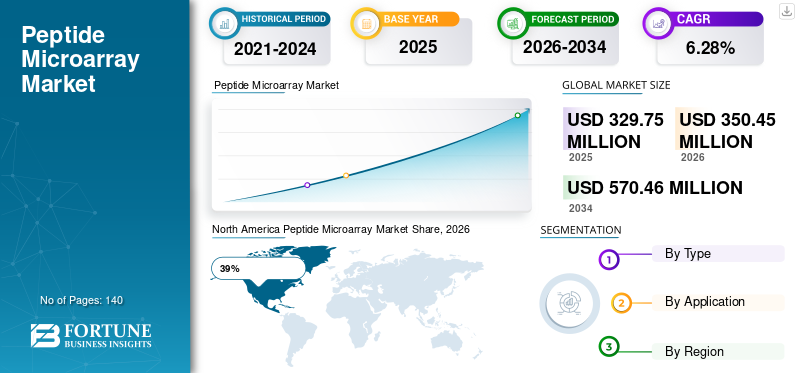
The peptide microarray market size was valued at USD 329.75 million in 2025. The market is projected to grow from USD 350.45 million in 2026 to USD 570.46 million by 2034, exhibiting a CAGR of 6.28% during the forecast period.

The peptide microarray market is gaining strong attention across biotechnology, proteomics, immunology, and molecular diagnostics sectors due to the increasing need for high-throughput screening technologies. Peptide microarrays enable researchers to analyze thousands of peptide interactions simultaneously, supporting biomarker discovery, antibody profiling, epitope mapping, and disease diagnostics. The growing focus on precision medicine, personalized therapeutics, and advanced protein analysis is accelerating adoption across pharmaceutical and biotechnology laboratories. peptide microarray market analysis indicates increasing demand for automated platforms, improved peptide synthesis technologies, and multiplex testing capabilities. peptide microarray market trends also highlight rising utilization in vaccine research, oncology studies, autoimmune disease investigations, and infectious disease monitoring across research institutions worldwide.
Download Free sample to learn more about this report.
 Global Market Size & Forecast
 Market Share
 Key Regional Highlights
North America
North America led the market with a 39% share, supported by advanced biomedical research and pharmaceutical development.
Europe
Europe accounted for 28% of the market, driven by growing investments in proteomics and molecular diagnostics.
Asia-Pacific
Asia-Pacific held a 24% share, supported by expanding biotechnology research and healthcare infrastructure.
U.S
The U.S. remains a key market, supported by advanced biomedical research and growing adoption of peptide microarray technologies.
Japan
Japan accounted for approximately 21% of the Asia-Pacific market, supported by advanced life sciences research and growing demand for molecular analysis technologies.
Read More

One of the most significant peptide microarray market trends is the integration of artificial intelligence and bioinformatics platforms with peptide array analysis. Laboratories are increasingly utilizing advanced analytical software to process large datasets generated from high-density peptide arrays. This trend improves identification of disease-specific biomarkers and supports predictive modeling for therapeutic development. High-resolution epitope mapping is becoming a standard approach in antibody characterization and vaccine development programs.
Download Free sample to learn more about this report.
Another emerging trend within the peptide microarray market is the increasing demand for customized peptide libraries designed for specific disease targets. Pharmaceutical companies are adopting personalized peptide microarray solutions for oncology, autoimmune disorders, and infectious disease research. Enhanced peptide synthesis techniques now allow researchers to create large-scale peptide collections with greater accuracy and reproducibility. Growing utilization of multiplex immunoassays and microfluidic technologies is further strengthening the peptide microarray market outlook by improving assay sensitivity, reducing sample consumption, and enabling faster research workflows.
Rising Demand for Precision Medicine and Biomarker Discovery
The increasing emphasis on precision medicine has become a major growth driver for the peptide microarray market. Healthcare providers and pharmaceutical companies are seeking technologies capable of identifying disease-specific biomarkers with high accuracy. Peptide microarrays provide large-scale screening capabilities that enable researchers to study protein interactions, immune responses, and disease progression mechanisms. As healthcare systems move toward individualized treatment approaches, the demand for advanced molecular diagnostic tools continues to expand.
peptide microarray market growth is further supported by extensive research activities in cancer immunotherapy, autoimmune disorders, infectious diseases, and neurological conditions. researchers utilize peptide arrays to identify therapeutic targets and validate biological pathways. Growing investments in proteomics and translational medicine programs have increased the deployment of peptide microarray platforms across academic institutions and biotechnology companies. The technology’s ability to deliver rapid and detailed molecular information positions it as a valuable solution for next-generation diagnostics and therapeutic development.
High Costs Associated with Advanced Peptide Synthesis and Array Fabrication
Despite significant technological advancements, the peptide microarray market faces restraints related to the cost of production and implementation. High-quality peptide synthesis requires sophisticated manufacturing equipment, specialized reagents, and stringent quality control procedures. These factors increase overall operational expenses and limit adoption among smaller research organizations and emerging biotechnology firms.
The complexity of array design and validation also contributes to elevated development costs. Laboratories often require skilled personnel to interpret data and manage experimental workflows. In addition, maintaining reproducibility across large peptide libraries remains challenging for some manufacturers. peptide microarray industry report assessments indicate that budget limitations within academic institutions can slow technology deployment. Cost-related barriers may restrict market penetration in developing economies where research funding and laboratory infrastructure remain relatively limited compared with established biotechnology regions.
Expansion of Immunotherapy and Vaccine Development Programs
Growing interest in immunotherapy and vaccine research creates substantial opportunities within the peptide microarray market. Pharmaceutical companies increasingly depend on peptide arrays to evaluate immune responses, identify antigenic targets, and characterize antibody interactions. The technology enables comprehensive mapping of immune system behavior, supporting development of next-generation vaccines and therapeutic antibodies.
peptide microarray market opportunities are expanding as global healthcare organizations prioritize preparedness for emerging infectious diseases. researchers use peptide arrays to analyze pathogen-specific immune responses and accelerate vaccine candidate selection. Increasing investments in oncology immunotherapy further enhance market potential. Advanced peptide microarray platforms provide valuable insights into tumor-associated antigens and immune escape mechanisms. These capabilities strengthen their role in therapeutic discovery pipelines and support continued demand from biotechnology and pharmaceutical sectors worldwide.
Data Interpretation Complexity and Standardization Limitations
One of the major challenges facing the peptide microarray market is the complexity associated with data analysis and interpretation. Large-scale peptide arrays generate extensive datasets that require advanced computational tools and specialized expertise. Variability in experimental conditions can influence assay outcomes, making standardization a critical concern across research environments.
peptide microarray market forecast studies indicate that differences in peptide immobilization methods, detection technologies, and analytical workflows may affect result consistency. Regulatory requirements for clinical applications further increase validation demands. Many laboratories face difficulties integrating large datasets into actionable biological insights. Addressing these challenges requires improved software platforms, standardized operating procedures, and collaborative efforts among technology developers, researchers, and healthcare organizations. Successfully overcoming these barriers will be essential for broader commercial adoption and clinical utilization.
Reagents account for approximately 58% of the peptide microarray market share due to their continuous utilization in peptide synthesis, assay preparation, labeling procedures, and detection workflows. research laboratories require a steady supply of specialized reagents to perform high-throughput screening experiments and maintain assay consistency. Growing demand for customized peptide libraries and biomarker discovery programs continues driving reagent consumption across pharmaceutical and academic sectors. The increasing complexity of proteomics studies has expanded demand for high-purity reagents capable of supporting sensitive analytical applications. peptide microarray market research report evaluations indicate that innovations in surface chemistry and peptide immobilization technologies are improving assay performance. Reagent manufacturers continue introducing optimized solutions designed for enhanced specificity, reproducibility, and signal detection. Strong recurring demand makes this segment a critical contributor to overall market expansion.
Services represent nearly 42% of the peptide microarray market share as organizations increasingly outsource peptide synthesis, array fabrication, assay development, and data analysis activities. Biotechnology firms often prefer specialized service providers to reduce operational costs and gain access to advanced expertise without investing heavily in internal infrastructure. peptide microarray industry analysis demonstrates growing demand for contract research services focused on epitope mapping, antibody characterization, biomarker identification, and vaccine development. Service providers offer customized solutions tailored to specific research objectives, enabling faster project execution. The expansion of precision medicine initiatives and collaborative research programs continues supporting growth within the services segment. Increasing complexity of peptide array studies further strengthens demand for professional analytical and consulting services.
To know how our report can help streamline your business, Speak to Analyst
Disease diagnostics holds approximately 46% of the peptide microarray market share, making it one of the largest application segments. Healthcare organizations increasingly rely on peptide microarrays to detect disease-specific biomarkers and improve diagnostic accuracy. The technology supports early identification of cancer, autoimmune disorders, infectious diseases, and neurological conditions through comprehensive protein interaction analysis. Growing emphasis on personalized healthcare has accelerated adoption of peptide microarrays within diagnostic laboratories. peptide microarray market insights indicate increasing use of multiplex diagnostic platforms capable of analyzing multiple disease markers simultaneously. Enhanced sensitivity and specificity contribute to improved patient management and treatment planning. Continuous advancements in biomarker discovery are expected to strengthen the role of peptide microarrays within clinical diagnostics and translational medicine programs.
Protein functional analysis accounts for nearly 54% of the peptide microarray market share due to widespread use in proteomics research, drug discovery, and therapeutic development. researchers utilize peptide arrays to investigate protein interactions, signaling pathways, enzyme activities, and immune system responses. These capabilities support identification of novel therapeutic targets and molecular mechanisms associated with disease progression. peptide microarray market size expansion within this segment is driven by increasing investments in biological research and advanced molecular characterization studies. Pharmaceutical companies use peptide microarrays to evaluate drug candidates and assess target engagement during preclinical development. Growing interest in systems biology and precision medicine continues stimulating demand for comprehensive protein analysis platforms. High-throughput functionality and detailed molecular insights make peptide microarrays essential tools for modern biomedical research.
North America Peptide Microarray Market Share, 2026 (%)
To get more information on the regional analysis of this market, Download Free sample
North America accounts for approximately 39% of the global peptide microarray market share. The region benefits from advanced healthcare infrastructure, strong biotechnology investment, and significant research funding. Pharmaceutical companies, academic institutions, and government-supported laboratories extensively utilize peptide microarray technologies for disease diagnostics, biomarker discovery, and therapeutic development. High levels of innovation continue strengthening regional leadership in peptide array applications.
Growing adoption of precision medicine and personalized treatment approaches further supports market expansion. The region hosts numerous biotechnology startups and established life science organizations actively investing in proteomics and immunology research. Increased demand for advanced diagnostic solutions and high-throughput screening technologies continues driving the North American peptide microarray market outlook.
Europe represents approximately 28% of the global peptide microarray market share. Strong research collaboration networks, well-developed biotechnology ecosystems, and extensive academic involvement contribute to regional growth. Countries across the region continue expanding investments in molecular diagnostics, translational medicine, and pharmaceutical innovation.
peptide microarray market trends in Europe emphasize increasing adoption of advanced analytical technologies for cancer research, autoimmune disease investigations, and infectious disease monitoring. Regulatory support for biotechnology innovation and expanding public-private partnerships further encourage technology implementation. Growing demand for personalized healthcare solutions remains a major factor supporting regional market development.
Germany contributes approximately 26% of the European peptide microarray market share. The country maintains a strong position within life sciences research through its extensive network of research institutes, biotechnology companies, and pharmaceutical manufacturers. Demand for peptide microarrays continues increasing in oncology, immunology, and proteomics applications.
German researchers actively utilize peptide array technologies for biomarker discovery and therapeutic target validation. The country's advanced laboratory infrastructure supports adoption of high-throughput screening platforms and customized peptide libraries. peptide microarray market analysis for Germany highlights increasing collaboration between academic centers and biotechnology companies focused on precision medicine initiatives. Growing investments in molecular diagnostics and biomedical innovation continue supporting long-term market expansion.
The United Kingdom accounts for approximately 22% of the European peptide microarray market share. Strong academic research capabilities and an established biotechnology sector contribute significantly to technology adoption. Universities and healthcare institutions increasingly employ peptide microarrays for disease profiling, immunological studies, and biomarker identification.
peptide microarray market research report assessments indicate rising demand for personalized diagnostic solutions across the country. Ongoing investments in genomics, proteomics, and precision healthcare programs are supporting broader utilization of peptide array platforms. Collaborative research projects involving public institutions and private biotechnology firms continue enhancing innovation within the UK market. Advanced analytical capabilities remain a major factor driving future growth opportunities.
Asia-Pacific holds approximately 24% of the global peptide microarray market share and represents one of the fastest-developing regions. Expanding healthcare infrastructure, increasing biotechnology investments, and rising awareness of advanced diagnostic technologies are supporting market growth. Governments across the region continue promoting biomedical research and innovation initiatives.
peptide microarray market opportunities are increasing due to growing demand for personalized medicine, proteomics research, and infectious disease monitoring. Academic institutions and pharmaceutical organizations are expanding utilization of peptide arrays for drug discovery and biomarker identification. The region's large patient population and growing healthcare expenditure further contribute to market expansion.
Japan represents approximately 21% of the Asia-Pacific peptide microarray market share. The country's strong biotechnology capabilities and emphasis on technological innovation support widespread adoption of peptide microarray solutions. research organizations actively utilize peptide arrays for cancer research, immune profiling, and protein interaction studies.
peptide microarray industry report evaluations highlight increasing integration of advanced diagnostic technologies within Japanese healthcare systems. Strong government support for scientific research and collaboration between academic institutions and pharmaceutical companies continues driving technology advancement. Demand for high-precision molecular analysis tools remains a key factor supporting market development in Japan.
China contributes approximately 35% of the Asia-Pacific peptide microarray market share. Rapid expansion of biotechnology research, increasing healthcare investments, and growing pharmaceutical manufacturing activities have strengthened demand for peptide microarray technologies. The country continues expanding research capabilities across genomics, proteomics, and molecular diagnostics.
peptide microarray market growth in China is supported by government initiatives promoting scientific innovation and healthcare modernization. Universities, research institutes, and biotechnology companies increasingly utilize peptide arrays for biomarker discovery and drug development programs. Growing awareness of precision medicine and advanced diagnostic approaches continues creating new opportunities for market participants.
The Rest of World region accounts for approximately 9% of the global peptide microarray market share. Countries across Latin America, the Middle East, and Africa are gradually expanding biotechnology research activities and healthcare infrastructure investments. Demand for advanced diagnostic technologies continues increasing as healthcare systems modernize.
peptide microarray market insights indicate rising adoption of molecular diagnostic tools in research institutions and specialized healthcare centers. International collaborations and technology transfer initiatives are supporting market development across emerging economies. Growing interest in infectious disease monitoring, personalized medicine, and biomedical research is expected to encourage broader implementation of peptide microarray platforms throughout the region.
The peptide microarray market is attracting substantial investment from biotechnology companies, pharmaceutical organizations, venture capital groups, and research institutions. Investors are focusing on technologies that support biomarker discovery, precision medicine, and next-generation diagnostic development. Increasing demand for high-throughput screening platforms has encouraged funding for advanced peptide synthesis systems, automation technologies, and data analytics solutions.
peptide microarray market opportunities are particularly strong within oncology research, vaccine development, autoimmune disease diagnostics, and therapeutic antibody characterization. Strategic partnerships between biotechnology firms and academic institutions continue generating new commercialization pathways. Investment activity is also increasing in Asia-Pacific countries where governments are expanding biotechnology infrastructure. Companies capable of delivering customized peptide libraries, advanced analytical services, and integrated bioinformatics platforms are expected to benefit from growing industry demand. Expansion of clinical research activities and translational medicine programs further enhances long-term investment potential across global markets.
Innovation remains a central component of the peptide microarray market. Manufacturers are introducing higher-density peptide arrays capable of analyzing thousands of molecular interactions within a single experiment. Enhanced surface chemistries and improved immobilization methods are increasing assay sensitivity and reproducibility. These advancements enable more accurate detection of disease-associated biomarkers and immune responses.
Recent product development efforts focus on integrating automation, artificial intelligence, and cloud-based analytical platforms with peptide microarray workflows. Companies are also expanding customized peptide library offerings designed for oncology, infectious disease research, and antibody profiling applications. peptide microarray market trends indicate increasing development of multiplex testing solutions that reduce sample consumption while improving throughput. Advanced fluorescence detection systems and miniaturized array formats continue improving laboratory efficiency and supporting broader adoption across research and diagnostic settings.
The peptide microarray market report provides extensive coverage of industry trends, market dynamics, technological developments, competitive landscapes, and emerging opportunities. The report evaluates key growth factors influencing adoption across biotechnology, pharmaceutical, academic, and clinical research environments. Comprehensive segmentation analysis examines market performance by type, application, end use, and geographical region.
Request for Customization to gain extensive market insights.
peptide microarray market forecast assessments also examine developments in biomarker discovery, disease diagnostics, protein functional analysis, and therapeutic research. The report analyzes strategic initiatives undertaken by major market participants, including product innovation, partnerships, research collaborations, and capacity expansion activities. Regional evaluations highlight opportunities across North America, Europe, Asia-Pacific, and Rest of World markets. Detailed coverage of investment trends, regulatory influences, and technological advancements provides valuable insights for stakeholders seeking a comprehensive understanding of the evolving peptide microarray industry outlook.
The global Peptide Microarray Market was valued at USD 329.75 million in 2025 and is projected to reach USD 570.46 million by 2034.
The market is expected to grow at a CAGR of 6.28% during the forecast period.
Reagents was the leading type segment, accounting for approximately 58% of the market, driven by continuous use in peptide synthesis, assay preparation, labeling, and detection workflows.
Key players include PEPperPRINT GmbH, RayBiotech, Inc., Creative Biolabs, Aurora Biomed Inc., Kinexus Bioinformatics Corporation, and Bio-Synthesis Inc.
Major trends include the integration of AI and bioinformatics with peptide array analysis and rising demand for customized peptide libraries. North America led the market with a 39% market share.


(Offer valid till 15th Nov 2026)
Get 30-60 hrs Free Customization
Expand Regional and Country Coverage, Segments Analysis, Company Profiles, Competitive Benchmarking, and End-user Insights.













.webp)






Get In Touch With Us
US +1 833 909 2966 ( Toll Free )
Receive a tailored pricing based on your needs.
Discuss your questions with our industry experts.
Have questions? Get quick answers before you purchase.

