Personal Finance Software Market Size, Share & Industry Analysis, By Tool (Budgeting Software, Tax Management Software, Retirement Planning Software, Investment Tracking Software, and Others), By Type (Web-based and Mobile-based), By Deployment (Cloud and On-premise), By End-user (Small Business Users and Individual Consumers), and Regional Forecast 2026–2034
 Download Free Sample
PERSONAL FINANCE SOFTWARE MARKET SIZE AND FUTURE OUTLOOK
 Listen to Audio Version
The global personal finance software market size was valued at USD 1.35 billion in 2025 and is projected to grow from USD 1.43 billion in 2026 to USD 2.57 billion by 2034, exhibiting a CAGR of 7.60% during the forecast period. North America dominated the personal finance software market with a market share of 32.60% in 2025.
The global market is experiencing significant growth, driven by increasing digitization, the need for greater financial transparency, and the rising demand for automated solutions. Mobile apps have also evolved as an essential tool for managing personal finances on the go.
In the scope of work, we have studied software offered by companies; Quicken Inc., The Infinite Kind, You Need A Budget LLC, Buxfer Inc., Doxo Inc., and others. These players have adopted various strategies to strengthen their market position and increase their market penetration in the personal finance software industry.
Many expense manager solutions offer user-friendly mobile apps that allow users to track expenses, set budgets, and analyze spending habits anytime, anywhere. Moreover, while expense manager solutions provide valuable insights, financial advisors can offer personalized advice and guidance. Integrating technology and human expertise can lead to more effective financial planning. For instance,
- In August 2024, Galileo Financial Technologies began allowing its FinTech partners to link their business clients with MasterCard’s expense reporting and analytics platform. By utilizing MasterCard Smart Data through FinTechs, companies can seamlessly import comprehensive purchase details into their enterprise resource planning (ERP) or expense management systems.
The COVID-19 pandemic positively affected the market due to an increased need for software that helps individuals manage their bank accounts, credit cards, investments, income, and expenses through smartphones or computers while in lockdown.
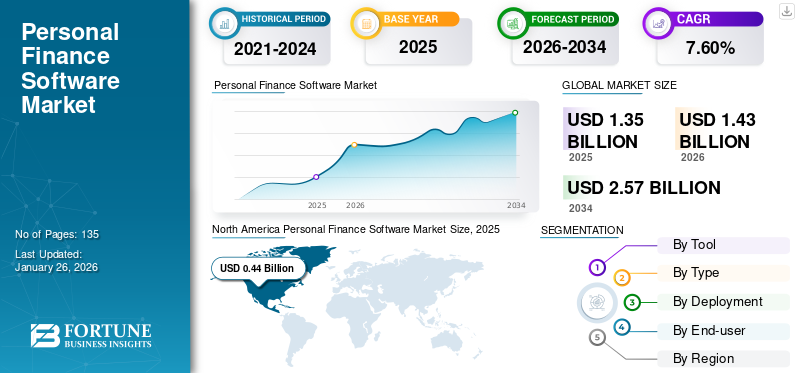
Download Free sample to learn more about this report.
Personal Finance Software Market Key Takeaways
 Global Market Size & Forecast
- 2025 Market Size: USD 1.35 billion
- 2026 Market Size: USD 1.43 billion
- 2034 Forecast Market Size: USD 2.57 billion
- CAGR: 7.60% from 2026-2034
 Market Share
- North America dominated the personal finance software market with a 32.60% share in 2025.
- The budgeting software segment is projected to account for a 30.77% share in 2026.
- The web-based segment is expected to lead with a 55.24% share in 2026.
 Key Regional Highlights
North America
North America generated USD 0.44 billion in 2025 and is projected to reach USD 0.46 billion in 2026.
Asia Pacific
Asia Pacific accounted for USD 0.28 billion in 2025 and is expected to reach USD 0.31 billion in 2026.
Europe
Europe was valued at USD 0.33 billion in 2025 and is projected to reach USD 0.35 billion in 2026.
U.S.
The personal finance software market was valued at USD 0.33 billion in 2025.
Japan
The market is projected to reach USD 0.07 billion in 2026.
Read More

IMPACT OF GENERATIVE AI
Increasing Use Cases of Generative AI in Personal Finance has led to Effective Financial Decisions
Generative AI is becoming a widely used resource in personal finance, showcasing the changing attitudes toward budgeting, investing, and financial planning. Tools including Google Gemini, Cleo, and ChatGPT are assisting individuals in making complicated financial choices. For instance, Gemini (previously known as Bard) can evaluate extensive financial data, produce reports, make predictions, and offer customized suggestions.
- According to Cleo’s 2024 AI and Money report, 74% of Gen Z and Millennials are receptive to utilizing AI-driven financial tools for managing their financial matters. Contrary to the common belief of careless spending, 57% of individuals aged 18 to 24 in the U.S. report that they are already setting aside money for retirement — and a significant number are achieving this with assistance from AI.
Moreover, a 2024 survey by Experian states that, out of 2,011 U.S. adults, 67% of polled Gen Z populace (aged 18 to 27 years) and 62% of surveyed millennials (aged 28 to 43 years) have used artificial intelligence to help with their finances. Users say that generative AI tools including ChatGPT have helped in areas including saving and budgeting (60%), investment planning (48%), and credit score improvement (48%).
MARKET DYNAMICS
Personal Finance Software Market Trends
Rise of FinTech to Emerge as a Key Trend in Personal Finance Management
Personal finance is experiencing a digital transformation fueled by the innovative advancements in fintech, leading to an age of unmatched ease and effectiveness. The fintech transformation has rendered personal finance management more reachable, streamlined, and customized to suit individual requirements. Through mobile banking and automated investments, the methods of saving, spending, and investing are undergoing a complete overhaul.
The need for customized services, integrating AI and ML technologies, digital banking, automated financial tools, and blockchain and cryptocurrency, represents rapid technological changes in the global fintech landscape. Although these technologies are still in their early stages, their influence on managing personal finances could be substantial. They provide innovative investment ways and possibilities for decentralized banking, which may result in more accessible financial services.
Market Drivers
Rapid Adoption of Mobile Banking to Boost the Market Expansion
The emergence of mobile banking, driven by the widespread availability of smartphones and the need for convenient financial services, has altered consumer habits, the competitive environment, and the entire banking sector. With unmatched ease, customers can utilize banking services at any time and from any location. Fintech firms and neobanks have significantly contributed to this shift, increasing market share. Many banks have started collaborating with these entities to provide improved mobile banking services.
- In January 2025, Abu Dhabi Islamic Bank (ADIB), a prominent financial institution in the UAE, introduced the region's inaugural personal finance management tool, the ADIB Money Management Tracker, in collaboration with Lune, an Emirati fintech firm. This initiative was designed to transform how customers oversee their finances, enabling them to obtain greater control and understanding of their financial activities.
The emergence of mobile banking applications and cutting-edge fintech options has made handling personal finances more manageable and efficient. This transition is essential for millennials and Gen Z, who are proficient with technology and encounter distinct financial challenges and prospects.
Market Restraints
Rising Cyber Attacks over Personal Finance to Limit the Market Growth
Phishing and social engineering threats are prevalent in the cybersecurity landscape of the financial services industry. In these incidents, cybercriminals deceive people into disclosing their personal or financial details, often by masquerading as a trusted organization. Online fraud, phishing schemes, and identity theft have grown, presenting considerable dangers to individuals' financial safety. The ease of online banking and digital transactions can help cybercriminals target unsuspecting victims.
- According to VMware, the first half of 2020 saw a 238% increase in cyberattacks targeting financial institutions. Moreover, according to IBM and the Ponemon Institute, the average cost of a data breach in the financial sector in 2021 is USD 5.72 million.
Systems and applications operating in the cloud demand security measures beyond merely depending on cloud providers for VPN, firewall, and WAF protection. As information and data from cloud-hosted applications become more exposed, these interfaces require security considerations beyond simple access control. Additionally, smartphone and tablet users' growing use of personal finance applications there is a risk of cyberattacks which significantly hinders market growth. This is due to data being transmitted through cloud computing platforms, which poses risks to these devices from malicious activities stemming from data exposure.
Market Opportunities
Increased Adoption of Personal Finance Software among Developing Economies provides a Huge Opportunity for Market Expansion
Emerging economies in the Asia Pacific, South America, and the Middle East & Africa (MEA) regions hold significant potential for the growth of financial technology (fintech) services, which is anticipated to propel personal finance software market growth throughout the forecast period. Additionally, the ongoing increase in the usage of the Internet and mobile phones in developing nations offers multiple opportunities for the market.
Additionally, artificial intelligence and machine learning support financial institutions at different phases of the risk management process, including recognizing risk exposure, quantifying, predicting, and evaluating its impacts.
SEGMENTATION ANALYSIS
By Tool
Rising Demand for Budgeting Software for Personalized Services Propelled the Segment Growth
Based on the tools, the market is segmented into budgeting software, tax management software, retirement planning software, investment tracking software, and other segments.
The budgeting software segment is projected to dominate the personal finance software market, accounting for 30.77% of the global market share in 2026. The budget planner assists both individuals and small business owners organize and manage their expenditures. It allows them to attain financial stability by ensuring timely bill payments and setting aside money for more considerable expenses, including a vehicle or a house. Additionally, the growing introduction of budget planners worldwide is expected to propel the growth of this segment.
- In March 2025, Slovenia-based Pocketnest, a white-label financial wellness solutions provider, launched a budget management tool to help users manage their expenses, debt, savings, and investments. The budget tool uses a bucket-based system instead of traditional spreadsheets, guides users to create personalized budgets, identifies surplus cash, and provides recommendations for the optimal allocation of funds.
The investment tracking software is projected to register the highest CAGR over the forecast period. The expansion of this sector can be linked to the rising awareness about investments among consumers. Different organizations, including the Office of Investor Education and Advocacy (OIEA) of The Securities and Exchange Commission, work to enhance investment knowledge among people. Additionally, several personal finance applications, including those from Quicken Inc., Buxfer Inc., and Intuit, offer investment tracking features that support the growth of this sector.
To know how our report can help streamline your business, Speak to Analyst
By Type
Demand for ‘Ease of Use’ Feature to Manage Personal Finances Boosted the Adoption of Web-based Solutions
The market is segmented into web-based and mobile-based, based on its type.
Web-based segment is expected to lead by deployment type, contributing 55.24% globally in 2026. The dominance of desktop-based software largely stems from its comprehensive features, such as charts and graphs, which are more accessible on desktops than mobile devices. Institutions might find this software more beneficial due to the intricate nature of their cash flow. Various personal finance programs, such as Moneydance, a desktop-specific personal finance tool, can be utilized on Windows, Mac, or Linux operating systems. Web-based type segment is anticipated to dominated the market share in 2025 by 55%.
The mobile-based segment will likely grow with the highest CAGR of 8.30% over the forecast period. The expansion of this segment can be linked to the widespread adoption of mobile phones globally. For example, in 2022, Newzoo International B.V., a data firm focused on video gaming and gamers, reported that the smartphone penetration rates in China, the U.S., and Japan reached 68.4%, 81.6%, and 78.6%, respectively. Additionally, several desktop-based personal software companies have begun launching applications that work on Android and iOS operating systems, contributing to the segmental growth.
By Deployment
Increasing Usage of Cloud-based Software to Enable Multi-device Access led to Segmental Growth
Based on deployment, the market is bifurcated into cloud-based and on-premise.
The cloud segment is projected to remain dominant, accounting for 62.24% of the global market share in 2026. A rise in the use of cloud services by numerous companies worldwide is anticipated to propel the growth of this segment. Additionally, the cloud facilitates data synchronization and allows users access across multiple devices. For example, an individual can effortlessly transition between a mobile device and a desktop using cloud deployment; thus, these advantages will likely stimulate the segment's growth throughout the projected period. The cloud segment is likely to hold 62% of the market share in 2025, exhibiting a CAGR of 7.70% during the forecast period.
On-premise, on the other hand, is expected to showcase a moderate CAGR growth over the forecast period. The rise of on-premise personal finance software is due to its strong security features. On-premise solutions allow for control over software updates and how often they occur. Consequently, this option is favored by many small businesses, as it provides the optimal method to safeguard and oversee their financial information.
By End-user
Increasing Need to Improve Financial Planning Process among Small Business Users to Augmented the Segment Expansion
The market is segmented into small business users and individual consumers, based on the end user.
Based on end-users, the adoption of personal finance software among small business users is estimated to grow with the highest CAGR of 7.8% over the forecast period. Numerous small enterprises and home-based businesses utilize personal finance software to organize and differentiate financial information from their companies, generating the needed analytical insights for improved financial planning. This adoption can be linked to the advantages offered by the software, which facilitates expense tracking and budgeting, invoicing and payment management, and cash flow management for small business owners. Additionally, the rising number of small businesses worldwide is expected to drive the growth of this segment. For instance,
- According to advocacy.sba.gov and Oberlo, in 2022, there were 33.2 million small businesses in the U.S.
Furthermore, individual consumers are expected to hold the largest market share of 56% in 2025 due to individuals' growing use of personal finance software, as they are better equipped to make informed financial decisions by providing a clear and real-time overview of their economic well-being. The increase in usage of personal finance software can be linked to heightened financial awareness among people. Industry experts report that over 60% of Americans believe they are more capable of is projected to reach their financial objectives than previous generations.
PERSONAL FINANCE SOFTWARE MARKET REGIONAL OUTLOOK
The market has been studied geographically across five central regions: North America, Europe, Asia Pacific, South America, and the Middle East & Africa.
North America
North America Personal Finance Software Market Size, 2025 (USD Billion)
To get more information on the regional analysis of this market, Download Free sample
The North America market generated USD 0.44 billion in 2025, representing 32.60% of the global market landscape, and is expected to reach USD 0.46 billion in 2026. The growth of the regional market is driven by the presence of major personal finance software companies, including Quicken Inc., PayPal Inc., and Buxfer Inc. Additionally, increasing campaigns and financial education initiatives are likely to contribute to this expansion during the forecast period. The U.S. market is projected to reach USD 0.34 billion by 2026.
- The BMO Real Financial Progress Index indicates that an increasing number of Americans, particularly from Gen Z, utilized artificial intelligence (AI) for financial and investment management in 2024. Among the 37% of Americans employing AI for financial assistance, the most prevalent applications involve gaining knowledge about personal finance topics (49%), establishing and/or revising household budgets (48%), discovering new investment strategies (47%), enhancing savings (47%), and formulating and/or updating their financial plans (46%).
Download Free sample to learn more about this report.
The personal finance software market in the U.S. has been dominant over the past few years in the North America region. This expansion is linked to the nation's increasing adoption of digital technology, leading to a notable integration of fintech personal finance management into people's financial routines. A survey conducted by the Pew Research Center in 2023 reveals that approximately half (54%) of adults in the U.S. claim to have considerable knowledge about personal finances. Additionally, 33% reported knowing a moderate amount about personal finances, while 13% admitted having limited or no knowledge. Understanding personal finances encompasses various financial strategies, such as saving, budgeting, managing debt, or investing. The U.S. market size is estimated to be USD 0.33 billion in 2025.
Asia Pacific
Asia Pacific accounted for USD 0.28 billion in 2025, representing 20.90% of the global market share, and is projected to reach USD 0.31 billion in 2026. The rising demand for self-service options and personalized products and services has driven the expansion of the mobile banking sector. Innovations in technology have led to the development of several valuable features in mobile banking, including real-time customer support, intuitive interfaces, and instant transactions. The Japan market is projected to reach USD 0.07 billion by 2026, the China market is projected to reach USD 0.09 billion by 2026, and the India market is projected to reach USD 0.04 billion by 2026.
Nearly nine in ten consumers in both emerging and developed markets within the Asia Pacific region actively engage in digital banking, and a majority are willing to acquire additional banking services through digital platforms. This change is expected to significantly drive market growth in the region in the years ahead.
South America
South America maintained a strong presence in the global market, reaching USD 0.12 billion in 2025, accounting for 9.20% share, and is expected to reach USD 0.13 billion in 2026. The market in South America sees a moderate growth rate over the forecast period, owing to the region’s growing digitization and innovative payment industry. According to industry experts, a substantial share of all bank account holders (44 percent) indicated they could imagine dealing with their financial transactions exclusively via smartphone in Brazil in the fourth quarter of 2024.
Moreover, as per the survey, around 40% of the Brazilian population is anxious about the national economic conditions and finances. The survey emphasizes that Brazilians are optimistic about the future in terms of finances and the economy.
Europe
Europe contributed 24.40% to the global market in 2025, with a valuation of USD 0.33 billion, and is projected to reach USD 0.35 billion in 2026. A strong interest in budgeting and planning applications characterizes the personal finance industry in Europe. The UK market is projected to reach USD 0.07 billion by 2026 and the Germany market is projected to reach USD 0.07 billion by 2026. Applications such as YNAB, Splitwise, Finanzguru - Konten & Verträge, and Emma - Budget Planner Tracker, among others, experienced significant downloads and user engagement in the first quarter of 2024, as reported by Sensor Tower.
- As reported by Eurostat, EU household savings increased by 56.1% over the decade from 2013 to 2023. The rise in savings is anticipated to persist throughout 2024 and 2025.
Middle East & Africa
In 2025, Middle East & Africa held 12.90% of the global market, reaching a valuation of USD 0.17 billion, and is projected to grow to USD 0.19 billion in 2026. The personal finance software demand in the Middle East & Africa will likely gain healthy CAGR growth over the forecast period. This region is expected to gain USD 0.17 billion in 2025. In recent years, the Middle Eastern population has seen a noticeable increase in financial literacy.
- In February 2024, Zain FinTech, the financial services division of Zain Group—a company that delivers innovative technologies and digital lifestyle communications in eight markets throughout the Middle East & Africa—unveiled its new fintech brand, Bede. This new mobile app, compliant with Shariah law, provides a simple and convenient consumer microfinance service that can be accessed with just a few taps.
As the Middle East continues to navigate its unique economic landscape, embracing personal finance software within the banking sector will undoubtedly play a pivotal role in shaping the future of finance in the region. The GCC countries are projected to acquire USD 0.06 billion in 2025.
COMPETITIVE LANDSCAPE
Key Industry Players
Companies are Focusing on Product Expansion Strategies to Meet the Evolving End-User Demands
The market is categorized as moderately consolidated. Key companies engage in expansion projects, forming strategic alliances, and entering joint ventures to enhance their competitive position. Leading firms are concentrating on technological innovations and growth initiatives to address the increasing demand for worldwide personal finance tools. Additionally, recent product launches have led to the establishment of collaborations aimed at creating new offerings.
- In January 2023, Plum, an innovative financial application in Europe, revealed the introduction of its personal finance app in five European nations: Portugal, Italy, Greece, the Netherlands, and Cyprus. Due to this expansion, Plum customers in these countries can now link their bank accounts to the app.
LIST OF PERSONAL FINANCE SOFTWARE COMPANIES PROFILED:
- Quicken Inc. (U.S.)
- The Infinite Kind (Scotland)
- You Need A Budget LLC (U.S.)
- Buxfer Inc. (U.S.)
- Doxo Inc. (U.S.)
- Money Dashboard Limited (U.K.)
- Moneyspire Inc. (U.S.)
- SPENDEE a.s. (Czech Republic)
- Personal Capital Corp.(U.S.)
- Banktivity (U.S.)
- Pocket Smith Ltd. (New Zealand)
- Finicity Corporation (U.S.)
- PayU (Netherlands)
- PayPal (U.S.)
- Personal Capital (U.S.)
- FutureAdvisor (U.S.)
KEY INDUSTRY DEVELOPMENTS:
February 2025: Moneyspire unveiled its newest software version for 2025, aimed at enhancing financial management to be more user-friendly, efficient, and secure for users around the globe. The latest version features a refined user interface, upgraded budgeting and reporting capabilities, increased platform support, and more.
January 2025: Quicken aimed to transform its financial management by introducing Quicken Business & Personal. This allows users to handle finances for various businesses and their accounts—all within a single platform. By managing invoices and keeping an eye on investments, the app removes the difficulties of using several tools, helping users to make more informed financial choices and reach their objectives more quickly.
January 2025: Doxo Inc. introduced an application that simplifies bill payment and management while assisting consumers in avoiding hidden charges such as overdraft fees. The application, named doxoBILLS, enables users to manage and pay bills to over 120,000 billers. It allows payments to any biller via a digital wallet without disclosing their bank or card details.
June 2024: JG Wentworth announced the acquisition of Ottopay, a complete digital platform for managing debt and processing payments. Ottopay provides users with an all-encompassing digital tool to help them comprehend, oversee, and fulfill their debt responsibilities more effectively. The software generates customized repayment plans that adjust to behavioral changes and smartly suggests methods for users to reduce interest costs and enhance their financial well-being.
May 2024: Treasure Financial, a fintech firm specializing in embedded investing, partnered with Sequence, a personal finance company recognized for its financial router platform. With this collaboration, Sequence intends to incorporate Treasure’s embedded investment API, allowing Sequence clients to effortlessly access Treasure’s range of actively managed investment offerings.
INVESTMENT ANALYSIS AND OPPORTUNITIES
An increase in investments in AI and machine learning offers the potential to transform the area of automation for time-consuming, mundane processes and provides a far more streamlined and personalized customer experience, which enhances the growth of the market.
Furthermore, major financial institutions including Bank of America, JPMorgan, and Morgan Stanley are making significant investments in machine learning technologies to create automated investment advisors and train systems to identify indicators of issues such as money laundering and other fraudulent activities, which is anticipated to generate profitable opportunities for the personal finance software market growth. For instance,
- In March 2025, Flex, a fintech firm that enables entrepreneurs to streamline their back-office operations and expand, revealed that it had secured USD 225 million in equity and debt financing to speed up the development of its payment framework and personal finance applications for business owners.
REPORT COVERAGE
The personal finance software market report provides a detailed market analysis and focuses on key aspects such as leading companies, product/service types, and leading product applications. Besides, the report offers insights into the market trends and highlights key industry developments. In addition to the factors above, the report encompasses several factors that contributed to the market's growth in recent years.
Request for Customization to gain extensive market insights.
REPORT SCOPE & SEGMENTATION
|
ATTRIBUTE |
DETAILS |
|
Study Period |
2021-2034 |
|
Base Year |
2025 |
|
Estimated Year |
2026 |
|
Forecast Period |
2026-2034 |
|
Historical Period |
2021-2024 |
|
Growth Rate |
CAGR of 7.60% from 2026 to 2034 |
|
Unit |
Value (USD Billion) |
|
Segmentation |
By Tool
By Type
By Deployment
By End-user
By Region
|
|
Companies Profiled in the Report |
Quicken Inc. (U.S.), The Infinite Kind (Scotland), You Need A Budget LLC (U.S.), Buxfer Inc. (U.S.), Doxo Inc. (U.S.), Money Dashboard Limited (U.K.), Moneyspire Inc. (U.S.), Personal Capital Corp. (U.S.), Pocket Smith Ltd. (New Zealand), and Paypal Inc. (U.S.). |
Frequently Asked Questions
The market is projected to reach USD 2.57 billion by 2034.
In 2025, the market was valued at USD 1.35 billion.
The market is projected to grow at a CAGR of 7.60% during the forecast period.
The budgeting software leads the market.
The rapid adoption of mobile banking boosts the market expansion.
You Need A Budget LLC, Quicken Inc., Personal Capital Corp., PayPal Inc., Moneyspire Inc., and Money Dashboard Limited are the top players in the market.
North America is expected to hold the highest market share.
By end-user, the small business users are expected to grow with the highest CAGR during the forecast period.



- 2021-2034
- 2025
- 2021-2024
- 135
Get 30-60 hrs Free Customization
Expand Regional and Country Coverage, Segments Analysis, Company Profiles, Competitive Benchmarking, and End-user Insights.













-
US +1 833 909 2966 ( Toll Free )
-
Get In Touch With Us