PFAS Testing Market Size, Share & Industry Analysis By Type (Products [Instruments {Liquid Chromatography Mass Spectrometry (LC-MS), Gas Chromatography Mass Spectrometry (GC-MS), Nuclear Magnetic Resonance Spectroscopy & Others} and Consumables] and Software & Services), By Technique (Liquid Chromatography with Tandem Mass Spectrometry (LC-MS/MS), Gas Chromatography-Mass Spectrometry (GC-MS), Mass Spectrometry & Others), By Application (Blood/Serum Testing, Microbial Testing, & Others), By End User, and Regional Forecast, 2026-2034
 Download Free Sample
KEY MARKET INSIGHTS
 Listen to Audio Version
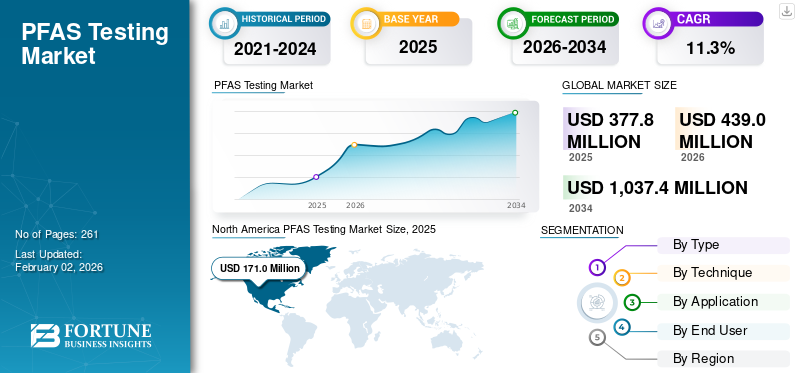
The global PFAS testing market size was valued at USD 377.8 million in 2025 and is projected to grow from USD 439.0 million in 2026 to USD 1,037.4 million by 2034, exhibiting a CAGR of 11.3% during the forecast period. North America dominated the global market with a market share of 45.26% in 2025.
PFAS testing refers to laboratory analysis of samples such as water, blood, and other products to detect and confirm the presence of per and polyfluoroalkyl substances. The rising focus of governmental organizations toward stringent regulations is significantly augmenting the demand for PFAS testing, thereby supporting the adoption rate of testing products and services in the market.
- For instance, according to the 2025 statistics published by the American Chemical Society (ACS), it was reported that about seven target PFAS were detected in over 99% of human serum samples.
Furthermore, the growing health concerns associated with PFAS exposure and the expansion of environmental programs are also some other factors supporting the increasing demand for these products and services in the market. This, along with the growing focus of major players on research and development activities to develop and introduce novel products, including Thermo Fisher Scientific, Inc., Agilent Technologies, Inc., and others, is expected to support the global PFAS testing market growth.
Download Free sample to learn more about this report.
PFAS Testing MARKET KEY TAKEAWAYS
 Market Size & Forecast
- 2025 Market Size: USD 377.8 Million
- 2026 Market Size: USD 439.0 Million
- 2034 Forecast Market Size: USD 1,037.4 Million
- CAGR: 11.3% from 2026–2034
 Market Share
- North America dominated the PFAS testing market with a 45.26% share in 2025.
- The liquid chromatography with tandem mass spectrometry (LC-MS/MS) segment is projected to account for 59.6% of the market in 2026.
- The water testing segment held a 62.6% market share in 2025.
 Key Regional Highlights
North American
North America remained the leading regional market, reaching USD 171.0 million in 2025.
Europe
Europe is expected to register strong growth with a CAGR of 10.5% during the forecast period.
Asia Pacific
Asia Pacific emerged as the third-largest regional market, valued at USD 78.9 million in 2025.
U.S.
The PFAS testing market is projected to reach USD 178.6 million in 2026.
Japan
Growing environmental monitoring and PFAS testing initiatives are supporting market expansion.
Read More

Market Dynamics
Market Drivers
Increasing Public Health Concerns Associated with PFAS Exposure to Drive Market Growth
The rising awareness of health risks linked with PFAS exposure is resulting in the growing penetration of PFAS testing across various applications, subsequently driving the growing adoption rate of these testing products in the market.
- For instance, according to the 2025 data published by the International Chemical Secretariat (ICS), it was reported that about 99% of all humans have measurable levels of PFAS in their bloodstreams.
PFAS chemicals have also been associated with a wide variety of health conditions such as thyroid disruption, immune dysfunction, and certain cancers. Increasing human exposure is resulting in growing public demand for stricter monitoring and transparency. Governmental and healthcare organizations are emphasizing routinely test for PFAS contamination to prevent long-term health consequences. Therefore, the factors mentioned above, along with the rising focus of prominent companies toward product launches, are anticipated to fuel the adoption rate, thereby supporting global PFAS testing market growth.
Other Prominent Drivers
- Escalating regulatory scrutiny and stricter drinking water/food/contact material limits are driving testing demand.
- Growing public, legal, and corporate interest in PFAS contamination and liability management, including litigation and remediation projects also drives the market growth.
Market Restraints
High Cost of PFAS Testing Products and Infrastructure to Limit Market Growth
There is an increasing demand for PFAS testing to detect and measure the presence of PFAS compounds. However, the high cost associated with these advanced instrumentation is anticipated to limit product adoption rate, especially in emerging nations such as Brazil, Mexico, and others.
PFAS testing requires advanced products such as liquid chromatography–tandem mass spectrometry (LC-MS/MS) or gas chromatography mass spectrometry (HRMS) coupled with specialized sample preparation workflows, sterile clean-lab environments, and skilled professionals, which substantially contribute to capital expenditure, operational costs, and maintenance needs.
- For instance, according to 2025 data published by Axion Analytical, Inc., it was reported that the price of a new gas chromatograph ranges from USD 30,000 to USD 100,000.
Therefore, high capital expenditure, less-developed healthcare infrastructure, and limited funding among prominent players are anticipated to limit the adoption rate of these products in the market.
Market Opportunities
Increasing Adoption in Developing Nations to Create Lucrative Opportunities
There is a growing health concerns associated with PFAS exposure, resulting in a growing focus on expanding PFAS-related regulations, especially in developing nations, including China, Brazil, and others. These countries are increasingly recognizing PFAS contamination as a public health and environmental threat, driving new testing regulations for drinking water, wastewater, and industrial contaminants. Increasing urbanization, growing healthcare expenditure, rising usage of chemicals in industries, and growing public awareness are further driving the demand for laboratory infrastructure, improved environmental monitoring, and compliance testing.
Moreover, growing awareness campaigns among governmental and healthcare organizations are some additional factors anticipated to fuel the product and software demand significantly during the forecast period.
- According to data published by Macrotends, the per capita healthcare spending was USD 672.45 in 2022, a 0.33% increase from 2021 in China.
Market Challenges
Lack of Standardized Methods for Testing to Limit Market Growth
There is a growing demand for innovative PFAS testing methods for various applications, such as water and soil testing across the globe. However, the lack of standard methods poses a major challenge for adoption of these products in the market.
The regulatory bodies have established certain methods for a limited set of PFAS compounds, including EPA Methods 533, 1633, and 537.1. However, these cover only a limited fraction of PFAS compounds currently identified. Hence, variations in analytical methods, sample preparation techniques, reporting limits, and target compound lists across regions such as the U.S., Europe, and others create inaccuracy in results, limit comparability, and further increase compliance complexity for industries.
- For instance, according to the 2025 study published by Rapid Micro Biosystems, Inc., it was reported that about 18% of respondents did not adopt rapid sterility testing owing to difficulties in regulatory acceptance among 66 respondents.
Therefore, the lack of standardized protocols makes it challenges for the prominent players to strengthen their product portfolio across various applications, thereby limiting product adoption rate in the market.
Other Prominent Challenges
- Backlogs and long turnaround times is a challenge as lab capacity struggles to keep pace with spikes in demand.
- Complexity of matrix interferences and need for validated methods for non‑water samples, such as food, cosmetics, and biological matrices deters market growth.
PFAS Testing Market Trends
Adoption of Advanced Methods to Fuel Product Demand
There is an increasing focus on the incorporation of technological advancements in analytical products in the market. The increasing adoption of high-resolution and advanced techniques such as mass spectrometry (HRMS) for non-target PFAS screening is reshaping the market. The regulatory requirements expand beyond a limited set of PFAS, resulting in growing demand toward HRMS technologies, such as time-of-flight (ToF) instruments and Orbitrap, to identify previously undetected or emerging PFAS levels in chemicals.
Moreover, technological advancement in these devices, such as integration of high‑throughput LC‑MS/MS platforms and automated sample prep to scale capacity and lower per‑sample costs, is further enhancing the development of methods, improving the robust compliance monitoring, thereby supporting the adoption of these products in the market.
- According to 2019 statistics published by Science Direct, it was reported that high-resolution mass spectrometry has discovered more than 750 PFAS compounds globally.
Other Prominent Trends
- Strong demand for accredited, certified PFAS testing services across environmental, food, cosmetics, and human biomonitoring samples.
- Increasing partnerships between instrument vendors and contract laboratories to deliver turnkey testing solutions.
- Consolidation and service expansion among major lab groups to capture remediation and corporate testing contracts.
Download Free sample to learn more about this report.
SEGMENTATION ANALYSIS
By Type
Increasing Product Launches to Drive Segmental Dominance
Based on type, the market is classified into products and software & services. The products segment is further classified into instruments and consumables. Instruments are further bifurcated into liquid chromatography mass spectrometry (LC-MS), gas chromatography mass spectrometry (GC-MS), nuclear magnetic resonance spectroscopy, and others.
To know how our report can help streamline your business, Speak to Analyst
The products segment held the largest market share in 2025. This growth is due to increasing health concerns associated with PFAS exposure, leading to a rise in diagnostic test volumes globally. This, along with the increasing focus of key players on research and development activities to launch novel devices, is further expected to support the segmental growth.
- In August 2025, Shimadzu Corporation launched the LCMS-8065XE triple quadrupole high-performance liquid chromatograph mass spectrometer in Japan and international markets.
The software & services segment is expected to grow at a CAGR of 11.6% over the forecast period.
By Technique
Increasing Product Launches Led to the Dominance of the Liquid Chromatography with Tandem Mass Spectrometry (LC-MS/MS) Segment
Based on technique, the market is bifurcated into liquid chromatography with tandem mass spectrometry (LC-MS/MS), gas chromatography-mass spectrometry (GC-MS), mass spectrometry and others.
The liquid chromatography with tandem mass spectrometry (LC-MS/MS) segment dominated the market in 2025. In 2026, the segment is anticipated to dominate with a 59.6% share. This is due to increasing prevalence of infectious diseases, resulting in the rising demand for novel products in the market. This, along with rising focus among key players toward research and development activities to launch advanced PFAS testing products, is anticipated to support the segmental growth in the market.
- In June 2024, Thermo Fisher Scientific, Inc., launched a new mass spectrometry platform at the American Society for Mass Spectrometry (ASMS) conference.
The gas chromatography-mass spectrometry segment is expected to grow at a CAGR of 10.3% over the forecast period.
By Application
The Growing Number of PFAS Testing Sites Led to Dominance of Water Testing Segment
Based on application, the market is segmented into blood/serum testing, microbial testing, water testing, and others.
The water testing segment dominated the global market in 2025. By application, the water testing segment held a largest share of 62.6% in 2025. This growth is due to increasing number of PFAS-contaminated sites, resulting in increasing demand for PFAS products and services, thereby contributing to the segment’s growth.
- For instance, according to 2025 statistics published by Environmental Working Group (EWG), there are about 9,552 PFAS-contaminated sites in the U.S.
The segment of blood/serum testing is set to grow with a growth rate of 12.2% across the forecast period.
By End-user
Increasing Initiatives Among Environmental Testing Laboratories Led to the Segment’s Dominance
Based on end user, the market is segmented into healthcare & research institutions, industrial & manufacturing companies, environmental testing laboratories, and others.
The environmental testing laboratories segment dominated the market in 2025. Increasing awareness about PFAS testing, growing healthcare expenditure, and growing initiatives to launch innovative methods among environmental testing laboratories are some of the vital factors contributing to segmental growth in the market. Furthermore, the segment is set to hold a 41.7% share in 2026.
- For instance, in September 2021, the EPA announced the first validated laboratory analytical method to test for 40 PFAS compounds in eight different environmental media: wastewater, surface water, groundwater, soil, biosolids, sediment, landfill leachate, and fish tissue.
In addition, healthcare & research institutions' end-users are projected to grow at a CAGR of 10.8% during the study period.
PFAS Testing Market Regional Outlook
Based on region, the market has been studied across North America, Europe, Asia Pacific, Latin America, and Middle East & Africa.
North America
North America PFAS Testing Market Size, 2025 (USD Million)
To get more information on the regional analysis of this market, Download Free sample
The North America market held dominanting share in 2024, valued at USD 142.5 million, and also took the leading share in 2025 with USD 171.0 million. The dominance of the region is due to certain factors, including U.S. EPA regulatory activity, state‑level limits, extensive remediation testing demand, and growing establishment of PFAS treatment plants, among others. In 2026, the U.S. market is estimated to reach USD 178.6 million.
- For instance, in June 2025, Veolia established one of the largest PFAS treatment systems with an aim to strengthen its brand presence in the U.S.
Europe and Asia Pacific
Other regions, such as Europe and Asia Pacific, are expected to witness considerable CAGR during the forecast period. During the study period, the European region is projected to record a growth rate of 10.5% and reached the valuation of USD 106.0 million in 2025. This is due to wide PFAS restrictions and member states tightening drinking water limits, and growing lab investment in the region. Additionally, rising environmental monitoring programmes and increasing industrial testing demand are also some of the factors supporting the regional market growth. Backed by these factors, countries such as the U.K. are recorded the valuation of USD 11.5 million, Germany of USD 20.6 million, and France of USD 10.7 million in 2025. After Europe, the market in the Asia Pacific reached USD 78.9 million in 2025 and secure the position of the third-largest region in the market. In the region, India registed USD 9.9 million while China recorded USD 25.6 million in 2025.
Latin America and Middle East & Africa
Over the forecast period, the Latin America and Middle East & Africa regions are expected to witness moderate growth in this market. The Latin America market in 2025 recorded USD 12.1 million as its valuation. This growth is tied to regulatory adoption and investment in accredited lab capacity is anticipated to boost product adoption in these regions. In the Middle East & Africa, GCC is attained the value of USD 4.8 million in 2025.
Competitive Landscape
Key Industry Players
A Growing Number of Product Launches Among Players to Support Their Dominance
A diversified product portfolio of novel products, coupled with strong geographic presence globally, is one of the major factors contributing to dominance of these companies in the market. Thermo Fisher Scientific Inc., and Agilent Technologies, Inc., are major players in the market in 2025. Moreover, the rising focus of prominent players on research and development activities to launch novel products also supports the growing PFAS testing market share.
- For instance, in October 2025, Thermo Fisher Scientific, Inc., launched the Orbitrap Exploris EFOX system engineered specifically for food safety testing and environmental analysis.
Other key players, including Merck KGaA and others, are also growing in the market, primarily due to their increasing focus on product launches to strengthen their presence in the market.
List of Key PFAS Testing Companies Profiled
- Thermo Fisher Scientific Inc. (U.S.)
- Merck KGaA (Germany)
- Agilent Technologies, Inc. (U.S.)
- PerkinElmer (U.S.)
- Waters Corporation (U.S.)
- SGS Société Générale de Surveillance SA (Switzerland)
- Babcock Laboratories, Inc. (U.S.)
- Intertek Group plc (U.K.)
- Shimadzu Corporation (Japan)
- AccuStandard (U.S.)
KEY INDUSTRY DEVELOPMENTS
- October 2025 – The Wyoming Department of Environmental Quality (DEQ) announced a contract for no-cost monitoring of PFAS among public water systems. The testing is funded through Wyoming’s Emerging Contaminants in Drinking Water Grant and will help public water systems comply with the new U.S. EPA PFAS drinking water regulation.
- November 2024 – U.S. Environmental Protection Agency launched a new, no-cost technical assistance effort focused on reducing exposure to perfluoroalkyl and polyfluoroalkyl substances (PFAS) and other emerging contaminants in small or disadvantaged communities. This helped the organization in strengthening its presence.
- June 2024 – Analytical Resource Labs (ARL), a provider of analytical testing services, launched its new PFAS testing service to strengthen its presence.
- June 2024 – Bigelow Laboratory for Ocean Sciences recently launched analytical services, certified by the State of Maine, to test for per- and polyfluoroalkyl substances, more commonly known as PFAS or “forever” chemicals.
- March 2024 – Waters Corporation announces new Oasis WAX/GCB and GCB/WAX for PFAS Analysis Cartridges with new design features that significantly streamline and expedite sample preparation and analysis of per- and polyfluoroalkyl substances (PFAS).
REPORT COVERAGE
The market report provides a detailed global PFAS testing market analysis and focuses on key aspects such as leading companies, type, technique, application, and end user. Besides this, the global report offers insights into the market growth trends and highlights key industry developments. In addition to the aforementioned factors, the report encompasses several factors that have contributed to the growth and advancement of the market over recent years.
Request for Customization to gain extensive market insights.
Report Scope & Segmentation
|
ATTRIBUTE |
DETAILS |
|
Study Period |
2021-2034 |
|
Base Year |
2025 |
|
Estimated Year |
2026 |
|
Forecast Period |
2026-2034 |
|
Historical Period |
2021-2024 |
|
Growth Rate |
CAGR of 11.3% from 2026-2034 |
|
Unit |
Value (USD Million) |
|
Segmentation |
By Type, Technique, Application, End User, and Region |
|
By Type |
· Products o Instruments § Liquid Chromatography Mass Spectrometry (LC-MS) § Gas Chromatography Mass Spectrometry (GC-MS) § Nuclear Magnetic Resonance Spectroscopy § Others o Consumables · Software & Services |
|
By Technique |
· Liquid Chromatography with Tandem Mass Spectrometry (LC-MS/MS · Gas Chromatography-Mass Spectrometry (GC-MS) · Mass Spectrometry · Others |
|
By Application |
· Blood/Serum Testing · Microbial Testing · Water Testing · Others |
|
By End User |
· Healthcare & Research Institutions · Industrial & Manufacturing Companies · Environmental Testing Laboratories · Others |
|
By Region |
· North America (By Type, By Technique, By Application, By End User, and by Country) o U.S. (By Application) o Canada (By Application) · Europe (By Type, By Technique, By Application, By End User, and by Country/Sub-region) o U.K. (By Application) o Germany (By Application) o France (By Application) o Italy (By Application) o Spain (By Application) o Scandinavia (By Application) o Rest of Europe (By Application) · Asia Pacific (By Type, By Technique, By Application, By End User, and by Country/Sub-region) o China (By Application) o Japan (By Application) o India (By Application) o Australia (By Application) o Southeast Asia (By Application) o Rest of Asia Pacific (By Application) · Latin America (By Type, By Technique, By Application, By End User, and by Country/Sub-region) o Brazil (By Application) o Mexico (By Application) o Rest of Latin America (By Application) · Middle East & Africa (By Type, By Technique, By Application, By End User, and by Country/Sub-region) o GCC (By Application) o South Africa (By Application) o Rest of the Middle East & Africa (By Application) |
Frequently Asked Questions
Fortune Business Insights says that the global market size was USD 377.8 million in 2025 and is projected to reach USD 1,037.4 million by 2034.
In 2025, the North America regional market value stood at USD 171.0 million.
Growing at a CAGR of 11.3%, the market will exhibit steady growth over the forecast period (2026-2034).
By type, the products segment is the leading segment in this market.
The introduction of novel PFAS testing systems is one of the major factors driving the market's growth.
Thermo Fisher Scientific, Inc., and Agilent Technologies, Inc., are the major players in the global market.
North America dominated the market share in 2025.
The growing health concerns associated with PFAS exposure, the growing number of product launches, among others, are some of the factors anticipated to fuel the adoption of these products worldwide.



- 2021-2034
- 2025
- 2021-2024
- 261
Get 30-60 hrs Free Customization
Expand Regional and Country Coverage, Segments Analysis, Company Profiles, Competitive Benchmarking, and End-user Insights.













.webp)






Related Reports
-
US +1 833 909 2966 ( Toll Free )
-
Get In Touch With Us