Pharmacovigilance Software Market Size, Share & Industry Analysis, By Functionality (Case Data Collection And Management, Adverse Event Reporting And Analysis), By Deployment (On Premise, On Demand), By End Use and Regional Forecast, 2026-2034
 Download Free Sample
Pharmacovigilance Software Market Overview
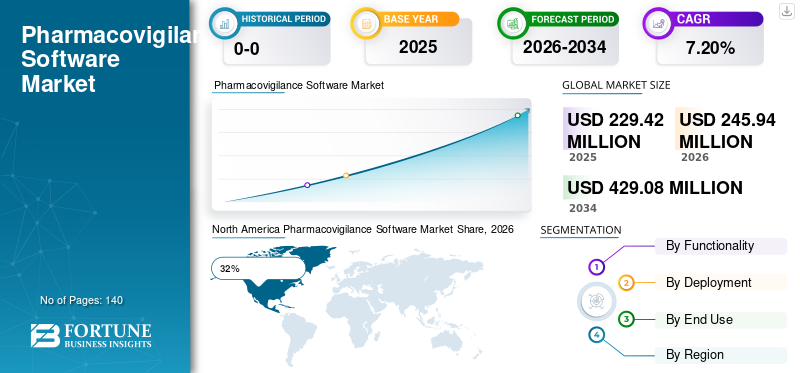
The pharmacovigilance software market size was valued at USD 229.42 million in 2025. The market is projected to grow from USD 245.94 million in 2026 to USD 429.08 million by 2034, exhibiting a CAGR of 7.20% during the forecast period.
The pharmacovigilance software market is witnessing substantial expansion due to the growing need for adverse drug reaction monitoring, regulatory compliance management, and automated safety reporting across the pharmaceutical and biotechnology sectors. pharmacovigilance software market Analysis indicates that organizations are increasingly adopting digital platforms to manage large volumes of safety data generated during clinical trials and post-marketing surveillance. The integration of artificial intelligence, machine learning, cloud computing, and real-world evidence analytics has transformed traditional drug safety operations. pharmacovigilance software market research report findings show that healthcare companies are investing heavily in software solutions that streamline signal detection, case processing, risk assessment, and regulatory submissions while improving operational efficiency and patient safety outcomes.
The USA pharmacovigilance software market remains a major contributor to global demand due to stringent regulatory requirements, widespread adoption of electronic health records, and increasing investments in drug safety infrastructure. Pharmaceutical manufacturers, contract research organizations, and healthcare providers are utilizing advanced pharmacovigilance platforms to improve adverse event reporting accuracy and accelerate regulatory compliance activities. The presence of established life sciences companies, continuous software innovation, and strong government support for patient safety monitoring have strengthened market penetration. pharmacovigilance software industry analysis highlights that cloud-enabled safety platforms, AI-assisted case management, and automated reporting systems are becoming standard operational tools across the United States pharmaceutical ecosystem.
Download Free sample to learn more about this report.
Pharmacovigilance Software Market Key Takeaways
 Global Market Size & Forecast
- 2025 Market Size: USD 229.42 Million
- 2026 Market Size: USD 245.94 Million
- 2034 Forecast Market Size: USD 429.08 Million
- CAGR: 7.20% from 2026–2034
 Market Share
- North America dominated with a revenue share of 32% in 2025.
- Adverse Event Reporting and Analysis accounted for approximately 56% of the market share.
- Pharmaceutical and biotechnology companies held approximately 62% of the market share.
 Key Regional Highlights
North America
North America led the market with a 32% share in 2025, supported by advanced healthcare infrastructure and strong regulatory requirements.
Europe
Europe accounted for 27% of the market, driven by stringent drug safety and reporting regulations.
Asia-Pacific
Asia-Pacific held a 19% share, supported by expanding pharmaceutical and biotechnology industries.
U.S.
The U.S. market is supported by strong pharmacovigilance regulations and increasing adoption of automated safety management solutions.
Japan
Japan: Japan accounted for 28% of the Asia-Pacific market, supported by its established pharmaceutical industry and growing focus on drug safety monitoring.
Read More

Pharmacovigilance Software Market Latest Trends
The pharmacovigilance software market trends indicate a rapid transition toward AI-powered automation and predictive analytics. Drug manufacturers are increasingly implementing machine learning algorithms that can identify safety signals faster than traditional manual review methods. Natural language processing technologies are being integrated into pharmacovigilance systems to analyze unstructured medical records, social media discussions, and physician reports. This advancement enables organizations to detect adverse reactions more efficiently while reducing operational workloads. pharmacovigilance software market insights further reveal growing demand for centralized safety databases capable of supporting global regulatory reporting requirements.
Another major trend shaping the pharmacovigilance software market outlook is the adoption of cloud-based platforms. Organizations are migrating from legacy systems to scalable software-as-a-service environments that offer faster deployment, remote accessibility, automatic updates, and lower maintenance costs. Integration with electronic health records, real-world evidence databases, and clinical trial management systems has become a strategic priority. Advanced dashboards, risk management modules, and automated compliance workflows are improving visibility across safety operations. As pharmaceutical companies continue to expand globally, interoperable and highly secure pharmacovigilance software solutions are becoming essential components of modern drug safety strategies.
Download Free sample to learn more about this report.
Pharmacovigilance Software Market Dynamics
DRIVER
Rising Demand for Pharmaceutical Safety Monitoring and Regulatory Compliance
The increasing complexity of drug development programs and the growing volume of adverse event reports are major drivers supporting pharmacovigilance software market growth. Regulatory agencies worldwide continue to strengthen pharmacovigilance requirements, compelling pharmaceutical companies to adopt advanced software solutions capable of handling large datasets efficiently. Drug manufacturers must continuously monitor product safety throughout clinical development and commercialization phases. This requirement has accelerated demand for automated safety databases, case processing tools, and regulatory reporting platforms.
pharmacovigilance software industry report findings indicate that pharmaceutical organizations are focusing on reducing manual workloads and improving reporting accuracy through digital transformation initiatives. The growing number of biologics, specialty drugs, vaccines, and personalized therapies has increased safety monitoring responsibilities. Organizations are implementing AI-enabled software to identify potential risks earlier and ensure timely regulatory submissions. These developments continue to support long-term expansion across the pharmacovigilance software market while improving patient safety outcomes and operational performance.
RESTRAINT
High Implementation and Integration Costs
Despite strong demand, the pharmacovigilance software market faces challenges associated with implementation expenses and integration complexities. Large-scale software deployments often require significant investments in infrastructure, customization, employee training, cybersecurity measures, and regulatory validation processes. Small and medium-sized pharmaceutical companies may experience budget constraints when adopting advanced pharmacovigilance platforms.
Many organizations continue to operate multiple legacy systems that store safety data across disconnected databases. Integrating new pharmacovigilance solutions with existing enterprise software can be technically challenging and time-consuming. pharmacovigilance software market Analysis suggests that prolonged deployment timelines may delay return on investment and discourage adoption among smaller market participants. Additionally, compliance requirements related to data privacy and cross-border information exchange increase operational complexity. These factors collectively limit implementation speed in certain regions and organizations.
OPPORTUNITY
Expansion of Ai-Enabled Pharmacovigilance Solutions
Artificial intelligence presents substantial opportunities across the pharmacovigilance software market. AI-powered solutions can automate case intake, duplicate detection, signal identification, literature monitoring, and risk assessment activities. These capabilities significantly improve efficiency while reducing human error. Pharmaceutical companies increasingly recognize the value of predictive analytics for proactive safety management and regulatory compliance.
pharmacovigilance software market opportunities are also emerging from the growing adoption of real-world evidence and patient-generated health data. Software vendors are developing platforms capable of analyzing information from wearable devices, electronic medical records, social media channels, and patient support programs. Such innovations enable earlier identification of adverse events and provide deeper insights into product safety profiles. As regulatory authorities encourage data-driven safety monitoring, demand for intelligent pharmacovigilance platforms is expected to strengthen across developed and emerging healthcare markets.
CHALLENGE
Managing Increasing Volumes of Global Safety Data
One of the primary challenges affecting the pharmacovigilance software market is the continuous growth in adverse event reporting volumes. Pharmaceutical companies receive safety information from multiple sources, including healthcare providers, patients, regulatory agencies, clinical trials, and digital health platforms. Managing these data streams while maintaining accuracy and compliance creates significant operational pressure.
pharmacovigilance software market forecast assessments indicate that organizations must invest in advanced analytics, data governance frameworks, and cybersecurity measures to address this challenge effectively. The globalization of pharmaceutical operations has introduced additional complexities related to multilingual reporting, varying regulatory standards, and cross-border data management requirements. Companies must ensure consistent data quality while maintaining rapid response capabilities. Failure to process safety information efficiently can result in regulatory penalties, delayed reporting, and reputational risks, making data management a critical challenge throughout the industry.
Pharmacovigilance Software Market Segmentation
By Functionality
Case Data Collection and Management represents approximately 44% of the pharmacovigilance software market share. This segment forms the operational foundation of pharmacovigilance activities by enabling organizations to collect, organize, validate, and maintain adverse event records throughout the product lifecycle. Pharmaceutical companies rely on centralized databases to manage increasing report volumes from clinical trials, healthcare professionals, patients, and regulatory authorities.
The segment benefits from growing demand for workflow automation and standardized safety data management. Modern platforms incorporate artificial intelligence, automated coding tools, and advanced validation features that improve processing accuracy. pharmacovigilance software market research report findings indicate that organizations prioritize robust case management capabilities because regulatory compliance depends heavily on accurate safety documentation. As reporting requirements continue to expand globally, investments in sophisticated case management solutions remain strong across pharmaceutical and biotechnology sectors.
Adverse Event Reporting and Analysis accounts for nearly 56% of the pharmacovigilance software market size. This segment is critical because regulatory authorities require timely submission and evaluation of adverse drug reaction data. Organizations increasingly deploy software platforms capable of automating case processing, signal detection, trend analysis, and regulatory reporting workflows.
Advanced reporting solutions integrate machine learning algorithms that identify potential safety concerns across large datasets. These platforms support global reporting standards while improving operational efficiency and compliance performance. pharmacovigilance software market trends demonstrate rising demand for analytical capabilities that transform raw safety data into actionable insights. As pharmaceutical portfolios become more complex and regulatory expectations continue to increase, adverse event reporting and analysis solutions maintain a dominant position within the overall market landscape.
To know how our report can help streamline your business, Speak to Analyst
By Deployment
On Premise deployment holds approximately 45% of the pharmacovigilance software market share. Many pharmaceutical organizations continue to utilize on-premise solutions due to concerns related to data privacy, regulatory control, and internal security requirements. These platforms provide direct oversight of infrastructure, customization capabilities, and greater control over sensitive patient information.
Large multinational pharmaceutical companies frequently prefer on-premise environments for complex safety operations involving proprietary datasets and extensive compliance requirements. pharmacovigilance software industry analysis suggests that organizations with established IT infrastructures often maintain existing deployments while gradually incorporating newer technologies. Although cloud adoption continues to expand, on-premise systems remain relevant among enterprises prioritizing strict data governance and internal control mechanisms.
On Demand deployment represents approximately 55% of the pharmacovigilance software market share and continues to gain momentum. Cloud-based platforms offer scalability, lower upfront costs, simplified maintenance, and faster implementation compared with traditional systems. Organizations can access safety data remotely while benefiting from automatic software updates and enhanced collaboration capabilities.
pharmacovigilance software market opportunities are increasing within this segment due to growing demand for flexible operational models. Small and medium-sized pharmaceutical companies particularly favor cloud deployments because they reduce infrastructure investments and accelerate digital transformation initiatives. Integration with clinical trial systems, electronic health records, and regulatory databases further strengthens adoption. As cybersecurity frameworks improve and regulatory acceptance increases, on-demand pharmacovigilance solutions are becoming preferred deployment options across multiple healthcare sectors.
By End Use
Pharmaceutical and biotechnology companies account for approximately 62% of the pharmacovigilance software market share. These organizations hold primary responsibility for monitoring drug safety throughout development and commercialization phases. Increasing product launches, biologics development, and global regulatory obligations continue to drive software adoption within this segment.
Companies require advanced pharmacovigilance platforms to manage adverse event reporting, signal detection, risk management planning, and regulatory submissions efficiently. pharmacovigilance software market growth remains closely linked to pharmaceutical innovation and expanding clinical research activities. Investments in automation, artificial intelligence, and integrated safety management solutions continue to strengthen demand among drug manufacturers worldwide.
Pharmacovigilance Software Market Regional Outlook
North America
North America Pharmacovigilance Software Market Share, 2026 (%)
To get more information on the regional analysis of this market, Download Free sample
North America accounts for approximately 32% of the global pharmacovigilance software market share. The region benefits from strong pharmaceutical research activities, advanced healthcare infrastructure, and rigorous regulatory requirements governing drug safety monitoring. Organizations across the United States and Canada continue to invest in cloud-based pharmacovigilance systems, artificial intelligence tools, and automated reporting platforms. The growing adoption of real-world evidence and digital health technologies further strengthens demand for integrated safety management solutions.
The region maintains a leadership position due to the presence of major pharmaceutical manufacturers, contract research organizations, and software developers. pharmacovigilance software market Analysis indicates that investments in patient safety initiatives, regulatory modernization programs, and advanced analytics capabilities support sustained market expansion. Increasing volumes of adverse event reports continue to encourage technology upgrades and process automation across safety operations.
Europe
Europe holds nearly 27% of the global pharmacovigilance software market share. The region is characterized by comprehensive regulatory frameworks, extensive pharmaceutical manufacturing capabilities, and strong emphasis on patient safety. Drug manufacturers across Europe are investing in digital pharmacovigilance solutions that improve compliance with evolving reporting requirements and enhance operational efficiency.
pharmacovigilance software market trends within Europe are influenced by ongoing modernization of safety databases, increased utilization of artificial intelligence, and expansion of real-world evidence programs. Organizations continue to integrate advanced analytics tools into pharmacovigilance workflows to improve signal detection and risk assessment capabilities. These developments contribute to consistent adoption across both established pharmaceutical markets and emerging biotechnology sectors.
Germany Pharmacovigilance Software Market
Germany represents approximately 24% of the European pharmacovigilance software market. The country has a well-established pharmaceutical industry supported by advanced research institutions, strong regulatory oversight, and extensive healthcare infrastructure. Pharmaceutical companies operating in Germany continue to prioritize digital safety management platforms that streamline adverse event reporting and regulatory compliance processes.
The German market benefits from increasing investments in healthcare digitization and data-driven drug safety initiatives. Organizations are implementing artificial intelligence technologies to improve signal detection, automate case processing, and enhance pharmacovigilance efficiency. pharmacovigilance software market forecast evaluations indicate growing demand for integrated safety systems capable of supporting both domestic and international regulatory obligations. Continuous innovation within the pharmaceutical sector further supports software adoption across the country.
United Kingdom Pharmacovigilance Software Market
The United Kingdom contributes approximately 21% of the European pharmacovigilance software market. Strong regulatory oversight, extensive clinical research activity, and advanced healthcare systems support ongoing demand for pharmacovigilance technologies. Pharmaceutical companies and contract research organizations are investing in modern software platforms that improve safety monitoring and compliance performance.
The market is also influenced by increasing adoption of cloud-based solutions and advanced analytics capabilities. pharmacovigilance software industry report assessments highlight growing interest in automated reporting tools, real-world evidence integration, and artificial intelligence applications. These innovations help organizations manage increasing volumes of safety data while maintaining compliance with evolving regulatory requirements. The United Kingdom remains a significant center for pharmacovigilance technology adoption and development.
Asia-Pacific
Asia-Pacific accounts for approximately 19% of the global pharmacovigilance software market share. Rapid pharmaceutical industry growth, expanding clinical trial activities, and increasing regulatory awareness have accelerated demand across the region. Countries including China, Japan, India, South Korea, and Australia are strengthening pharmacovigilance frameworks to improve patient safety and regulatory compliance.
pharmacovigilance software market opportunities continue to emerge as healthcare systems undergo digital transformation. Organizations are investing in cloud-based safety platforms, automated reporting solutions, and advanced analytics technologies to manage growing volumes of adverse event data. Expanding pharmaceutical exports and increasing participation in multinational clinical research programs further contribute to market development across the region.
Japan Pharmacovigilance Software Market
Japan represents approximately 28% of the Asia-Pacific pharmacovigilance software market. The country maintains a highly developed pharmaceutical sector supported by strict regulatory standards and advanced healthcare infrastructure. Pharmaceutical companies utilize sophisticated pharmacovigilance software to ensure efficient adverse event monitoring and regulatory reporting.
The market is experiencing increasing adoption of artificial intelligence and automation technologies that improve case management and signal detection processes. pharmacovigilance software market research report findings suggest that organizations are focusing on operational efficiency while addressing growing safety monitoring requirements associated with innovative therapies and aging population healthcare needs. These factors continue to support technology investments throughout the Japanese market.
China Pharmacovigilance Software Market
China accounts for approximately 35% of the Asia-Pacific pharmacovigilance software market. Rapid pharmaceutical manufacturing growth, increasing clinical trial activity, and evolving regulatory requirements have significantly expanded demand for pharmacovigilance technologies. Organizations are investing in modern software platforms capable of supporting large-scale safety monitoring operations.
The Chinese market benefits from government initiatives promoting healthcare digitization and improved patient safety standards. pharmacovigilance software market outlook assessments indicate rising demand for cloud-based solutions, automated reporting tools, and advanced analytics capabilities. As domestic pharmaceutical companies expand internationally, the need for globally compliant pharmacovigilance systems continues to increase across the country.
Rest of World
Rest of World regions account for approximately 22% of the global pharmacovigilance software market share. Countries across Latin America, the Middle East, and Africa are strengthening pharmacovigilance frameworks to improve drug safety oversight and align with international regulatory standards. Growing pharmaceutical investments and healthcare modernization initiatives contribute to increasing software adoption.
pharmacovigilance software market growth across these regions is supported by expanding clinical research activities, rising awareness of adverse event reporting requirements, and greater use of digital health technologies. Organizations are gradually transitioning from manual safety processes to automated platforms that improve compliance and reporting efficiency. Continued healthcare infrastructure development is expected to create additional opportunities for software vendors operating in these markets.
List of Top Pharmacovigilance Software Companies
- Oracle (Cerner)
- Accenture
- IBM Corporation
- ITClinical
- UBC (United BioSource Corporation)
- Ab Cube
- Ennov
- EXTEDO
- Veeva Systems
- IQVIA
- Sarjen Systems Pvt. Ltd.
- Flex Databases
- Tepsivo Oy
- ArisGlobal
Top Two Companies by Market Share
- IQVIA – 14%
- Oracle (Cerner) – 12%
Investment Analysis and Opportunities
Investment activity within the pharmacovigilance software market continues to increase as pharmaceutical organizations prioritize digital transformation initiatives. Venture capital firms, private equity investors, and healthcare technology companies are supporting development of cloud-based pharmacovigilance platforms, artificial intelligence solutions, and advanced analytics tools. Investments focus heavily on automation technologies capable of reducing case processing times and improving regulatory compliance efficiency.
pharmacovigilance software market opportunities are expanding through partnerships between software developers, pharmaceutical manufacturers, and contract research organizations. Growing demand for real-world evidence analysis, predictive safety monitoring, and integrated risk management solutions creates favorable conditions for market expansion. Emerging economies are also attracting investment due to increasing pharmaceutical production and regulatory modernization programs. Companies offering scalable, interoperable, and AI-enabled platforms remain well positioned to capitalize on evolving industry requirements.
New Product Development
Innovation remains a central focus across the pharmacovigilance software market. Vendors are introducing artificial intelligence modules that automate case intake, literature monitoring, duplicate detection, and signal identification. Machine learning algorithms are being integrated into safety platforms to improve decision-making accuracy while reducing manual workloads. These innovations help organizations process increasing volumes of safety data more efficiently.
Software developers are also expanding cloud-native architectures that support global collaboration, regulatory compliance, and real-time reporting. pharmacovigilance software market trends reveal growing emphasis on advanced dashboards, predictive analytics, and interoperability with electronic health record systems. New product development initiatives increasingly focus on user-friendly interfaces, cybersecurity enhancements, and automated workflow management. Such innovations strengthen operational performance while enabling pharmaceutical organizations to meet evolving regulatory expectations.
Five Recent Developments (2023-2025)
- ArisGlobal expanded AI-driven automation capabilities within its pharmacovigilance platform to improve case processing efficiency and signal detection.
- Veeva Systems enhanced cloud-based safety management functionality with advanced reporting and global compliance features.
- IQVIA introduced upgraded pharmacovigilance analytics tools supporting real-world evidence integration and risk assessment activities.
- Oracle strengthened pharmacovigilance workflow automation capabilities to improve adverse event reporting accuracy and regulatory compliance.
- EXTEDO expanded regulatory information management integration features supporting global safety reporting requirements.
Report Coverage Pharmacovigilance Software Market
The pharmacovigilance software market report provides comprehensive evaluation of market structure, competitive landscape, technology developments, deployment models, functionality segments, end-user categories, and regional performance indicators. The report examines key drivers, restraints, opportunities, and challenges influencing market dynamics while assessing strategic initiatives adopted by leading industry participants.
Request for Customization to gain extensive market insights.
pharmacovigilance software market research report coverage includes analysis of adverse event reporting systems, case data management platforms, cloud deployment trends, artificial intelligence integration, regulatory compliance requirements, and investment activity. The study evaluates regional demand patterns across North America, Europe, Asia-Pacific, and Rest of World markets while identifying growth opportunities emerging from digital transformation and healthcare modernization initiatives. Detailed company profiling, segmentation analysis, and market outlook assessments provide valuable insights for pharmaceutical manufacturers, software vendors, investors, and healthcare organizations.



- 2021-2034
- 2025
- 0-0
- 140
-

(Offer valid till 30th Sep 2026)
Get 30-60 hrs Free Customization
Expand Regional and Country Coverage, Segments Analysis, Company Profiles, Competitive Benchmarking, and End-user Insights.




















-
US +1 833 909 2966 ( Toll Free )
-
Get In Touch With Us