Photoacoustic Imaging Market Size, Share & Industry Analysis, By Type (Hardware [Instruments and Accessories] and Software), By Imaging Mode (Photoacoustic Tomography (PAT), Photoacoustic Microscopy (PAM) and Photoacoustic Endoscopy (PAE)), By Application (Oncology, Cardiovascular Disorders, Musculoskeletal Disorders and Others), By End User (Hospitals & Clinics, Diagnostic Imaging Centers and Others), and Regional Forecast, 2026-2034
 Download Free Sample
Photoacoustic Imaging Market Size and Future Outlook
 Listen to Audio Version
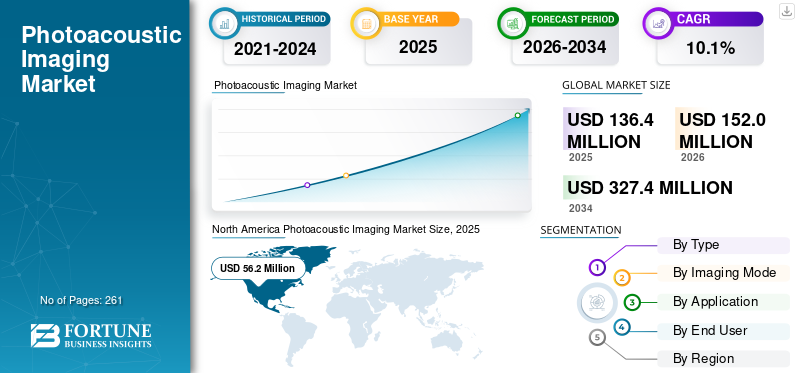
The global photoacoustic imaging market size was valued at USD 136.4 million in 2025 and is projected to grow from USD 152.0 million in 2026 to USD 327.4 million by 2034, exhibiting a CAGR of 10.1% during the forecast period. North America dominated the global photoacoustic imaging market with a market share of 38.46% in 2025.
Photoacoustic imaging is a non-invasive biomedical technique based on the photoacoustic phenomenon that uses pulsed laser light to produce images of optical absorption contrast within tissues. The increasing prevalence of oncology and inflammation-use cases, and the rising demand for handheld and point-of-care devices, are resulting in a growing penetration rate of these products in the market.
- For instance, according to the 2024 data published by the American Cancer Society (ACS), over 2.0 million new cancer cases are expected to occur in the U.S.
Furthermore, the growing integration of technological advancements by prominent players, such as FUJIFILM Corporation, ADVANTEST CORPORATION, among others, is contributing to the product demand in the market.
Download Free sample to learn more about this report.
Photoacoustic Imaging Market KEY TAKEAWAYS
 Market Size & Forecast
- 2025 Market Size: USD 136.4 million
- 2026 Market Size: USD 152.0 million
- 2034 Forecast Market Size: USD 327.4 million
- CAGR: 10.1% from 2026–2034
 Market Share
- North America dominated the global photoacoustic imaging market with a 38.46% share in 2025.
- The oncology segment accounted for a 44.9% share in 2025.
- The Photoacoustic Microscopy (PAM) segment held a 50.7% share in 2025.
 Key Regional Highlights
North America
North America USD 56.2 million in 2025. Strong clinical adoption supported by chronic disease prevalence and advanced research funding.
Europe
Europe USD 41.6 million in 2026. Rising R&D activity and development of novel imaging technologies supporting market expansion.
Asia Pacific
Asia Pacific USD 37.6 million in 2026. Expanding research infrastructure and early adoption across diagnostic and research institutes driving growth.
U.S.
U.S. USD 56.3 million in 2026. Strong translational research ecosystem and high disease burden supporting adoption of photoacoustic imaging.
Japan
Japan USD 7.8 million in 2026. High diagnostic demand and chronic disease prevalence supporting imaging adoption.
Read More

Photoacoustic Imaging Market Trends
Technological Advancements in Photoacoustic Imaging Products is Emerging Market Trend
There is an increasing trend in market as the technology shifts from cart/bench-top, episodic toward skin-conformal patches and wearable form factors that can support tracking of hemodynamics and related physiological parameters for a longer time period. Different prominent players are focusing on technologically advanced miniaturized devices that enhance the precision and efficacy.
Additionally, the development of more continuous or frequently repeated assessments, such as bedside surveillance, monitoring vascular dynamics, and others, further improves practical wearability as compared to traditional devices.
- In October 2022, Luxonus Inc., announced that its application for a medical device marketing license for its photoacoustic 3D imaging system had been approved by Japan’s Pharmaceuticals and Medical Devices Agency (PMDA).
Other Prominent Trends
Integration of photoacoustic imaging with ultrasound for dual‑mode systems, advances in laser and detector technologies to improve penetration and resolution, and progress in real‑time 3D reconstruction algorithms are few other significant market trends.
Download Free sample to learn more about this report.
Market Dynamics
Market Drivers
Increasing Prevalence of Chronic Disorders to Fuel Market Growth
The increasing prevalence of chronic conditions such as cancer, cardiovascular disorders and others is resulting in a growing number of diagnostic procedures among the patient population, subsequently boosting the photoacoustic imaging market growth.
- For instance, according to 2025 data published by the Macmillan Cancer Support, it was reported that about 3.5 million people are living with cancer in the U.K.
Photoacoustic imaging can support researchers and clinicians in the characterization of tumors by showing blood-related functional signals such as oxygenation patterns and vascularity, which further augmenting the adoption rate of this technique in the market. Therefore, the factors above, along with growing focus of key players on introducing research and development activities to launch novel instruments and software, are expected to boost the adoption rate of these products, thereby supporting the market growth.
Market Restraints
Limited Clinical Evidence and Inadequate Reimbursement to Hamper the Market Growth
There is an increasing demand for photoacoustic imaging diagnostic procedures for cancer detection among the patient population. However, limited clinical evidence for photoacoustic imaging is restraining the penetration of this technique among healthcare settings such as hospitals and imaging providers in the market.
Furthermore, inadequate reimbursement policies are resulting in denial of claims, inconsistent payment, increased out-of-pocket expenses, and other factors, further hampering the adoption rate and hindering the market growth globally.
- For instance, optoacoustic breast imaging is currently tracked under a temporary Category III CPT code, which signals that the technology is still in the “data-collection/emerging adoption” phase rather than a fully established, routinely reimbursed standard of care; further limiting the broader rollout into routine clinical workflows.
Market Opportunities
Expansion of Diagnostic Imaging Network in Emerging Countries is a Lucrative Market Growth Opportunity
There is a rapid expansion of healthcare facilities in developing nations, such as India, Mexico, and others. The growing volumes of diagnostic tests, expansion of hospital infrastructure and the increasing number of diagnostic imaging centers are subsequently increasing the adoption of photoacoustic imaging in healthcare facilities.
The preference for diagnostic imaging centers has increased owing to their advantages, including convenience, cost-effectiveness, faster turnaround times and minimized risk of hospital-acquired infections.
- According to 2025 data published by The Hindu, there are about 300,000 diagnostic labs in India.
Market Challenges
Limited Healthcare Access in Developing Countries to Limit Market Growth
There is an increasing demand for photoacoustic imaging among the patient population. However, shortages of technologically advanced systems, underdeveloped hospital infrastructure, limited healthcare expenditure and inadequate reimbursement policies, particularly in emerging nations, are resulting in limited access to medical facilities for the patient population.
Additionally, a limited number of clinical facilities and professionals, is another prominent factor, resulting in the delayed diagnostic procedures among the patient population, especially in emerging countries, including India, Mexico and others.
- For instance, according to 2023 data published by The World Bank Group (WBG), it was reported that approximately 4.5 billion people lack full access to essential health services worldwide.
Other Prominent Challenges
- Stringent regulatory clearance pathways for clinical devices.
- Competition from established imaging modalities such as ultrasound, MRI, CT.
- Technical limitations, such as penetration depth for optical contrast and integration complexity with clinical workflows slows product adoption.
SEGMENTATION ANALYSIS
By Type
Increasing Number of Product Launches Led to the Hardware Segment Dominance
Based on the type, the market is classified into hardware and software. Additionally, hardware is further bifurcated into instruments and accessories.
To know how our report can help streamline your business, Speak to Analyst
The hardware segment held the largest photoacoustic imaging maarket share in 2025. The growth is owing to the increasing prevalence of chronic conditions among the patient population, resulting in a rising number of diagnostic test volumes worldwide. This, along with the rising focus of prominent companies and research institutes on introducing novel products, is drive segment growth
- For instance, in September 2024, UCL researchers developed a new hand-held scanner that can generate highly detailed 3D photoacoustic images, making them a reliable tool for earlier disease diagnosis.
The software segment is expected to grow at a CAGR of 9.7% over the forecast period.
By Imaging Mode
The Increasing Adoption of Photoacoustic Microscopy (PAM) Led Segmentt Dominance
Based on imaging mode, the market is segmented into Photoacoustic Tomography (PAT), Photoacoustic Microscopy (PAM), and Photoacoustic Endoscopy (PAE).
The Photoacoustic Microscopy (PAM) segment dominated the global market in 2025 with a share of 50.7%. This growth is owing to increasing volumes of diagnostic tests, resulting in an increasing demand for photoacoustic microscopy procedures, thereby supporting the adoption rate of this imaging modality in the market. PAM is gaining traction in vascular imaging, plaque assessment, breast lesion characterization and dermatological applications where optical contrast adds diagnostic specificity.
- For instance, according to various research articles, it was reported that recent advancements in PAM technology have dramatically improved its imaging speed, enabling real-time observation of dynamic biological processes in vivo and motion-sensitive targets in situ, such as brain activities and placental development.
The Photoacoustic Endoscopy (PAE) segment is set to flourish with a growth rate of 10.9% across the forecast period.
By Application
The Growing Prevalence of Cancer Led to the Dominance of the Oncology Segment
Based on application, the market is segmented into oncology, cardiovascular disorders, musculoskeletal disorders and others.
The oncology segment dominated the global market in 2025 with a share of 44.9%. The growth is due to increasing prevalence of chronic conditions, such as various types of cancer, resulting in a growing number of diagnostic procedures globally, thereby supporting the adoption rate of these devices in the market.
- For instance, according to the 2024 statistics published by the American Cancer Society (ACS), it was reported that 20 million cases were diagnosed with cancer in 2022 globally.
The segment of cardiovascular disorders is set to flourish with a growth rate of 9.5% across the forecast period.
By End-user
Increasing Number of Hospitals & Clinics Led to Segmental Growth
Based on end user, the market is bifurcated into hospitals & clinics, diagnostic imaging centers and others.
The hospitals & clinics end users are projected to grow at a 10.0% CAGR during the forecast period.
The others segment dominated the market in 2025. The growing prevalence of chronic conditions such as cancer, increasing number of diagnostic procedures, the surge in research institutions and pharmaceutical & biotechnological companies, are some of the crucial factors supporting the segment growth. Furthermore, the segment is set to hold a 53.2% share in 2026.
- For instance, according to 2025 statistics published by the India Brand Equity Foundation (IBEF), it was reported that there are about 3,000 drug companies in India.
Photoacoustic Imaging Market Regional Outlook
Based on region, the market has been studied across North America, Europe, Asia Pacific, Latin America, and the Middle East & Africa.
North America
North America Photoacoustic Imaging Market Size, 2025 (USD Million)
To get more information on the regional analysis of this market, Download Free sample
The North America market held a dominant share in 2024, valued at USD 49.1 million, and also took the leading share in 2025 with USD 56.2 million of value. The growing prevalence of chronic diseases, increasing research, and early clinical adoption due to strong academic centers and funding for translational research, are some of the factors supporting the growth of the segment.
- For instance, according to 2024 data published by the Center for Disease Control & Prevention (CDC), it was reported that the prevalence of Inflammatory Bowel Disease (IBD) is estimated between 2.4 and 3.1 million among the patient population in the U.S.
U.S. Photoacoustic Imaging Market
Based on North America’s strong contribution, the U.S. market can be analytically approximated at around USD 56.3 million in 2026, accounting for roughly 37.0% of global sales.
Europe
Europe is projected to record a growth rate of 8.3% in the coming years, which is the second highest among all regions, and reach a valuation of USD 41.6 million by 2026. The growing research and development activities to launch novel products are likely to support the market growth.
U.K. Photoacoustic Imaging Market
The U.K. market in 2026 is estimated at around USD 7.6 million, representing roughly 5.0% of global revenues.
Germany Photoacoustic Imaging Market
Germany’s market is projected to reach approximately USD 8.7 million in 2026, equivalent to around 5.7% of global sales.
Asia Pacific
Asia Pacific is estimated to reach USD 37.6 million in 2026 and secure the position of the third-largest region in the market. Asia Pacific market is expanding as research infrastructure develops and local OEMs and distributors enter the space. Emerging markets show nascent adoption primarily in research institutes and ,.
Japan Photoacoustic Imaging Market
The Japan’s market in 2026 is estimated at around USD 7.8 million, accounting for roughly 5.1% of global revenues. Japan has historically reported a relatively high prevalence of chronic disorders, with a large number of diagnostic test volumes.
China Photoacoustic Imaging Market
China’s market is projected to be one of the largest worldwide, with 2026 revenues estimated at around USD 14.5 million, representing roughly 9.5% of global sales.
India Photoacoustic Imaging Market
The India’s market size in 2026 is estimated at around USD 4.0 million, accounting for roughly 2.6% of global revenues.
Latin America and Middle East & Africa
The Latin America and Middle East & Africa regions are expected to witness moderate growth in this market space during the forecast period. The Latin America market is set to reach a valuation of USD 6.1 million in 2026. The growth is due to the development of healthcare infrastructure and medical tourism hubs in these regions. In the Middle East & Africa, the GCC is set to reach a value of USD 2.5 million in 2026.
South Africa Photoacoustic Imaging Market
The South Africa market is projected to reach around USD 0.9 million in 2026, representing roughly 0.6% of global revenues.
Competitive Landscape
Key Industry Players
Increasing Number of Product Launches to Support Key Players Dominance
A robust and diversified product portfolio, along with a significant focus on strategic initiatives globally, is one of the crucial factors supporting the dominance of different companies in the market. FUJIFILM Corporation, and ADVANTEST CORPORATION are major companies in the market. Moreover, the growing emphasis by key companies on R&D to launch novel products is likely to strengthen their presence, further supporting market growth
- For instance, in July 2025, FUJIFILM Corporation announced a new instrument intended to enhance applications in oncology, neurobiology, and molecular biology. The Vevo F2 LAZR-X20 photoacoustic imaging platform features "high-powered, intelligent laser technology for advanced tissue characterization with high accuracy."
Other key players, including Seno Medical and others, are also growing, primarily due to their increasing emphasis on acquisitions and partnerships with other players to strengthen their presence in the market.
List of Key Photoacoustic Imaging Companies Profiled
- FUJIFILM Corporation (Japan)
- Seno Medical (U.S.)
- Advantest Corporation (Japan)
- TomoWave Laboratories, Inc. (U.S.)
- iThera Medical GmbH (Germany)
- Luxonous (Japan)
- Verasonics, Inc. (U.S.)
- Kibero (Germany)
- InnoLas Laser GmbH (Germany)
- LUMIBIRD (France)
KEY INDUSTRY DEVELOPMENTS
- January 2026: Researchers from the Keck School of Medicine of USC and the California Institute of Technology have shown that an innovative, noninvasive technique can be used to quickly collect 3D images of the human body, from head to foot. The technology combines ultrasound and photoacoustic imaging, which detects sound waves generated by light, to simultaneously collect images of both tissue and blood vessels.
- July 2025: PHIRE aims to bring close to market a novel high-resolution theranostic medical device effective in the clinical applications for cancer lesions smaller than 1 mm, ready for application in human bladder cancer, and effective both in male and female patients.
- June 2025: PhotoSound Technologies, Inc., partnered with Verasonics, Inc. the leader in research ultrasound to offer customers the PhotoSound Legion AMP for use with Vantage and Vantage NXT Research Ultrasound Systems. The partnership offers Vantage customers expanded capabilities by integrating the Legion AMP in applications using photoacoustic imaging, thermoacoustic imaging, and monitoring radiation therapy, among others.
- July 2021: Advantest Corporation announced that its Hadatomo Z photoacoustic microscope received a Laser Industry Encouragement Award at the 13th Industry Awards sponsored by the Laser Society of Japan. This helped the company in strengthening its product portfolio.
- November 2020: FUJIFILM Corporation celebrated the first installation of the new Vevo F2 imaging platform with photoacoustics at the Université de Tours, Tours, France.
- May 2020: FUJIFILM Corporation launched the Vevo F2, the ultra-high to low frequency ultrasound imaging system with a frequency range stretching from 71-1 MHz. This helped the company in strengthening its product portfolio.
- May 2019: iThera Medical received CE approval for its MSOT Acuity imaging system, indicating conformity with health, safety, and environmental protection for medical devices sold in Europe.
REPORT COVERAGE
The report provides a detailed global photoacoustic imaging market analysis and focuses on key aspects such as leading companies and market segmentation, including type, usage, application, and end user. Besides this, the global report offers insights into the market growth trends and highlights key industry developments. In addition to the aforementioned factors, the report encompasses several factors that have contributed to the growth and advancement of the market over recent years.
Request for Customization to gain extensive market insights.
Report Scope & Segmentation
|
ATTRIBUTE |
DETAILS |
|
Study Period |
2021-2034 |
|
Base Year |
2025 |
|
Estimated Year |
2026 |
|
Forecast Period |
2026-2034 |
|
Historical Period |
2021-2024 |
|
Growth Rate |
CAGR of 10.1% from 2026-2034 |
|
Unit |
Value (USD Million) |
|
Segmentation |
By Type, Imaging Mode, Application, End User, and Region |
|
By Type |
|
|
By Imaging Mode |
|
|
By Application |
|
|
By End User |
|
|
By Region |
North America (By Type, By Imaging Mode, By Application, By End User, and by Country)
Europe (By Type, By Imaging Mode, By Application, By End User, and by Country/Sub-region)
Asia Pacific (By Type, By Imaging Mode, By Application, By End User, and by Country/Sub-region)
Latin America (By Type, By Imaging Mode, By Application, By End User, and by Country/Sub-region)
Middle East & Africa (By Type, By Imaging Mode, By Application, By End User, and by Country/Sub-region)
|
Frequently Asked Questions
Fortune Business Insights says that the global market size was USD 136.4 million in 2025 and is projected to reach USD 327.4 million by 2034.
In 2025, the North America regional market value stood at USD 56.2 million.
Growing at a CAGR of 10.1%, the market will exhibit steady growth over the forecast period (2026-2034).
By type, the hardware segment is the leading segment in this market.
The introduction of novel photoacoustic imaging systems is one of the major factors driving the market's growth.
FUJIFILM Corporation and ADVANTEST CORPORATION are the major players in the global market.
North America dominated the market share in 2025.
The growing prevalence of chronic disorders, the rising number of diagnostic imaging procedures, among others, are some of the prominent factors anticipated to boost the adoption of these products worldwide.



- 2021-2034
- 2025
- 2021-2024
- 261
Get 30-60 hrs Free Customization
Expand Regional and Country Coverage, Segments Analysis, Company Profiles, Competitive Benchmarking, and End-user Insights.













.webp)






Related Reports
-
US +1 833 909 2966 ( Toll Free )
-
Get In Touch With Us