Piezoelectric Ceramics Market Size, Share & Industry Analysis, By Type (Lead Zirconate Titanate (PZT) and Lead-free Ceramics), By Application (Automotive, Healthcare, IT & Telecom, Consumer Goods, Aerospace & Defense, and Others), and Regional Forecast, 2026-2034
 Download Free Sample
KEY MARKET INSIGHTS
 Listen to Audio Version
The global piezoelectric ceramics market size was valued at USD 1.17 billion in 2025 and is projected to grow from USD 1.23 billion in 2026 to USD 1.8 billion by 2034, exhibiting a CAGR of 4.90% during the forecast period. Asia Pacific dominated the piezoelectric ceramics market with a market share of 72% in 2025.
Piezoelectric ceramics are a smart material that converts mechanical stress into electrical energy and vice versa. This unique property arises from the alignment of electric dipoles within the ceramic material when subjected to mechanical stress or an electric field. The increasing use of these materials in consumer electronics, automotive, and medical devices drives this trend. Additionally, advancements in manufacturing technologies are enhancing their performance and efficiency, further boosting their adoption.
The major players in the market are PI Ceramics GmbH, APC International, Ltd., L3Harris Technologies, Inc., and CeramTec.
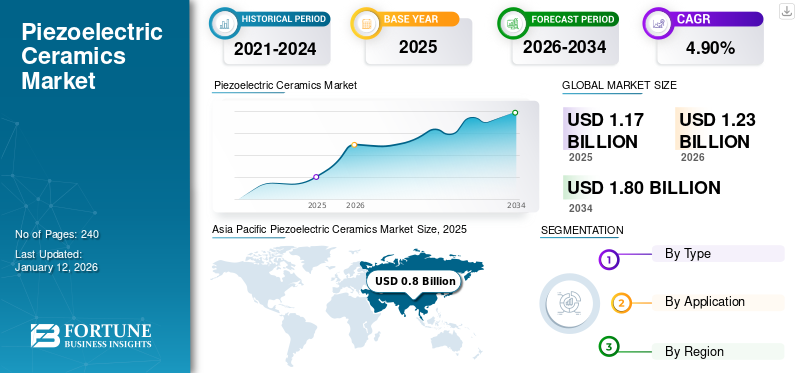
Download Free sample to learn more about this report.
Piezoelectric Ceramics MARKET KEY TAKEAWAYS
 Market Size & Forecast
- 2025 Market Size: USD 1.17 billion
- 2026 Market Size: USD 1.23 billion
- 2034 Forecast Market Size: USD 1.8 billion
- CAGR: 4.90% from 2026–2034
 Market Share
- Asia Pacific dominated the piezoelectric ceramics market with a 72% share in 2025.
- The Lead Zirconate Titanate (PZT) segment held the largest market share in 2026.
- The consumer goods segment accounted for the largest market share in 2026.
 Key Regional Highlights
North American
North America reached USD 0.16 billion in 2026, supported by rising adoption in sensors, medical devices, and automotive applications.
Europe
Europe maintained steady growth in 2026, driven by automotive, aerospace, and consumer electronics demand.
Asia Pacific
Asia Pacific reached USD 0.84 billion in 2026, driven by strong electronics manufacturing and automotive demand.
U.S.
The market is supported by increasing consumption in high-performance sensors across automotive and electronics sectors.
Japan
The market is driven by strong electronics manufacturing capabilities and expanding automotive applications.
Read More

PIEZOELECTRIC CERAMICS MARKET TRENDS
Technological Advancement of Lead-free Piezoelectric Ceramics Is Propelling Market Growth
Technological advancement in lead-free piezoelectric ceramics has gained noteworthy attention in recent years due to the growing demand for environmentally friendly materials. These ceramics are essential in various applications, including sensors, actuators, and transducers, where piezoelectric properties are crucial.
One of the key advancements involves the development of new compositions that can replace traditional lead-based materials while maintaining desirable piezoelectric properties. Additionally, improvements in processing techniques, such as sol-gel synthesis and hydrothermal methods, have enhanced the performance of these materials. The integration of novel additives and dopants has also played a significant role in refining their properties.
Download Free sample to learn more about this report.
MARKET DYNAMICS
MARKET DRIVERS
Growing Need for High-Performance Sensors Drives Market Growth
The growing need for high-performance sensors is driving the market. This demand is fueled by advancements in various industries that require precision and efficiency, such as automotive, aerospace, and consumer electronics. As technology evolves, the integration of the product into sensors will become essential for applications such as pressure sensing, motion detection, and vibrational energy harvesting.
Consequently, manufacturers are focusing on enhancing the performance and reliability of these materials to meet the increasing market requirements.
MARKET RESTRAINTS
High Cost of Product and Raw Material May Restrain Market Growth
The high cost of the product can be a significant barrier to its widespread application in various industries. This price is often influenced by factors such as the raw materials used, production processes, and the complexity of manufacturing. As technology advances, there is ongoing research aimed at reducing these costs while maintaining the performance and quality of the ceramics. Additionally, developing alternative materials or optimizing existing manufacturing methods could help make the product more accessible for various applications.
MARKET OPPORTUNITIES
Emergence of IoT Technology Creates Market Expansion Scenario
As more devices become interconnected, the demand for advanced materials that can efficiently convert mechanical energy into electrical energy is increasing. This trend is driving innovations and expanding application areas for market products, particularly in smart sensors, actuators, and energy harvesting devices. With the rise of industrial automation, smart homes, and wearable technology, the market for these ceramics is poised for significant expansion. Thus, the emergence of IoT technology creates an opportunity for the piezoelectric ceramics market growth.
MARKET CHALLENGES
Limited Raw Material Options Challenging Market Growth
Limited raw material options and increasing environmental regulations pose challenges for manufacturers of product, particularly with lead-containing materials including PZT. This can lead to higher costs and difficulty sourcing materials for industrial applications.
The availability and sourcing of specific materials necessary for production can impact the overall supply chain and cost efficiency. As a result, companies may face difficulties meeting demand, affecting their competitiveness in the market. Additionally, the reliance on a narrow range of raw materials could lead to vulnerabilities in production if there are disruptions in supply. Finding alternative materials or improving recycling processes may be critical in addressing these challenges.
TRADE PROTECTIONISM
Many countries impose tariffs on imported piezoelectric ceramics to make local products more competitive. This can lead to surging prices for consumers and manufacturers reliant on imported materials. Trade barriers can disrupt supply chains, causing delays and increasing costs for companies that utilize products in their applications. This is particularly critical in industries such as electronics, automotive, and healthcare, where these materials are essential.
Segmentation Analysis
By Type
Lead Zirconate Titanate (PZT) Segment to Dominate due to its Exceptional Properties
Based on type, the market is classified into Lead Zirconate Titanate (PZT) and Lead-free Ceramics.
Among these, Lead Zirconate Titanate (PZT) dominates the market. PZT is a critical material in the market due to its exceptional properties, such as high piezoelectric coefficients and dielectric constants. The demand for PZT is driven primarily by its applications in various sectors, including automotive, consumer electronics, and industrial automation. As technology advances, the need for more efficient and compact piezoelectric devices is expected to increase, further boosting the demand for PZT in the market. Innovative developments in material synthesis and processing are also likely to enhance the performance and applicability of PZT, reinforcing its position in the market.
By Application
Consumer Goods Segment to Lead Owing to Rising Product Adoption in Consumer Electronics
Based on application, the market is classified into automotive, healthcare, IT & telecom, consumer goods, aerospace & defense, and others.
Among these, the consumer goods segment held the largest piezoelectric ceramics market share. The product is increasingly being integrated into various consumer goods applications due to its unique ability to change mechanical stress into electrical energy and vice versa. In appliances such as dishwashers and washing machines, the product can be used in sensors to detect water levels, ensuring optimal performance and energy efficiency.
Piezoelectric ceramics have found various automotive applications due to their unique properties. In automotive systems, products can serve as actuators in mechanisms such as fuel injectors, throttle control, or in adaptive suspension systems. They can rapidly and accurately control movements, enhancing the vehicle's performance.
Piezoelectric Ceramics Market Regional Outlook
By region, the market is categorized into North America, Europe, Asia Pacific, Latin America, and the Middle East & Africa.
Asia Pacific
Asia Pacific Piezoelectric Ceramics Market Size, 2025 (USD Billion)
To get more information on the regional analysis of this market, Download Free sample
The Asia Pacific region captured 72.00% of the global market in 2025, generating USD 0.8 billion in revenue, and is projected to reach USD 0.84 billion in 2026. Asia Pacific is generally considered the largest and fastest-growing market. It includes China, Japan, South Korea, India, and Taiwan, which are major manufacturing hubs for electronics. Further, surging product demand from automobiles is anticipated to drive the market in the region.
North America
North America contributed approximately USD 0.15 billion to the global market in 2025, accounting for 12.00% share, and is expected to reach USD 0.16 billion in 2026. North America is also a significant market, driven by the use of products in various applications such as portable electronics, medical devices, and automotive. The U.S. is the leading country in the region with rising product consumption in high-performance sensors. Increasing demand for sensors from industries such as electronics, automotive, and aerospace will boost market growth in the country.
Europe
In 2025, the Europe market stood at USD 0.13 billion, representing 9.00% of global demand, and is projected to grow to USD 0.13 billion in 2026. The European region will register significant growth during the forecast period. Europe's market is influenced by the use of products in industries such as automotive, aerospace, and consumer electronics.
Latin America
Latin America recorded a market size of USD 0.05 billion in 2025, capturing 4.10% of the global market share, and is projected to reach USD 0.05 billion in 2026. Latin America showcases a growing demand for piezoelectric ceramics, particularly in Brazil. This region's growth is often linked to urbanization, investments in the healthcare sector, and the increasing usage of advanced medical solutions.
Middle East & Africa
In 2025, Middle East & Africa generated USD 0.05 billion, contributing 4.00% to global market revenue, and is projected to grow to USD 0.05 billion in 2026. The Middle East & Africa is witnessing gradual growth in the product market. As industries continue to advance and diversify, the product market is expected to grow, presenting numerous opportunities for manufacturers and suppliers within the Middle East & Africa.
COMPETITIVE LANDSCAPE
Key Industry Players
Introduction of New Products by Companies Result in Their Dominating Position
The market is highly competitive, with major players focusing on capacity expansion, sustainability, and mergers & acquisitions to strengthen their market presence. Key global companies include PI Ceramics GmbH, APC International, Ltd., L3Harris Technologies, Inc., and CeramTec. While global leaders dominate in developed markets, regional players are expanding aggressively in emerging economies, intensifying competition in the industry.
LIST OF KEY PIEZOELECTRIC CERAMICS COMPANIES PROFILED
- PI Ceramics GmbH (Germany)
- APC International, Ltd. (U.S.)
- L3Harris Technologies, Inc. (U.S.)
- CeramTec (Germany)
- Arkema (France)
- Sparkler Ceramics (India)
- TDK Corporation (Japan)
- Hong Kong Piezo Co. Ltd. (China)
- Piezo Kinetics Inc. (U.S.)
- CTS Corporation (U.S.)
KEY INDUSTRY DEVELOPMENTS
- April 2023: PI Ceramic introduced a piezoceramic product for sensor technology applications in medical technology and industrial automation. The product is utilized for air bubble detection, flow metering, and ultrasonic metrology.
- April 2023: CTS Corporation acquired maglab AG, an expert in electric vehicle Such development helped the company enhance its position in the electric vehicle sensor market and heightened the demand for contemporary piezoelectric ceramics in automotive applications.
REPORT COVERAGE
Request for Customization to gain extensive market insights.
Report Scope & Segmentation
|
ATTRIBUTE |
DETAILS |
|
Study Period |
2021–2034 |
|
Base Year |
2025 |
|
Estimated Year |
2026 |
|
Forecast Period |
2026-2034 |
|
Historical Period |
2021–2024 |
|
Growth Rate |
CAGR of 4.90% from 2026-2034 |
|
Unit |
Value (USD Billion) and Volume (Million Cubic Centimeters (MCC)) |
|
Segmentation |
By Type
|
|
By Application
|
|
|
By Region
|
Frequently Asked Questions
Fortune Business Insights says that the global market value stood at USD 1.23 billion in 2026 and is projected to reach USD 1.8 billion by 2034.
In 2025, the market value stood at USD 0.8 billion.
The market is expected to exhibit a CAGR of 4.90% during the forecast period of 2026-2034.
The consumer goods segment led the market by application.
The growing need for high-performance sensors is the key factor driving the market.
PI Ceramics GmbH, APC International, Ltd., L3Harris Technologies, Inc., and CeramTec are some of the leading players in the market.
The emergence of IoT technology and technological advancement in lead-free piezoelectric materials are expected to drive product adoption.



- 2021-2034
- 2025
- 2021-2024
- 240
Get 30-60 hrs Free Customization
Expand Regional and Country Coverage, Segments Analysis, Company Profiles, Competitive Benchmarking, and End-user Insights.


















Related Reports
-
US +1 833 909 2966 ( Toll Free )
-
Get In Touch With Us