Polybutylene Adipate Terephthalate Market Size, Share & Industry Analysis, By Application (Packaging, Consumer Goods, Agriculture & Horticulture, Coatings & Adhesives, and Others) and Regional Forecast, 2026-2034
 Download Free Sample
KEY MARKET INSIGHTS
 Listen to Audio Version
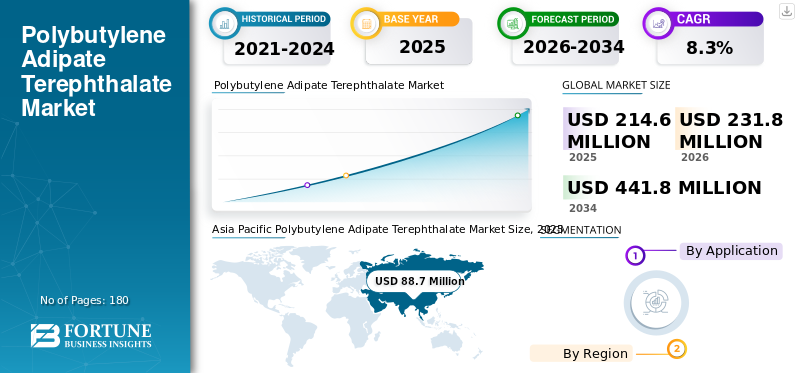
The global polybutylene adipate terephthalate market size was valued at USD 214.6 million in 2025 and is projected to grow from USD 231.8 million in 2026 to USD 441.8 million by 2034 at a CAGR of 8.3% during the forecast period. Asia Pacific dominated the polybutylene adipate terephthalate market with a market share of 41.3% in 2025.
Polybutylene adipate terephthalate (PBAT) is a biodegradable and renewable synthetic polymer that is made from the combination of adipic acid, 1,4-butanediol, and terephthalic acid. PBAT has excellent flexibility, toughness, and processability, making it a popular choice for applications such as packaging, agricultural films, and others. It is known for its ability to biodegrade under industrial composting conditions. The increasing demand for biodegradable plastics is slated to drive the market growth.
The COVID-19 pandemic had a mixed effect on the global market. While the demand for certain applications such as packaging and disposable products surged due to heightened hygiene concerns, supply chain interruptions and lower industrial activity challenged the overall market. This resulted in transient variations in polybutylene adipate terephthalate prices and production levels throughout the pandemic.
Download Free sample to learn more about this report.
Polybutylene Adipate Terephthalate Market Key Takeaways
 Global Market Size & Forecast
- 2025 Market Size: USD 214.6 million
- 2026 Market Size: USD 231.8 million
- 2034 Forecast Market Size: USD 441.8 million
- CAGR: 8.3% from 2026–2034
 Market Share
- Asia Pacific dominated the polybutylene adipate terephthalate market with a market share of 41.3% in 2025.
- The packaging segment will hold the largest polybutylene adipate terephthalate market share by 70.45% in 2026.
- The consumer goods segment is expected to hold a 24% share in 2023.
 Key Regional Highlights
Asia Pacific
The market in Asia Pacific reached USD 88.7 million in 2025 and is projected to reach USD 96.4 million in 2026. The region is the largest and fastest growing market for PBAT.
North America
The North America market was valued at USD 43.1 million in 2025 and is estimated to reach USD 46.2 million in 2026, supported by strong demand for sustainable packaging solutions.
Europe
Europe held 30.90% of the global market, reaching USD 66.3 million in 2025 and is projected to grow to USD 71.6 million in 2026.
U.S.
The U.S. market size is estimated to hit USD 37.3 million in 2026.
Japan
Japan is expected to reach USD 88.7 million in 2026.
Read More

Polybutylene Adipate Terephthalate Market Trends
Bio-based PBAT and Production Process Advancement to Drive Sustainability and Economic Viability in the Market
The development of bio-based polybutylene adipate terephthalate is a significant trend in the industry, as it helps reduce the carbon footprint and improve the environmental credentials of products. Bio-based PBAT is made from renewable feedstock, such as plant oils or agricultural waste, rather than fossil fuels. This shift toward renewable raw materials is consistent with the increasing emphasis on sustainability and the transformation to a circular economy. The utilization of renewable feedstock can assist in reducing the reliance on fossil fuels and contribute to a more sustainable supply chain. Asia Pacific witnessed a growth from USD 139.9 million in 2022 to USD 75.1 million in 2023.
In addition to the development of biobased PBAT, the product manufacturing industry has witnessed advancements in production processes. Improvements in chemical synthesis techniques, process optimization, and the use of advanced technologies, such as continuous production and automated control systems, have led to increased efficiency, reduced energy consumption, and enhanced product quality. These advancements have enabled manufacturers to scale up production, improve the economic viability of PBAT, and better cater to the growing demand for sustainable and biodegradable materials.
Download Free sample to learn more about this report.
Polybutylene Adipate Terephthalate Market Growth Factors
PBAT’s Superior Properties to Propel its Adoption in Sustainable Packaging
The packaging industry is a key driver of the growing market. The widespread adoption of polybutylene adipate terephthalate in various packaging applications has been a significant factor behind the material’s increasing popularity and market expansion. One of the main reasons for PBAT’s popularity in the packaging sector is its high biodegradability and composability. As consumers and regulators become more aware of the environmental impact of single use plastics, the need for sustainable packaging alternatives has increased. PBAT’s capacity to degrade under industrial composting settings makes it an appealing alternative to traditional petroleum-based plastics, especially for food packaging, disposable tableware, and shopping bags.
Furthermore, polybutylene adipate terephthalate’s unique combination of flexibility, toughness, and processability makes it suitable for a wide range of packaging formats. From flexible films and pouches to rigid containers and trays, PBAT can be customized to meet the different needs of the packaging sector. This versatility has enabled the product to penetrate a wide range of packaging segments, further driving the polybutylene adipate terephthalate market growth.
The packaging shift toward sustainable materials has coincided with advancements in PBAT production processes, which have improved the material’s cost-competitiveness and availability. As a result, PBAT has become an increasingly viable and preferred choice for packaging manufacturers seeking to reduce their environmental footprint while maintaining the desired performance characteristics.
RESTRAINING FACTORS
Higher Costs, Limited Production, and Weak Waste Infrastructure May Hinder the Market Growth
Despite increasing demand for PBAT in the packaging industry and other applications, the material currently holds a relatively lower market share in the biodegradable plastic industry compared to other plastic alternatives. One of the key issues is that polybutylene adipate terephthalate has a greater production cost than leading biopolymers and typical petroleum-based polymers. The complex synthesis process and the relatively nascent stage of PBAT manufacturing contribute to its higher manufacturing expenses. This can make it challenging for PBAT to compete in terms of price with more established plastic alternatives, especially in price-sensitive markets.
Furthermore, the limited availability of production capacity and the relatively small number of manufacturers globally can constrain the material’s supply and hinder its widespread adoption. In addition, the lack of comprehensive waste management infrastructure and composting facilities in many regions can hamper the full realization of the product’s biodegradability benefits. Developing the necessary waste treatment capabilities is essential to enable the circular use of PBAT-based products and further drive market growth.
Polybutylene Adipate Terephthalate Market Segmentation Analysis
By Application Analysis
To know how our report can help streamline your business, Speak to Analyst
Packaging Segment Led Due to Increasing Flexible Films, Bags, Pouches, and Rigid Containers Demand
Based on application, the market is segmented into packaging, consumer goods, agriculture & horticulture, coatings & adhesives, and others.
The packaging segment will hold the largest polybutylene adipate terephthalate market share by 70.45% in 2026 and is the fastest-growing application in the global market. PBAT’s excellent biodegradability, flexibility, and processability make it a preferred choice for various packaging formats, including flexible films, bags, pouches, and rigid containers. The rising consumer and regulatory demand for sustainable packaging solutions is a major driver for product adoption in this sector.
PBAT finds application in consumer products such as disposable tableware, cosmetic containers, and personal care items. Its biodegradable and compostable properties align with the increasing consumer preference for environmentally friendly alternatives to conventional plastics, which is significantly driving the PBAT demand in consumer products.
- The consumer goods segment is expected to hold a 24% share in 2023.
Polybutylene adipate terephthalate has gained traction in the agriculture & horticulture sectors for applications such as mulch films, plant pots, and seedling trays. The material’s biodegradability allows for easy disposal and integration into the soil, reducing waste and environmental impact has bolstered the market growth.
PBAT’s versatility extends to the coating & adhesives market, where it is used as a component in water-based and solvent-free formulations. The material’s flexible and durable properties have driven the demand significantly for applications such as paper coatings, hot melt adhesives, and pressure-sensitive adhesives.
REGIONAL INSIGHTS
By region, the market is divided into the Asia Pacific, Europe, North America, and the rest of the world.
Asia Pacific Polybutylene Adipate Terephthalate Market Size, 2025 (USD Million)
To get more information on the regional analysis of this market, Download Free sample
Asia Pacific
The market in Asia Pacific reached USD 88.7 million in 2025, representing 41.30% of total market revenue, and is projected to reach USD 96.4 million in 2026. The region is the largest and fastest growing market for PBAT, driven by rapid industrialization, urbanization, and rising environmental awareness in countries such as China, Japan, South Korea, and India. China is dominant country in the market due to its large production capacities, cost-effective manufacturing capabilities, and increasing demand from various end-use industries like packaging, agriculture, and consumer goods within the country as well as for exports. In addition, the region’s robust packaging industry, coupled with supportive government regulations and policies promoting biodegradable materials, has been instrumental in driving market expansion. The market in China is anticipated to hold 50.8 million in 2026. On the other hand, India is likely to be USD 12.9 million and Japan is expected to reach USD 88.7 million in 2026.
- In China, the consumer goods segment is estimated to hold a 24.4% market share in 2023.
To know how our report can help streamline your business, Speak to Analyst
North America
North America is another significant market for polybutylene adipate terephthalate, particularly in the U.S. The North America market was valued at USD 43.1 million in 2025, capturing 20.10% of global revenue, and is estimated to reach USD 46.2 million in 2026. The region’s well-established packaging industry and the growing consumer demand for sustainable alternatives to traditional plastics have fueled the product adoption. In addition, the development of advanced manufacturing capabilities and the presence of major industry players in North America further contribute to the regional market’s growth. The U.S. market size is estimated to hit USD 37.3 million in 2026.
Europe
Europe is a mature market, with countries such as Germany, France, and the U.K. at the forefront of the shift toward biodegradable and compostable materials. In 2025, Europe held 30.90% of the global market, reaching a valuation of USD 66.3 million, and is projected to grow to USD 71.6 million in 2026. Stringent environmental regulations, such as the EU’s Single-Use Plastics Directive, have accelerated the adoption of PBAT in packaging and other applications across the region. The U.K. market is likely to hold USD 18.5 million in 2026. Meanwhile, the Germany market is expected to be USD 22.9 million in 2026 and France is likely to be USD 10.04 million in 2025.
Middle East & Africa
In 2025, the Middle East & Africa market stood at USD 16.5 million, representing 7.70% of global demand, and is projected to grow to USD 17.7 million in 2026.
Rest Of The World
The market in the rest of the world is likely to be valued at USD 16.51 million in 2025 as the fourth-largest region, including regions such as Latin America and the Middle East & Africa, is relatively smaller but growing rapidly. Increasing environmental awareness, investments in sustainable infrastructure, and the expansion of multinational packaging companies in these regions are the key factors driving the product demand.
List of Key Companies in Polybutylene Adipate Terephthalate Market
Investments in Technological and Production Advancements by Companies to Strengthen Their Market Position
Key polybutylene adipate terephthalate manufacturers are actively engaged in various strategic initiatives to strengthen their market position and capitalize on the growing demand for biodegradable materials. Major players are investing in technology upgrades and R&D to improve production efficiency and product performance. Manufacturers are also focused on developing innovative PBAT-based formulations and applications to diversify their product portfolios. Furthermore, leading companies are entering strategic collaborations and partnerships to expand their geographical reach, access new markets, and enhance their overall competitiveness in the global market.
LIST OF KEY COMPANIES PROFILED:
- BASF SE (Germany)
- Novamont S.p.A. (Norway)
- Kingfa Sci.&Tech. Co.,Ltd. (China)
- OerlikonBarmagHuitong (Yangzhou) Engineering Co., Ltd. (China)
- Xinjiang Blue Ridge Tunhe Sci.&Tech. Co., Ltd. (China)
- Jin Hui Zhao Long High Tech Co., Ltd. (China)
- DAWN (China)
- Mitsubishi Corporation (Hong Kong) Limited. (Japan)
- Entec Polymers (U.S.)
- Hangzhou Peijin Chemical Co., Ltd. (China)
REPORT COVERAGE
The research report provides a comprehensive polybutylene adipate terephthalate market analysis and emphasizes crucial aspects such as leading companies and applications. In addition, it provides quantitative data regarding volume and value, market analysis, research methodology for market data, and insights into market trends. It highlights vital industry developments and the competitive landscape. In addition to the abovementioned factors, the report encompasses various factors that have contributed to the market's growth in recent years.
Request for Customization to gain extensive market insights.
Key Industry Development
June 2024 - BASF introduced a biomass-balanced version of its compostable biopolymer, ecoflex® F Blend C1200 BMB. This PBAT variant offers a 60% lower product carbon footprint compared to the standard grade, utilizing renewable feedstocks attributed via a certified biomass balance approach.
March 2022 - Novamont and Versalis strengthened their green chemistry partnership, focusing on developing renewable-based chemical platforms. This collaboration aims to accelerate the development of technologies and supply chains in the bioeconomy sector.
Report Scope & Segmentation
|
ATTRIBUTE |
DETAILS |
|
Study Period |
2021-2034 |
|
Base Year |
2025 |
|
Estimated Year |
2026 |
|
Forecast Period |
2026-2034 |
|
Historical Period |
2021-2024 |
|
Unit |
Value (USD Million) and Volume (Kiloton) |
|
Growth Rate |
CAGR of 8.3% during 2026-2034 |
|
Segmentation |
By Application
|
|
By Region
|
Frequently Asked Questions
Fortune Business Insights says that the global market size was USD 214.6 million in 2025 and is projected to reach USD 441.8 million by 2034.
The Asia Pacific held the largest share in the market in 2025.
Growing at a CAGR of 8.3%, the market is expected to exhibit rapid growth during the forecast period (2026-2034).
By application, the packaging segment occupied the largest share in 2025.
Pbats biodegradability, versatility, and production advancements in sustainable packaging are the key factors driving the market growth.
China held the highest share of the market in 2025.
BASF SE, Novamont S.p.A., Kingfa Sci.&Tech. Co., Ltd., and Jin Hui Zhao Long High Tech Co., Ltd. are the leading players in the market.
The rising demand for eco-friendly packaging and increasing regulatory scenario is anticipated to boost product consumption.



- 2021-2034
- 2025
- 2021-2024
- 180
Get 30-60 hrs Free Customization
Expand Regional and Country Coverage, Segments Analysis, Company Profiles, Competitive Benchmarking, and End-user Insights.


















Related Reports
-
US +1 833 909 2966 ( Toll Free )
-
Get In Touch With Us