Potassium Oleate Market Size, Share & Industry Analysis, By Product Form (Aqueous Solution, Paste, and Solid), By End Use (Household Cleaning, Industrial & Institutional Cleaning, Personal Care & Cosmetics, Agriculture & Horticulture, and Others), and Regional Forecast, 2026-2034
 Download Free Sample
KEY MARKET INSIGHTS
 Listen to Audio Version
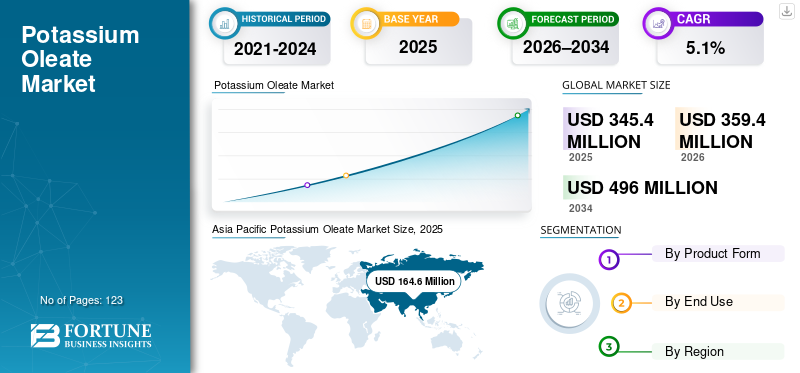
The global potassium oleate market size was valued at USD 345.4 million in 2025. The market is projected to grow from USD 359.4 million in 2026 to USD 496.0 million by 2034, exhibiting a CAGR of 5.1% during the forecast period. Asia Pacific dominated the potassium oleate market with a market share of 47.65% in 2025.
Potassium oleate is a potassium salt of oleic acid, widely used as an anionic surfactant, emulsifier, and soap base across industries, including personal care, industrial cleaning, agrochemical, and specialty chemical applications. Its excellent water solubility, strong foaming properties, and relatively mild profile make it suitable for human-contact formulations. It serves a vital role in the making of liquid soaps, shaving creams, cosmetics, and pharmaceutical products, while also supporting functional roles in industrial cleaners, textile processing, and flotation agents.
The market demand is primarily supported by the steady consumption of personal care and hygiene products, rising use of liquid and specialty soaps, and consistent uptake of industrial and institutional cleaning formulations. However, the overall market expansion remains moderate due to substitution pressure from synthetic surfactants in cost-sensitive applications and the mature nature of traditional soap-based end uses.
The market is dominated by large oleochemical producers and specialty surfactant manufacturers with secure access to natural fatty acid feedstocks, particularly oleic acid derived from vegetable oils. Established oleochemical groups and surfactant suppliers such as Hangzhou Leap Chem Co., Ltd., Henan Tianfu Chemical Co., Ltd, Kao Chemicals, PCC Group, and Viva Corporation maintain market presence through vertically integrated production, global manufacturing networks, and long-term supply relationships with downstream formulators.
Download Free sample to learn more about this report.
POTASSIUM OLEATE MARKET KEY TAKEAWAYS
 Global Market Size & Forecast
- 2025 Market Size: USD 345.4 million
- 2026 Market Size: USD 359.4 million
- 2034 Forecast Market Size: USD 496.0 million
- CAGR: 5.10% from 2026-2034
 Market Share
- Asia Pacific captured 47.65% of the potassium oleate market in 2025.
- The industrial & institutional cleaning segment remains a major end-use category, driven by demand from food processing, commercial laundries, textile processing, and industrial cleaning applications.
- The personal care & cosmetics segment remains a key end-use category, supported by growing applications in soaps, shaving creams, cleansers, and skincare products.
 Key Regional Highlights
North America
North America reached USD 62.4 million in 2025, supported by stable demand across major applications.
Europe
Europe was valued at USD 78.9 million in 2025 and is projected to grow at a 3.5% CAGR over the forecast period.
Asia Pacific
Asia Pacific generated USD 164.6 million in 2025 and is projected to reach USD 171.9 million in 2026.
U.S.
The U.S. market is projected to reach USD 55.4 million by 2026, accounting for approximately 15% of global revenue.
Japan
Japan is recognized as a key Asia Pacific market with growing demand for potassium oleate.
Read More
 Global Market Size & Forecast
- 2025 Market Size: USD 345.4 million
- 2026 Market Size: USD 359.4 million
- 2034 Forecast Market Size: USD 496.0 million
- CAGR: 5.10% from 2026-2034
Market Share- Asia Pacific captured 47.65% of the potassium oleate market in 2025.
- The industrial & institutional cleaning segment remains a major end-use category, driven by demand from food processing, commercial laundries, textile processing, and industrial cleaning applications.
- The personal care & cosmetics segment remains a key end-use category, supported by growing applications in soaps, shaving creams, cleansers, and skincare products.
Key Regional HighlightsNorth America
North America reached USD 62.4 million in 2025, supported by stable demand across major applications.
Europe
Europe was valued at USD 78.9 million in 2025 and is projected to grow at a 3.5% CAGR over the forecast period.
Asia Pacific
Asia Pacific generated USD 164.6 million in 2025 and is projected to reach USD 171.9 million in 2026.
U.S.
The U.S. market is projected to reach USD 55.4 million by 2026, accounting for approximately 15% of global revenue.
Japan
Japan is recognized as a key Asia Pacific market with growing demand for potassium oleate.
Read More
POTASSIUM OLEATE MARKET TRENDS
Rising Preference for Fatty-Acid Based and Mild Surfactants to Drive Formulation Adoption
End-use industries are increasingly favoring the product due to its plant-derived origin, mild surfactant profile, and strong biodegradability compared with petroleum-based synthetic surfactants. This trend is the most evident in personal care, cosmetics, and specialty soap formulations, where the demand is rising for skin-friendly, sulfate-free, and naturally positioned ingredients. The product is widely used in liquid soaps, shaving products, and specialty cleansers owing to its excellent solubility, stable foaming, and compatibility with sensitive-skin formulations. As sustainability commitments strengthen across consumer-facing brands, naturally derived oleochemical surfactants are gaining preference over conventional synthetic alternatives, reinforcing long-term product adoption.
- Companies such as Kao Corporation, Emery Oleochemicals, and KLK OLEO continue to position fatty-acid–based surfactants, including potassium oleate, within mild and bio-based product portfolios to align with evolving formulation standards.
Download Free sample to learn more about this report.
MARKET DYNAMICS
MARKET DRIVERS
Surging Demand from Personal Care and Industrial Cleaning Applications to Drive Market Growth
The global potassium oleate market growth is primarily driven by the rising demand for personal care, specialty soap, and industrial cleaning formulations. It is a key ingredient in liquid soaps, shaving creams, and cosmetic cleansers, where it functions as an effective emulsifier and foaming agent with favorable dermatological properties. Rising hygiene awareness, expanding middle-class populations, and increasing consumption of premium and specialty personal care products are major drivers of product demand. In addition, industrial and institutional cleaning is valued for its grease-cutting efficiency, water solubility, and compatibility with alkaline cleaning systems used in food processing, textile treatment, and surface cleaning applications. Hence, sustained consumption across both consumer and industrial end uses will support the global market growth during the forecast period.
MARKET RESTRAINTS
Feedstock Price Sensitivity and Substitution by Synthetic Surfactants May Limit Market Expansion
Despite its favorable functional and sustainability profile, the global market faces constraints related to raw material price sensitivity and competitive substitution. Its production is directly linked to oleic acid availability and pricing, which, in turn, depend on vegetable oil markets such as palm, soybean, and sunflower oils. Fluctuations in agricultural feedstock prices can affect production economics and margin stability, particularly for cost-sensitive industrial applications. Additionally, in high-volume cleaning and detergent segments, potassium oleate faces substitution pressure from lower-cost synthetic surfactants that offer comparable performance at reduced formulation costs. In mature soap and cleaning markets, buyers often prioritize price competitiveness over natural positioning, limiting the potential for premium pricing. These factors collectively limit the global market growth, despite a steady demand from regulated and specialty applications.
MARKET OPPORTUNITIES
Rising Preference for Bio-Derived and Specialty-Grade Oleochemical Surfactants to Create Lucrative Opportunities
Bio-derived, specialty-grade products present a significant growth opportunity as sustainability requirements intensify across the personal care, cosmetics, and institutional cleaning sectors. Although the product already benefits from a natural origin, the demand is shifting toward certified, traceable, and sustainably sourced oleochemical inputs to meet brand-owner and regulatory expectations. Premium personal care formulations, natural soaps, and specialty cleaning products offer higher-value growth potential, supported by consumer preference for biodegradable and mild ingredients. Additionally, emerging applications in agrochemical formulations, textile auxiliaries, and specialty emulsification systems provide incremental upside. Suppliers with secure access to sustainable fatty acid feedstocks, consistent quality control, and formulation support capabilities are well-positioned to capture this higher-margin growth.
Segmentation Analysis
By Product Form
Aqueous Solution Segment Dominated Due to Direct Liquid Formulation Compatibility
Based on product form, the market is segmented into aqueous solution, paste, and solid.
The aqueous solution segment accounted for the largest global potassium oleate market share in 2025, supported by its superior solubility, ease of dosing, and direct compatibility with liquid formulations. The aqueous form is widely preferred for household cleaning, institutional & industrial cleaners, and liquid personal care products, where ready-to-use surfactant systems are required. Its ability to integrate seamlessly into aqueous formulations without additional processing steps makes it the dominant choice for large-volume and continuous-use applications.
The paste segment is expected to grow steadily at a compound annual growth rate (CAGR) of ~4.0% over the forecast period. The paste form of the product is primarily used in specialty soaps, concentrated cleaning formulations, and semi-solid personal care products. This form offers higher active content and improved storage stability compared to aqueous solutions, supporting its adoption in applications that require controlled viscosity and formulation flexibility.
By End Use
Household Cleaning Segment Led the Market Driven by Extensive Consumption
By end use, the market is segmented into household cleaning, industrial & institutional cleaning, personal care & cosmetics, agriculture & horticulture, and others.
To know how our report can help streamline your business, Speak to Analyst
The household cleaning segment accounted for the largest share in 2025, reflecting its widespread use in liquid soaps, surface cleaners, and grease-removal formulations. The product’s strong emulsification properties, biodegradability, and favorable safety profile support its widespread adoption in consumer cleaning products. The segment is expected to maintain its leadership position with rising hygiene awareness and sustained demand for liquid and mild cleaning solutions.
The industrial & institutional cleaning segment represents another primary end use, supported by demand from food processing facilities, commercial laundries, textile processing units, and industrial surface cleaning applications. In these environments, potassium oleate is valued for its alkaline stability, grease-cutting efficiency, and compatibility with heavy-duty cleaning systems. This segment is projected to expand at a CAGR of ~4.3% over the forecast period, reflecting steady institutional demand and the replacement of harsher surfactants in regulated cleaning environments.
The personal care & cosmetics segment constitutes a high-value, moderate-growth segment, driven by usage in liquid soaps, shaving creams, cosmetic cleansers, and specialty skin-contact formulations. Growth is supported by the increasing demand for mild, fatty-acid–based surfactants in premium and natural personal care products. However, due to formulation substitution and concentration limits, growth remains comparatively modest, with a compounded annual growth rate (CAGR) of ~3.7% over the forecast period.
Potassium Oleate Market Regional Outlook
By geography, the market is segmented into North America, Europe, Asia Pacific, Latin America, and the Middle East & Africa.
Asia Pacific
Asia Pacific Potassium Oleate Market Size, 2025 (USD Million)
To get more information on the regional analysis of this market, Download Free sample
Asia Pacific dominated the global market in 2025 with a value of USD 164.6 million and is projected to hit USD 171.9 million in 2026. The region’s leadership is supported by strong demand from countries such as China and India. The region benefits from a well-established oleochemical manufacturing base, abundant availability of vegetable oil feedstocks, and cost-competitive production. Rising hygiene awareness, expanding urban populations, and growing penetration of liquid soaps and surface cleaners continue to support demand growth.
To know how our report can help streamline your business, Speak to Analyst
China Potassium Oleate Market
Based on Asia Pacific’s substantial contribution and China’s large-scale downstream consumption, the China market is poised to be valued at USD 79.2 million in 2026, accounting for approximately ~22% of global revenues. The product demand is driven by extensive use in household cleaning products, industrial & institutional cleaners, and personal care formulations.
India Potassium Oleate Market
The India market is likely to reach USD 34.4 million in 2026, representing roughly ~10% of global revenues. Household cleaning, personal care products, and agricultural applications, including insecticidal soaps and wetting agents, primarily drive product demand in the country.
North America
North America, which reached a value of USD 62.4 million in 2025, remains a significant regional market. North America’s market is supported by stable demand from industrial & institutional cleaning, personal care formulations, and specialty applications. The region benefits from advanced formulation standards, strong regulatory oversight, and growing preference for bio-based and mild surfactants. Sustainability initiatives and corporate commitments to reduce petrochemical surfactant use continue to encourage the adoption of fatty acid-based alternatives, particularly in institutional and specialty cleaning products.
U.S. Potassium Oleate Market
The U.S. market is estimated to reach USD 55.4 million in 2026, accounting for approximately ~15% of global revenues.
Europe
The Europe market reached a valuation of USD 78.9 million in 2025 and is projected to grow at a CAGR of 3.5% over the forecast period. The region represents a mature and regulation-driven market, characterized by a strong emphasis on chemical safety, biodegradability, and sustainability. Demand is primarily driven by personal care, household cleaning, and institutional cleaning applications, where mild, naturally derived surfactants are preferred.
Germany Potassium Oleate Market
The Germany market is slated to reach USD 18.3 million in 2026, equivalent to around ~5% of global revenues. The product demand is supported by Germany’s strong base in industrial cleaning, personal care manufacturing, and specialty chemical formulation.
U.K. Potassium Oleate Market
The U.K. market is set to record a valuation of USD 12.7 million in 2026, accounting for approximately ~4% of global revenues. Growth is supported by demand from household cleaning, personal care formulations, and institutional maintenance applications.
Latin America
Latin America reached a market valuation of USD 20.6 million in 2025. The rise in regional demand is closely linked to population growth, improved hygiene standards, and the gradual expansion of institutional cleaning and agrochemical use. The region’s access to vegetable oil feedstocks also supports local oleochemical production and downstream consumption.
Brazil Potassium Oleate Market
The Brazil market is poised to touch a value of USD 9.6 million in 2026, accounting for roughly ~3% of global revenues. Demand is driven by household cleaning products, agricultural & horticultural applications, and industrial cleaning formulations, supported by Brazil’s large consumer base and agricultural sector.
Middle East & Africa
The Middle East & Africa’s market valuation was worth USD 19.0 million in 2025. The region represents a smaller but steadily developing market for the product, supported by growing demand from industrial & institutional cleaning, household hygiene products, and agricultural applications.
COMPETITIVE LANDSCAPE
Key Industry Players
Product Consistence and Formulation Compliance to Define Key Players’ Competitive Strength
The market is characterized by the presence of oleochemical producers and specialty surfactant manufacturers with secure access to fatty acid feedstocks, established processing capabilities, and diversified downstream exposure. Competitive positioning is primarily driven by feedstock integration into natural oils and oleic acid, product consistency, and the ability to meet formulation and regulatory requirements across personal care, household cleaning, and industrial applications. Key players include Hangzhou Leap Chem Co., Ltd., Henan Tianfu Chemical Co., Ltd, Kao Chemicals, PCC Group, and Viva Corporation, which leverage vertically integrated oleochemical operations, global manufacturing footprints, and long-term supply relationships with formulators.
LIST OF KEY POTASSIUM OLEATE COMPANIES PROFILED
- Anmol Chemicals (India)
- Aquaspersions (U.K.)
- Ataman Chemicals (Turkey)
- FUJIFILM Wako Chemical Corporation (Japan)
- Hangzhou Leap Chem Co., Ltd. (China)
- Henan Tianfu Chemical Co., Ltd. (China)
- Huzhou City Linghu Xinwang Chemical Co., Ltd. (China)
- Kao Chemicals (Japan)
- PCC Group (Germany)
- Viva Corporation (India)
KEY INDUSTRY DEVELOPMENTS
- October 2025: KLK OLEO expanded its downstream surfactant formulation capabilities in Southeast Asia to support the growing demand for fatty acid-based potassium soaps and mild surfactants used in household cleaning and personal care applications. The expansion strengthens the company’s ability to supply potassium oleate grades tailored for liquid soaps and institutional cleaning formulations.
- July 2024: Emery Oleochemicals announced process optimization initiatives across its oleochemical facilities in Europe to improve efficiency in potassium soap and specialty surfactant production. The initiative focuses on enhancing product consistency and reducing environmental footprint, supporting increased adoption of biodegradable surfactants in regulated personal care and industrial cleaning applications.
- March 2024: Kao Corporation expanded its naturally derived surfactant portfolio for personal care and household products, increasing the use of fatty-acid potassium salts, including potassium oleate, in premium and mild formulations.
REPORT COVERAGE
The global potassium oleate market analysis provides an in-depth study of market size and forecast across all market segments included in the report. It includes details on the market dynamics and market trends expected to drive the market over the forecast period. It offers an insight into technological advancements, new product launches, key industry developments, and partnerships, mergers, and acquisitions. The market research report also encompasses a detailed competitive landscape, including the market share and profiles of key operating players.
Request for Customization to gain extensive market insights.
Report Scope & Segmentation
| ATTRIBUTE | DETAILS |
| Study Period | 2021-2034 |
| Base Year | 2025 |
| Estimated Year | 2026 |
| Forecast Period | 2026-2034 |
| Historical Period | 2021-2024 |
| Growth Rate | CAGR of 5.1% from 2026-2034 |
| Unit | Value (USD Million), Volume (Kiloton) |
| Segmentation | By Product Form, End Use, and Region |
| By Product Form |
|
| By End Use |
|
| By Region |
|
Frequently Asked Questions
Fortune Business Insights says that the global market size was valued at USD 345.4 million in 2025 and is projected to reach USD 496.0 million by 2034.
In 2025, the market value stood at USD 164.6 million.
The market is slated to exhibit steady growth at a CAGR of 5.1% during the forecast period of 2026-2034.
The household cleaning end use segment led the market in 2025.
Growing demand from personal care and industrial cleaning applications is a key factor expected to drive market growth.
Hangzhou Leap Chem Co., Ltd., Henan Tianfu Chemical Co., Ltd, Kao Chemicals, PCC Group, and Viva Corporation are some of the prominent players in the market.
Asia Pacific held the highest market share in 2025.
The rising preference for fatty-acid based and mild surfactants is a key factor anticipated to drive product adoption.



- 2021-2034
- 2025
- 2021-2024
- 123
Get 30-60 hrs Free Customization
Expand Regional and Country Coverage, Segments Analysis, Company Profiles, Competitive Benchmarking, and End-user Insights.


















Related Reports
-
US +1 833 909 2966 ( Toll Free )
-
Get In Touch With Us