Powdered Beverages Market Size, Share & Industry Analysis, By Product Type (Dairy-Based Beverage Powders {Milk Powder and Flavored Milk Powder}, Hot Beverage Powders {Coffee Powder and Tea Powder}, Fruit & Flavored Drink Powders, Hydration & Electrolyte Powders, Cocoa & Chocolate-Based Beverage Powders, and Others), By Nature (Conventional and Organic), By Distribution Channel (Foodservice and Retail {Supermarkets/Hypermarkets, Convenience Stores, Specialty Stores, and Online Retail), and Regional Forecast, 2026-2034
 Download Free Sample
(Offer valid till 30th Sep 2026)

Powdered Beverages Market Size and Future Outlook
 Listen to Audio Version
The global powdered beverages market size was valued at USD 21.93 billion in 2025. The market is projected to grow from USD 23.04 billion in 2026 to USD 34.40 billion by 2034, exhibiting a CAGR of 5.14% during the forecast period. Asia Pacific dominated the powdered beverages market with a market share of 46.15% in 2025.
Powdered beverages are dehydrated drink formulations that are mixed with liquids, such as milk and water, before consumption. This powder comprises a range of core materials, including functional additives, plant-centric components, dairy solids, and flavoring agents. Common types of powdered drinks include malt-based drink powder, pediatric nutrition powders, electrolyte powders, and hot beverage powders. Regarding target end users, this product is useful for both institutional and household use. The surging demand for instant pre-mix powders and the inclination toward convenience are key factors driving the global market growth.
Companies such as Nestle S.A., JDE Peet’s, and The Coca-Cola Company are prominent players in the market. New product launches are a pivotal strategy adopted by key players to improve their position.
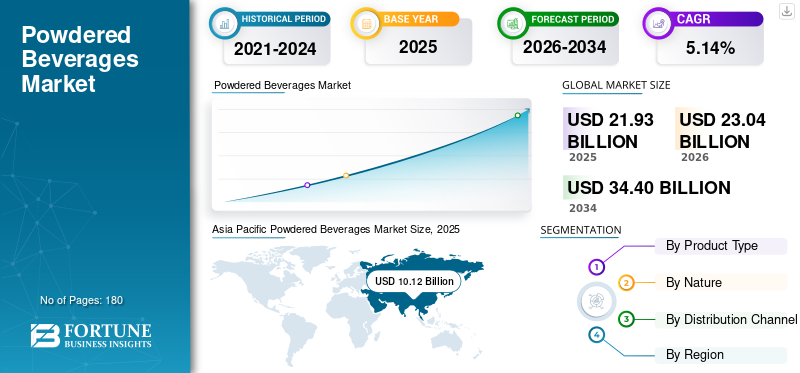
Download Free sample to learn more about this report.
Powdered Beverages Market Key Takeaways
 Global Market Size & Forecast
- 2025 Market Size: USD 21.93 billion
- 2026 Market Size: USD 23.04 billion
- 2034 Forecast Market Size: USD 34.40 billion
- CAGR: 5.14% from 2026-2034
 Market Share
- Asia Pacific dominated the powdered beverages market with a 46.15% share in 2025.
- The hydration & electrolyte powders segment is projected to grow at the highest CAGR of 9.19% during the forecast period.
- The organic segment is projected to grow at the highest CAGR of 8.86% during the forecast period.
 Key Regional Highlights
Asia Pacific
Asia Pacific reached USD 10.12 billion in 2025, maintaining its position as the largest regional market.
Europe
Europe recorded a market value of USD 5.25 billion in 2025.
North America
North America reached a valuation of USD 3.41 billion in 2025.
U.S.
The market was valued at USD 2.56 billion in 2025, accounting for approximately 11.68% of global sales.
Japan
The market was valued at USD 1.38 billion in 2025, representing around 6.30% of global market revenues.
Read More

POWDERED BEVERAGES MARKET TRENDS
Growing Shift toward Functional Formulations is a Prominent Trend
The global industry is witnessing a remarkable trend toward health-oriented/functional formulations. Today, more than half of the population is seeking drinks that provide specific advantages, such as increased energy, enhanced hydration, and immune support. In addition, functional ingredient-enriched drinks improve muscle performance & recovery and enhance digestive health. This sudden shift of consumers toward health-centric drinks is majorly driven by increasing health consciousness and rising incidences of chronic illnesses. To overcome such scenarios, most manufacturers are incorporating a range of health-promoting ingredients, such as botanical extracts, vitamins, minerals, and electrolytes, in powdered form without hampering taste or stability.
MARKET DYNAMICS
MARKET DRIVERS
Download Free sample to learn more about this report.
Rising Demand for Convenience Products Fuels the Sales of Powdered Beverages
The augmented demand for convenience-oriented items is a key driver boosting the use of powdered drinks. In this modern era, the majority of individuals are struggling with work-life balance and are seeking products that add convenience to their schedules. Powdered drinks provide a balance between functionality and convenience, as they are easy to carry and store and can be prepared with minimal effort. Innovations in the sector, such as stick-pack formats, instant solubility, and single-serve sachets, have further reduced the manual labor required for preparation. Moreover, these formats offer flexibility in preparation and portion control, as well as customization. After witnessing these advantages, beverage producers are focusing on reformulating their portfolios and adding more powdered drinks for global consumers.
MARKET RESTRAINTS
Surging Consumer Inclination toward Ready-to-Drink Alternatives Hinders Market’s Growth
One of the main difficulties in the global market is the increasing availability of ready-to-drink formats. Modern consumers, specifically in time-constrained environments, are moving toward drinks that minimize the need for additional preparation, aligning with on-the-go consumption habits. This sudden shift is further propelled by upgradation in packaging technologies, such as single-serve cans and aseptic cartons, which improve shelf life and portability, while offering a consistent taste without any consumer adjustment. Additionally, ready-to-drink beverages are addressing the gap in the powdered drinks sector, offering low-sugar, premium, and fortified variants that meet rising wellness preferences. As a result, the above-mentioned factors impede the global powdered beverages market share.
MARKET OPPORTUNITY
Usage of Modern Technologies in the Beverage Sector Unlocks Growth Opportunities
The adoption of advanced technologies in the beverage industry opens various growth possibilities. To enhance quality, producers are adopting freeze-drying and spray-drying technologies. Along with product quality, this technique also extends the shelf life of flavored drinks and coffee powders. The agglomeration technique is another modern technology used to address clumping/poor solubility in powdered drinks. Moreover, the microencapsulation method is gaining traction to preserve functional compounds and vitamins. Additionally, it allows the controlled release of nutrients and flavors, further adding to the powdered beverages market growth. In addition, integrating digital technologies (data analytics/real-time monitoring), especially in processing, contributes to improved consistency and efficiency in powdered drinks.
Segmentation Analysis
By Product Type
Dairy-Based Beverage Powders Dominated the Market Due to High Nutritional Density
Based on product type, the market is segmented into dairy-based beverage powders, hot beverage powders, fruit & flavored drink powders, hydration & electrolyte powders, cocoa & chocolate-based beverage powders, and others.
The dairy-based beverage powders category led the market in 2025. Compared to electrolyte and malt-based drink powders, dairy-based powders provide higher nutritional value. These powders are also known for offering satiety, owing to their high fat and protein content, which helps minimize digestion and aid in maintaining fullness for extended periods. Moreover, it is more economical than specialized functional powders, further adding to the segment’s growth.
The hydration & electrolyte powders are projected to grow at a high CAGR of 9.19% over the forecast period.
By Nature
Conventional Segment Leads in the Market Due to Affordability
Based on nature, the market is distributed into conventional and organic.
The conventional category led the industry in 2025. Conventionally produced powders are cost-effective compared to organic forms, owing to lower certification and raw ingredient prices. Traditional powdered drinks provide a wider range of formats and flavors than organic powders. Moreover, it is highly suitable for foodservice and mass-market channels, mainly due to their consistent supply. Additionally, conventional powders have an extended shelf life and improved formulation flexibility, which captivates consumer attention. As a result, the aforementioned factors strengthen the segment’s potential.
The organic segment is projected to grow at a high CAGR of 8.86% over the forecast period.
To know how our report can help streamline your business, Speak to Analyst
By Distribution Channel
Retail Sector Led the Market Owing to Greater Product Variety
On the basis of the distribution channel, the market is divided into foodservice and retail.
In 2025, the retail category leads in the market. Compared to foodservice, retail outlets cater to a large consumer base by offering an assortment of powdered products in various pack sizes and flavors. Moreover, retailers introduce new products more quickly and offer the option of bulk purchasing. In addition, lower operational complexity than in foodservice and the greater influence of promotions drive sales of powdered drinks through retail outlets. Moreover, wider penetration in urban/semi-urban areas, along with flexible pricing, further add to the growth.
The foodservice is projected to grow at a high CAGR of 6.97% over the forecast period.
Powdered Beverages Market Regional Outlook
By region, the market is categorized into Europe, North America, Asia Pacific, South America, and the Middle East & Africa.
Asia Pacific
Asia Pacific Powdered Beverages Market Size, 2025 (USD Billion)
To get more information on the regional analysis of this market, Download Free sample
The Asia Pacific region dominated, reaching USD 10.12 billion by 2025. The increasing number of product innovations and rising consumer demand for sugar free powdered drinks boost the region's potential.
India Powdered Beverages Market
The India market in 2025 was valued at around USD 2.67 billion, accounting for roughly 12.17% of the global market revenues.
China Powdered Beverages Market
China's market is projected to be one of the largest worldwide, with revenues recorded at around USD 3.34 billion in 2025, accounting for roughly 15.24% of global market sales.
Japan Powdered Beverages Market
The Japan market in 2025 was valued at around USD 1.38 billion, accounting for approximately 6.30% of the global market revenues.
Europe
The European market reached USD 5.25 billion in 2025, recording a growth rate of 4.57% in the coming years, and secured the second position. The growing consumer preference for convenience premixes and the awareness of the health benefits of functional powdered drinks are driving regional potential.
Germany Powdered Beverages Market
The German market in 2025 was valued at around USD 1.18 billion, representing roughly 5.37% of the global market revenues.
U.K. Powdered Beverages Market
The U.K. market reached approximately USD 1.02 billion in 2025, equivalent to around 4.67% of the global market sales.
North America
North America reached a valuation of USD 3.41 billion in 2025. The market in North America is expected to grow due to augmented demand for drink mixes among athletes and the expanding beverages sector. Moreover, the adoption of advanced production technology and a strong café culture fuel regional growth.
U.S. Powdered Beverages Market
Based on North America's strong contribution and the U.S. dominance within the region, the U.S. market was approximated at around USD 2.56 billion in 2025, accounting for roughly 11.68% of global sales.
South America and the Middle East & Africa
South America and the Middle East & Africa regions are expected to witness moderate growth in this market space during the forecast period. The South America market reached a valuation of USD 1.94 billion in 2025. The flourishing e-commerce sector and increasing health consciousness are expected to drive demand. The Middle East & Africa market reached USD 1.21 billion in 2025.
South Powdered Beverages Market
The South African market reached around USD 0.60 billion in 2025, representing roughly 2.73% of global revenues.
COMPETITIVE LANDSCAPE
Key Industry Players
Product Development Aids in Catering to Rising Consumer Demands
The powdered drinks sector is characterized by a wide presence of prominent food manufacturers, such as the Coca-Cola Company, Nestle S.A., and JDE Peet’s, which use their strong product portfolios and robust supply networks to maintain their positions. Along with this, the key players are also trying to expand their base and enter into acquisitions or partnerships to increase their market share.
LIST OF KEY POWDERED BEVERAGES COMPANIES PROFILED
- Nestle S.A. (Switzerland)
- PepsiCo Inc. (U.S.)
- The Coca-Cola Company (U.S.)
- JDE Peet’s (Netherlands)
- The Kraft Heinz Company (U.S.)
- Danone S.A. (France)
- Keurig Dr Pepper Inc. (U.S.)
- Unilever PLC (U.K.)
- Mondelez International (U.S.)
- Arla Foods (Denmark)
KEY INDUSTRY DEVELOPMENTS
- March 2026: Nestle S.A., a Swiss-based food conglomerate, introduced a new smart-ageing nutritional powdered drink under its brand, Vital. This product will first launch in Brazil later this year and will be available in four flavor variants.
- June 2025: V8 Energy, a brand of Campbell Soup Company, a U.S.-based food manufacturer, unveiled its latest on-the-go convenience drink mix powders. This powder provides an energy boost and is commercially available in pomegranate blueberry, peach mango, and strawberry lemonade flavors for Americans.
- January 2025: Ocean Spray Cranberries, Inc., a cooperative of cranberry growers in the U.S., collaborated with Dyla Brands, an American better-for-you drink mixes firm, to release powdered drink mixes. This product can be purchased via Amazon and Walmart stores across the U.S.
- January 2025: Celsius Hydration, an American healthy drinks producer, announced the launch of CELSIUS HYDRATION, an electrolyte-based powder to improve hydration.
- June 2023: Nuun Hydration, a subsidiary of Nestle Health Science, a nutritional products division in Switzerland, revealed a sports hydration electrolyte powder. This item comprises five important nutrients and offers 90% less sugar.
REPORT COVERAGE
The global market provides an in-depth study of the market size & forecast by all the market segments included in the market reports. The global market forecast analysis includes details on the market dynamics and global market trends expected to drive the market during the forecast period. The global powdered beverages market analysis offers information on the technological advancements, new product launches, key industry developments, and details on partnerships, mergers & acquisitions. The industry forecast also encompasses a detailed competitive landscape with information on the market segmentation, market share, and profiles of key operating players.
Request for Customization to gain extensive market insights.
Report Scope & Segmentation
| ATTRIBUTE | DETAILS |
| Study Period | 2021-2034 |
| Base Year | 2025 |
| Estimated Year | 2026 |
| Forecast Period | 2026-2034 |
| Historical Period | 2021-2024 |
| Growth Rate | CAGR of 5.14% from 2026-2034 |
| Unit | Value (USD Billion) |
| Segmentation | By Product Type, Nature, Distribution Channel, Region |
| By Product Type |
|
| By Nature |
|
| By Distribution Channel |
|
| By Region |
|
Frequently Asked Questions
Fortune Business Insights says that the global market value stood at USD 21.93 billion in 2025 and is projected to reach USD 34.40 billion by 2034.
In 2025, the market value stood at USD 10.12 billion.
The market is expected to exhibit a CAGR of 5.14% during the forecast period.
By nature, the conventional segment led the global market in 2025.
The rising demand for convenience products fuels the sales of powdered drinks.
Nestle S.A., JDE Peet’s, and The Coca-Cola Company are among the key players in the market.
Asia Pacific held the largest market share in 2025.
The growing shift toward functional formulations is a prominent trend.



- 2021-2034
- 2025
- 2021-2024
- 180
-
(Offer valid till 30th Sep 2026)
Get 30-60 hrs Free Customization
Expand Regional and Country Coverage, Segments Analysis, Company Profiles, Competitive Benchmarking, and End-user Insights.




















Related Reports
-
US +1 833 909 2966 ( Toll Free )
-
Get In Touch With Us