Precision Fermentation-Derived Dairy Protein Market Size, Share & Industry Analysis, By Product Type (Whey Proteins, Casein Proteins, Bovine Specialty Dairy Proteins, and Human Milk-Identical Proteins), By Source (Yeast, Fungi, and Bacteria), By Application (Dairy Alternatives, Infant Formula, Sports & Performance Nutrition, Functional Foods, Bakery & Confectionery, RTD Beverages, and Others), and Regional Forecast, 2026–2034
 Download Free Sample
(Offer valid till 31st Oct 2026)

Precision Fermentation-Derived Dairy Protein Market Size and Future Outlook
 Listen to Audio Version
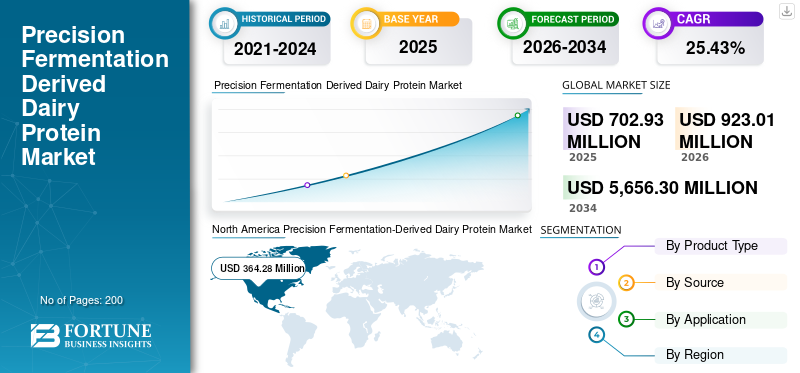
The precision fermentation-derived dairy protein market size was valued at USD 702.93 million in 2025. The market is projected to grow from USD 923.01 million in 2026 to USD 5,656.30 million by 2034, exhibiting a CAGR of 25.43% during the forecast period. North America dominated the precision fermentation derived dairy protein market with a market share of 51.82% in 2025.
Precision fermentation-derived dairy proteins are produced using engineered microorganisms rather than animal-based milk production, yielding dairy-identical proteins such as whey proteins, casein proteins, bovine specialty dairy proteins, lactoferrin, and human milk-identical proteins. The process uses yeast, fungi, or bacteria to express target dairy proteins, followed by fermentation, separation, purification, and food-grade processing. These proteins are designed to deliver the nutritional and functional properties of conventional dairy proteins, including solubility, emulsification, foaming, gelation, melt, stretch, creaminess, and amino acid quality. The market is gaining traction across dairy alternatives, infant formula, sports & performance nutrition, functional foods, bakery & confectionery, and RTD beverages, as food manufacturers seek animal-free ingredients that can improve product quality without relying on traditional dairy supply chains.
As regulatory approvals increase and key players expand commercial supply, precision fermentation-derived dairy proteins are expected to move from premium niche applications toward broader use in dairy products, free product formulations, protein beverages, functional foods, and specialty nutrition. Perfect Day Inc., ImaginDairy, Verley, Formo Foods GmbH, TurtleTree, and others dominate the market.
Download Free sample to learn more about this report.
Precision Fermentation Derived Dairy Protein Market KEY TAKEAWAYS
 Global Market Size & Forecast
- 2025 Market Size: USD 702.93 million
- 2026 Market Size: USD 923.01 million
- 2034 Forecast Market Size: USD 5,656.30 million
- CAGR: 25.43% during 2026–2034
 Market Share
- North America dominated the global market with a 51.82% share in 2025.
- Whey Protein dominated the market in 2025 with a value of USD 444.16 million.
- Yeast held the largest source segment in 2025 with a value of USD 416.51 million.
 Key Regional Highlights
North America
The market reached USD 364.28 million in 2025 and is projected to grow at a 24.70% CAGR.
Europe
The market reached USD 160.91 million in 2025 and is projected to grow at a 25.75% CAGR.
Asia Pacific
The market reached USD 112.17 million in 2025 and is projected to grow at the highest 27.87% CAGR.
U.S.
The market was valued at USD 294.49 million in 2025 and is projected to grow at a 24.33% CAGR.
Japan
Japan’s market is expected to benefit from rising demand for high-quality protein ingredients.
Read More

Precision Fermentation-Derived Dairy Protein Market Trends
Rising Demand for Clean-Label and Sustainable Food Ingredients is a Prominent Market Trend
The increasing need for clean-label, sustainable food ingredients is a major trend in the market, as consumers and food manufacturers seek ingredients that balance nutrition, transparency, functionality, and reduced environmental impact. Precision fermentation allows companies to produce dairy-identical proteins without conventional animal-based production, supporting animal-free, lactose-free, and more traceable ingredient positioning. This is important for brands developing premium dairy alternatives, sports nutrition, RTD beverages, functional foods, and infant nutrition products that need recognizable benefits without compromising taste, texture, or protein quality. Unlike many plant-based proteins, precision-fermentation-derived whey and casein can deliver dairy-like functional properties, such as solubility, emulsification, foaming, melt, stretch, and creaminess. Sustainability claims also support this trend, as fermentation can reduce reliance on land-intensive livestock systems and provide more resilient protein production. As clean-label expectations expand beyond ingredient lists to include sourcing, greenhouse gas emissions, and supply chain transparency, precision fermentation dairy proteins are gaining stronger positioning in premium and innovation-led food products.
- According to the International Food Information Council (IFIC) 2024 Food & Health Survey, which covered 3,000 U.S. consumers, continued tracking consumer attitudes toward food production, safety, ingredients, and purchasing decisions, showing that ingredient transparency remains a key food-choice issue.
MARKET DYNAMICS
Market Drivers
Download Free sample to learn more about this report.
Increasing Financial Support and Funding to Drive Market Growth
Increasing financial support is strengthening the precision fermentation-derived dairy protein market growth, as investors, governments, and strategic food companies continue to fund technologies that can produce whey proteins, casein proteins, lactoferrin, and other functional dairy proteins without animal-based production. The sector is still transitioning from pilot to large scale production. Hence, capital availability directly affects fermentation capacity, downstream processing, regulatory approvals, product launches, and commercial partnerships. Funding is especially important as dairy protein production via precision fermentation requires significant investment in strain engineering, fermentation processes, purification systems, quality testing, and food-grade manufacturing assets. As more capital flows into key players, companies can improve product quality, reduce production costs, and expand use in dairy products, infant formula, sports nutrition, functional foods, and RTD beverages. The funding trend is also supported by food security and sustainability priorities, as precision fermentation can provide a stable dairy protein supply without relying fully on livestock production, land availability, or conventional milk supply volatility.
- According to the Good Food Institute, the investment in precision fermentation protein ingredient-producing companies is increased from USD 458 million in 2023 to USD 651 million in 2024.
Market Restraints
High Production Cost and Availability of Alternatives at a Lower Price to Hamper Market Growth
High production cost remains one of the strongest restraints for the market, especially when compared with conventional dairy proteins, plant-based proteins, amino acid blends, and other lower-cost protein ingredients. Producing bioidentical whey, casein, or specialty dairy proteins requires engineered microbial strains, sterile fermentation, controlled feedstocks, downstream separation, purification, drying, and compliance with food-grade quality standards. These steps make early-stage precision fermentation-derived proteins more expensive than commodity whey, milk protein concentrate, soy protein, pea protein, and other alternative protein ingredients. In addition, conventional dairy protein has mature supply chains, while plant-based protein has wider availability and lower entry pricing for many food manufacturers. This cost gap can slow adoption in mass-market dairy alternatives, bakery, confectionery, and everyday beverages, where price sensitivity is high. The restraint is especially visible in casein proteins and human milk-identical proteins, where functional properties are attractive, but production costs, regulatory approvals, and scale-up risks remain significant.
Market Opportunities
Increasing Technological Advancement to Offer Lucrative Market Opportunities
Technological advancement is creating a major opportunity for the market as improvements in strain design, feedstock use, fermentation technologies, downstream processing, and process integration can directly reduce production costs and improve product quality. The market opportunity is strongest where technology helps companies produce proteins with strong functional properties, such as beta-lactoglobulin for solubility and foaming, casein proteins for melt and stretch, and lactoferrin for immunity and nutrition applications. Advances in larger bioreactors, continuous fermentation, AI-assisted strain optimization, improved secretion systems, and biomass or by-product valorization can help companies move from limited batches to large-scale production. These improvements also support cleaner taste, better amino acid profiles, higher purity, improved stability, and more consistent performance in dairy products, infant formula, sports nutrition, and functional foods. As production becomes more efficient, precision fermentation-derived dairy proteins can become more attractive against animal-based production and plant-based proteins, especially in premium products where sustainability, clean formulation, and functionality is cruical.
- In May 2025, TurtleTree received an FDA “No Questions” letter for LF+, its precision-fermented lactoferrin, making this bioactive milk protein available for food, adult nutrition, wellness supplements, and functional food applications.
SEGMENTATION ANALYSIS
By Product Type
Strong Functional Performance, Early Commercialization, and Wider Food Application Base Leads to Whey Proteins Segment Dominance
Based on product type, the market is segmented into whey proteins, casein proteins, bovine specialty dairy proteins, and human milk-identical proteins.
The whey protein segment dominated the market in 2025, valued at USD 444.16 million. This is supported by earlier commercialization, stronger regulatory readiness, and wider use across food and nutrition applications. Precision fermentation-derived whey proteins, especially beta-lactoglobulin and alpha-lactalbumin, are valued for their high solubility, clean taste, emulsification and foaming properties, and high-quality amino acid profiles. These functional properties make them suitable for sports & performance nutrition, RTD beverages, dairy alternatives, bakery products, frozen desserts, and functional foods. Compared to casein and specialty milk proteins, whey proteins have achieved faster commercial traction as they are easier to formulate into beverages, powders, protein bars, ice cream, and other high-protein food products. The segment also benefits from increasing consumer demand for animal-free, lactose-free, and sustainable dairy protein ingredients without compromising the nutritional profile of conventional dairy.
The casein protein segment is projected to grow at the fastest CAGR of 30.54% during the forecast period. Casein proteins are expected to expand rapidly as they are critical for cheese, yogurt, cream cheese, dairy desserts, and dairy alternatives that require melting, stretching, gelation, emulsification, viscosity, and a creamy texture. As precision fermentation technologies improve and large-scale production becomes more commercially viable, casein is likely to gain stronger adoption among dairy alternative manufacturers seeking effective sensory and functional performance.
To know how our report can help streamline your business, Speak to Analyst
By Source
Established Recombinant Protein Expression Capability and Better Scalability to Support Yeast Segment Growth
Based on the source, the market is segmented into yeast, fungi, and bacteria.
The yeast segment held the largest precision fermentation-derived dairy protein market share in 2025, with a value of USD 416.51 million. This is due to its strong suitability for recombinant dairy protein production, scalability, and established use in food-grade fermentation processes. Yeast-based systems are widely preferred as they can be engineered to consistently express complex dairy proteins, including whey and casein proteins, lactoferrin, and other specialty milk proteins. Yeast also supports controlled fermentation, efficient protein secretion, and compatibility with industrial fermentation infrastructure, making it one of the most practical sources for commercial dairy protein production. It is highly used in producing animal-free dairy proteins for dairy alternatives, functional foods, infant formula, RTD beverages, and sports nutrition. The segment benefits from continuous improvements in strain engineering, media optimization, and downstream purification, which increase yield, reduce production costs, and enable large-scale production.
The bacteria segment is expected to grow at the fastest CAGR of 27.61% during the forecast period. Although bacteria currently hold a smaller share than yeast and fungi, their faster growth is expected to be driven by advances in synthetic biology, lower-cost fermentation routes, faster microbial growth cycles, and potential use in selected specialty dairy proteins and bioactive ingredients.
By Application
Rising Demand for Animal-Free Dairy Products to Drive Dairy Alternatives Segment Growth
Based on application, the market is segmented into dairy alternatives, infant formula, sports & performance nutrition, functional foods, bakery & confectionery, RTD beverages, and others.
The dairy alternative segment held the largest share of the market in 2025, valued at USD 211.52 million. The segment’s growth is driven by increasing demand for animal-free dairy products that offer the taste, texture, and nutritional performance of conventional dairy. Precision fermentation-derived dairy proteins help overcome key limitations of plant-based dairy alternatives, including low protein quality, off-flavors, poor creaminess, limited foaming, and reduced cheese functionality. Whey and casein proteins produced through precision fermentation can improve the sensory profile and functional properties of animal-free milk, yogurt, ice cream, cheese, cream cheese, and dairy desserts. This makes the segment highly attractive for food manufacturers developing premium dairy alternatives with clean-label, sustainable, lactose-free, and animal-free positioning. The segment also benefits from rising consumer interest in sustainable food ingredients, reduced greenhouse gas emissions, and products that deliver real dairy-like performance without animal-based production.
The infant formula segment is projected to grow at the fastest CAGR of 29.93%. Growth is expected to be supported by rising interest in high-value dairy bioactives such as lactoferrin, alpha-lactalbumin, osteopontin, and human milk-identical proteins.
Precision Fermentation-Derived Dairy Protein Market Regional Outlook
Regionally, the market is analyzed across North America, Europe, Asia Pacific, South America, and the Middle East & Africa.
North America
North America Precision Fermentation-Derived Dairy Protein Market Size, 2025 (USD Million)
To get more information on the regional analysis of this market, Download Free sample
North America accounted for USD 364.28 million in 2025 and is projected to grow at a CAGR of 24.70% during the forecast period. North America is expected to remain one of the most advanced regions in the market, supported by early regulatory progress, strong food-tech commercialization, and high acceptance of premium protein nutrition formats. The region benefits from a well-developed ecosystem of biotechnology companies, ingredient innovators, dairy alternative brands, sports nutrition companies, and venture-backed fermentation platforms. In the U.S., precision fermentation-derived whey proteins have gained early traction as they can be used in protein powders, RTD beverages, frozen desserts, bakery products, and animal-free dairy products without compromising functional properties such as solubility, foaming, emulsification, and clean taste. The region is also moving beyond whey proteins into bovine specialty dairy proteins such as lactoferrin, which supports growth in adult nutrition, functional foods, supplements, and immunity-positioned products.
U.S. Precision Fermentation-Derived Dairy Protein Market
The U.S. market was valued at USD 294.49 million in 2025 and is expected to expand at a CAGR of 24.33% during the forecast period. The U.S. dominates the North American market as it has the strongest combination of regulatory activity, consumer-facing launches, B2B ingredient partnerships, and demand for protein nutrition. Perfect Day’s FDA GRAS documentation confirms that its non-animal whey protein is composed of fermentation-derived beta-lactoglobulin, supporting the early commercial foundation for animal-free whey proteins in the country. In 2024, the Good Food Institute highlighted continued progress in the fermentation sector, including product development and partnerships across meat, seafood, eggs, dairy, and ingredients, indicating that U.S.-linked fermentation companies are still moving from proof of concept toward commercial food applications.
Europe
The regional market reached USD 160.91 million in 2025 and is expected to grow at a CAGR of 25.75% during the forecast period. Europe is becoming a strategic region for precision fermentation-derived dairy proteins due to its strong dairy culture, industrial biotechnology base, sustainability agenda, and high demand for animal-free cheese, yogurt, and functional dairy alternatives. Unlike North America, where whey proteins led early commercialization, Europe’s long-term growth is expected to be more strongly shaped by casein proteins, as cheese functionality is highly important across European food systems. Precision fermentation-derived casein is attractive as it can deliver melt, stretch, gelation, viscosity, and creamy texture, which are difficult to achieve with plant based proteins alone.
Germany Precision Fermentation-Derived Dairy Protein Market
Germany accounted for USD 42.42 million in 2025. Germany is expected to be the leading European country market due to its strong alternative protein ecosystem, advanced food manufacturing base, and visible company-level investment. Germany-based Formo is one of the most important regional players, focusing on fermentation-enabled alternatives to dairy and egg-based products. In 2025, the European Investment Bank provided nearly USD 38 million in financial support to Formo to further develop and scale fermentation processes for dairy and egg alternatives. The monetary support from financial organizations in Germany positions it as a key European hub for precision fermentation-derived dairy protein development, especially for casein-driven cheese alternatives, functional dairy products, and premium animal-free formulations.
Asia Pacific
Asia Pacific market reached USD 112.17 million in 2025 and is the fastest-growing region, with a 27.87% CAGR. However, this growth structure differs strongly based on country. The region combines large dairy demand, rising protein nutrition consumption, infant nutrition demand, food security concerns, and growing policy interest in alternative protein technologies. Precision fermentation-derived dairy proteins can address multiple regional needs, including reliable dairy protein supply, lactose-free product development, high-value infant nutrition ingredients, and better-performing dairy alternatives.
China Precision Fermentation-Derived Dairy Protein Market
China was valued at USD 40.40 million in 2025. China is expected to remain the largest market in the Asia Pacific region due to its high demand for dairy ingredients, a strong nutrition industry, a premium infant formula sector, and growing interest in high-quality protein foods. Precision fermentation-derived whey proteins can be used in RTD beverages, fortified foods, protein powders, dairy alternatives, and bakery applications, while lactoferrin and other bioactive dairy proteins are relevant for premium nutrition and immunity-positioned products. China’s infant nutrition sector is particularly important for future demand as alpha-lactalbumin, lactoferrin, osteopontin, and human milk-identical proteins can support premium formulation strategies.
India Precision Fermentation-Derived Dairy Protein Market
India market reached USD 15.81 million in 2025. India is expected to grow rapidly from a smaller base as the country has a large dairy-consuming population, rising demand for protein nutrition, and increasing interest in sustainable food technologies. The country’s opportunity is different from China as India’s market is likely to be shaped by affordable nutrition, dairy analogues, fortified foods, and localized production platforms rather than only premium infant nutrition. Zero Cow Factory is a key Indian company in this space. In April 2024, it announced USD 4 million investment in seed funding to develop animal-free protein and dairy products using bioengineered microbes and precision fermentation. It supports India’s long-term role in cost-sensitive, scalable animal-free dairy protein applications, especially cheese, yogurt, ice cream, and protein-enriched foods.
South America and Middle East & Africa
South America accounted for USD 47.90 million in 2025, growing at a CAGR of 24.17%. South America is still an emerging region in the market, with consumption expected to be driven by imported ingredients, multinational product launches, and selective local innovation than by broad commercial production in the near term. The region has strong long-term potential due to its large dairy consumption base, urban food retail growth, demand for functional nutrition, and increasing awareness of sustainable protein production.
The Middle East & Africa market was valued at USD 17.07 million in 2025 and is projected to expand at a CAGR of 23.43%. The market is being shaped by food security priorities, demand for premium nutrition, import dependence, and interest in technologies that reduce reliance on conventional animal-based production. In the Middle East, Israel and the UAE are more relevant to technology development and investment, while adoption in Africa is more likely to begin with imported ingredients, sports nutrition, functional foods, and premium dairy alternatives.
South Africa Precision Fermentation-Derived Dairy Protein Market
The South Africa market was valued at approximately USD 3.46 million in 2025 and is projected to grow at a CAGR of 22.58% during forecast period. South Africa market is expected to grow as it has a more developed food retail infrastructure, stronger demand for supplements and sports nutrition, and greater exposure to alternative protein innovation than many neighboring markets. The country also has early precision fermentation-related activity through De Novo Foodlabs, which received a USD 700,000 non-dilutive grant from the South African government to advance animal-free protein research using precision fermentation technology.
COMPETITIVE LANDSCAPE
Key Industry Players
Increasing Capacity Expansion by Key Players Reshapes the Market Competition
The market is moderately consolidated, with a limited number of companies such as Perfect Day Inc., ImaginDairy, Verley, Formo Foods GmbH, and TurtleTree leading product development and commercialization. These players are expanding fermentation capacity, improving production yield, and partnering with dairy, ingredient, and food manufacturers to scale whey proteins, casein proteins, lactoferrin, and other specialty dairy proteins. Capacity expansion is another important factor as the market is still moving from pilot-scale production to commercial supply, and thus companies that can reduce production costs, secure regulatory approvals, and deliver consistent functional properties will gain stronger competitive positions.
Key Players in the Market
|
Rank |
Company Name |
|
1 |
Perfect Day Inc. |
|
2 |
ImahinDairy |
|
3 |
Verley |
|
4 |
Formo Foods GmbH |
|
5 |
TurtleTree |
List of Key Precision Fermentation-Derived Dairy Protein Companies Profiled
- Perfect Day Inc. (U.S.)
- Remilk Ltd. (Israel)
- Vivici (Netherlands)
- TurtleTree (Singapore)
- ImaginDairy (Israel)
- Formo Foods GmbH (Germany)
- Standing Ovation (France)
- Better Dairy (U.K.)
- Helaina (U.S.)
- Verley (France)
KEY INDUSTRY DEVELOPMENTS
- April 2026: Standing Ovation, a French food-tech company, secured USD 34.2 million in Series B funding to accelerate the commercialization of its precision-fermented dairy proteins.
- April 2026: Praj Industries, an Indian biotech company, has established a new precision fermentation lab in Pune and signed an MoU with a government body to accelerate new technologies to develop dairy protein and alternatives to animal protein products at the industry level.
- October 2025: Standing Ovation and Bel Group validated the world’s first industrial-scale production of precision-fermented casein from cheese whey. The companies reported that the process converts acidic whey, a cheesemaking by-product, into high-quality caseins, supporting circular production and lower-carbon dairy protein manufacturing.
- April 2025: Bel Group and Standing Ovation announced a breakthrough technology to convert dairy co-products such as whey serums into bovine casein proteins through precision fermentation. The partnership aims to validate industrial-scale production while improving circularity, reducing waste, and supporting more sustainable dairy protein manufacturing.
- February 2025: Vivici, a Netherlands-based startup formed by Fonterra and DSM-Firmenich to produce dairy proteins via precision fermentation, secured USD 34 million funding from its Series A round. The company planned to use the funding to expand its animal-free dairy operations and enter the lactoferrin market.
REPORT COVERAGE
The market report analyzes the market in depth and highlights key aspects, including precision fermentation-derived dairy protein market trends, supply chain, market dynamics, prominent companies, investment in research and development, and end-use. In addition, the research report provides insights into the market and highlights significant industry developments.
Request for Customization to gain extensive market insights.
Report Scope & Segmentation
| ATTRIBUTE | DETAILS |
| Study Period | 2021-2034 |
| Base Year | 2025 |
| Estimated Year | 2026 |
| Forecast Period | 2026-2034 |
| Historical Period | 2021-2024 |
| Growth Rate | CAGR of 25.43% from 2026 to 2034 |
| Unit | Value (USD Million) |
|
Segmentation |
By Product Type
|
|
By Source
|
|
|
By Application
|
|
|
By Region
|
Frequently Asked Questions
Fortune Business Insights says that the global market was USD 702.93 million in 2025 and is anticipated to reach USD 5,656.30 million by 2034.
At a CAGR of 25.43%, the market will exhibit steady growth over the forecast period.
By product type, the whey protein segment led the market.
North America held the largest market share in 2025.
Increasing financial support and funding is driving market growth.
Perfect Day Inc., ImaginDairy, Verley, Formo Foods GmbH, and TurtleTree are leading companies in the market.
Increasing clean-label and sustainable food ingredients is a key market trend.



- 2021-2034
- 2025
- 2021-2024
- 200
-
(Offer valid till 31st Oct 2026)
Get 30-60 hrs Free Customization
Expand Regional and Country Coverage, Segments Analysis, Company Profiles, Competitive Benchmarking, and End-user Insights.




















Related Reports
-
US +1 833 909 2966 ( Toll Free )
-
Get In Touch With Us