 Download Free Sample



Get a Quote
Receive a tailored pricing based on your needs.
- Choose license type
- Multiple user options
- Custom scope & coverage
- Fast turnaround
"Designing Growth Strategies is in our DNA"
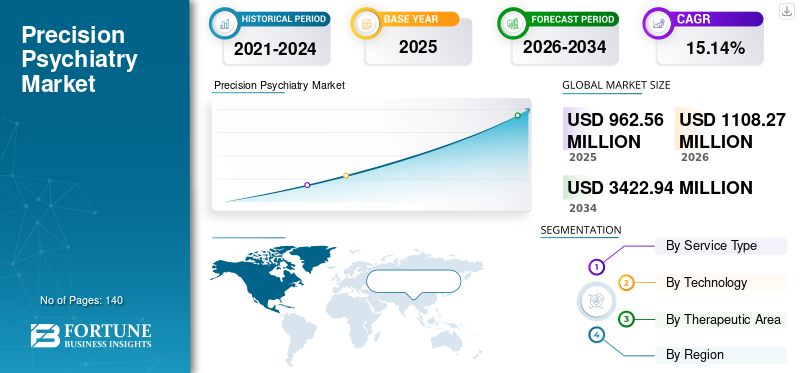
The precision psychiatry market size was valued at USD 962.56 Million in 2025. The market is projected to grow from USD 1108.27 Million in 2026 to USD 3422.94 Million by 2034, exhibiting a CAGR of 15.14% during the forecast period.

The precision psychiatry market is transforming mental healthcare by integrating genetics, biomarkers, pharmacogenomics, artificial intelligence, and advanced diagnostics to deliver individualized treatment strategies. Unlike traditional psychiatric approaches that rely on trial-and-error prescribing, precision psychiatry focuses on patient-specific biological and clinical characteristics to improve treatment outcomes. The increasing prevalence of depression, anxiety disorders, bipolar disorder, schizophrenia, and other neuropsychiatric conditions is accelerating adoption of precision-based diagnostic tools and treatment pathways. precision psychiatry market analysis indicates growing demand for biomarker-guided therapies, genetic testing panels, and predictive algorithms that support clinicians in medication selection and disease management. The precision psychiatry market report highlights expanding collaborations among diagnostic companies, research institutions, and healthcare providers to develop personalized mental health solutions. AI-driven analytics and multi-omics technologies are becoming critical components of precision psychiatry market growth.
The United States represents the largest national market for precision psychiatry due to its advanced healthcare infrastructure, widespread adoption of pharmacogenomic testing, and strong investment in mental health innovation. Healthcare providers are increasingly integrating genetic testing into psychiatric treatment planning to reduce adverse drug reactions and optimize medication efficacy. Academic medical centers, psychiatric clinics, and diagnostic laboratories are expanding the use of biomarker-based assessment tools. The growing burden of treatment-resistant depression and increasing awareness regarding personalized medicine continue to support market expansion. precision psychiatry market Research Report findings indicate that the United States remains a leading hub for innovation involving AI-driven psychiatric diagnostics, pharmacogenomics, and predictive mental health analytics.
Download Free sample to learn more about this report.
 Global Market Size & Forecast
 Market Share
 Key Regional Highlights
North America
North America leads with a 41% share, supported by advanced precision medicine infrastructure and rising adoption of personalized psychiatric care.
Europe
Europe accounts for 29% of the market, driven by growing investments in psychiatric diagnostics and biomarker research.
Asia-Pacific
Asia-Pacific holds 22%, supported by expanding healthcare infrastructure and increasing adoption of precision medicine technologies.
U.S
The market benefits from strong adoption of pharmacogenomic testing, advanced diagnostics, and personalized mental healthcare.
Japan
Growing precision medicine initiatives and advanced diagnostic capabilities support market development.
Read More

One of the most significant precision psychiatry market trends is the increasing use of pharmacogenomic testing for psychiatric medication selection. Healthcare providers are utilizing genetic insights to determine how individual patients metabolize antidepressants, antipsychotics, and mood stabilizers. This approach minimizes treatment failures and improves clinical outcomes. Pharmacogenomics is becoming an important component of precision mental healthcare across hospitals, specialty clinics, and diagnostic laboratories.
Download Free sample to learn more about this report.
Another major trend is the integration of artificial intelligence and machine learning into psychiatric diagnostics and treatment planning. AI platforms analyze patient histories, biomarker profiles, genetic data, and behavioral patterns to support personalized treatment recommendations. Multi-omics research combining genomics, proteomics, metabolomics, and neuroimaging is also gaining momentum. Emerging precision psychiatry initiatives are focusing on biomarker discovery, predictive treatment response models, and digital phenotyping technologies. These developments are expanding precision psychiatry market opportunities while strengthening clinical decision-making capabilities across mental health systems.
Rising Demand for Personalized Mental Healthcare Solutions
The primary driver of precision psychiatry market growth is the increasing demand for individualized mental healthcare interventions. Conventional psychiatric treatment often involves multiple medication trials before achieving symptom control. Precision psychiatry addresses this challenge through pharmacogenomics, biomarker analysis, and personalized treatment algorithms.
Healthcare providers are increasingly adopting genetic testing platforms to identify medication response patterns and minimize adverse drug reactions. Rising rates of depression, anxiety, bipolar disorder, schizophrenia, and treatment-resistant psychiatric conditions are further supporting demand. In addition, growing awareness among clinicians regarding precision medicine benefits is encouraging broader implementation. Research initiatives focused on biomarker identification and AI-enabled treatment optimization are accelerating innovation. These factors collectively strengthen the precision psychiatry market outlook by enhancing treatment accuracy, improving patient outcomes, and reducing healthcare inefficiencies.
Limited Reimbursement and High Implementation Complexity
A major restraint affecting the Precision Psychiatry Industry Analysis is the limited reimbursement framework associated with psychiatric genetic testing and biomarker diagnostics. Many healthcare systems still classify advanced psychiatric testing as emerging technology, creating reimbursement uncertainties.
Implementation complexity also limits adoption. Precision psychiatry requires integration of genetic testing, laboratory analysis, data interpretation, and clinician education. Many psychiatric professionals lack specialized training in pharmacogenomics and precision medicine applications. Furthermore, healthcare facilities may face challenges involving workflow integration, data management, and patient counseling requirements. Concerns related to genetic privacy and regulatory compliance can also slow adoption. These barriers may restrict broader utilization among smaller healthcare providers and emerging healthcare markets despite growing clinical evidence supporting precision psychiatry approaches.
Expansion of Biomarker-Based Psychiatry Platforms
The growing development of biomarker-driven psychiatric diagnostics presents a significant opportunity within the precision psychiatry market. Researchers are increasingly identifying biological markers associated with depression, schizophrenia, anxiety disorders, bipolar disorder, and treatment response prediction.
Biomarker innovations support earlier diagnosis, disease stratification, and individualized treatment planning. Combined with AI-based analytics, these tools can improve diagnostic accuracy and clinical efficiency. Pharmaceutical companies are also exploring companion diagnostics linked to psychiatric drug development programs. The emergence of multi-omics technologies and precision-focused clinical trials creates substantial opportunities for diagnostic providers and healthcare organizations. Continued advancements in biomarker validation and commercialization are expected to strengthen precision psychiatry market share across multiple therapeutic segments.
Standardization and Clinical Validation Requirements
One of the major challenges facing the precision psychiatry market is the need for standardized clinical validation frameworks. Although genetic testing and biomarker technologies continue to advance, variability in testing methodologies and interpretation standards remains a concern.
Healthcare providers require robust clinical evidence demonstrating improved patient outcomes before adopting new technologies at scale. Regulatory agencies also demand extensive validation for diagnostic tools and treatment algorithms. The complexity of psychiatric disorders, which involve genetic, environmental, and behavioral factors, further complicates validation efforts. In addition, integrating diverse datasets including genomics, neuroimaging, and electronic health records requires sophisticated infrastructure. These challenges may delay commercialization timelines and limit adoption rates despite significant innovation within the sector.
Genetic testing represents the dominant segment within the precision psychiatry market. Pharmacogenomic testing helps clinicians understand how patients metabolize psychiatric medications, enabling more personalized treatment selection. Healthcare providers increasingly utilize genetic panels to support antidepressant, antipsychotic, and mood stabilizer prescribing decisions.
Growing awareness regarding medication response variability is accelerating demand for psychiatric genetic testing. The segment benefits from technological advancements in sequencing platforms, expanding clinical evidence, and increasing physician acceptance. Genetic testing also plays a critical role in reducing adverse drug reactions and improving treatment adherence. precision psychiatry market forecast studies indicate continued dominance of this segment due to expanding clinical adoption and increasing patient awareness.
Biomarker Analysis: Biomarker analysis is emerging as a rapidly expanding segment within the precision psychiatry market. Biomarkers support disease stratification, treatment response prediction, and patient monitoring across multiple psychiatric conditions.
Researchers continue identifying molecular, proteomic, and neurological biomarkers linked to psychiatric disorders. Biomarker-driven approaches provide deeper insights into disease mechanisms while supporting targeted intervention strategies. Growing investments in biomarker discovery programs and precision psychiatry research initiatives are strengthening segment growth. As validation efforts progress, biomarker analysis is expected to become an increasingly important component of psychiatric diagnostics and treatment optimization.
Immunoassay technologies play an important role in biomarker detection and psychiatric diagnostics. These platforms support identification of protein markers, inflammatory indicators, and other biological signals associated with psychiatric disorders.
The segment benefits from established laboratory infrastructure and broad clinical familiarity. Healthcare providers increasingly use immunoassay-based approaches to support precision psychiatry programs and biomarker-driven research initiatives. Advances in assay sensitivity and automation continue enhancing market adoption.
PCR technology holds a larger share due to its critical role in genetic testing and pharmacogenomic analysis. PCR-based platforms enable rapid detection of genetic variants associated with medication metabolism and treatment response.
The growing utilization of pharmacogenomic testing in psychiatric care supports continued demand for PCR solutions. Diagnostic laboratories favor PCR due to its accuracy, scalability, and cost-effectiveness. Increasing implementation of personalized medicine programs further strengthens the segment’s position within the Precision Psychiatry Industry Report.
Hospitals and clinics represent the leading end-user segment due to increasing integration of precision psychiatry tools into clinical practice. Psychiatric specialists are adopting pharmacogenomic testing and biomarker assessments to improve treatment planning and patient outcomes.
Growing patient demand for personalized care and expanding mental health programs contribute to segment growth. Large healthcare systems are investing in precision medicine infrastructure to support advanced psychiatric services.
Clinical laboratories play a vital role in genetic testing, biomarker analysis, and diagnostic interpretation. These facilities support healthcare providers through specialized testing services and data analysis capabilities.
Increasing demand for psychiatric genetic testing and precision diagnostics is expanding laboratory service volumes. Laboratory investments in automation, sequencing technologies, and AI-enabled analytics are supporting continued market development.
North America dominates the precision psychiatry market due to advanced healthcare infrastructure, extensive precision medicine initiatives, and strong adoption of pharmacogenomics. The region benefits from significant investments in psychiatric research, biomarker discovery, and AI-enabled healthcare technologies. Academic institutions, diagnostic providers, and healthcare systems actively collaborate on personalized mental health solutions. Growing awareness regarding treatment-resistant psychiatric disorders further supports adoption. The presence of leading market participants and favorable innovation ecosystems continues strengthening regional leadership.
Europe represents a major market driven by expanding precision medicine programs and increasing mental health research investments. Healthcare systems across the region are exploring personalized treatment approaches to improve psychiatric care efficiency. Biomarker research initiatives, pharmacogenomic testing adoption, and AI-based clinical tools contribute to market development. Regulatory focus on personalized healthcare and collaborative research networks further support regional growth.
Germany serves as a leading European hub for precision psychiatry research and implementation. The country benefits from strong biomedical research infrastructure, extensive clinical trial activity, and growing utilization of pharmacogenomic testing. Healthcare institutions increasingly integrate personalized treatment approaches into psychiatric care pathways. Research organizations are actively investigating biomarkers and AI-enabled psychiatric diagnostics. Government-supported innovation initiatives and collaboration between academia and industry contribute to market expansion. precision psychiatry market insights indicate strong demand for personalized mental healthcare solutions throughout Germany.
The United Kingdom continues to expand precision psychiatry adoption through academic research, healthcare innovation programs, and increasing awareness of personalized medicine. Mental health service providers are exploring genetic testing and biomarker-guided treatment approaches to improve clinical outcomes. Universities and research institutions actively participate in precision psychiatry projects focused on treatment response prediction and disease stratification. Growing integration of digital health technologies and AI-based decision support systems further supports market development.
Asia-Pacific is emerging as a rapidly developing market supported by expanding healthcare infrastructure, increasing mental health awareness, and rising investments in genomic medicine. Countries across the region are strengthening precision healthcare capabilities through research partnerships and technology adoption. Growing prevalence of psychiatric disorders and improving access to advanced diagnostics are accelerating demand. Healthcare modernization initiatives continue supporting market opportunities across major economies.
Japan maintains a strong position in precision psychiatry through advanced healthcare systems, genomic research expertise, and technology-driven healthcare innovation. Healthcare providers increasingly explore personalized treatment strategies for depression, anxiety disorders, and neuropsychiatric conditions. Precision medicine initiatives and biomarker research programs support continued market growth. The country's emphasis on technological innovation enhances adoption of AI-driven psychiatric diagnostics and treatment optimization tools.
China represents one of the most promising markets due to expanding healthcare infrastructure, growing genomic research investments, and increasing mental health awareness. Healthcare institutions are adopting advanced diagnostic technologies and precision medicine frameworks. Government support for biotechnology innovation and large-scale genomic initiatives contributes to market development. Rising demand for personalized healthcare solutions further strengthens China's position within the regional market.
The Rest of World region, including Latin America, the Middle East, and Africa, demonstrates increasing interest in precision psychiatry technologies. Healthcare modernization programs and expanding awareness regarding personalized medicine support market development. Although adoption remains comparatively lower than developed regions, growing investments in genomic testing infrastructure and mental healthcare services create future opportunities. International partnerships and technology transfer initiatives continue enhancing market accessibility across emerging economies.
Investment activity within the precision psychiatry market continues to expand as stakeholders recognize the value of personalized mental healthcare. Venture capital firms, biotechnology companies, and healthcare investors are funding innovations involving pharmacogenomics, biomarker discovery, AI-driven diagnostics, and digital mental health platforms.
Growing clinical evidence supporting personalized treatment approaches is encouraging investment across diagnostic testing, software analytics, and companion diagnostic development. precision psychiatry market opportunities are particularly strong in biomarker validation, predictive treatment algorithms, and multi-omics research platforms. Strategic partnerships among healthcare providers, academic institutions, and diagnostic companies are accelerating commercialization efforts. Investors are increasingly targeting technologies capable of improving treatment outcomes while reducing healthcare costs associated with psychiatric disorders.
New product development in the precision psychiatry market focuses on advanced genetic testing panels, biomarker discovery platforms, AI-enabled treatment recommendation systems, and integrated clinical decision-support tools. Companies are developing next-generation diagnostic solutions capable of identifying patient-specific treatment response patterns.
Innovations involving multi-omics analysis, machine learning, and digital phenotyping are expanding precision psychiatry capabilities. Emerging products integrate genomic, proteomic, behavioral, and neuroimaging data to support personalized treatment planning. Healthcare providers increasingly seek comprehensive diagnostic platforms that streamline clinical workflows while improving treatment outcomes. Ongoing research into biomarker-guided psychiatric therapies and companion diagnostics continues generating opportunities for product innovation.
The precision psychiatry market report provides comprehensive coverage of industry developments, market trends, technological advancements, competitive landscape analysis, and emerging opportunities. The report evaluates pharmacogenomics, biomarker analysis, artificial intelligence applications, and personalized treatment strategies across psychiatric care settings.
Request for Customization to gain extensive market insights.
The study includes detailed precision psychiatry market analysis by service type, technology, therapeutic area, end user, and geography. It assesses market drivers, restraints, challenges, and opportunities influencing industry development. Regional assessments examine healthcare infrastructure, adoption trends, research initiatives, and competitive dynamics. The report further profiles major companies operating within the industry and evaluates strategic developments, innovation pipelines, investment activities, and product advancements shaping future market evolution.
Fortune Business Insights says that the global market value stood at USD 962.56 million in 2025 and is projected to reach USD 3,422.94 million by 2034.
The market is expected to exhibit a CAGR of 15.14% during the forecast period of 2026–2034.
Genetic testing was the leading service type segment, supported by growing use of pharmacogenomic testing to personalize psychiatric medication selection and reduce adverse drug reactions.
Key players include Invitae Corporation, Myriad Genetics, Polaris Genomics, GeneDx, Genomind, and CNSDose.
Major trends include increasing adoption of pharmacogenomic testing and integration of AI/ML, multi-omics, and digital phenotyping into psychiatric diagnostics and treatment planning. North America led the market with a 41% share.


(Offer valid till 15th Nov 2026)
Get 30-60 hrs Free Customization
Expand Regional and Country Coverage, Segments Analysis, Company Profiles, Competitive Benchmarking, and End-user Insights.













.webp)






Get In Touch With Us
US +1 833 909 2966 ( Toll Free )
Receive a tailored pricing based on your needs.
Discuss your questions with our industry experts.
Have questions? Get quick answers before you purchase.

