Military Drone Market Size, Share, Russia-Ukraine War, & Industry Analysis, By End User (Army, Air Force, Navy, and Special Operations Forces), By Drone Type (Nano & Micro Drones, Tactical UAS, and MALE UAVs), By Launch & Recovery Mode (Hand-Launched, VTOL, and Runway-Launched), By Platform Configuration (Fixed-Wing, Rotary-Wing, and Hybrid VTOL Drones), By Range (Below 10 km, 10-50 km, and Above 500 km), By Payload (EO/IR Payloads, Radar Payloads, and SIGINT/ELINT Payloads), By Autonomy Level (Remotely Piloted, Semi-Autonomous, and AI-Assisted Drones), and Regional Forecast, 2026-2034
 Download Free Sample
Military Drone Market Size and Future Outlook
 Listen to Audio Version
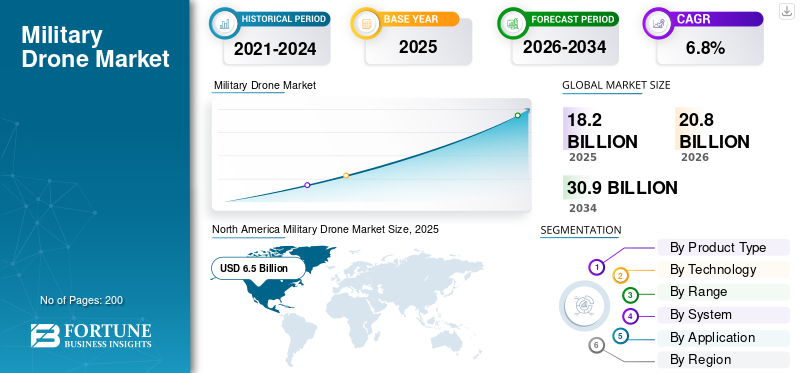
The global military drone market size was valued at USD 19.83 billion in 2025 and is projected to grow from USD 22.49 billion in 2026 to USD 52.31 billion by 2034, exhibiting a CAGR of 11.1% during the forecast period. North America dominated the military drone market with a market share of 40.49% in 2025.
A military drone, also known as an Unmanned Aerial Vehicle (UAV), is a remotely piloted aircraft system used in military operations. These drones are equipped with advanced sensors and cameras that provide real-time situational awareness, aiding decision-making and improving the effectiveness of military operations. The market is expected to grow significantly in the coming years, driven by increasing military spending and growing procurement of military drones by defense forces.
The integration of Artificial Intelligence (AI) and machine learning algorithms into military drones is improving autonomous flight capabilities, target recognition, and mission planning, leading to more effective and efficient operations. The adoption of AI is modernizing military drone technologies from picking targets autonomously with precision. Furthermore, increasing investment in AI and autonomous systems for advanced technologies is boosting the market expansion. For instance, in December 2023, General Atomics Aeronautical Systems, a business unit of General Atomics, was awarded a USD 389 million contract to deliver MQ-1C-25M Gray Eagle Modernized Extended Range systems to the U.S. Army.
The growing use of UAVs in the defense and security industry for several applications including surveying, mapping, transportation, combat operations, and monitoring, will fuel the demand for military UAVs in the coming years. Rise in defense expenditure of various countries to procure modernized & technologically advanced military drones/UAVs for intensified combat capability is expected to support the global market growth.
Key players in the market include MDA Space, Northrop Grumman, Maxar Space Systems, Airbus Defence and Space, Thales Alenia Space, Blue Origin, Rocket Lab, Astroscale, Astrobotic, and GITAI. These companies compete through advanced robotic arm and manipulator technologies, autonomous navigation and docking capabilities, broader satellite servicing and in-orbit assembly portfolios, lunar and planetary exploration robots, and integrated end users tailored for satellite life-extension, debris removal, space station maintenance, and exploration missions across government and commercial space programs.
Download Free sample to learn more about this report.
RUSSIA-UKRAINE WAR IMPACT
High Adoption Rate of Military Drones in Russia-Ukraine War Has Bolstered the Market Growth
In the Russia-Ukraine war, which began in February 2022, witnessed the utilization of drones by both Russia and Ukraine for various military operations, such as Intelligence, Surveillance, and Reconnaissance (ISR) operations, target acquisition support, and other operations.
- In January 2023, Russia recently acquired Iranian loitering munitions Shahed-136 called Geranium-2 by Russian Ground Forces. Its first use was mentioned in September 2022 for military operations in the Kharkiv region in Eastern Ukraine. Furthermore, it has been utilized to target Kyiv, Odesa, and Mykolaiv.
- Ukraine has been supplied with more than 700 Switchblade kamikaze drones to target Western Crimea, an airbase and ship harbor near Sevastopol, and airbases at Ryazan and Saratov.
In addition, March 2022, Russia signed a contract worth USD 12 million with China to provide military drones for the Russian Armed Forces amid the ongoing Russia-Ukraine war. These factors are expected to propel the market growth over the forecast period.
MILITARY DRONE MARKET TRENDS
Significant Advancements and Key Developments in Military Drone Technology to Drive the Market Growth
Military drone technology has undergone significant advancements in recent years, with key developments in stealth technology, Artificial Intelligence (AI) and autonomous flight, and swarming technology. Stealth drones are designed to evade enemy radar detection, making them virtually invisible during reconnaissance and combat missions. These drones are constructed with special materials and shapes that reduce their radar cross-section, rendering them difficult to detect even by advanced radar systems. AI has revolutionized military drone technology by enabling autonomous decision-making. Drones equipped with AI algorithms can process vast amounts of data in real-time, making split-second decisions without human intervention. Swarming technology allows multiple drones to operate collaboratively as a coordinated unit. This innovation has significant implications for military tactics and strategies. Military drones are equipped with an array of advanced sensors and payloads that enhance their capabilities. These include high-resolution cameras, thermal imaging, LiDAR (Light Detection and Ranging), electronic warfare systems, and signal intelligence (SIGINT).
MARKET DYNAMICS
MARKET DRIVERS
Download Free sample to learn more about this report.
Growing Procurement of Drones for Military Applications is Boosting the Market Growth
Modern warfare is changing as having bigger, more powerful weapons is no longer remains the main advantage on the battlefield. Instead, the military warfare is shifting its focus to better tools which helps them see, track, and understand the enemy. This phase of electronic warfare has created a huge demand for the use of military drones (UAVs) in the military sector. UAVs do not need a crew on-board for flight, and can be autonomous or remotely-controlled by human personnel from a safe distance. Aside from ISR, UAVs are also employed for offenses. UAVs as big as a small aircraft have the capacity to carry missiles into the battlefield, while autonomous UAVs can be of the size of a wingspan of a bird, are used for kamikaze warfare. Such capabilities make drones a must-have for any military, allowing for major push-back to the enemy from the safety of the ground stations.
- For instance, in April 2023, Ukraine announced that it had procured over 300 DJI Mavic 3T UAVs and sent on the front lines. The thermal and zoom capabilities of these UAVs made them ideal to gather intelligence on ground zero.
MARKET RESTRAINTS
Government Rules and Regulations in the Missile Technology Control Regime (MTCR) to Hinder Market Growth
Growing geo-political tensions across the globe are contributing to the deceleration of market growth. The vast majority of commercial drones and unmanned aerial vehicles are equipped with cameras, making them prone to online assaults. National security is further hampered by the suspicion of snooping through the network. Market growth is slowing down as countries have started imposing restrictions on products from a specific manufacturer.
- For instance, in May 2023, the use of Chinese drones for any kind of activity was banned in two states. In suspicion of suspected data leaks through the network of drones, the U.S. Department of Defense and other agencies have already blacklisted the company.
MARKET OPPORTUNITIES
Expanding Global Defense Modernization Creates Vast Opportunities for Military Drone Manufacturers
The market presents substantial growth opportunities driven by escalating defense budgets globally, rising geopolitical tensions, and accelerating demand for unmanned systems capable of performing high-risk missions without human casualties. Governments across Asia Pacific, Europe, and the Middle East are procuring advanced UAV platforms to modernize aging fleets. The integration of AI, edge computing, and swarming technologies is opening new segments in autonomous combat systems. Additionally, the growing demand for persistent ISR, electronic warfare, and loitering munitions is creating lucrative adjacent markets, while allied interoperability requirements are incentivizing multi-nation procurement programs and collaborative development frameworks.
MARKET CHALLENGES
Regulatory Complexity and Technology Proliferation Risks Pose Significant Challenges to Market Growth
The military drone market growth faces significant challenges including stringent export control regulations, particularly under MTCR and ITAR frameworks, which limit technology transfer and restrict cross-border sales. Rapid technological advancements create obsolescence risks, compelling manufacturers to sustain high R&D investment. Cybersecurity vulnerabilities in communication and control systems remain a critical concern. Ethical and legal debates around autonomous lethal systems create political friction that can delay procurement approvals. Additionally, supply chain disruptions affecting critical components such as semiconductors, propulsion systems, and advanced sensors are creating cost pressures and production delays across the industry.
Segmentation Analysis
By End User
Rising Integration of Defense Modernization and Land Warfare Requirements are Driving the Dominance of Army/Land Forces Segment
Based on end user, the market is segmented into army/land forces, air force, navy/naval forces, and special operations & strategic security agencies.
The army/land forces segment accounted for the largest market share in 2025. Demand from army and land forces is rising sharply as ground-centric military doctrines evolve to incorporate unmanned systems for forward reconnaissance, fire support coordination, and force protection. Militaries increasingly rely on tactical UAVs to reduce soldier exposure in contested terrain, enabling real-time situational awareness and precision targeting that conventional systems cannot provide at comparable cost and risk.
The navy/naval forces segment is anticipated to rise with a CAGR of 11.7% over the forecast period.
To know how our report can help streamline your business, Speak to Analyst
By Drone Type
Growing Requirements for MALE UAVs in Extended-Endurance Persistent Surveillance is Accelerating the Leading Position of the Segment
Based on drone type, the market is segmented into nano & micro military drones, mini & small tactical drones, tactical UAS, MALE UAVs, HALE UAVs, combat UAVs/UCAVs, loitering munitions/one-way attack drones, and collaborative combat aircraft/loyal wingman.
In 2025, the Medium-Altitude Long-Endurance (MALE) UAVs segment dominated the global market as they are witnessing strong demand as defense forces prioritize persistent ISR and strike missions over large geographic areas. Their ability to loiter for 20-40 hours at operational altitudes, carry multi-sensor payloads, and operate in contested environments makes them the preferred platform for border monitoring, counterterrorism, and theater-level intelligence operations across global defense programs.
The collaborative combat aircraft/loyal wingman segment is projected to grow at a CAGR of 12.4% over the forecast period.
By Launch & Recovery Mode
Operational Versatility Compared to Vertical-Takeoff Alternatives are Boosting the Governance of Runway-Launched Segment
Based on launch & recovery mode, the market is segmented into hand-launched, VTOL/vertical takeoff and landing, runway-launched, catapult/rail-launched, tube/canister-launched, air-launched, and ship-launched.
The runway-launched segment is anticipated to witness a dominating market share over from 2026 to 2034 as they continue to command strong market preference through their superior payload capacity, operational range, and aerodynamic stability compared to vertical-takeoff alternatives. Their compatibility with established airbase infrastructure reduces deployment costs while supporting heavier sensor suites and extended mission durations, making them the platform of choice for strategic ISR, maritime patrol, and multi-role combat support operations.
The tube/canister-launched segment is projected to grow at a high CAGR of 12.6% over the forecast period.
By Platform Configuration
Superior Aerodynamic Efficiency and Mission Flexibility Have Placed Fixed-Wing Drones as the Most Preferred Platform Configuration
Based on platform configuration, the market is segmented into fixed-wing drones, rotary-wing drones, hybrid VTOL drones, jet-powered drones, tube-launched/canister-launched drones, and tethered drones.
The fixed-wing drones segment dominated the segmental share in 2025 due to their inherent aerodynamic advantages including longer range, higher cruise speeds, and greater fuel efficiency compared to rotary-wing platforms. These characteristics make them ideally suitable for sustained surveillance, electronic warfare, and strike missions where endurance and coverage area are critical operational requirements across land, maritime, and high-altitude environments.
In addition, tube-launched/canister-launched drones are projected to grow at a CAGR of 13.0% during the forecast period.
By Range
Tactical Versatility at Short and Long Ranges is Propelling the 50 km to 150 km Segment Leadership
Based on range, the market is segmented into below 10 km, 10 km to 50 km, 50 km to 150 km, 150 km to 500 km, 500 km to 1,500 km, and above 1,500 km.
The 50 km to 150 km segment accounted for the largest market share in 2025. Drones operating in the 50 km to 150 km range bracket are experiencing elevated demand as they bridge the gap between short-range tactical UAVs and long-range strategic platforms. This range supports corps-level ISR, artillery targeting, and forward area communications relay missions, making them highly valuable for ground forces requiring responsive, beyond-line-of-sight aerial support without the logistical footprint of larger systems.
The below 10 km segment is anticipated to rise with a CAGR of 12.1% over the forecast period.
By Payload
Multi-Mission Sensor Superiority is Fueling Demand for the EO/IR Payloads Segment
Based on payload, the market is segmented into EO/IR payloads, radar payloads, SIGINT/ELINT/COMINT payloads, electronic warfare payloads, strike/warhead payloads, and communication relay payloads.
In 2025, the EO/IR payloads segment dominated the global market as Electro-Optical/Infrared (EO/IR) payloads represent the most widely adopted sensor category in military UAVs, driven by their dual-capability to deliver high-resolution daytime imagery and thermal detection in low-light or adverse weather conditions. Armed forces rely on EO/IR systems for target identification, battle damage assessment, and force tracking making this payload segment essential across all military drone mission profiles in virtual manner.
The electronic warfare payloads segment is projected to grow at a CAGR of 12.3% over the forecast period.
By Communication/Datalink Type
Encrypted Digital Datalink Segment to Lead Due to Accelerating Vulnerability of Unencrypted Communications
Based on communication/datalink type, the market is segmented into line-of-sight RF datalink, encrypted digital datalink, SATCOM/BLOS datalink, mesh network datalink, fiber-optic control link, and autonomous/silent-mode operation.
The encrypted digital datalink segment is anticipated to witness a dominating market share over the forecast period. The growing threat of signal interception, spoofing, and electronic warfare against UAV communication systems is creating urgent demand for encrypted digital datalinks. Military operators require jam-resistant, low-probability-of-intercept communication channels to maintain reliable command, control, and data transmission in contested electromagnetic environments, driving adoption of advanced encryption standards and frequency-hopping datalink architectures across all drone tiers.
The autonomous/silent-mode operation segment is projected to grow at a high CAGR of 11.7% over the forecast period.
By Autonomy Level
Remotely Piloted Drones Segment Dominated Due to Operational Precision Requirements and Human Oversight Mandates
Based on autonomy level, the market is segmented into remotely piloted drones, semi-autonomous drones, AI-assisted drones, autonomous mission drones, swarm-capable drones, and GNSS-denied/EW-resilient drones.
The remotely piloted drones segment dominated the segmental market share in 2025. Remotely piloted drones retain strong demand as rules of engagement, international law, and command accountability requirements mandate human control over lethal decision-making. Despite advances in autonomy, defense agencies continue prioritizing human-in-the-loop systems for strike missions, particularly in complex urban environments, ensuring that remotely piloted platforms remain the dominant operational configuration across major military UAV programs globally.
In addition, swarm-capable drones are projected to grow at a CAGR of 12.6% during the forecast period.
Military Drone Market Regional Outlook
By geography, the market is categorized into North America, Europe, Asia Pacific, and Rest of the World.
North America
North America Military Drone Market Size, 2025 (USD Billion)
To get more information on the regional analysis of this market, Download Free sample
North America held the dominant military drone market share in 2024, valuing at USD 6.96 billion, and also maintained the leading share in 2025, with USD 8.03 billion. The region leading position is underpinned by the U.S. Department of Defense's multi-billion-dollar UAV procurement budgets, advanced domestic industrial base, and robust R&D ecosystems enabling continuous next-generation platform development.
U.S. Military Drone Market
Based on North America’s strong contribution and the U.S.’s dominance within the region, the U.S. market can be analytically approximated at around USD 8.29 billion in 2026, growing at roughly 10.6% CAGR during the forecast period. The U.S. remains the global leader in military drone development and deployment, with DoD programs spanning Predator, Reaper, Global Hawk, and next-generation autonomous systems, supported by the world's largest defense R&D budget.
Europe
Europe is estimated to reach USD 5.82 billion in 2026 and secure the position of second largest region in the market. Europe is witnessing accelerated military drone procurement driven by NATO defense spending commitments, takeaways from the Ukraine conflict, and growing demand for sovereign UAV capabilities reducing dependence on non-European suppliers across member states.
U.K. Military Drone Market
The U.K. market in 2026 is estimated at around USD 1.12 billion, growing at roughly 11.1% CAGR during the forecast period. The U.K. is expanding its military UAV fleet through programs like the Protector RG Mk1, driven by NATO obligations, post-Brexit defense sovereignty goals, and the need for persistent maritime and land surveillance capabilities.
Germany Military Drone Market
Germany’s market is projected to reach approximately USD 0.85 billion in 2026. Germany's market is growing as the Bundeswehr pursues ISR and strike-capable UAV acquisitions, supported by record defense budgets post-2022 security policy shift and active participation in European MALE UAV development programs.
Asia Pacific
Asia Pacific is projected to record a CAGR of 12.0% during the forecast period, which is the highest among all regions, and reach a valuation of USD 4.88 billion by 2026. Asia Pacific represents the fastest-growing market as China, India, Japan, South Korea, and Australia aggressively expand unmanned aerial capabilities in response to regional security dynamics, maritime territorial disputes, and broad defense modernization imperatives.
China Military Drone Market
China’s market is projected to be one of the largest in Asia Pacific, with 2026 revenues estimated at around USD 2.26 billion. China is among the world's largest military drone producers and users, with platforms like Wing Loong and CH series serving domestic PLA operations and aggressive export programs across Asia, Africa, and the Middle East.
Japan Military Drone Market
The Japan market share in 2026 is estimated at around USD 0.56 billion, growing at roughly 12.2% CAGR during the forecast period. Japan is rapidly expanding unmanned aerial capabilities amid rising regional tensions, with significant investments in maritime surveillance drones, domestically developed platforms, and U.S.-allied interoperable systems supporting island chain defense strategies.
India Military Drone Market
The India market in 2026 is estimated at around USD 0.90 billion. India's market is expanding rapidly, propelled by border security needs, the Atmanirbhar Bharat indigenization policy, and high-profile procurements including armed MALE UAVs and domestically developed combat drone programs advancing under DRDO and private sector partnerships.
Rest of the World
The rest of the world include Middle East and Africa and Latin America. These regions are expected to witness moderate growth in this market space during the forecast period. The Middle East & Africa and Latin America market is set to reach a valuation of USD 2.00 billion and USD 0.72 billion in 2026, respectively. The Rest of the World segment is emerging as a significant market driven by counterterrorism operations, border security requirements, and increasing defense budget allocations enabling first-time UAV platform acquisitions.
COMPETITIVE LANDSCAPE
Key Industry Players
Key Players Focus on Attritable Autonomy, Loitering Munitions, and Multi-Domain ISR Platforms to Boost Their Market Positions
The military drone market is being strengthened by key players that are shifting unmanned systems from standalone ISR platforms toward networked, attritable, strike-capable, and autonomy-driven defense ecosystems. Companies such as General Atomics Aeronautical Systems, Northrop Grumman, Lockheed Martin, Boeing, AeroVironment, Baykar, Israel Aerospace Industries, Elbit Systems, Textron Systems, and BAE Systems are focusing on MALE/HALE UAVs, tactical drones, loitering munitions, naval UAS, collaborative combat aircraft, autonomous launched effects, secure datalinks, and multi-mission payload integration.
General Atomics is strengthening its position through its MQ-9B, Gray Eagle, and collaborative combat aircraft development, while Northrop Grumman is expanding high-end maritime ISR through the MQ-4C Triton. Boeing is advancing in carrier-based unmanned aviation through the MQ-25 Stingray, helping naval forces extend the range and endurance of carrier air wings. AeroVironment is scaling loitering munition demand through Switchblade systems, while Baykar is expanding export-led UCAV adoption through Bayraktar TB2 and AKINCI platforms. Meanwhile, Israel Aerospace Industries, Elbit Systems, Textron Systems, Anduril, and BAE Systems are contributing through MALE UAVs, tactical UAS, autonomous air vehicles, ISR payloads, electronic warfare integration, and modular mission systems.
These strategies are helping shift the market from conventional drone procurement toward persistent ISR, precision strike, drone swarming, attritable mass, and manned-unmanned teaming, there by supporting stronger long-term market growth.
LIST OF KEY MILITARY DRONE COMPANIES PROFILED
- General Atomics Aeronautical Systems (U.S.)
- Northrop Grumman (U.S.)
- Lockheed Martin (U.S.)
- Boeing (U.S.)
- AeroVironment (U.S.)
- Baykar (Turkey)
- Israel Aerospace Industries (Israel)
- Elbit Systems (Israel)
- Textron Systems (U.S.)
- BAE Systems (U.K.)
KEY INDUSTRY DEVELOPMENTS
- June 2026: French automaker Renault Group and defense contractor Thales signed a strategic partnership to manufacture TOUTATIS, a remotely operated loitering munition. The production is slated for 1,000 units per month.
- February 2026: The US Department of War named 25 vendors for its Drone Dominance Program, a USD 1 billion initiative, to field thousands of low-cost attritable attack UAS.
- February 2026: Electro Optic Systems (EOS) and ROKETSAN entered a strategic partnership to develop integrated counter-drone laser capabilities.
- October 2025: Drone manufacturer Vector secured a multi-year capability delivery and integration agreement with US SOCOM for elite operations.
- May 2025: Qatar finalized a massive USD 1.96 billion contract for purchasing General Atomics’ MQ-9B UAVs.
REPORT COVERAGE
This research offers a detailed analysis of emerging trends and rapidly adopted technologies in the industry across key regions. The report outlines key drivers of market growth and challenges to expansion, delivering a detailed overview of the maritime industry landscape. The study highlights recent advancements to boost industry insights and support stakeholders in making well-informed decisions.
Request for Customization to gain extensive market insights.
Report Scope & Segmentation
| ATTRIBUTE | DETAILS |
| Study Period | 2021-2034 |
| Base Year | 2025 |
| Estimated Year | 2026 |
| Forecast Period | 2026-2034 |
| Historical Period | 2021-2024 |
| Growth Rate | CAGR of 11.1% from 2026-2034 |
| Unit | Value (USD Billion) |
| Segmentation | By End User, By Drone Type, By Launch & Recovery Mode, By Platform Configuration, By Range, By Payload, By Communication/Datalink Type, By Autonomy Level and Region |
| By End User |
|
| By Drone Type |
|
| By Launch & Recovery Mode |
|
| By Platform Configuration |
|
| By Range |
|
| By Payload |
|
| By Communication/Datalink Type |
|
| By Autonomy Level |
|
| By Region |
|
Frequently Asked Questions
According to Fortune Business Insights, the global market value stood at USD 19.83 Billion in 2025 and is projected to reach USD 52.31 Billion by 2034.
In 2025, the market value stood at USD 8.03 billion.
The market is expected to exhibit a CAGR of 11.1% during the forecast period.
By army/land forces segment is expected to dominate the market.
Growing procurement of drones in military applications is boosting the market growth.
General Atomics Aeronautical Systems (U.S.), Northrop Grumman (U.S.), Lockheed Martin (U.S.), Boeing (U.S.), and AeroVironment (U.S.) are few major players in the global market.
North America dominated the market in 2025



- 2021-2034
- 2025
- 2021-2024
- 250
Get 30-60 hrs Free Customization
Expand Regional and Country Coverage, Segments Analysis, Company Profiles, Competitive Benchmarking, and End-user Insights.




















Related Reports
-
US +1 833 909 2966 ( Toll Free )
-
Get In Touch With Us