Programmatic Digital Out Of Home Market Size, Share & Industry Analysis, By Programmatic Platforms (Demand-Side Platforms, Supply-Side Platforms), By Location, By End-use, By Format, and Regional Forecast, 2026-2034
 Download Free Sample
Programmatic Digital Out Of Home Market Overview
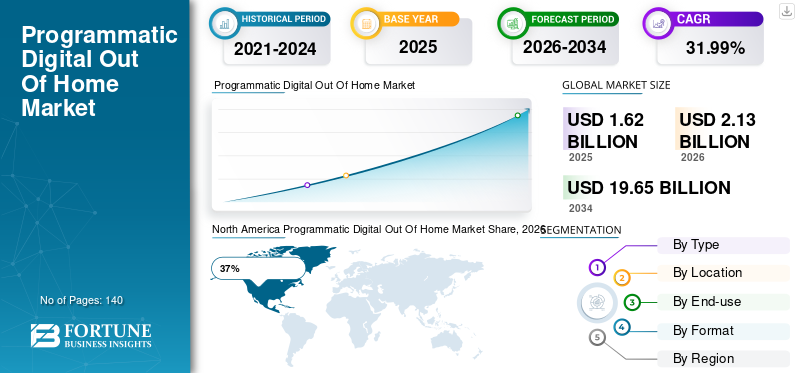
The global programmatic digital out of home market size was valued at USD 1.62 billion in 2025. The market is projected to grow from USD 2.13 billion in 2026 to USD 19.65 billion by 2034, exhibiting a CAGR of 31.99% during the forecast period.

The programmatic digital out of home market is transforming the global advertising ecosystem through automated media buying, real-time audience targeting, and dynamic content delivery across digital screens. programmatic digital out of home market growth is supported by increasing deployment of connected displays in transportation hubs, retail centers, commercial buildings, and urban streets. More than 1.2 million programmatically addressable digital screens are actively integrated into advertising networks, enabling advertisers to optimize campaigns through audience analytics and contextual triggers. programmatic digital out of home market Analysis indicates that brands are increasingly allocating budgets toward automated outdoor advertising due to improved campaign measurement, flexible inventory access, and integration with omnichannel marketing strategies.
The United States programmatic digital out of home market remains the largest national market, supported by advanced advertising infrastructure and widespread digital screen penetration. Approximately 37% of global programmatic digital out of home market share is concentrated in North America, with the United States contributing the majority of regional demand. Airports, transit stations, roadside digital billboards, shopping malls, and entertainment venues continue to expand screen inventories across major metropolitan areas. More than 88% of U.S. adults are exposed to out-of-home advertising formats during weekly commuting activities. Programmatic Digital Out Of Home Industry Analysis highlights strong adoption among retail, automotive, consumer goods, financial services, and entertainment advertisers seeking audience-based campaign activation and real-time optimization.
Download Free sample to learn more about this report.
Programmatic Digital Out Of Home Market Key Takeaways
 Global Market Size & Forecast
- 2025 Market Size: USD 1.62 Billion
- 2026 Market Size: USD 2.13 Billion
- 2034 Forecast Market Size: USD 19.65 Billion
- CAGR: 31.99% from 2026-2034
 Market Share
- North America dominated with a regional market share of 37% in 2025.
- Demand-side platforms led by type with approximately 58% market share.
- Location-based deployments accounted for approximately 40% market share.
 Key Regional Highlights
North America
North America held the largest regional share at 37% of the global market.
Europe
Europe accounted for 29% of the global market, supported by increasing digital advertising adoption.
Asia-Pacific
Asia-Pacific represented 25% of the global market, driven by expanding digital media infrastructure.
U.S
The U.S. remains a major market, supported by advanced digital advertising ecosystems and widespread digital screen deployment.
Japan
Japan accounted for 18% of the Asia-Pacific market, supported by strong digital infrastructure and urban advertising demand.
Read More

Programmatic Digital Out Of Home Market Latest Trends
programmatic digital out of home market Trends are increasingly shaped by artificial intelligence, audience analytics, and contextual advertising capabilities. Advertisers are deploying dynamic creative optimization systems that modify advertising content according to weather conditions, traffic density, event schedules, and consumer demographics. This capability improves engagement and campaign relevance across digital billboards, transit displays, retail media screens, and urban street furniture. Another significant programmatic digital out of home market trend is the integration of omnichannel advertising strategies.
Download Free sample to learn more about this report.
Brands increasingly synchronize campaigns across mobile devices, connected television platforms, social media channels, and digital outdoor displays. Such integration enables unified audience targeting and consistent messaging across multiple consumer touchpoints. Retail media networks have emerged as a major growth area, with indoor digital screens installed in supermarkets, shopping centers, and convenience stores. Programmatic buying platforms now provide access to hundreds of thousands of retail-based displays. Smart city projects are also accelerating deployment of connected outdoor screens capable of supporting real-time content updates and automated campaign management.
Programmatic Digital Out Of Home Market Dynamics
DRIVER
Growing Demand for Data-Driven Advertising and Automated Media Buying
The primary growth driver in the programmatic digital out of home market is the increasing demand for data-driven advertising solutions. Advertisers require measurable campaign outcomes, audience-specific targeting, and flexible purchasing models. Programmatic platforms enable brands to purchase inventory based on audience characteristics, location patterns, and behavioral insights. More than 300 active integrations between demand-side and supply-side platforms facilitate seamless media transactions. Real-time bidding capabilities help advertisers optimize campaign delivery and improve operational efficiency. Smart cities, digital infrastructure expansion, and connected screen deployment further support market growth. programmatic digital out of home market Insights show that advertisers increasingly prioritize automated advertising channels capable of delivering contextual relevance and measurable performance metrics across high-traffic public environments.
RESTRAINT
High Infrastructure Deployment and Maintenance Requirements
The programmatic digital out of home market faces restraints associated with infrastructure costs and operational complexity. Installation of digital displays requires substantial investment in hardware, networking systems, display management software, and maintenance operations. Large-format digital billboards require continuous power supply, network connectivity, and content management systems to ensure uninterrupted performance. Maintenance challenges such as screen calibration, hardware failures, and connectivity disruptions can reduce operational efficiency. Regulatory restrictions in several urban areas limit new screen installations and delay deployment approvals. Programmatic Digital Out Of Home Industry Report assessments indicate that permit approval timelines, zoning regulations, and environmental compliance requirements create barriers for rapid expansion in selected markets. These factors may restrict inventory growth despite increasing advertiser demand.
OPPORTUNITY
Expansion of Retail Media Networks and Smart City Infrastructure
One of the strongest programmatic digital out of home market Opportunities lies in the expansion of retail media networks and smart city projects. Retail chains are installing digital screens across stores to monetize customer traffic and improve shopper engagement. Indoor digital displays positioned near checkout areas, entrances, and promotional zones provide highly targeted advertising opportunities. Smart city investments are increasing deployment of connected kiosks, digital wayfinding systems, and intelligent public information displays. These assets create additional inventory for automated advertising transactions. programmatic digital out of home market Forecast studies indicate that transportation systems, airports, railway stations, and urban transit corridors will continue adding addressable digital screens. Such developments expand advertiser reach and create new opportunities for audience-based targeting and contextual messaging.
CHALLENGE
Fragmented Ecosystem and Measurement Standardization Issues
A major challenge within the programmatic digital out of home market is the fragmented technology ecosystem. Numerous media owners, software providers, demand-side platforms, and supply-side platforms operate across different markets using varying measurement methodologies. Standardizing audience metrics and attribution frameworks remains difficult. Advertisers often require consistent reporting across multiple campaign channels, yet differences in screen inventory, audience tracking technologies, and performance indicators can complicate campaign evaluation. Cross-market measurement standards are still evolving. programmatic digital out of home market Outlook assessments highlight the need for greater interoperability between platforms and unified audience measurement systems. Achieving consistency in campaign reporting, impression validation, and attribution analysis remains critical for long-term industry expansion.
Programmatic Digital Out Of Home Market Segmentation
By Type
Demand-side platforms account for approximately 58% of the programmatic digital out of home market share. These platforms enable advertisers and agencies to purchase advertising inventory through automated bidding systems and audience-based targeting tools. Demand-side platforms support campaign optimization through demographic analysis, geographic targeting, weather triggers, and consumer movement data. Integration with mobile advertising and connected television campaigns strengthens omnichannel advertising capabilities. Large advertisers increasingly rely on demand-side platforms to manage inventory across thousands of digital screens simultaneously.
Supply-side platforms represent approximately 42% of the programmatic digital out of home market share. These systems enable media owners to manage inventory, automate transactions, and maximize occupancy rates across digital screens. Supply-side platforms connect inventory providers with advertisers through real-time marketplaces and private auction environments. Programmatic Digital Out Of Home Industry Analysis shows increasing adoption among billboard operators, transit media providers, airport networks, and retail screen owners. Inventory management tools allow media companies to improve utilization rates and streamline campaign delivery processes.
To know how our report can help streamline your business, Speak to Analyst
By Location
Location-based deployment accounts for approximately 40% of programmatic digital out of home market share. Urban centers, highways, transportation hubs, shopping districts, and commercial complexes represent the largest concentration of digital inventory. Location intelligence enables advertisers to target audiences according to traffic patterns, geographic behavior, and proximity to retail destinations. programmatic digital out of home market Trends indicate increasing demand for premium locations such as airports, train stations, and city centers where audience density remains consistently high. Smart location analytics support campaign customization and improve advertising relevance. Outdoor digital displays continue to attract significant investment due to their visibility and ability to deliver large-scale audience exposure.
By End-use
The end-use segment holds approximately 35% of programmatic digital out of home market share. Major advertisers include retail companies, automotive manufacturers, financial institutions, telecommunications providers, entertainment firms, and consumer goods brands. Retail remains a dominant end-use category due to its focus on location-based customer engagement. Automotive companies utilize digital outdoor advertising to promote new vehicle launches and dealership campaigns. Financial services firms increasingly deploy programmatic outdoor advertising for brand awareness initiatives. programmatic digital out of home market Insights indicate growing participation from healthcare, education, and technology sectors seeking high-impact audience reach in public environments.
By Format
Format-based applications account for approximately 25% of programmatic digital out of home market share. Digital billboards remain the leading format due to their large audience reach and strong visual impact. Video-enabled displays, transit screens, interactive kiosks, and retail media displays contribute significantly to segment development. Dynamic creative content, motion graphics, and real-time updates improve audience engagement levels. programmatic digital out of home market Opportunities within this segment are supported by advances in display technology, higher screen resolution, and interactive advertising experiences. Advertisers increasingly favor visually rich formats that deliver measurable engagement and enhanced brand visibility across public spaces.
Programmatic Digital Out Of Home Market Regional Outlook
North America Programmatic Digital Out Of Home Market Share, 2026 (%)
To get more information on the regional analysis of this market, Download Free sample
North America
North America holds approximately 37% of the programmatic digital out of home market share, making it the leading regional market. The region benefits from extensive digital billboard networks, advanced advertising technologies, and strong programmatic ecosystem maturity. The United States contributes the majority of regional demand, supported by widespread deployment of connected displays across highways, airports, shopping centers, and transit stations. Advertisers increasingly utilize automated media buying platforms to improve campaign precision and audience targeting. Retail, automotive, financial services, and entertainment sectors remain major spending categories. Integration of mobile advertising with digital outdoor campaigns continues to strengthen omnichannel strategies. Artificial intelligence and audience analytics are widely adopted for campaign optimization. Growing investments in smart city infrastructure further support digital screen expansion. Strong collaboration between media owners and technology providers enhances market competitiveness.
Europe
Europe accounts for approximately 29% of the programmatic digital out of home market share and remains a significant contributor to global industry development. The region benefits from advanced public transportation infrastructure, high urbanization levels, and increasing digital screen installations. Programmatic advertising adoption is accelerating across transit hubs, commercial districts, and retail locations. Advertisers increasingly focus on contextual and audience-based targeting solutions to improve campaign effectiveness. Automotive, telecommunications, consumer goods, and financial services sectors are major users of programmatic outdoor advertising. Smart city projects across major European countries continue to create new advertising inventory. Media owners are expanding partnerships with advertising technology providers to streamline transactions. Demand for audience measurement and campaign attribution tools continues to rise. Digital transformation initiatives support long-term market expansion throughout the region.
Germany Programmatic Digital Out Of Home Market
Germany represents approximately 24% of the European programmatic digital out of home market share. The country has a highly developed advertising infrastructure supported by dense urban populations and extensive transportation networks. Digital displays are widely installed across railway stations, airports, shopping centers, and city-center locations. Programmatic buying platforms are increasingly adopted by advertisers seeking efficient audience targeting solutions. Automotive manufacturers, retailers, and industrial companies remain key advertising contributors. Smart city investments are driving deployment of connected screens and digital communication platforms. Advanced audience analytics and campaign measurement technologies are gaining importance among advertisers. Real-time content management capabilities enhance campaign flexibility and responsiveness. Continued digital transformation across public spaces supports inventory growth. Germany remains one of Europe's most technologically advanced programmatic advertising markets.
United Kingdom Programmatic Digital Out Of Home Market
The United Kingdom accounts for approximately 27% of the European programmatic digital out of home market share. The country is recognized as one of the most mature programmatic advertising environments globally. London serves as a major hub for digital outdoor advertising, featuring extensive deployment of premium digital displays. Advertisers actively use automated buying systems to engage commuters, shoppers, and urban audiences. Contextual advertising and dynamic creative optimization have become widely adopted campaign strategies. Retail, finance, entertainment, and telecommunications sectors drive significant advertising demand. Media owners continue expanding programmatic inventory availability across transport and retail environments. Audience measurement technologies are becoming increasingly sophisticated. Omnichannel campaign integration remains a major industry focus. Continued innovation strengthens the United Kingdom's leadership position within the European market.
Asia-Pacific
Asia-Pacific holds approximately 25% of the programmatic digital out of home market share and represents one of the fastest-growing regions globally. Rapid urbanization and large metropolitan populations create significant advertising opportunities. Governments and private investors continue funding smart city projects that support digital display deployment. Major cities across the region are expanding connected billboard networks, transit displays, and retail media installations. Retail, technology, telecommunications, and entertainment sectors are key advertising participants. Increasing internet connectivity supports integration between mobile and outdoor advertising channels. Programmatic technologies help advertisers improve campaign efficiency and audience targeting accuracy. Growing adoption of artificial intelligence enhances campaign optimization capabilities. Transportation hubs remain important advertising locations. Continuous infrastructure modernization supports sustained regional market development.
Japan Programmatic Digital Out Of Home Market
Japan contributes approximately 18% of the Asia-Pacific programmatic digital out of home market share. The country possesses one of the world's most advanced digital advertising ecosystems. Major cities such as Tokyo and Osaka feature extensive networks of digital displays across transportation and commercial environments. Programmatic advertising technologies are widely adopted by leading brands seeking efficient audience engagement. Consumer electronics, retail, entertainment, and automotive sectors are significant contributors to advertising activity. Advanced audience analytics support highly targeted campaign execution. Artificial intelligence and automation technologies continue improving advertising effectiveness. High commuter traffic volumes create valuable advertising opportunities in transit locations. Investments in next-generation display technologies further strengthen market growth. Japan remains a leader in innovative digital outdoor advertising solutions.
China Programmatic Digital Out Of Home Market
China accounts for approximately 31% of the Asia-Pacific programmatic digital out of home market share, making it the largest market within the region. Rapid urban development and large-scale smart city initiatives have significantly expanded digital advertising infrastructure. Major metropolitan areas continue deploying digital billboards, transit displays, and retail media networks. Technology companies and consumer brands are major users of automated outdoor advertising solutions. High population density enables advertisers to reach large audiences efficiently. Programmatic buying platforms improve campaign management and targeting capabilities. Growing adoption of data analytics supports enhanced audience measurement. Retail and e-commerce sectors increasingly utilize digital outdoor media for brand promotion. Infrastructure modernization projects continue creating new inventory opportunities. Strong digital transformation trends support long-term market expansion.
Rest of World
The Rest of World region represents approximately 9% of the programmatic digital out of home market share. Growth is supported by increasing investments in digital infrastructure across the Middle East, Latin America, and Africa. Major cities are deploying connected advertising screens in airports, shopping malls, transportation networks, and commercial districts. Smart city initiatives are creating new opportunities for programmatic advertising deployment. Retail, tourism, hospitality, and telecommunications sectors remain major end users. Media owners are adopting automated transaction platforms to improve inventory utilization and operational efficiency. Audience measurement technologies are becoming more widely available across developing markets. Expansion of internet connectivity supports integration with broader digital marketing strategies. Government infrastructure projects continue enhancing advertising environments. The region offers significant long-term opportunities for market participants.
List of Top Programmatic Digital Out Of Home Companies
- JCDecaux Group
- Stroer SE & Co. KGaA
- Clear Channel Outdoor Holdings, Inc.
- Outfront Media Inc.
- oOh!media Limited.
- Lamar Advertising Company
- Broadsign International LLC.
- Focus Media
- Crimtan
- Daktronics Dr.
Top Two Companies with Highest Market Share
- JCDecaux Group – 16% market share
- Clear Channel Outdoor Holdings, Inc. – 13% market share
Investment Analysis and Opportunities
programmatic digital out of home market investment activity continues to increase as advertisers, media owners, and technology providers expand digital infrastructure capabilities. Capital allocation is focused on connected display deployment, audience analytics platforms, artificial intelligence systems, and automated transaction technologies. Investors view programmatic outdoor advertising as a strategic extension of omnichannel marketing ecosystems because it combines physical audience reach with digital measurement capabilities.
Retail media networks present substantial investment opportunities due to their ability to influence purchasing decisions near points of sale. Transportation hubs, airports, railway stations, and urban mobility networks also attract significant investment because of high audience density and extended dwell times. programmatic digital out of home market Opportunities are further supported by growing demand for contextual targeting and real-time content delivery.
New Product Development
New product development within the programmatic digital out of home market is centered on artificial intelligence, advanced analytics, and interactive advertising technologies. Media technology providers are launching next-generation content management systems capable of real-time creative adaptation based on audience behavior, weather conditions, and location-specific events. These solutions improve campaign relevance and advertiser engagement.
Interactive displays featuring touch capabilities, QR code integration, and mobile connectivity are becoming increasingly common. programmatic digital out of home market Trends indicate growing demand for immersive advertising experiences that connect physical and digital consumer journeys. Display manufacturers are introducing higher-resolution screens with improved brightness, energy efficiency, and durability for outdoor environments.
Five Recent Developments (2023-2025)
- Broadsign expanded its programmatic advertising capabilities through the acquisition of Place Exchange in 2025, strengthening global inventory access and supply-side platform integration.
- Major outdoor media operators increased deployment of programmatically connected screens across transportation hubs and urban centers during 2024 and 2025.
- Several advertising technology providers introduced artificial intelligence-powered dynamic creative optimization tools for real-time content personalization in 2024.
- Retail media networks significantly expanded indoor digital display installations across supermarkets, shopping centers, and convenience stores throughout 2023 and 2024.
- Leading media owners enhanced omnichannel advertising integrations, enabling synchronized campaign activation across mobile, connected television, and digital outdoor advertising platforms during 2025.
Report Coverage Of Programmatic Digital Out Of Home Market
The programmatic digital out of home market Report provides extensive coverage of industry structure, technology evolution, competitive dynamics, segmentation analysis, and regional performance. The report evaluates demand-side platforms, supply-side platforms, advertising formats, deployment locations, and end-use industries shaping market development. programmatic digital out of home market Research Report coverage includes analysis of digital screen deployment, audience targeting technologies, campaign automation systems, and measurement frameworks.
Request for Customization to gain extensive market insights.
The study examines major growth drivers, market restraints, emerging opportunities, and operational challenges influencing industry participants. It also assesses competitive positioning of leading companies involved in digital outdoor advertising infrastructure, software platforms, and media inventory management. programmatic digital out of home market Insights presented in the report cover adoption trends across retail, transportation, entertainment, financial services, telecommunications, and consumer goods sectors.
Frequently Asked Questions
Fortune Business Insights says that the global market value stood at USD 1.62 billion in 2025 and is projected to reach USD 19.65 billion by 2034.
The market is expected to exhibit a CAGR of 31.99% during the forecast period of 2026-2034.
Demand-side platforms were the leading type segment, accounting for approximately 58% of the market, supported by automated bidding and audience-based targeting capabilities.
Key players include JCDecaux Group, Stroer SE & Co. KGaA, Clear Channel Outdoor Holdings, Inc., Outfront Media Inc., oOh!media Limited, and Lamar Advertising Company.
Major trends include growing adoption of AI-powered dynamic creative optimization and audience analytics, along with increasing omnichannel advertising and retail media integration. North America leads with approximately 37% market share, supported by advanced advertising infrastructure and widespread digital-screen deployment.



- 2021-2034
- 2025
- 2021-2024
- 140
-

(Offer valid till 30th Sep 2026)
Get 30-60 hrs Free Customization
Expand Regional and Country Coverage, Segments Analysis, Company Profiles, Competitive Benchmarking, and End-user Insights.




















-
US +1 833 909 2966 ( Toll Free )
-
Get In Touch With Us