Psychiatric Digital Biomarkers Market Size, Share & Industry Analysis, By Type (Wearables, Mobile-based Applications, Sensors), By Clinical Practice (Diagnostic, Monitoring, Predictive & Prognostic), By End-use, and Regional Forecast, 2026-2034
 Download Free Sample
Psychiatric Digital Biomarkers Market Overview
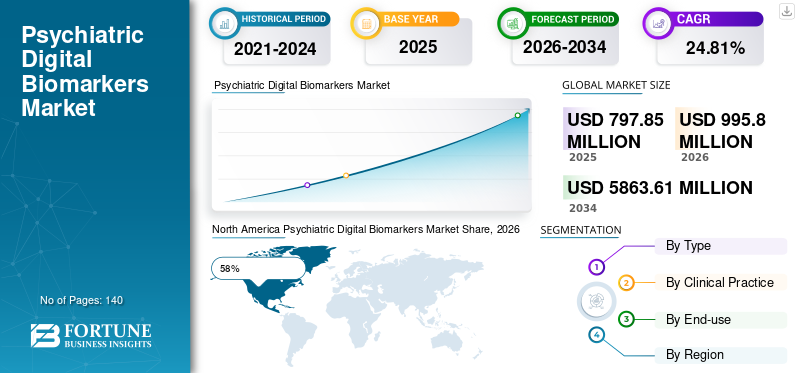
The global psychiatric digital biomarkers market size was valued at USD 797.85 billion in 2025. The market is projected to grow from USD 995.8 billion in 2026 to USD 5863.61 billion by 2034, exhibiting a CAGR of 24.81% during the forecast period.

The psychiatric digital biomarkers market is gaining substantial attention across the healthcare technology ecosystem due to the growing need for objective mental health assessment tools. Psychiatric digital biomarkers utilize wearable devices, smartphone applications, sensors, behavioral analytics, speech monitoring systems, and artificial intelligence platforms to measure cognitive, emotional, and behavioral patterns associated with psychiatric disorders. The increasing burden of depression, anxiety, schizophrenia, bipolar disorder, and neuropsychiatric conditions is accelerating adoption across clinical environments. Healthcare providers are integrating continuous monitoring solutions to improve diagnosis accuracy, treatment response evaluation, and patient engagement. The psychiatric digital biomarkers market Report indicates strong demand from pharmaceutical companies, digital health providers, research institutions, and mental healthcare networks.
The United States psychiatric digital biomarkers market represents approximately 44% of the North American market due to advanced digital healthcare infrastructure and extensive adoption of remote patient monitoring technologies. More than 60% of behavioral health organizations in major metropolitan regions have incorporated digital assessment tools into patient monitoring programs. Rising investments in mental health technology, increasing smartphone penetration exceeding 90%, and expanding telepsychiatry services continue to support market expansion. The Psychiatric Digital Biomarkers Industry Analysis highlights strong demand from clinical research organizations and pharmaceutical developers seeking objective endpoints for psychiatric drug trials. Artificial intelligence-driven behavioral analytics platforms are also experiencing wider deployment across healthcare systems.
Download Free sample to learn more about this report.
Psychiatric Digital Biomarkers Market Key Takeaways
 Global Market Size & Forecast
- 2025 Market Size: USD 797.85 Billion
- 2026 Market Size: USD 995.8 Billion
- 2034 Forecast Market Size: USD 5,863.61 Billion
- CAGR: 24.81% from 2026-2034
 Market Share
- North America dominated with a regional market share of 58% in 2025.
- Wearables led by type with approximately 40% market share.
- Diagnostic psychiatric digital biomarkers led by clinical practice with approximately 31% market share.
 Key Regional Highlights
North America
North America held the largest regional share at 58% of the global market.
Europe
Europe accounted for 24% of the global market, supported by growing adoption of digital mental health technologies.
Asia-Pacific
Asia-Pacific represented 13% of the global market, driven by increasing digital healthcare adoption.
U.S
The U.S. remains a major market, supported by advanced healthcare infrastructure and growing use of digital biomarkers.
Japan
Japan accounted for 27% of the Asia-Pacific market, supported by technological advancements in digital healthcare and psychiatric monitoring.
Read More

psychiatric digital biomarkers market Latest Trends
The psychiatric digital biomarkers market trends indicate a rapid shift toward passive monitoring technologies that collect behavioral and physiological information without requiring constant patient interaction. Healthcare organizations are increasingly adopting wearable sensors capable of measuring sleep quality, heart rate variability, movement patterns, and stress-related physiological changes. These indicators are being used to identify early signs of depression, anxiety, and cognitive decline. Artificial intelligence integration represents another major trend shaping the psychiatric digital biomarkers market Outlook. Machine learning algorithms can process large volumes of behavioral and physiological data to generate predictive insights for clinicians. Voice-based biomarkers are also gaining attention as speech patterns, tone fluctuations, and language structures demonstrate strong correlations with psychiatric disorders.
Download Free sample to learn more about this report.
The market is witnessing increased collaboration between pharmaceutical companies and digital health technology developers. Psychiatric digital biomarkers are becoming important components of decentralized clinical trials and remote patient monitoring programs. Smartphone-based applications capable of capturing mood changes, social interaction behavior, screen activity, and cognitive performance are expanding their clinical relevance. Another emerging trend involves multimodal biomarker platforms combining wearable data, speech analytics, cognitive assessments, and environmental factors into a unified mental health monitoring ecosystem. These platforms are helping healthcare professionals achieve higher diagnostic precision while supporting personalized treatment approaches. Growing regulatory recognition of digital endpoints further strengthens commercial opportunities throughout the psychiatric digital biomarkers market Research Report landscape.
psychiatric digital biomarkers market Dynamics
DRIVER
Rising Prevalence of Mental Health Disorders and Increasing Demand for Objective Psychiatric Assessment
The rising incidence of psychiatric disorders remains the primary growth driver for the psychiatric digital biomarkers market. Mental health conditions affect hundreds of millions of individuals worldwide, creating substantial pressure on healthcare systems. Traditional psychiatric evaluations largely depend on subjective patient reporting and clinician observations, creating variability in diagnosis and treatment decisions. Psychiatric digital biomarkers provide objective and continuous measurements that improve clinical decision-making processes. Healthcare providers increasingly utilize wearable technologies and mobile applications to monitor behavioral patterns associated with depression, anxiety, schizophrenia, and bipolar disorder. Pharmaceutical companies are also integrating digital biomarkers into clinical research programs to generate more accurate outcome measurements. Growing acceptance of telehealth services further strengthens demand for continuous monitoring technologies that support remote psychiatric care delivery and personalized treatment planning.
RESTRAINT
Data Privacy Concerns and Regulatory Compliance Complexities
Despite significant opportunities, the psychiatric digital biomarkers market faces restraints associated with data privacy and security concerns. Psychiatric digital biomarkers collect highly sensitive information including behavioral data, speech recordings, physiological signals, sleep patterns, and cognitive performance indicators. Healthcare organizations must comply with strict data protection regulations, increasing implementation complexity. Concerns regarding cybersecurity breaches and unauthorized access to mental health information continue to affect patient trust. Regulatory agencies require extensive validation of digital biomarkers before widespread clinical adoption. Variations in regulatory frameworks across regions further complicate commercialization strategies for technology providers. Smaller companies often encounter challenges related to compliance costs and validation requirements. These factors can delay product launches and limit adoption among healthcare providers seeking proven and secure digital health solutions.
OPPORTUNITY
Expansion of Personalized Psychiatry and Digital Therapeutics
The emergence of personalized psychiatry creates substantial opportunities for the psychiatric digital biomarkers market Opportunities segment. Healthcare systems increasingly recognize the need for individualized treatment strategies due to the diverse nature of psychiatric disorders. Digital biomarkers enable clinicians to track real-time patient responses and adjust treatment plans accordingly. Artificial intelligence platforms can identify unique behavioral signatures associated with specific psychiatric conditions, improving therapeutic precision. Pharmaceutical companies are leveraging digital biomarkers to optimize patient selection during clinical trials and enhance treatment outcome monitoring. Digital therapeutics platforms are also integrating biomarker-driven insights to provide personalized interventions. Growing investments in precision medicine initiatives and patient-centered healthcare models support broader deployment of psychiatric digital biomarkers across hospitals, clinics, and research institutions worldwide.
CHALLENGE
Clinical Validation and Interoperability Limitations
One of the major challenges affecting the psychiatric digital biomarkers market growth involves establishing robust clinical validation across diverse patient populations. Many digital biomarker technologies remain in early stages of validation and require extensive longitudinal studies before achieving widespread acceptance. Differences in device standards, data collection methodologies, and analytical frameworks create interoperability challenges. Healthcare providers often utilize multiple electronic health record systems that may not seamlessly integrate digital biomarker outputs. Variability in patient engagement and adherence can also influence data quality. Furthermore, clinicians require standardized guidelines to interpret digital biomarker findings consistently. Addressing these challenges remains essential for expanding adoption and ensuring long-term sustainability within the Psychiatric Digital Biomarkers Industry Report environment.
psychiatric digital biomarkers market Segmentation
By Type
Wearables hold approximately 40% market share within the psychiatric digital biomarkers market Size landscape. Smartwatches, wristbands, biosensor patches, and physiological monitoring devices provide continuous measurement of heart rate variability, activity levels, sleep quality, and stress indicators. These technologies support early detection of depressive episodes, anxiety disorders, and behavioral abnormalities. Healthcare providers increasingly utilize wearable-generated data to supplement traditional psychiatric evaluations. The growing integration of electrodermal activity monitoring and biometric sensing technologies further strengthens adoption. Pharmaceutical companies also employ wearable devices during decentralized clinical trials to collect real-world patient data.
Mobile-based applications account for nearly 34% market share within the psychiatric digital biomarkers market Forecast environment. Smartphones enable passive and active data collection through mood assessments, cognitive exercises, behavioral monitoring, voice analysis, and social interaction tracking. Mobile applications provide cost-effective solutions for large-scale psychiatric monitoring programs. Increasing smartphone penetration rates exceeding 80% across several developed markets contribute significantly to adoption. Healthcare providers utilize mobile platforms to track treatment adherence and symptom progression remotely. Artificial intelligence-powered applications can identify behavioral changes associated with mental health deterioration.
Sensors represent approximately 26% market share within the psychiatric digital biomarkers market Insights segment. Advanced sensors capture physiological, environmental, and behavioral information associated with psychiatric conditions. Technologies include electroencephalography sensors, motion sensors, speech recognition systems, environmental monitoring platforms, and biometric devices. Sensor-based solutions are increasingly used in research settings to establish objective biomarkers for mental health disorders. Hospitals and academic institutions employ sophisticated sensor networks to study cognitive function, emotional regulation, and neurological behavior. The growing emphasis on multimodal data collection supports broader sensor deployment across psychiatric assessment programs.
To know how our report can help streamline your business, Speak to Analyst
By Clinical Practice
Diagnostic psychiatric digital biomarkers hold approximately 31% market share and represent the largest clinical application segment. Healthcare providers utilize digital biomarkers to improve diagnostic precision and reduce dependence on subjective assessments. Behavioral analytics, speech monitoring, cognitive testing, and physiological indicators provide valuable clinical insights into psychiatric disorders. Diagnostic platforms help identify early manifestations of depression, schizophrenia, bipolar disorder, and anxiety disorders. Pharmaceutical researchers also utilize diagnostic biomarkers during patient stratification and clinical trial enrollment processes.
Monitoring applications account for nearly 29% market share within the psychiatric digital biomarkers market Research Report framework. Continuous monitoring technologies enable clinicians to observe patient conditions between clinical visits. Wearable devices, mobile applications, and remote monitoring systems provide real-time insights into behavioral and physiological changes. These solutions support relapse prevention, treatment optimization, and long-term patient management. Healthcare providers increasingly rely on monitoring biomarkers to evaluate medication effectiveness and patient adherence. The expansion of remote healthcare delivery models further increases demand for continuous psychiatric monitoring technologies.
Predictive and prognostic applications contribute approximately 22% market share within the Psychiatric Digital Biomarkers Industry Analysis ecosystem. These solutions utilize artificial intelligence algorithms to forecast disease progression, relapse risk, treatment outcomes, and behavioral deterioration. Predictive analytics platforms process large datasets generated through wearables, smartphones, and sensor technologies. Healthcare providers leverage these insights to implement proactive interventions before symptom escalation occurs. Pharmaceutical developers increasingly integrate predictive biomarkers into drug development programs to improve patient selection and outcome prediction.
By End-use
End-use organizations collectively account for approximately 18% market share and include healthcare companies, hospitals, psychiatric clinics, pharmaceutical manufacturers, research institutions, and contract research organizations. Healthcare companies alone represent nearly 51% of end-use demand due to extensive integration of digital biomarkers into drug development and patient monitoring initiatives. Hospitals increasingly adopt digital biomarker platforms to support clinical decision-making and remote care programs. Academic research institutions utilize these technologies for behavioral health studies and biomarker validation projects. Expanding partnerships between healthcare providers and technology developers continue to accelerate end-use adoption across global markets.
psychiatric digital biomarkers market Regional Outlook
North America Psychiatric Digital Biomarkers Market Share, 2026 (%)
To get more information on the regional analysis of this market, Download Free sample
North America
North America dominates the psychiatric digital biomarkers market with approximately 58% market share. The region benefits from advanced healthcare infrastructure, extensive digital health adoption, and strong investment activity within mental health technology sectors. Healthcare providers increasingly deploy wearable monitoring systems, artificial intelligence platforms, and remote patient assessment tools across psychiatric care settings. The prevalence of depression, anxiety disorders, and neuropsychiatric conditions continues to drive demand for objective monitoring solutions. The United States represents the largest contributor within North America, accounting for nearly 76% of regional demand. Pharmaceutical companies actively integrate psychiatric digital biomarkers into clinical trials and drug development programs. Academic research institutions collaborate with technology developers to validate emerging digital endpoints. Telepsychiatry adoption has further accelerated implementation of remote monitoring technologies.
Europe
Europe accounts for approximately 24% market share within the psychiatric digital biomarkers market. The region benefits from expanding digital health strategies, increasing mental healthcare investments, and growing adoption of remote monitoring technologies. Healthcare providers across Europe are integrating wearable devices and mobile-based psychiatric assessment tools into routine clinical practice. Strong academic research networks contribute to biomarker validation and technological innovation. Several European countries have established national digital healthcare frameworks supporting adoption of advanced monitoring solutions. Pharmaceutical companies increasingly utilize digital biomarkers during neurological and psychiatric clinical trials. Artificial intelligence applications for behavioral health assessment continue gaining regulatory attention throughout the region.
Germany Psychiatric Digital Biomarkers Market
Germany represents approximately 28% of the European psychiatric digital biomarkers market. The country benefits from a strong healthcare technology ecosystem and extensive investment in digital medicine initiatives. Hospitals and psychiatric clinics increasingly deploy wearable monitoring systems to support mental health assessment and treatment optimization. Research institutions actively participate in biomarker validation programs focusing on depression, schizophrenia, and cognitive disorders. Digital health reimbursement frameworks support broader adoption of remote monitoring technologies. Pharmaceutical manufacturers utilize psychiatric digital biomarkers during clinical development activities. The German market continues expanding through collaborations between technology companies, healthcare providers, and academic organizations developing innovative mental health solutions.
United Kingdom Psychiatric Digital Biomarkers Market
The United Kingdom accounts for nearly 22% of the European psychiatric digital biomarkers market. Growing emphasis on mental healthcare accessibility and digital transformation supports market expansion. Healthcare organizations are increasingly adopting smartphone-based monitoring applications and wearable technologies for psychiatric assessment. Research collaborations involving universities, healthcare providers, and digital health developers contribute to innovation. National initiatives promoting remote healthcare services have accelerated implementation of digital monitoring programs. Artificial intelligence-driven behavioral analytics solutions are gaining traction across clinical settings. Strong clinical research activity and increasing investment in mental health technology continue strengthening the United Kingdom's position within the regional market.
Asia-Pacific
Asia-Pacific contributes approximately 13% market share within the psychiatric digital biomarkers market. The region is experiencing rapid adoption due to increasing smartphone penetration, growing awareness of mental health disorders, and expanding digital healthcare infrastructure. Countries across Asia-Pacific are investing heavily in telehealth platforms and remote patient monitoring systems. Large population bases create significant opportunities for scalable psychiatric assessment technologies. Healthcare providers increasingly utilize mobile applications and wearable devices to address mental health challenges in urban populations. Government initiatives supporting healthcare digitization contribute to broader market development. Pharmaceutical companies are expanding clinical research activities across the region, creating additional demand for objective digital endpoints.
Japan Psychiatric Digital Biomarkers Market
Japan accounts for approximately 27% of the Asia-Pacific psychiatric digital biomarkers market. The country benefits from advanced healthcare technology adoption and strong innovation capabilities. Healthcare providers increasingly deploy wearable monitoring solutions for elderly populations experiencing cognitive and psychiatric disorders. Artificial intelligence-driven analytics platforms support personalized mental healthcare approaches. Academic institutions actively participate in psychiatric biomarker research and validation initiatives. Pharmaceutical companies integrate digital monitoring technologies into neurological and psychiatric clinical studies. Growing demand for remote healthcare services and population aging trends continue supporting market expansion. Japan remains one of the most technologically advanced psychiatric digital biomarker markets within Asia-Pacific.
China Psychiatric Digital Biomarkers Market
China represents approximately 23% of the Asia-Pacific psychiatric digital biomarkers market. Rapid digitalization, extensive smartphone usage, and increasing mental health awareness are driving adoption. Healthcare organizations are deploying mobile-based psychiatric monitoring platforms across urban healthcare networks. Artificial intelligence technologies play a significant role in behavioral analytics and predictive mental health assessment. Government healthcare modernization programs support digital health innovation and infrastructure development. Pharmaceutical companies increasingly conduct clinical research activities utilizing digital biomarkers. The large patient population and expanding telehealth ecosystem create substantial opportunities for technology providers. China continues emerging as a major growth center within the psychiatric digital biomarkers market analysis framework.
Rest of World
The Rest of World region accounts for approximately 5% market share within the psychiatric digital biomarkers market. Adoption is increasing across Latin America, the Middle East, and Africa as healthcare systems gradually implement digital health technologies. Mental health awareness campaigns and growing healthcare investments contribute to market development. Mobile-based monitoring applications represent the most widely adopted solutions due to lower implementation costs and broad accessibility. Several countries are expanding telemedicine infrastructure to improve mental healthcare delivery in underserved areas. International collaborations between healthcare organizations and technology developers support introduction of psychiatric digital biomarker platforms. Research institutions are increasingly exploring digital monitoring approaches for psychiatric conditions. While adoption remains lower than in developed markets, improving internet connectivity and smartphone penetration create favorable conditions for future expansion. The region presents significant long-term opportunities for providers seeking new markets within the global psychiatric digital biomarkers ecosystem.
List of Top Psychiatric Digital Biomarkers Companies
- Koneksa Health
- Biogen
- Empatica Inc.
- VivoSense
- IXICO plc
- Sonde Health, Inc.
- Clario
Top Two Companies with Highest Market Share
- Biogen – 16% market share
- Koneksa Health – 14% market share
Investment Analysis and Opportunities
Investment activity within the psychiatric digital biomarkers market has increased significantly as healthcare organizations prioritize objective mental health monitoring solutions. Venture capital firms, pharmaceutical manufacturers, and healthcare technology investors are actively funding companies specializing in wearable technologies, artificial intelligence analytics, digital therapeutics, and remote patient monitoring systems. The increasing prevalence of psychiatric disorders creates strong demand for scalable diagnostic and monitoring platforms. Clinical trial modernization represents a major investment opportunity. Pharmaceutical companies seek digital biomarkers that can improve patient recruitment, treatment monitoring, and endpoint measurement.
As decentralized clinical trials become more common, demand for wearable and mobile-based biomarker technologies continues expanding. Artificial intelligence-driven predictive analytics platforms also attract substantial funding due to their potential to identify mental health deterioration before clinical symptoms become severe. Emerging markets offer additional opportunities as smartphone adoption and digital healthcare infrastructure continue improving. Strategic collaborations between healthcare providers, research institutions, and technology developers are expected to accelerate innovation.
New Product Development
New product development remains a central focus within the psychiatric digital biomarkers market. Companies are introducing advanced wearable devices capable of measuring physiological signals associated with stress, mood changes, sleep disturbances, and cognitive performance. Improvements in sensor accuracy and battery efficiency are enhancing device reliability and user experience.
Artificial intelligence integration has enabled development of sophisticated behavioral analytics platforms capable of processing large volumes of real-world patient data. Voice-based biomarker technologies are becoming increasingly important for detecting depression, anxiety, and cognitive impairment through speech analysis. Several developers are also introducing multimodal platforms combining wearable data, smartphone activity patterns, environmental information, and cognitive assessments.
Five Recent Developments (2023-2025)
- In 2023, Koneksa Health expanded strategic partnerships to accelerate evidence-based digital biomarker deployment across clinical trial environments.
- In 2023, Empatica received additional regulatory clearance for digital biomarkers measuring pulse and respiratory rate through its monitoring platform.
- In 2024, multiple pharmaceutical developers increased integration of psychiatric digital biomarkers into decentralized clinical trial programs for neurological and psychiatric disorders.
- In 2025, Empatica introduced the EmbraceMini wearable platform designed for clinical research, sleep monitoring, and digital biomarker applications.
- In 2025, several psychiatric digital biomarker providers expanded artificial intelligence-driven predictive analytics capabilities to support personalized mental health monitoring and early intervention programs.
Report Coverage
The psychiatric digital biomarkers market Report provides comprehensive coverage of market trends, competitive dynamics, technology developments, investment activities, and regional performance. The report evaluates key market segments including wearables, mobile-based applications, sensors, and emerging digital monitoring technologies. Detailed analysis of diagnostic, monitoring, predictive, and prognostic clinical applications is included to highlight evolving adoption patterns.
Request for Customization to gain extensive market insights.
The report examines demand drivers associated with increasing psychiatric disorder prevalence, expanding telehealth adoption, and growing interest in objective mental health assessment. Market restraints, opportunities, and implementation challenges are thoroughly assessed to provide a balanced industry perspective. Regional analysis covers North America, Europe, Asia-Pacific, and Rest of World markets with country-level insights for major economies.
Frequently Asked Questions
Fortune Business Insights says that the global market value stood at USD 797.85 billion in 2025 and is projected to reach USD 5,863.61 billion by 2034.
The market is expected to exhibit a CAGR of 24.81% during the forecast period of 2026-2034.
Wearables was the leading type segment, accounting for approximately 40% market share, supported by continuous measurement of physiological and behavioral indicators.
Key players include Koneksa Health, Biogen, Empatica Inc., VivoSense, IXICO plc, and Sonde Health, Inc.
Major trends include the growing adoption of passive monitoring and AI-driven behavioral analytics, along with increasing use of voice-based and multimodal biomarkers. North America leads with approximately 58% market share.



- 2021-2034
- 2025
- 2021-2024
- 140
-

(Offer valid till 30th Sep 2026)
Get 30-60 hrs Free Customization
Expand Regional and Country Coverage, Segments Analysis, Company Profiles, Competitive Benchmarking, and End-user Insights.













.webp)






-
US +1 833 909 2966 ( Toll Free )
-
Get In Touch With Us