Quantum Computing in Healthcare Market Size, Share & Industry Analysis, By Component (Software, Hardware, Services, and QCaaS) / Platform), By Deployment (On-Premise, Cloud-Based and Hybrid), By Technology (Superconducting Qubits, Trapped Ions, Quantum Annealing, Quantum Machine Learning, & Others), By Application (Drug Discovery & Development, Medical Diagnostics, Genomics & Precision Medicine, Radiotherapy, Risk Analysis, & Others), By End User (Pharmaceutical & Biotechnology Companies, Labs & Research Institutes, Healthcare Payers, & Others), and Regional Forecast, 2026-2034
 Download Free Sample
Quantum Computing in Healthcare Market Size and Future Outlook
 Listen to Audio Version
The global quantum computing in healthcare market size was valued at USD 191.7 million in 2025. The market is projected to grow from USD 269.5 million in 2026 to USD 4,560.7 million by 2034, exhibiting a CAGR of 42.42% during the forecast period. North America dominated the global quantum computing in healthcare market with a market share of 47.20% in 2025.
The global quantum computing in healthcare market is anticipated to witness exponential growth, driven by the computational superiority of quantum processors. The market is poised for growth due to rising corporate investment and substantial public sector funding. The importance of quantum computing is highlighted in critical areas such as drug discovery, proteomics and genomics, cybersecurity, scheduling, and supply chain planning, resulting in significant cost savings and performance gains. These advantages further elevate demand and propel the growth of the global quantum computing in healthcare market.
Several key companies are engaging in strategic collaborations and partnerships to advance their technology and capitalize on the market's growth.
- For instance, in June 2025, IonQ, a leading commercial quantum computing and networking company, collaborated with AstraZeneca, Amazon Web Services (AWS), and NVIDIA to develop a quantum-accelerated computational chemistry workflow with the potential to drive innovation in healthcare, life sciences, chemistry, and other fields.
Major players in the quantum computing industry, such as Amazon Web Services, Inc., Microsoft, and IBM, operating in the market, are focusing on developing various innovative healthcare solutions to support the growing global demand for quantum computing in healthcare sector.
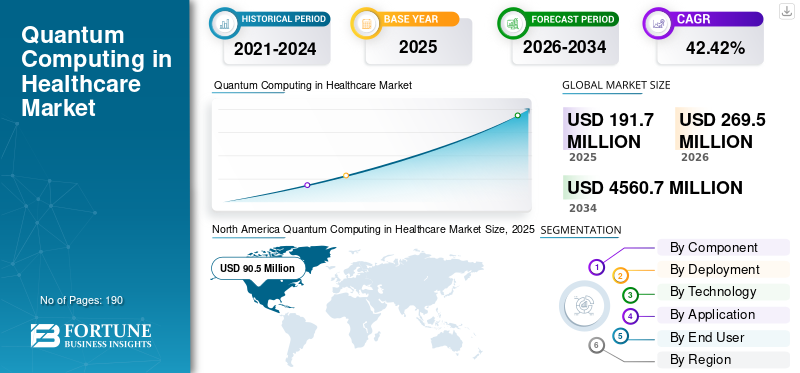
Download Free sample to learn more about this report.
Quantum Computing in Healthcare Market Key Takeaways
 Market Size & Forecast
- 2025 Market Size: USD 191.7 Million
- 2026 Market Size: USD 269.5 Million
- 2034 Forecast Market Size: USD 4,560.7 Million
- CAGR: 42.42% from 2026–2034
 Market Share
- North America dominated the global quantum computing in healthcare market with a 47.20% share in 2025.
- Drug discovery & development segment is anticipated to account for 33.3% of the market in 2026.
- Pharmaceutical & biotechnology companies segment is expected to hold a 38.2% share in 2026.
 Key Regional Highlights
North America
North America led the global market with a 47.20% share in 2025.
Asia Pacific
Asia Pacific is expected to witness strong growth due to increasing investments in quantum healthcare technologies.
Europe
Europe is experiencing rising adoption of quantum computing for pharmaceutical research and innovation.
U.S.
The country remains a key market driven by strong investments in drug discovery and quantum computing research.
Japan
The market is supported by growing advancements in healthcare technology and quantum innovation initiatives.
Read More

QUANTUM COMPUTING IN HEALTHCARE MARKET TRENDS
Growing Focus on Quantum-Ready Cybersecurity Is a Significant Market Trend Observed
Emphasis on Quantum-ready cybersecurity is becoming a major trend in the market, underscoring growing concerns around data security. Key organizations are recognizing quantum computing as a time-bound security risk and focusing on encryption methods, such as RSA and ECC, to safeguard patients' healthcare information. As a result, regulatory bodies such as NIST are promoting a structured transition to post-quantum cryptography (PQC), including guidance on what must be replaced and how to migrate in stages. These developments are driving enterprise spending on PQC-ready security products, along with testing, integration, and compliance services, particularly in regulated industries where strict security timelines and audits necessitate faster action.
- For instance, in August 2024, the U.S. government approved and issued the first major PQC standards as FIPS 203/204/205, which signals to regulated markets that PQC is shifting from optional R&D to procurement and implementation. These developments aim to cater to the global demand for quantum computing in the healthcare market.
Download Free sample to learn more about this report.
MARKET DYNAMICS
MARKET DRIVERS
Rising Applications of Quantum Computing in Drug Discovery and Precision Medicine Are Driving Industry Growth
The increasing use of quantum computing in drug discovery & development, medical diagnostics, and precision medicine, particularly in genomics, is driving quantum computing in healthcare market growth. These emerging technologies address critical challenges in healthcare, including high research and development (R&D) costs, lengthy timelines, and complex data. Even small performance improvements can yield significant financial value. Pharmaceutical and biotech companies are increasingly running pilots for molecular simulation, protein–ligand interaction modeling, and optimization in early discovery that can reduce trial-and-error in early R&D, shorten screening cycles, and lower the cost of selecting the right candidates. This creates a need for quantum cloud access, software tools, and specialist services to build repeatable workflows.
Furthermore, in genomics analysis, the expansion of sequencing and personalized treatment programs creates massive computational workloads, encouraging healthcare and life-science organizations to invest in hybrid quantum-HPC-AI pipelines.
Together, these applications create demand for quantum hardware access and also for quantum-ready software platforms, cloud services, and enterprise integration, which expands the overall market and encourages companies to integrate these quantum computing solutions into their workflows.
- For instance, in April 2023, Moderna, Inc., a biotechnology company pioneering messenger RNA (mRNA) therapeutics and vaccines, collaborated with IBM to explore next-generation technologies, including quantum computing and artificial intelligence, to advance and accelerate mRNA research and science, thereby driving market growth.
MARKET RESTRAINTS
Regulatory and National-Security Constraints to Hamper Market Growth
Regulatory and national security constraints are significant factors hindering the adoption of quantum computing in the market. Quantum technologies are widely regarded as strategic, leading to more stringent screening, mandatory notifications, export-license checks, and restrictions on code sharing for cross-border partnerships. These controls add time, legal cost, and uncertainty to commercial plans. Additionally, the vendor may need government clearance before selling systems abroad, partnering with certain entities, or transferring IP. When approvals are delayed, companies postpone product launches, limit market access, and, in some cases, redesign products or contract structures to comply with regulations. This reduces the speed of scaling, increases costs, and slows overall market growth.
- For instance, in July 2022, the U.K. government blocked a transaction under the National Security and Investment Act (NSIA) that would have allowed Beijing Infinite Vision Technology to license intellectual property from the University of Manchester related to vision-sensing technology.
MARKET OPPORTUNITIES
Technological Advancement in the Quantum Computing Field to Offer Lucrative Market Growth Opportunities
One of the key factors driving market growth is the advancement of technology in the field of quantum computing. These technological advancements have introduced improvements in reducing errors, enhancing reliability, and creating clearer, fault-tolerant roadmaps. As systems become more stable and scalable, companies feel more confident that quantum can deliver repeatable results, driving further market growth. These advantages are prompting key companies to invest heavily in technological advancement and new product launches.
- For instance, in November 2025, IBM launched a new tab built around a new experimental quantum computing chip called Loon, demonstrating that it has reached a key milestone toward creating useful quantum computers before the end of the decade.
MARKET CHALLENGES
High Cost and Operational Complexity Pose a Critical Challenge to Market Growth
One of the major challenges for the market is the high cost associated with quantum computing. These cost stems from the need for specialized cryogenic equipment, such as dilution refrigerators, ultra-clean environments, and complex electronic hardware. In addition, the need for expert staff further adds to overall expenses. As companies scale from dozens to hundreds of qubits, costs often increase faster than performance gains.
- For instance, in September 2025, Live Science reported on a Canadian startup (Qubic) developing a cryogenic amplifier designed to cut one of the biggest pain points in quantum systems. The article notes that existing cryogenic amplifiers and electronics generate heat, rely on cooling hardware, add bulk and cost, and make system scaling harder. These factors pose a significant challenge to the market.
Segmentation Analysis
By Component
Services Segment Led Due to Its Ability to Build Hybrid Workflows
Based on component, the market is divided into software, hardware, services, and Quantum-as-a-Service (QCaaS) / Platform.
The services segment dominated the quantum computing market in 2025. Most companies lack in-house quantum expertise and are therefore shifting toward outsourcing quantum computing services that help identify suitable use cases and build hybrid workflows. This preference among key companies to outsource managed services and training, rather than invest upfront for dedicated hardware, drives the dominance of the segment. The strong demand for external expertise and workflow-building makes services a larger and faster-moving revenue pool. Furthermore, strategic collaborations among key companies to offer innovative solutions support market growth.
- For instance, in November 2025, Palo Alto Networks, in collaboration with IBM, offered a new Quantum-Safe Readiness solution designed to help enterprises identify cryptographic exposure, understand quantum-computing related risks, and accelerate their transition toward quantum-safe security.
The hardware segment is expected to grow at a CAGR of 49.86% over the forecast period.
To know how our report can help streamline your business, Speak to Analyst
By Deployment
Cost-Effectiveness Boosted Cloud Segment Growth
Based on deployment, the market is segmented into on-premises, cloud-based, and hybrid.
In 2025, cloud dominated the market due to the cost-effectiveness and scalability opportunities offered by these solutions. Cloud access enabled pharmaceutical companies to start with pay-as-you-go usage, avoid capital expense, and scale pilots across global teams with standard security and IT governance. They also help users keep the latest software without procurement delays, which are critical in a fast-moving market. These advantages reinforced the dominance of the cloud-based segment in terms of deployment. Underscoring these advantages, key market players are focusing on launching new products in this segment.
- For instance, in April 2025, IonQ launched its cloud-based quantum computer, IonQ Forte Enterprise, globally through Amazon Braket, a managed quantum computing service from Amazon Web Services (AWS).
The on-premise segment is projected to grow at a CAGR of 38.21% during the forecast period.
By Technology
Advantages of Superconducting Qubits to Reinforce Their Dominance in The Market
Based on technology, the market is segmented into superconducting qubits, trapped ions, quantum annealing, quantum machine learning, photonic quantum computing, neutral atom quantum computing, and others.
Superconducting qubits dominated the market due to their benefits from semiconductor-style manufacturing, support for fast gate speeds, and a strong ecosystem of vendors. These advantages make them one of the most industrialized approaches for scaling up systems. These advantages encourage key companies to launch new products.
- For instance, in December 2025, Rigetti Computing, Inc. launched its 84-qubit Ankaa-3 system. Ankaa-3 is Rigetti’s newest flagship quantum computer, featuring an extensive hardware redesign that enables superior performance.
The trapped ions segment is projected to grow at a CAGR of 44.95% during the study period.
By Application
Drug Discovery & Development Segment Led due to its Ability to Reduce R&D Time
Based on applications, the market is segmented into drug discovery & development, medical diagnostics, genomics & precision medicine, radiotherapy, risk analysis, healthcare logistics & scheduling, cybersecurity & data encryption, clinical trials optimization, medical imaging, and others.
In 2025, drug discovery & development dominated the market, as it offers a prominent business payoff. Even small improvements in molecular simulation, reaction modeling, or optimization can reduce R&D time, cost, and failure rates. Quantum computing is being tested specifically in areas where classical methods struggle most, so pharmaceutical companies continue to fund research initiatives to optimize operations. In 2026, the segment is anticipated to account for 33.3% share of the market.
- For instance, in June 2025, IonQ reported results with AstraZeneca, AWS, and NVIDIA demonstrating a quantum-accelerated computational chemistry workflow aimed at pharmaceutical innovation.
The healthcare logistics & scheduling segment is projected to grow at a CAGR of 47.88% during the forecast period.
By End User
Strategic Collaboration of Pharmaceutical Companies with Other Key Players Kept Them in a Leading Position
Based on end users, the market is segmented into pharmaceutical & biotechnology companies, labs & research institutes, healthcare payers, healthcare providers, CROs and CDMOs, and others.
The pharmaceutical and biotechnology companies captured the key global quantum computing in healthcare market share in 2025, as they have the largest budgets and strongest urgency to find faster discovery methods and better molecules. They already invest heavily in technological advancement and are willing to fund multi-year collaborations to gain a competitive advantage. So they become the earliest paying users for quantum pilots, software subscriptions, and platform partnerships. In 2026, the segment is anticipated to account for 38.2% share of the market.
- For instance, in April 2023, IBM announced an agreement with Moderna to explore the application of quantum computing and generative AI in advancing mRNA research. Such collaborations and partnerships are necessary to drive the growth of the segment.
The healthcare providers segment is projected to grow at a CAGR of 50.90% during the study period.
Quantum Computing in Healthcare Market Regional Outlook
By geography, the market is categorized into Europe, North America, Asia Pacific, Latin America, and the Middle East & Africa.
North America
North America Quantum Computing in Healthcare Market Size, 2025 (USD Million)
To get more information on the regional analysis of this market, Download Free sample
North America held the dominant share in 2024, valued at USD 65.6 million, and maintained its leading position in 2025, with a value of USD 90.5 million. The market in the region is expected to increase significantly over the forecast years, driven by government funding, big tech platforms, and early enterprise pilots in the region. Healthcare providers in the U.S. and Canada are investing in expanding quantum computing solutions, boosting market growth.
U.S Quantum Computing in Healthcare Market
Based on North America’s strong contribution and the U.S. dominance within the region, the U.S. market can be analytically approximated at around USD 117.1 million in 2026, accounting for roughly 43.5% of the global quantum computing in healthcare market.
Europe
Europe is projected to record a growth rate of 41.97% in the coming years, the second-highest among all regions, and reach a valuation of USD 68.5 million by 2026. The region is estimated to have robust growth due to multi- country investment and focus on building shared infrastructure.
U.K Quantum Computing in Healthcare Market
The U.K. quantum computing in healthcare market in 2026 is estimated to be around USD 15.5 million, representing roughly 5.7% of the global market in 2026.
Germany Quantum Computing in Healthcare Market
Germany’s market is projected to reach approximately USD 16.4 million in 2026, equivalent to around 6.1% of the global market.
Asia Pacific
Asia Pacific is estimated to reach USD 53.8 million in 2026 and secure the position of the third-largest region in the market.
Japan Quantum Computing in Healthcare Market
In Japan, the market in 2026 is estimated at around USD 14.8 million, accounting for roughly 5.5% of the global market.
China Quantum Computing in Healthcare Market
China’s market is projected to be one of the largest worldwide, with 2026 revenues estimated at around USD 19.4 million, representing roughly 7.2% of global sales.
India Quantum Computing in Healthcare Market
In India, the quantum computing in healthcare market in 2026 is estimated to be around USD 6.3 million, accounting for roughly 2.3% of the global revenue.
Latin America and the Middle East & Africa
The Latin America and Middle East & Africa regions are expected to witness moderate growth in the market during the forecast period. The Latin America market is set to reach a valuation of USD 10.0 million in 2026. The region is experiencing growth due to increasing investment and government initiatives. In the Middle East & Africa, the GCC is set to reach a value of USD 5.7 million in 2026.
South Africa Quantum Computing in Healthcare Market
In South Africa, the quantum computing in healthcare market is projected to reach approximately USD 1.3 million by 2026, accounting for roughly 0.49% of the global revenue.
COMPETITIVE LANDSCAPE
Key Industry Players
Key Players are Forging Collaborations to Boost their Market Share
The global quantum computing in healthcare market has a consolidated market structure, with companies such as IBM, Google, Microsoft, and Amazon Web Services, Inc., holding a significant market share. This leading market share of these companies is due to strategic partnerships, technological advancements, and rising investments in the sector.
- For instance, in October 2025, Google showcased a quantum chip that demonstrated an algorithm capable of achieving verifiable quantum advantage on hardware. The hardware can compute the structure of a molecule, paving the way for real-world applications in drug discovery. Such developments aimed to expand the product offering and drive market growth.
Other notable players in the global market include D-Wave Quantum Inc., Rigetti & Co., LLC, Quantinuum, and ATOM COMPUTING, INC. These companies are expected to prioritize technological advancements, strategic collaborations, and new product launches to strengthen their market position.
LIST OF KEY QUANTUM COMPUTING IN HEALTHCARE COMPANIES PROFILED
- Amazon Web Services, Inc.(U.S.)
- Microsoft (U.S.)
- IBM (U.S.)
- Google (U.S.)
- IonQ (U.S.)
- Quantinuum (U.S.)
- D-Wave Quantum Inc. (Canada)
- Rigetti & Co, LLC. (U.S.)
- Quantum XChange (U.S.)
- ATOM COMPUTING, INC. (U.S.)
- Classiq (Israel)
- SandboxAQ (U.S.)
KEY INDUSTRY DEVELOPMENTS
- September 2025: QuEra Computing, a developer of advanced neutral-atom quantum computers, received an investment of USD 230.0 million in its Series B round from NVentures to advance quantum-accelerated supercomputing.
- November 2025: Quantinuum launched Helios, a general-purpose commercial quantum computer designed to accelerate the adoption of quantum computing by enterprises. Helios enabled developers to program a quantum computer in much the same way they program heterogeneous classical computers.
- November 2025: SuperQ Quantum Computing Inc. partnered with Science & Humans, a Canadian hormonal health company, to deploy quantum-AI-powered clinician solutions for S&H. The partnership enabled SuperQ to deliver AI clinicians enhanced by quantum computing-based optimization and integrate them into its real-world healthcare workflows.
- November 2023: Classiq launched a new industry initiative, the Quantum Computing for Life Sciences & Healthcare Center, in collaboration with NVIDIA and the Tel Aviv Sourasky Medical Center. The initiative aimed to develop and implement quantum algorithms and applications, targeting their transformative potential in life sciences and healthcare.
- January 2022: Capgemini established a dedicated Lab and team of quantum technology experts to develop capabilities and coordinate research facilities aimed at advancing quantum technologies and exploring their potential.
REPORT COVERAGE
Request for Customization to gain extensive market insights.
Report Scope & Segmentation
|
ATTRIBUTE |
DETAILS |
|
Study Period |
2021-2034 |
|
Base Year |
2025 |
|
Estimated Year |
2026 |
|
Forecast Period |
2026-2034 |
|
Historical Period |
2021-2024 |
|
Growth Rate |
CAGR of 42.42% from 2026-2034 |
|
Unit |
Value (USD Million) |
|
Segmentation |
By Component, Deployment, Technology, Application, End User, and Region |
|
By Component |
· Software · Hardware · Services · Quantum-as-a-Service (QCaaS) / Platform |
|
By Deployment |
· On-Premise · Cloud-Based · Hybrid |
|
By Technology |
· Superconducting Qubits · Trapped Ions · Quantum Annealing · Quantum Machine Learning · Photonic Quantum Computing · Neutral Atom Quantum Computing · Others |
|
By Application |
· Drug Discovery & Development · Medical Diagnostics · Genomics & Precision Medicine · Radiotherapy · Risk Analysis · Healthcare Logistics & Scheduling · Cybersecurity & Data Encryption · Clinical Trials Optimization · Medical Imaging · Others |
|
By End User |
· Pharmaceutical & Biotechnology Companies · Labs & Research Institutes · Healthcare Payers · Healthcare Providers · CROs and CDMOs · Others |
|
By Region |
· North America (By Component, Deployment, Technology, Application, End User, and Country) o U.S. o Canada · Europe (By Component, Deployment, Technology, Application, End User, and Country/Sub-region) o Germany o U.K. o France o Spain o Italy o Scandinavia o Rest of Europe · Asia Pacific (By Component, Deployment, Technology, Application, End User, and Country/Sub-region) o China o Japan o India o Australia o Southeast Asia o Rest of Asia Pacific · Latin America (By Component, Deployment, Technology, Application, End User, and Country/Sub-region) o Brazil o Mexico o Rest of Latin America · Middle East & Africa (By Component, Deployment, Technology, Application, End User, and Country/Sub-region) o GCC o South Africa o Rest of Middle East & Africa |
Frequently Asked Questions
According to Fortune Business Insights, the global market value stood at USD 191.7 million in 2025 and is projected to reach USD 4,560.7 million by 2034.
In 2025, the market value stood at USD 90.5 million.
The market is expected to exhibit a CAGR of 42.42% during the forecast period (2026-2034).
By component, the services segment led the market.
Rising applications of quantum computing in drug discovery and proteomics are a key factor driving market growth.
Amazon Web Services, Inc., Microsoft, IBM, and Google are the major players in the global market.
North America dominated the market in 2025.



- 2021-2034
- 2025
- 2021-2024
- 190
Get 30-60 hrs Free Customization
Expand Regional and Country Coverage, Segments Analysis, Company Profiles, Competitive Benchmarking, and End-user Insights.













.webp)






Related Reports
-
US +1 833 909 2966 ( Toll Free )
-
Get In Touch With Us