Quantum Computing Market Size, Share & Industry Analysis, By Component (Hardware and Software), By Deployment (On-premise and Cloud-Based), By Application (Machine Learning, Optimization, Biomedical Simulations, Financial Services, Cryptography, Electronic Material Discovery, and Others), By End User (Healthcare, Banking, Financial Services, and Insurance (BFSI), Automotive, Energy and Utilities, Chemical, Manufacturing, and Others), and Regional Forecast, 2026–2034
 Download Free Sample
QUANTUM COMPUTING MARKET SIZE AND FUTURE OUTLOOK
 Listen to Audio Version
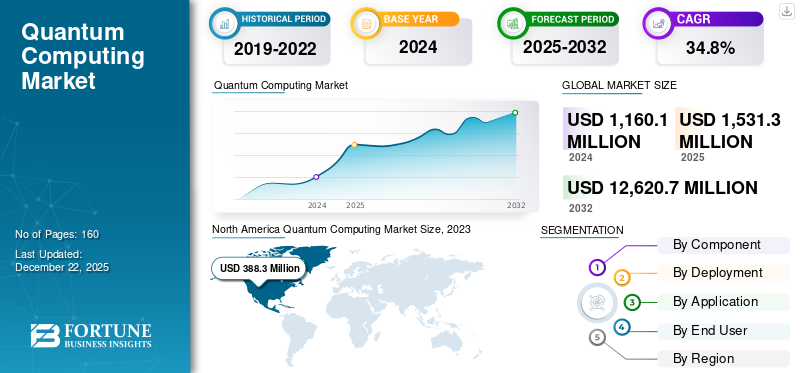
The global quantum computing market size was valued at USD 1.39 billion in 2025 and is projected to grow from USD 1.82 billion in 2026 to USD 17.89 billion by 2034, exhibiting a CAGR of 33.0% during the forecast period. North America dominated the quantum computing market with a market share of 43.88% in 2025.
Quantum computing consists of the hardware, software, cloud-based platforms, and other support services that utilize quantum mechanics to provide the ability to do complex calculations or solve problems that traditional computing cannot. The solutions also enable multi-dimensional computations across many industries, such as optimization, machine learning, cryptography, biomedical simulation, financial modeling, and materials discovery, among others. The market growth is driven by increasing investments by enterprises and governments for advanced computing capabilities, which are expected to propel the global market growth.
Key players in the market comprise IBM Corporation, D-Wave Systems Inc., Microsoft Corporation, Intel Corporation, and Rigetti & Co, Inc. These companies are focusing on partnerships and ecosystem collaboration with cloud providers, research institutes, government agencies, and industry users to accelerate technology commercialization and develop industry-specific use cases.
Download Free sample to learn more about this report.
Quantum Computing Market Key Takeaways
 Global Market Size & Forecast
- 2025 Market Size: USD 1.39 billion
- 2026 Market Size: USD 1.82 billion
- 2034 Forecast Market Size: USD 17.89 billion
- CAGR: 33.0% (2026–2034)
 Market Share
- North America dominated the market with a 43.88% share in 2025.
- The hardware segment accounted for the largest market share and is projected to grow at a 15.1% CAGR during the forecast period.
- The cloud-based segment held the largest market share in 2025 and is expected to register the highest growth at a 36.3% CAGR during the forecast period.
 Key Regional Highlights
Asia Pacific
Asia Pacific is projected to reach USD 0.35 billion by 2026 and is expected to register the highest growth at a 36.5% CAGR during the forecast period.
North America
North America generated USD 0.61 billion in 2025, maintaining its leading market position.
Europe
Europe is projected to reach USD 5.46 billion by 2026, growing at a 31.0% CAGR during the forecast period.
U.S.
U.S. market is projected to reach USD 0.47 billion by 2026.
Japan
Japan market is projected to reach USD 0.06 billion by 2026.
Read More

IMPACT OF GENERATIVE AI
Rising Use of Generative AI to Enhance Quantum Algorithm Development
Generative Artificial Intelligence (AI) is contributing positively toward market expansion by enhancing various aspects such as quantum algorithms (design), error correction, circuit optimization, and simulation workflows. Organizations are being assisted in finding real-world quantum applications much quicker than they would otherwise be able to spot in areas such as drug discovery, financial modelling, logistics, and materials science, among others. The synergy of generative AI with quantum computing encourages vendors to sell their quantum platforms to customers as part of larger AI and high-performance computing ecosystems. Consequently, this will lead to quicker adoption of Quantum-as-a-Service as users can access quantum resources via AI‐enabled platforms and do not need deep knowledge of how to program for quantum computers.
- In February 2025, Quantinuum announced its Generative Quantum AI framework, Gen QAI, which uses quantum-generated data to support applications in medicine development, financial market modeling, and logistics optimization.
These factors are anticipated to fuel the market growth in the coming years.
QUANTUM COMPUTING MARKET TRENDS
Rising Quantum Cloud Access and Error-Correction Advancements to Accelerate Commercial Adoption
With quantum computer clouds, companies, schools, and research organizations can run quantum algorithms on their computers without spending a great amount of money to buy very expensive, specialized quantum computer hardware. Cloud service providers are also developing their capabilities for providing access to computing systems running quantum algorithms that would be more reliable through the advancement of quantum error-correction methods. This will further enable commercial organizations to move from pilot projects to practical uses in the marketplace. Areas that will benefit from this trend are optimization, drug development, materials science, finance, and artificial intelligence, all of which require very high-precision computations to produce optimal results. With continued improvements in cloud services and available hardware technology, quantum computing players are set to help implement a more scalable model for quantum-as-a-service (QaaS) in enterprise markets.
- In November 2025, IBM launched new quantum processors, software, and algorithmic breakthroughs, including progress on IBM Quantum Loon and efficient quantum error correction decoding with a reported 10x speed improvement.
MARKET DYNAMICS
MARKET DRIVERS
Download Free sample to learn more about this report.
Increasing Government Funding to Strengthen Quantum Technology Ecosystems
Increased government funding for quantum solutions will help to continue the success of pre-existing national research institutions, propelling quantum computing market growth. They will be able to develop new quantum technologies, including quantum hardware, and provide job training for the workforce. Therefore, early-stage commercialization opportunities will also be supported and developed. By having access to public funds, the quantum industry can reduce the burden of high capital costs associated with running a quantum start-up and a research institution, and ultimately speed up the development of processors, error correction, and quantum software as well as cloud-based quantum computing.
In addition, since quantum computing is still considered a highly advanced area of technology and has long cycles for research and development. Further, as high costs are associated with establishing an infrastructure to support quantum computing, government-funded programs assist in establishing domestic quantum ecosystems for national security purposes and improving the global competitiveness of a nation in advanced computing. For instance,
- In November 2025, the U.S. Department of Energy announced USD 625 million in funding to renew its five National Quantum Information Science Research Centers.
MARKET RESTRAINTS
Lack of Skilled Labor across the Globe to Hinder Market Proliferation
A key limitation for market expansion is skilled workforce given the diverse areas covered under quantum computing (quantum physics, computer science, cryogenics, electronics, mathematics and software engineering). Many companies are to utilize quantum technology yet due to the limited number of quantum algorithm developers, hardware engineers and error correction specialists within the industry, which limits their ability to conduct pilot tests and commercialize their solutions. In addition, the lack of talent creates higher costs for hiring staff by new companies and technology vendors, reducing the scalability of product development and support teams. As a result, regions with well-developed academic programs, research facilities, and industry training infrastructure are expected to adopt quantum computing at a faster pace.
MARKET OPPORTUNITIES
Rising Demand for Post-Quantum Security Solutions to Create New Opportunities for Market Growth
The market has a significant growth opportunity due to concern about potential future cyberattacks from quantum computers and the preparations of both enterprises and governments for migration to post-quantum cryptography. Large-scale quantum computers have the potential to compromise commonly used forms of encryption. Hence, banks, defense agencies, cloud service providers, telecommunications providers, and organizations with critical infrastructure would give priority to planning for quantum-safe security. This has created the demand for quantum-safe algorithms, crypto-agility platforms, security consulting services, and hybrid cryptographic systems that will protect sensitive data up until large-scale quantum computers are commercially available. Consequently, post-quantum security is creating an adjacent growth opportunity that facilitates increased awareness and investment by enterprises in quantum technologies. For instance,
- In January 2025, Accenture made a strategic investment in QuSecure, a post-quantum cybersecurity company, to strengthen crypto-agility and quantum-safe security solutions for government and enterprise customers.
Segmentation Analysis
By Component
High Capital Intensity of Quantum Hardware to Drive Hardware Segment Dominance
Based on component, the market is categorized into hardware and software.
The hardware segment is anticipated to account for the largest quantum computing market share and is expected to continue its dominance by growing at a CAGR of 15.1% during the forecast period. The dominance is owing to the high cost of developing cryogenic systems, processor control electronics, interconnects, and supporting infrastructure to build and use a quantum system. Due to this, vendors and research organizations invest in large amounts in superconductors, trapped ions, and photonic devices before software and services could be monetized across larger scale supercomputers as the primary source of revenue.
The software segment is anticipated to grow at the highest CAGR of 34.3% over the forecast period. The segment is expanding as businesses are progressively incorporating quantum algorithms, development tools, middleware, simulators, and cloud-based platforms for creating usable applications without making substantial capital expenditures on sophisticated quantum physical infrastructures.
By Deployment
Expansion of Quantum-as-a-Service Platforms to Drive Cloud-Based Segment Growth
Based on deployment, the market is bifurcated into on-premise and cloud-based.
The cloud-based accounted for the largest market share in 2025 and is expected to grow at the highest CAGR of 36.3% during the forecast period. The dominance is due to the rising demand from organizations such as companies, educational institutions, or researchers to access a quantum processor from their homes rather than build an expensive quantum computer infrastructure on-site. The majority of deployments by vendors have also included cloud-based solutions, allowing the largest-scale implementation of quantum computers to be integrated into the cloud. This would enable researchers to perform experiments, develop algorithms, and test out commercial use through cloud-based models called "quantum as a service" (QaaS).
The on-premise segment is anticipated to grow at a moderate CAGR of 31.8% over the forecast period. This is owing to the fact that adoption remains limited to government agencies, defense organizations, national laboratories, and large enterprises that require dedicated quantum infrastructure, stronger data control, and customized system integration despite high setup and maintenance costs.
By Application
Hybrid Quantum/Classical Optimization Workflows to Boost Optimization Segment Growth
Based on application, the market is divided into machine learning, optimization, biomedical simulations, financial services, cryptography, electronic material discovery, and others (traffic optimization, weather forecasting, and so on).
The optimization segment accounted for the largest market share in 2025. As it is one of the most commercially viable near-term applications for logistics, supply chains, portfolio management, manufacturing scheduling, and creating energy grids. Optimization is a top priority for enterprises as a result of the advantage of being able to solve complex problems using quantum and hybrid quantum/classical algorithms, where classical computing becomes inefficient and impractical when solving large-scale problems.
The machine learning segment is anticipated to grow at the highest CAGR of 35.3% over the forecast period. The segment is growing as enterprises increasingly explore quantum-enhanced machine learning for faster pattern recognition, complex data processing, model optimization, and AI-driven applications across finance, healthcare, logistics, and materials research.
By End User
To know how our report can help streamline your business, Speak to Analyst
Growing Use of Quantum Algorithms in Risk and Portfolio Optimization Drove BFSI Segment Leadership in 2025
Based on end user, the market is classified into healthcare, banking, financial services, and insurance (BFSI), automotive, energy and utilities, chemical, manufacturing, and others (transportation, logistics, and so on).
The banking, financial services, and insurance (BFSI) segment held a dominating market share in 2025. This is due to the deployment of quantum algorithms for portfolio optimization, fraud detection, risk modeling, derivative pricing, and complex financial simulations from an early stage. Banks, insurers, and investment companies are known for large budgets allocated on advanced computing mechanisms while experimenting with quantum and hybrid quantum-classical systems to better the speed of decision-making, security, and arithmetic efficiency.
The healthcare segment is anticipated to grow at the highest CAGR of 34.9% during the forecast period. The segment is expanding as pharmaceutical firms, research organizations and health care providers use quantum computing for drug discovery, molecular modeling, protein modeling, genomic analysis, and optimizing complex clinical data.
Quantum Computing Market Regional Outlook
By geography, the market is categorized into North America, South America, Europe, the Middle East & Africa, and Asia Pacific.
North America
North America Quantum Computing Market Size, 2025 (USD Billion)
To get more information on the regional analysis of this market, Download Free sample
North America held the largest market share in 2024, valuing at USD 0.47 billion, and also maintained the leading share in 2025, with a value of USD 0.61 billion. The market in North America is expected to increase owing to the strong presence of leading quantum technology companies. This includes a large number of cloud service businesses, universities, labs, and government-supported research programs in both Canada and the U.S. There was also evidence of early enterprise usage of quantum computing by firms in the BFSI, healthcare, defense, and technology sectors. Finally, a mature cloud infrastructure to support enterprises already exists, along with a significant amount of investment in commercial pilot projects, quantum processors, and quantum software platforms.
- In August 2025, IBM and AMD announced a partnership to develop next-generation computing architectures combining quantum computing and high-performance computing, referred to as quantum-centric supercomputing.
These factors play a significant role in fueling the regional market growth.
U.S. Quantum Computing Market
Based on North America’s strong contribution and the U.S. dominance within the region, the U.S. market reached a value of approximately around USD 0.47 billion in 2026, accounting for roughly 25.8% of global sales.
To know how our report can help streamline your business, Speak to Analyst
Europe
The Europe market is projected to record a growth rate of 31.0% over the forecast period, which is the fourth highest among all regions, and reach a valuation of USD 5.46 billion by 2026. The market in Europe is expanding, owing to the increasing number of governments creating regulations to bring business development to the various industries within Europe via the use of cloud and quantum technology. For these reasons and surging advancements in technology, it is expected that the market will continue to grow strongly in the coming years.
U.K. Quantum Computing Market
The U.K. market is estimated to touch around USD 0.12 billion in 2026, representing roughly 6.6% of global revenues.
Germany Quantum Computing Market
The Germany market is projected to reach approximately USD 0.09 billion in 2026, equivalent to around 4.9% of global sales.
Asia Pacific
The Asia Pacific market is estimated to reach USD 0.35 billion in 2026 and is expected to grow at the highest CAGR of 36.5% during the forecast period. The market growth is driven by the increasing level of funding for quantum initiatives through government-backed programs as well as substantial private investment in quantum technologies by China, Japan, South Korea, India, and Australia. Increasing collaboration between universities, national laboratories, cloud service providers, and quantum hardware manufacturers are providing additional momentum to the growth of quantum computing in the region.
- In June 2025, IBM and Japan’s RIKEN unveiled the first IBM Quantum System Two deployed outside the U.S. at RIKEN’s Kobe facility, where it was co-located with the Fugaku supercomputer.
China Quantum Computing Market
The China market is projected to be one of the largest markets worldwide, with 2026 revenues estimated to reach around USD 0.10 billion, representing roughly 5.5% of global sales. This is owing to strong government funding and rapid expansion of national quantum research infrastructure. Rising use in cybersecurity, AI, materials research, and industrial optimization further supports product adoption.
Japan Quantum Computing Market
The Japan market is estimated to reach a value of around USD 0.06 billion in 2026, accounting for roughly 3.3% of global revenues.
India Quantum computing Market
The India market is estimated at around USD 0.07 billion in 2026, accounting for roughly 3.8% of global revenues.
South America
The South America market is set to reach a valuation of USD 0.02 billion in 2026 and is expected to witness moderate growth during the forecast period. This is owing to the gradual adoption of quantum cloud platforms for research, financial modeling, logistics optimization, and academic innovation, supported by emerging digital transformation initiatives in Brazil and other key economies. In South America, Brazil is set to reach a value of USD 0.01 billion in 2026.
Middle East and Africa
The Middle East and Africa market is estimated to reach USD 0.06 billion in 2026 and expected to grow at a prominent rate in the coming years. This is owing to increasing government spending on advanced computing and cybersecurity, which will support national digital transformation initiatives. The GCC and Israel will drive some of these efforts while both regions have a growing interest in quantum computing to optimize energy use, model financial transactions, develop defense solutions, and establish secure communication networks. In the Middle East & Africa, the GCC is set to reach a value of USD 0.03 billion in 2026.
- In September 2025, IBM expanded its Strategic Collaboration Agreement with AWS to accelerate secure cloud adoption and digital transformation across the Middle East, using IBM Consulting’s hybrid cloud and AI capabilities alongside AWS cloud services.
COMPETITIVE LANDSCAPE
Key Industry Players
Key Players’ Focus on Expanding Quantum Hardware, Cloud Platforms, and Industry-Specific Use Cases to Strengthen their Market Positions
The global quantum computing market holds a semi-consolidated market structure, with prominent players such as IBM Corporation, D-Wave Systems Inc., Microsoft Corporation, Intel Corporation, and Rigetti & Co, Inc. holding significant positions. These companies are investing in quantum processors, quantum cloud platforms, quantum software development kits, error correction, hybrid quantum-classical computing, and quantum-as-a-service models to meet rising demand from BFSI, healthcare, government, defense, energy, chemicals, logistics, and research sectors.
Other notable players in the global market include Alphabet, Inc. (Google LLC), QC Ware, Quantinuum Ltd., Riverlane, and IonQ. These companies are focusing on continuous product innovation, superconducting and photonic quantum systems, trapped-ion and neutral-atom technologies, cloud-based access, strategic partnerships with enterprises and research institutes, and expansion of application-specific quantum solutions, which are expected to strengthen their market positioning over the forecast period.
LIST OF KEY QUANTUM COMPUTING COMPANIES PROFILED
- IBM Corporation (U.S.)
- D-Wave Systems Inc. (Canada)
- Microsoft Corporation (U.S.)
- Intel Corporation (U.S.)
- Rigetti & Co, Inc. (U.S.)
- Alphabet, Inc. (Google LLC) (U.S.)
- QC Ware (U.S.)
- Quantinuum Ltd. (U.S.)
- Riverlane (U.K.)
- IonQ (U.S.)
KEY INDUSTRY DEVELOPMENTS
- June 2026: IBM announced plans to invest more than USD 10 billion in quantum computing over five years, covering R&D, manufacturing scaling, ecosystem partnerships, M&A, and its roadmap toward fault-tolerant quantum computers.
- November 2025: Quantinuum commercially launched Helios, described by the company as its highly accurate general-purpose commercial quantum computer, with access through cloud and on-premise offerings.
- May 2025: D-Wave announced the general availability of its Advantage2 quantum computer, its most advanced and performant quantum system. The launch supports commercial quantum use cases across optimization, AI, research, life sciences, and national security applications.
- February 2025: Riverlane, IQM Quantum Computers, and Zurich Instruments launched the SurgeonQ project, a strategic collaboration to develop a quantum error correction platform capable of running multiple real-time QEC operation.
- February 2025: Rigetti entered a strategic collaboration agreement with Quanta Computer to accelerate the development and commercialization of superconducting quantum computing. The partnership supports Rigetti’s efforts to scale quantum systems and strengthen commercial deployment pathways.
- February 2025: Microsoft unveiled Majorana 1, a quantum processing unit powered by topological qubits and designed to fit one million qubits on a single chip. The launch supports Microsoft’s long-term roadmap for fault-tolerant quantum computing through Azure Quantum.
- December 2024: Google Quantum AI announced Willow, its state-of-the-art quantum chip, which demonstrated improved quantum error correction and benchmark performance. The launch supports Google’s roadmap toward commercially relevant, large-scale quantum computing applications.
REPORT COVERAGE
The global quantum computing market analysis includes a comprehensive study of the market size and forecast by all the market segments included in the report. It includes details on the market dynamics and market trends expected to drive the market over the forecast period. It provides information on key aspects, including an overview of technological advancements, pipeline candidates, the regulatory environment, and product launches. Additionally, it details partnerships, mergers & acquisitions, and industry developments by key regions. The global market research report also provides a detailed competitive landscape with information on the market share and profiles of key operating players.
Request for Customization to gain extensive market insights.
Report Scope & Segmentation
| ATTRIBUTE | DETAILS |
| Study Period | 2021-2034 |
| Base Year | 2025 |
| Estimated Year | 2026 |
| Forecast Period | 2026-2034 |
| Historical Period | 2021-2024 |
| Growth Rate | CAGR of 33.0% from 2026-2034 |
| Unit | Value (USD Billion) |
| Segmentation | By Component, Deployment, Application, End User, and Region |
| By Component |
|
| By Deployment |
|
| By Application |
|
| By End User |
|
| By Region |
|
Frequently Asked Questions
According to Fortune Business Insights, the global market value stood at USD 1.39 billion in 2025 and is projected to reach USD 17.89 billion by 2034.
The market is growing at a CAGR of 33.0% during the forecast period of 2026-2034.
In 2025, the market value stood at USD 0.61 billion.
By end user, BFSI segment led the market in 2025.
Increasing government funding strengthening quantum technology ecosystems is a key factor driving the market.
IBM Corporation, D-Wave Systems Inc., Microsoft Corporation, Intel Corporation, and Rigetti & Co, Inc. are the major players in the global market.
North America dominated the market in 2025.



- 2021-2034
- 2025
- 2021-2024
- 125
Get 30-60 hrs Free Customization
Expand Regional and Country Coverage, Segments Analysis, Company Profiles, Competitive Benchmarking, and End-user Insights.




















Related Reports
-
US +1 833 909 2966 ( Toll Free )
-
Get In Touch With Us