Range Hood Market Size, Share & Industry Analysis, By Product Type (Wall Mount, Under Cabinet, Ceiling/Ceiling Mount, Island Mount, Downdraft Ventilation, and Others), By End-User (Residential and Commercial), and Regional Forecast, 2026-2034
 Download Free Sample
Range Hood Market Size and Industry Overview
 Listen to Audio Version
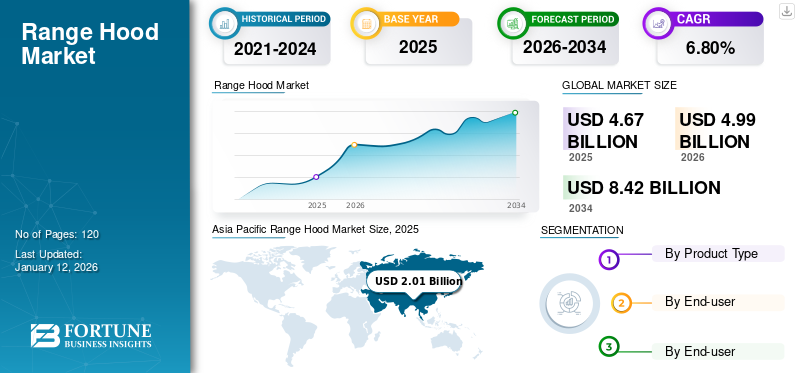
The global range hood market size was valued at USD 4.67 billion in 2025 and is projected to grow from USD 4.99 billion in 2026 to USD 8.42 billion by 2034, exhibiting a CAGR of 6.80% during the forecast period. Asia Pacific dominated the global market with a share of 43.10% in 2025.
A range hood is a kitchen appliance placed over a cooktop (or stove) that has a fan and filtering system designed to extract airborne particles, smoke and grease, and odors created when cooking to improve indoor air quality and comfort while cooking. This market is driven by an increase in consumer awareness of indoor air quality, an increase in urbanization, changes in kitchen design and usage, and the proliferation of smart home technologies. The market serves in both residential and commercial sectors. Residential use currently accounts for a large portion of the market, primarily due to an increase in home renovations, new modern look kitchens and small spaces which require more ventilation.
Download Free sample to learn more about this report.
This industry has the potential to continue steady growth, due to ongoing increases in technological innovations including Internet of Things (IoT) and energy intelligent design, as well as increasingly smart features such as remote control, automatic fan speeds, and multi-connectivity with other cooking appliances. Additional factors such as expansion in hospitality rooms, growing discretionary income, and new demand for sustainable and eco-friendlier products are also expected to drive future demand. With the growing understanding of healthy living quarters, both in terms of air quality and efficient kitchen functionality, ongoing innovations and wider acceptance of the product should be widely established in both developed and emerging regions in the future.
Download Free sample to learn more about this report.
Global Range Hood Market Overview
Market Size:
- 2025 Value: USD 4.67 billion
- 2026 Value: USD 4.99 billion
- 2034 Forecast Value: USD 8.42 billion
- CAGR: 6.80% from 2026 to 2034
Market Share:
- Regional Leader: Asia Pacific held the largest share in 2025, driven by rapid urbanization, increasing kitchen renovations, and growing consumer focus on indoor air quality
- Product-Type Leader: Wall‑mount range hoods accounted for the largest revenue share in 2024
- End‑User Dominance: The residential sector leads the market, supported by home remodeling trends, modular kitchen design adoption, and high demand in hospitality applications
Industry Trends:
- Rising consumer awareness of indoor air quality, health and hygiene concerns, and kitchen ventilation needs
- Modern kitchen design trends—including open layouts and compact spaces—driving preferences for efficient and stylish ventilation solutions
- Gradual integration of smart features such as IoT connectivity, automatic fan control, remote operation, and compatibility with other cooking appliances
Driving Factors:
- Increased urban living and modern kitchen remodeling fueling demand for efficient ventilation systems
- Emphasis on healthy indoor environments and odor-free cooking experiences
- Smart home technology adoption supporting demand for connected, automated range hood solutions
- Growth in hospitality and commercial kitchens elevating demand for high-performance, aesthetically pleasing range hoods
Key players like Whirlpool Corporation, BSH Home Appliances, and Elica S.p.A. are making significant strides in this evolution. They are dedicated to advancing product development, incorporating smart technology, and refining their designs. These businesses are also enhancing their distribution channels and strengthening their brand presence to cater to the rising consumer demand in global markets.
MARKET DYNAMICS
RANGE HOOD MARKET TRENDS
Increasing Health Consciousness Drives Demand for High-Performance Range Hoods with Advanced Filtration
As consumers become more health conscious and aware of the importance of air quality in their home environment, the shift of market demand toward high-performance and advanced filtration has also taken place. New cooking methods produce massive amounts of airborne contaminants from cooking oils that generate grease, smoke, combustion byproducts, and strong odors that can affect air quality and health. As a result, consumers are looking for hoods with larger motors and higher CFM (Cubic Feet per Minute) ratings to quickly and adequately remove airborne contaminants right away. At the same time, consumers want more advanced filtration systems that go beyond basic grease filtration. Today's advanced filtration systems include multi-stage systems that feature mesh filtration for grease capture in combination with activated charcoal filters or other specialty adsorptive media that are created to adsorb vapors from volatile organic compounds (VOCs) and neutralize lingering cooking odors in the kitchen air.
MARKET DRIVERS
Modern Kitchen Designs and Indoor Air Quality Concerns Drive Demand, thereby Boosting Market Share
The increasing prevalence of modern kitchen designs and focus on indoor air quality have been main contributors to the rising use of hoods and subsequently a growing range hood market share. As consumers choose more open and modular spaces for kitchen, there is more attention paid to sturdy, stylish ventilation options that support modern aesthetics while creating a more hygienic cooking environment for consumers. Now, hoods and their accompanying features are recognized not only for their functionality but also their design-oriented nature; it is expected that hoods will be incorporated into kitchen spaces that showcase visually tall and very clean designs.
Commercial kitchens face additional requirements and regulations that accelerate the use of newly developed models, which is ultimately all towards each entity's focus on health. Ventilation plays a crucial role in maintaining health and adhering to safety practices, fire zoning requirements as well as making a comfortable working environment for staff. This demand from both residential trends of looking creative and commercial requirements has supported demand for the market growth as both give more attention to effective and modern ventilation.
MARKET RESTRAINTS
High Cost Restricts Market Adoption
The incorporation of advanced technologies- IoT-connected appliances, energy efficient appliances, and improved filtration - in today's hoods has substantially raised manufacturing and retailer costs. The higher price of the unit, combined with expensive installation and maintenance, creates a significant financial hurdle for many consumers, especially in price-conscious and developing markets. Thus, a significant portion of potential customers are either deferring the purchase of range hoods altogether, or settling for a more affordable model. This is key to understanding the slow adoption of advanced range hoods.
Additionally, such high initial costs of hoods may become magnified for consumers by limited awareness about the long-term health and air quality benefits. Many consumers either downplay the risk of indoor pollutants, or refrain from even investing in a hood due to perceived installation complexity and costs. This tends to suppress market growth amid rising demand for modern kitchen appliances.
MARKET OPPORTUNITIES
Rising Awareness of Indoor Air Quality Drives Demand of the market
As consumers become increasingly aware of the significance of indoor air quality, this presents a valuable opportunity for the market. As more and more consumers begin to realize the health risks of airborne pollutants, smoke, and cooking byproducts, they are also looking for better effective kitchen ventilation solutions. Range hoods are being seen as required products to eliminate harmful particles and odors and are becoming increasingly important for healthier living environments and improved respiratory wellness.
This growing awareness of health and wellness is prompting consumers to spend more money on advanced technologies with improved filtration, smart technology, energy-star ratings and so on. Manufacturers are responding to this increased demand by releasing new products that meet and address consumers’ needs; thus, creating an attractive market for better hoods as they become vital components of modern health-conscious homes.
Segmentation Analysis
By Product Type
Growing Demand for Versatile Ventilation Solutions Drives Wall Mount Hood’s Dominance
Based on product type, the market is classified into wall mount, under cabinet, ceiling/ceiling mount, island mount, downdraft ventilation, and others.
Wall mount segment holds the largest market share globally due to their versatility, ease of installation, and ability to fit comfortably in almost any kitchen design. They have proven themselves capable of performing to practically all cooking needs, effectively clearing cooking odors and/or smoke from the cooking area. This is especially in North America, where open layouts in kitchen designs are driving market growth. Looking forward, wall mount hoods should continue to command a majority share in the market, fueled by design and technology improvements and consumer preferences for high-quality, professional-styled, stainless-steel appliances. The segment will benefit from the introduction of smart features in appliances, quieter performance, and energy efficient models.
The under cabinet hood remains prevalent in the Americas. It carries a strong value in space saving applications and its compatibility with cabinetry. Although smaller in market share, ceiling and island mount hoods are seeing a rise in popularity in premium kitchens, especially with modern aesthetic and design. Downdraft or niche ventilation provide specialized solutions for specific applications.
By End-user
Rising Commercial Demand and Regulatory Focus Drives Commercial Segmental Growth
Based on end-user, the market is segmented into residential and commercial.
The commercial segment holds the highest share in the market, propelled by the rapid expansion of the foodservice industry, strict regulatory standards for indoor air quality, and a growing emphasis on energy efficiency and sustainability. High-quality, stainless steel solutions dominate this segment because businesses prioritize durability, compliance, and advanced features to ensure safe and efficient kitchen environments. The commercial sector is also growing at the highest CAGR, fueled by ongoing investments in smart ventilation, demand-controlled systems, and innovations that address fire safety and environmental regulations.
In contrast, the residential segment, while significant, is characterized by consumer demand for quieter, aesthetically pleasing, and easy-to-install systems that enhance home kitchen comfort and design. While residential adoption is rising due to higher disposable incomes and lifestyle upgrades, its growth rate is outpaced by the commercial sector, where compliance, operational efficiency, and technological advancements remain the primary drivers.
Range Hood Market Regional Outlook
By region, the market is categorized into North America, Europe, Asia Pacific, and the Rest of the World.
Asia Pacific
Asia Pacific Range Hood Market Size, 2025 (USD Billion)
To get more information on the regional analysis of this market, Download Free sample
The Asia Pacific region holds the highest market share, driven by rapid urbanization, changing lifestyles, and increasing numbers of restaurants and food chains developing, in countries like India and China. In 2025, the Asia Pacific market stood at USD 2.01 billion, representing 43.10% of global demand, and is projected to grow to USD 2.16 billion in 2026. The demand from consumers for modern kitchen solutions is increasing, and high-quality, stainless steel products are leading the market due to their longevity, quality, and aesthetic appeal. Products include technology improvements such as quieter operation, smart options, and energy efficiency features to meet the expectations of a growing middle-class population. This focus on indoor air quality and stylish kitchens prompts manufacturers to expand innovation and promote the continued adoption of products in the region. Asia Pacific represents a key growth area for manufacturers.
Within Asia Pacific, China is a key engine of growth, owing to its urban population, real estate development, and large presence of both traditional and modern foodservice outlets. The data indicates that mostly stainless-steel units (high quality) are the dominating format based on consumer preference (heavy commercial influences also). The growth in sales of smart kitchen technology, such as noise-reduction technology and IoT, has gained particular momentum as contemporary Chinese consumers have pushed for increasingly high-end features that can improve trust, convenience, and functionality. The high quantity of both international and local manufacturers ensures that there is a very competitive market, and consumer demand for new and innovative products, including energy-efficient technology, is continuing to shape growth trends and the velocity of sales.
North America
The North American market is characterized by strong consumer demand for quiet, energy-efficient and technology-oriented kitchen solutions, with high quality, stainless steel products, dominating both the residential and commercial sectors. As people desire open-concept homes and frequent renovations, the necessary spending on effective air quality management has not only expanded the market but encouraged manufacturers to explore products with features like remote control, sensor-based operation, and smart connectivity.
The U.S. market dominates the North American region, with considerable increases related to the public's awareness of sustainability and indoor air quality; a stronger regulatory environment, the popularity of open-plan kitchens, and more involvement from multi-unit and commercial construction all contribute to the growth. Brands are expecting to engage tech-savvy consumers who increasingly expect to use their devices, forms of connected technologies and incorporate advanced controls.
Europe
The market in Europe is being driven by vigorous energy efficiency and environmental mandates, which are resulting in consistent use of high-quality stainless steel ventilation solutions to address the needs of both residential and commercial markets. The market's focus on environmental sustainability and indoor air quality is changing consumers' preferences and ultimately their purchasing behaviors towards the latest innovative, energy-efficient appliances that are often highlighted by smart features and silent operation. The current trend toward retrofitting existing foodservice operations and newly building kitchens to green industry standards has accelerated the adoption of more advanced ventilation systems. There are legacy kitchens that present challenges to retrofitting, but the continued push for environmentally friendly and cost effective solutions will ensure manufacturers remain innovative and responsive to the changing needs of the market on the continent.
Rest of the World
The range hood market growth in the rest of the world region is encouraged by the growth of the foodservice industry, urbanization, and increases in knowledge of modern kitchen ventilation benefits. Consumer and commercial operators are purchasing products made of high-quality, stainless-steel materials that will last longer to solve many of their ventilation problems. Regulatory and mature markets vary, but it is clear that companies are moving toward producing energy-efficient appliances and smart appliances as consumer demands change and increase. Companies are starting to design systems that are modular and inexpensive to these potential markets around a wide variety of kitchen sizes and different operations, which will lead to the continual growth of this market in growing economies and unsaturated markets.
COMPETITIVE LANDSCAPE
Key Industry Players
Intense Global Competition among Leading Manufacturers Spurs Innovation in the Market
The range hood market contains many of the top global and regional competitors are all competing to gain competitive edge which fosters differentiation and innovation in an otherwise stagnated segment. Companies are heavily investing in innovative technologies such as smart devices, energy efficiencies, and advanced filtration technologies, in order to augment performance and react to changing consumer preferences. This level of competition empowers consumers with greater choice of products that are delivering more impressive features, aesthetics, and longevity.
The larger players in the market; Broan-NuTone, Faber, Elica, Whirlpool, and Bosch, are also continuing and expanding their global reach through partnerships, mergers and acquisitions, and building plants in other global markets. These companies are creating new areas of distribution, enhancing them to recognize and acknowledge local market expectations and regulations, which is very important. Today, there are changing and elevated performance expectations from consumer products in this competitive realm. High-end expectations in performance, perceived quality, novelty, and generally high levels of market demand fluctuations are all dramatically changing operational capacities of the sector.
LIST OF KEY RANGE HOOD COMPANIES PROFILED
- BSH Home Appliances (Germany)
- GE Appliances (U.S.)
- Panasonic Corporation (Japan)
- Samsung Electronics (South Korea)
- Windster Hoods (U.S.)
- Elica S.p.A. (Italy)
- Falmec S.p.A. (Italy)
- Faber S.p.A. (Italy)
- Broan-NuTone (U.S.)
- Whirlpool (U.S.)
KEY INDUSTRY DEVELOPMENTS
- January 2025: Zephyr introduced the Forte Wall Custom Range Hood in January 2025 amidst significant market demand for customizable kitchen appliances. The premium product gives homeowners the opportunity to customize the materials, finishes, and even the performance of the ventilation. Moreover, it eliminates smoke and odors quickly and efficiently. Ultimately, the Forte is a reflection of the trend toward design-centric solutions in modern kitchen ventilation.
- September 2024: At IFA 2024, LG Electronics displayed the latest energy efficient home appliances, keeping in line with the EU’s ambitious aim of achieving carbon neutrality by 2050 and the REPowerEU strategy to reduce reliance on fossil fuels. The cutting edge innovations exhibit high performance and a substantial reduction in energy consumption.
- April 2024: Whirlpool Corporation finalized a strategic collaboration agreement with Arçelik A.Ş, combining its European appliance business with Arçelik’s operations. This new venture formed Beko Europe B.V., in which Whirlpool Company has a 25% stake, while maintaining full ownership of select brands, such as InSinkErator.
- April 2024: Samsung Electronics featured its new premium kitchen & lifestyle appliances at EuroCucina 2024 in Milan, connected and smart features that are designed to change how people experience living in the home. The brand's overriding vision is to illustrate a fully connected, integrated home.
- August 2023: Broan-NuTone was recognized for the 11th consecutive time as higher than its competitors in two categories of the 2023 Kitchen & Bath Business (KBB) magazine’s Readers’ Choice Awards. The company remains committed to improving indoor air quality with premium residential ventilation solutions.
REPORT COVERAGE
The global range hood market analysis provides market size & forecast by all the segments included in the report. It includes details on the market dynamics and market trends expected to drive the market in the forecast period. It offers information on the prevalence of malocclusion in key regions/countries, key industry developments, new product launches, details on partnerships, mergers & acquisitions in key countries. The report covers detailed competitive landscape with information on the market share and profiles of key players.
Request for Customization to gain extensive market insights.
Report Scope & Segmentation
|
ATTRIBUTE |
DETAILS |
|
Study Period |
2021-2034 |
|
Base Year |
2025 |
|
Estimated Year |
2026 |
|
Forecast Period |
2026-2034 |
|
Historical Period |
2021-2024 |
|
Growth Rate |
CAGR of 6.80% from 2026-2034 |
|
Unit |
Value (USD Billion) |
|
Segmentation |
By Product Type
|
|
By End-user
|
|
|
By Region
|
Frequently Asked Questions
Fortune Business Insights says that the global market value stood at USD 4.99 billion in 2026 and is projected to reach USD 8.42 billion by 2034.
In 2025, the market value stood at USD 2.01 billion.
The market is expected to exhibit a CAGR of 6.80% during the forecast period.
The wall mount hood segment led the market by product type in terms of market share.
The key factors driving the market are modern kitchen designs and increasing concerns about indoor air quality, which are fueling the market growth.
Broan-NuTone, Faber, Elica, Whirlpool, and Bosch are the top players in the market.
Asia Pacific dominates the market in 2025.
Range hood adoption is driven by the popularity of open-concept kitchens and rising awareness of indoor air quality. Consumers seek efficient ventilation that removes smoke and odors while complementing sleek kitchen designs.



- 2021-2034
- 2025
- 2021-2024
- 120
Get 30-60 hrs Free Customization
Expand Regional and Country Coverage, Segments Analysis, Company Profiles, Competitive Benchmarking, and End-user Insights.















Related Reports
-
US +1 833 909 2966 ( Toll Free )
-
Get In Touch With Us