Rapid Microbiology Testing Market Size, Share & Industry Analysis By Product Type (Instruments [Automated Blood Culture Systems, Cameras, Mass Spectrometers, PCR Systems, Bioluminescence & Fluorescence-based Detection Systems, & Others] & Reagents & Consumables), By Method (Nucleic Acid Based, Viability Based, Biochemical & Immunological Based, Growth Based, & Others), By Application (Clinical Diagnostics, Pharmaceutical & Biologics Manufacturing & Others), By End User (Hospitals & ASCs, Clinical Laboratories, Pharmaceutical & Biotechnology Companies & Others), & Regional Forecast, 2026-2034
 Download Free Sample
Rapid Microbiology Testing Market Size and Future Outlook
 Listen to Audio Version
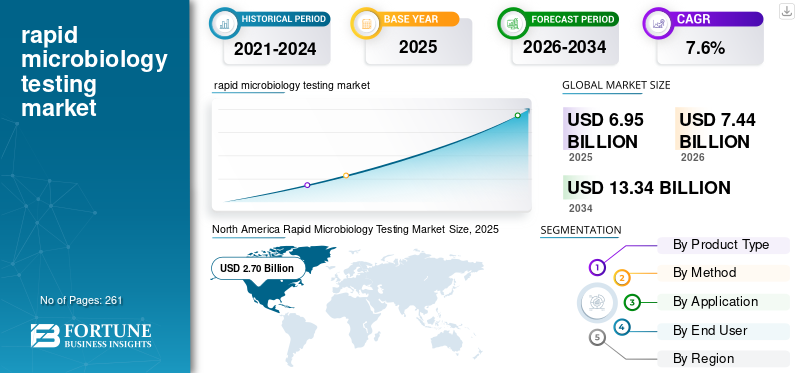
The global rapid microbiology testing market size was valued at USD 6.95 billion in 2025 and is projected to grow from USD 7.44 billion in 2026 to USD 13.34 billion by 2034, exhibiting a CAGR of 7.6% during the forecast period. North America dominated the global rapid microbiology testing market with a market share of 38.85% in 2025.
Rapid microbiology testing refers to advanced laboratory methods used for the rapid detection, identification, and quantification of microorganisms. The growing prevalence of infectious diseases is resulting in a growing number of patient admissions in healthcare settings. The rising patient pool and technology advancements in these devices are further boosting the volumes for diagnostic tests, thereby supporting adoption rate of these rapid microbiology testing products in the market.
- For instance, according to the 2023 statistics published by the World Health Organization (WHO), it was stated that an estimated 263 million cases were affected form malaria worldwide.
Furthermore, the growing focus on point-of-care testing among patients and increasing demand for pharmaceutical sterility testing are crucial factors supporting the growing number of test volumes in the market. This, along with the increasing focus of prominent players, including BIO MÉRIEUX SA, Danaher Corporation, and others, is anticipated to support the Rapid Microbiology Testing market growth.
Download Free sample to learn more about this report.
Rapid Microbiology Testing Market Key Takeaways
 Market Size & Forecast
- 2025 Market Size: USD 6.95 billion
- 2026 Market Size: USD 7.44 billion
- 2034 Forecast Market Size: USD 13.34 billion
- CAGR: 7.6% from 2026–2034
 Market Share
- North America dominated the global rapid microbiology testing market with a market share of 38.85% in 2025.
- The nucleic acid based segment is expected to lead the market with a 42.1% share in 2026.
- The clinical diagnostics segment accounted for a 49.9% share of the global market in 2025.
 Key Regional Highlights
North America
North America generated USD 2.70 billion in 2025, supported by strong adoption of rapid diagnostics, advanced laboratory infrastructure, and favorable regulatory frameworks.
Europe
Europe reached USD 2.30 billion in 2025 and is projected to grow at a CAGR of 7.3% during the forecast period due to its strong pharmaceutical manufacturing base and increasing demand for rapid testing methods.
Asia Pacific
Asia Pacific recorded USD 1.47 billion in 2025, driven by expanding healthcare infrastructure, rising patient admissions, and increasing industry consolidation activities.
U.S.
The market is estimated to reach USD 2.67 billion in 2026, supported by growing demand for clinical diagnostics and pharmaceutical quality control applications.
Japan
The country is expected to witness steady market growth, supported by increasing adoption of advanced diagnostic technologies and a strong focus on healthcare quality and patient safety.
Read More

Market Dynamics
Market Drivers
Increasing Prevalence of Infectious Diseases to Drive Market Growth
The growing prevalence of infectious diseases such as influenza and others is resulting in growing demand for diagnostic procedures among the patient population, subsequently fueling the adoption rate of these diagnostic test kits across the market.
- For instance, according to the 2025 data published by the World Health Organization (WHO), it was reported that about 3-5 million people were affected by severe influenza globally.
Additionally, the increasing benefits of rapid detection systems, such as reduced risk of disease transmission, shorter treatment delays, and earlier intervention, are vital factors contributing to the growing focus of key players on expanding technological advancements. Therefore, the factors mentioned above, along with the growing focus of key players toward product approvals, are expected to boost the adoption rate, thereby supporting the global rapid microbiology testing market size.
Market Restraints
High Cost Associated with Advanced Instruments to Hamper Market Growth
There is an increasing demand for advanced rapid detection products owing to their certain benefits, including faster results, accuracy, and others. However, the high cost associated with advanced rapid detection systems is anticipated to hinder the adoption rate for these products, especially in developing nations such as India, Mexico, and others.
The advanced devices, such as ATP-based viability analyzers, molecular detection systems, and others, often demand high upfront capital investment, resulting in limited product adoption, especially across emerging organizations and small-sized firms in the market. Additionally, the extra costs associated with these products, such as software integration, regulatory compliance initiatives, further add to the financial burden among the key players.
- For instance, according to data published by GenTech Scientific in 2025, it was reported that the price of advanced mass spectrometers typically costs above USD 100,000.
Therefore, high upfront costs, less-developed healthcare infrastructure and financial sustainability concerns among key players are expected to hinder the adoption rate of these products in the market.
Market Opportunities
Growing Adoption in Emerging Markets to Create Lucrative Market Opportunities
There is a growing prevalence of infectious diseases, resulting in an increased focus on improving access to healthcare facilities, especially in emerging nations, including China, Mexico, and others. The ongoing awareness toward rapid detection methods for disease screening, healthcare spending, and diagnostic awareness has significantly increased the demand for these tests.
Moreover, growing demand for reliable microbial detection methods across pharmaceutical & biotechnology companies and clinical diagnostics, regulatory alignment with global standards, and others are some of the additional factors anticipated to drive the product demand significantly over the forecast period.
- According to data published by Macrotends, the per capita healthcare spending was USD 672.45 in 2022, a 0.33% increase from 2021 in China.
Market Challenges
Regulatory & Compliance Complexities in Emerging Countries to Limit Market Growth
There is a growing demand for rapid detection systems among the global patient population. However, the regulatory and compliance landscape as well as submission formats pose a significant challenge for market expansion.
The technological advancements providing distinct benefits such as accuracy, sensitivity, and others often require extensive documentation, validation, and regulatory submissions. Additionally, the continuous improvisation of regulatory framework among manufacturers delays site adoption, slows down method and technology transfers, and further adds to cost and risk in the market.
- For instance, according to the 2025 study published by Rapid Micro Biosystems, Inc., it was reported that about 18% of the research respondents did not adopt rapid sterility testing owing to difficulties in regulatory acceptance among 66 respondents.
Therefore, regulatory diversification makes it challenging for prominent companies to strengthen their business across various nations due to difficulty in maintaining documentation, validation systems and others, particularly among the mid-sized and small-sized companies, thereby hindering the market adoption.
Other Prominent Challenges:
- Interoperability and integration issue with laboratory information systems and existing workflows demanding investment and change management.
- Analytical limitations for certain organisms and sample types highlights complementary traditional methods remaining necessary in some use cases.
Rapid Microbiology Testing Market Trends
Technological Advancements in these Products has Emerged as a Market Trend
There is a growing focus on incorporation of technological advancements in these products across the market. These could include polymerase chain reaction systems, and others that provide high-throughput, automated workflows and high sensitivity to patients.
Moreover, the growing preference for point-of-care diagnostic testing, owing to its distinct benefits such as minimal sample volume, faster time-to-result, and others, is boosting the adoption rate of these products. Additionally, the increasing focus of major players on research and development activities to incorporate artificial intelligence, automation, and digital microbiology, is expected to fuel the market development.
- In September 2024, Terumo Corporation and Cell Technologies collaborated with Nova Biomedical to enable automated cell culture sensing with Terumo BCT's Quantum Flex Cell Expansion System through integration with Nova's BioProfile FLEX2 Automated Cell Culture Analyzer.
Other Prominent Trends:
- Shift toward molecular and nucleic acid-based rapid assays for higher sensitivity and specificity, and adoption of multiplex testing formats.
- Increasing automation and laboratory integration to shorten time-to-result and reduce hands-on time, including onboard sample preparation.
- Rising demand from pharmaceutical and biomanufacturing for rapid sterility and environmental monitoring methods to accelerate batch release and reduce production downtime.
- Expansion of rapid testing in the food and beverage industry for real-time quality control and supply chain assurance.
Download Free sample to learn more about this report.
SEGMENTATION ANALYSIS
By Product Type
Increasing Prevalence of Infectious Diseases Drives Reagents & Consumables Segment Dominance
Based on product type, the market is classified into instruments and reagents & consumables. Instruments are further bifurcated into automated blood culture systems, mass spectrometers, PCR systems, bioluminescence & fluorescence-based detection systems, and others.
To know how our report can help streamline your business, Speak to Analyst
The instruments segment held the largest market share in 2025. This growth is attributed to the increasing number of diagnostic test among the patients and technological advnacements in these products globally. This, along with the increasing focus of key players on research and development activities to launch novel products, is further contributing to the segmental growth.
- In April 2020, Thermo Fisher Scientific Inc., launched five new Thermo Scientific SureTect PCR Assays and enhanced software, including Campylobacter jejuni, C. coli, and C. lari detection and identification, E. coli O157: H7 and STEC screening, STEC identification, Staphylococcus aureus detection, and Vibrio cholerae, V. parahaemolyticus, and V. vulnificus detection and identification.
The reagents & consumables segment is expected to grow at a CAGR of 7.7% over the forecast period.
By Method
Growing Focus on Research & Development Led to Dominance of Nucleic Acid Based Segment
Based on the method, the market is bifurcated into nucleic acid based, viability based, biochemical and immunological based, growth based, and others.
The nucleic acid based segment dominated the market in 2025. In 2026, the segment is anticipated to dominate with a 42.1% share. The dominant share is owing to its demand for faster diagnostic outcomes and growing focus towards strict regulatory standards among the regulatory bodies and the market. This, along with rising focus among key players toward research and development activities to launch advanced rapid microbiology testing products, is anticipated to support the segmental growth in the market.
- In September 2025, FUJIFILM Wako Pure Chemical Corporation launched the RiboNAT Rapid Sterility Test, a nucleic acid amplification test (NAT) method.
The viability based segment is expected to grow at a CAGR of 7.9% over the forecast period.
By Application
The Increasing Prevalence of Infectious Diseases Led to the Dominance of the Clinical Diagnostics Segment
Based on application, the market is segmented into clinical diagnostics, pharmaceutical & biologics manufacturing, and others.
The clinical diagnostics segment dominated the global market in 2025. By application, the clinical diagnostics segment held the share of 49.9% in 2025. The growth is owing to the increasing prevalence of infectious diseases resulting in growing patient admissions, further supporting the diagnostic test volumes among the patients in the market.
- For instance, according to 2023 statistics published by the National Center for Biotechnology Information (NCBI), about 120 million cases of pneumonia occur every year worldwide.
The segment of pharmaceutical & biologics manufacturing is set to flourish with a growth rate of 8.0% across the forecast period.
By End-user
Increasing Number of Hospitals & ASCs Led to the Segment’s Dominance
Based on end user, the market is segmented into hospitals & ASCs, clinical laboratories, pharmaceutical & biotechnology companies, and others.
The hospitals and ASCs segment dominated the market in 2025. Growing patient pool, increasing healthcare spending, rising number of hospitals & ASCs, and others are some of the crucial factors contributing to segmental growth in the market. Furthermore, the segment is set to hold a 45.8% share in 2026.
- For instance, according to 2023 statistics published by the Statistisches Bundesamt, it was reported that there are about 1,874 hospitals in Germany.
In addition, clinical laboratories end-users are projected to grow at a CAGR of 7.6% during the study period.
Rapid Microbiology Testing Market Regional Outlook
Based on region, the market has been studied across North America, Europe, Asia Pacific, Latin America, and the Middle East & Africa.
North America Rapid Microbiology Testing Market Size, 2025 (USD Billion)
To get more information on the regional analysis of this market, Download Free sample
North America
North America market held the dominant share valued at USD 2.52 billion in 2024 and USD 2.70 billion in 2025. The dominance of this region is due to factors including rising prevalence of infectious diseases, growing adoption rates in clinical diagnostics and pharmaceutical quality control, advanced laboratory infrastructure, and supportive reimbursement and regulatory frameworks, among others. In 2026, the U.S. market is estimated to reach USD 2.67 billion.
- For instance, according to 2024 statistics published by the American Journal of Kidney Disease, it was reported that about 50%-60% of women have at least one urinary tract infection in the U.S.
Europe
Other regions, such as Europe, are expected to witness considerable CAGR during the forecast period. During the study period, the European region is projected to record a growth rate of 7.3% and reach the valuation of USD 2.30 billion in 2025. This is owing to the strong pharmaceutical manufacturing presence, growing demand for rapid methods to meet regulatory expectations, improving access to diagnostics, among others, in the region. Backed by these factors, countries such as the U.K. recorded valuation of USD 0.42 billion, Germany USD 0.59 billion, and France USD 0.44 billion in 2025.
Asia Pacific
After Europe, the market in the Asia Pacific reached USD 1.47 billion in 2025 and secure the position of the third-largest region in the market. Increasing number of patient admissions, development of healthcare infrastructure and growing acquisitions and mergers among the other players are some of the factors supporting the growth of the market in the region. In the region, India is reached USD 0.22 billion while China registered USD 0.48 billion in 2025.
Latin America and Middle East & Africa:
Over the forecast period, the Latin America and Middle East & Africa regions are expected to witness moderate growth in this market. The Latin America market in 2025 recorded USD 0.27 billion as its valuation. The increasing prevalence of infectious diseases, the development of healthcare infrastructure, and demand for novel products are expected to drive product adoption in these regions. In the Middle East & Africa, GCC attained the value of USD 0.09 billion in 2025.
Competitive Landscape
Key Industry Players
A Growing Number of Acquisitions Among the Other Players to Support Their Dominance
A diversified product portfolio of novel products, coupled with a strong geographic presence globally, is one of the major factors contributing to the dominance of these companies in the market. BIOMÉRIEUX SA and Danaher Corporation are major players operating in the market. Moreover, the rising focus of prominent players on acquisitions and mergers among other players is likely to support the global rapid microbiology testing market share.
- For instance, in June 2025, BIOMÉRIEUX SA acquired Day Zero Diagnostics, a U.S.-based infectious disease diagnostics company with an aim to enhance bioMérieux's capabilities in next-generation sequencing (NGS) and rapid diagnostics.
Other key players, including Thermo Fisher Scientific Inc., and others, are also growing in the market, primarily due to their rising focus on product launches to strengthen their presence in the market.
List of Key Rapid Microbiology Testing Companies Profiled:
- BIOMÉRIEUX SA (France)
- Danaher Corporation (U.S.)
- Thermo Fisher Scientific Inc. (U.S.)
- Abbott (U.S.)
- BD (U.S.)
- Bruker (U.S.)
- QuidelOrtho Corporation (U.S.)
- Charles River Laboratories (U.S.)
- Sartorius AG (Germany)
- Merck KGaA (Germany)
KEY INDUSTRY DEVELOPMENTS:
- November 2025 – Lonza has signed an agreement to acquire Redberry SAS, a company specializing in rapid microbiology testing solutions utilizing solid-phase cytometry technology for pharmaceutical quality control applications. This helped the company in strengthening its presence.
- May 2025 – Researchers at Osmania University developed a low-cost rapid diagnostic test using gold nanoparticles to cater to the population suffering from Sepsis.
- March 2025 – Nelson Labs expanded its product-sterility testing capabilities through the use of rapid microbiological methods (RMMs) at three laboratory sites, including Salt Lake City and Itasca, Illinois, in the U.S., and Europe at a site in Wiesbaden, Germany.
- May 2024 – Sherlock Bio initiated the trial of its over-the-counter rapid test for detecting sexually transmitted infections (STIs) such as chlamydia and gonorrhea and strengthen its product portfolio.
- January 2024 – Rapid Micro Biosystems, Inc., an innovative life sciences technology company, announced that Samsung Biologics has selected the Growth Direct platform to automate its microbial quality control processes, delivering increased efficiency, more robust data integrity, and scalable quality control operations.
REPORT COVERAGE
The market report provides a detailed global rapid microbiology testing market analysis and focuses on key aspects such as leading companies, product type, method, application, and end user. Besides this, the global report offers insights into the market growth trends and highlights key industry developments. In addition to the aforementioned factors, the report encompasses several factors that have contributed to the growth and advancement of the market over recent years.
Request for Customization to gain extensive market insights.
Report Scope & Segmentation
|
ATTRIBUTE |
DETAILS |
|
Study Period |
2021-2034 |
|
Base Year |
2025 |
|
Forecast Period |
2026-2034 |
|
Historical Period |
2021-2024 |
|
Growth Rate |
CAGR of 7.6% from 2026-2034 |
|
Unit |
Value (USD Billion) |
|
Segmentation |
By Product Type, Method, Application, End User, and Region |
|
By Product Type |
|
|
By Method |
|
|
By Application |
|
|
By End User |
|
|
By Region |
|
Frequently Asked Questions
Fortune Business Insights says that the global market size was USD 6.95 billion in 2025 and is projected to reach USD 13.34 billion by 2034.
In 2025, the North America regional market value stood at USD 2.70 billion.
Growing at a CAGR of 7.6%, the market will exhibit steady growth over the forecast period (2026-2034).
By product type, the reagents & consumables segment is the leading segment in this market.
The introduction of novel rapid microbiology testing systems is one of the major factors driving the market's growth.
BIOMÉRIEUX SA and Danaher Corporation are the major players in the global market.
North America dominated the market share in 2025.
The growing prevalence of infectious diseases and increasing number of product launches, among others, are some of the factors expected to boost the adoption of these products globally.



- 2021-2034
- 2025
- 2021-2024
- 261
Get 30-60 hrs Free Customization
Expand Regional and Country Coverage, Segments Analysis, Company Profiles, Competitive Benchmarking, and End-user Insights.













.webp)






Related Reports
-
US +1 833 909 2966 ( Toll Free )
-
Get In Touch With Us