Solid State Transformer Market Size, Share & Industry Analysis, By Voltage Level (MV/LV and HV/MV), By Application (Renewable Power Generation, Electric Vehicle, Charging Stations, Power Grids, Traction Locomotives, and Others), and Regional Forecast, 2026-2034
 Download Free Sample
(Offer valid till 30th Sep 2026)

Solid State Transformer Market Size and Future Outlook
 Listen to Audio Version
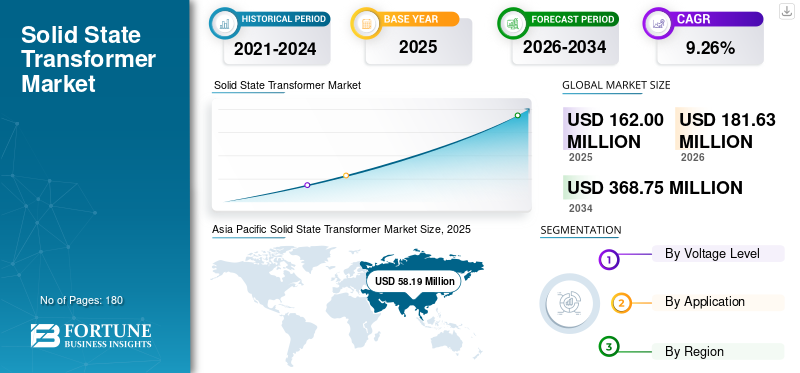
The global solid state transformer market size was valued at USD 162.00 million in 2025. The market is projected to grow from USD 181.63 million in 2026 to USD 368.75 million by 2034, exhibiting a CAGR of 9.26% during the forecast period. Asia Pacific dominated the solid state transformer market with a market share of 35.92% in 2025.
Moreover, the Asia Pacific region holds the largest market share in terms of revenue, primarily driven by significant investments in smart grids, particularly in China and India, alongside the need for high-efficiency, compact power conversion in rail traction and industrial.
Solid state transformer (SST), also known as a smart transformer, is a modern network device that integrates different power electronic converter stages with low or high-frequency transformers. SST delivers several benefits, such as they are efficient in utilization, highly reliable and robust, and are inexpensive as compared to traditional transformers.
- In October 2025, the national leader in heavy-duty freight electrification, WattEV, unveiled its SST, a small medium voltage power conversion system (MV-PCS) intended to hasten the installation of MCS quick chargers.
Hitachi Energy is a dominant leader in the global transformer market, ranking as the top manufacturer by installed base, portfolio breadth, and manufacturing capacity. Other players include GE Vernova, Eaton, Hitachi, Power Systems and Controls, Inc. The solid-state transformer (SST) market is a highly competitive, fast-growing sector driven by the need for renewable energy integration, electric vehicle (EV) infrastructure, and grid modernization.
Download Free sample to learn more about this report.
SOLID STATE TRANSFORMER MARKET TRENDS
Integration of Renewable Energy Sources and Distributed Energy Resources is Shaping Market Trends
The market is witnessing strong growth driven by grid modernization and electrification trends. One key trend is the increasing integration of renewable energy sources and distributed energy resources (DERs), where SSTs enable bidirectional power flow, voltage regulation, and real-time grid control. The rise of electric vehicle (EV) fast-charging infrastructure is also accelerating adoption, as SSTs offer compact design, high power density, and improved efficiency compared to conventional transformers.
Download Free sample to learn more about this report.
MARKET DYNAMICS
MARKET DRIVERS
Smart Grid Modernization and Power Infrastructure Upgrades to Drive Market Growth
SSTs offer precise voltage control and dynamic regulation. This is crucial for the smart grid, where power distribution needs to be optimized in real time to balance supply chain and demand across diverse sources (e.g., renewables, storage, traditional grids). Traditional transformers suffer from inefficiencies due to heat losses and magnetic flux limitations. SSTs, which use semiconductors, can operate at much higher efficiency, especially in high-frequency switching and wide-range voltage conversion. This leads to a more energy-efficient grid, which is central to smart grid objectives of reducing energy waste. One of the critical features of smart grids is bidirectional power flow, where energy can flow both from the central grid to consumers and from local power sources (such as solar panels, home batteries) back into the grid. Solid-state devices, such as SSTs, enable this functionality, improving the flexibility of energy distribution.
MARKET RESTRAINTS
Complexity in Integration with Existing Infrastructure to Restrain Market Growth
Existing grid systems were designed with traditional transformers in mind, which are large, robust, and less flexible compared to modern solid-state systems. Integrating SSTs into these grids requires significant modifications and upgrades to existing power distribution networks, control systems, and protection mechanisms. For instance, digital control systems and power electronics in SSTs must be integrated with the current monitoring and management infrastructure, which may not be compatible. This makes the transition costly and technically complex for utilities.
MARKET OPPORTUNITIES
Technological Advancements in Semiconductors to Offer Growth Opportunities
Technological advancements in semiconductors are a major driver of solid state transformer market growth opportunities. These advancements, particularly in wide-bandgap semiconductors such as silicon carbide (SiC) and gallium nitride (GaN), offer several key benefits that significantly enhance the performance, efficiency, and cost-effectiveness of solid-state devices. SiC and GaN semiconductors are capable of handling higher power densities in smaller form factors. This enables the design of more compact and lightweight solid-state devices. The ability to deliver more power in a smaller size is crucial for applications such as EVs, 5G infrastructure, and consumer electronics.
- In November 2025, a partnership between SolarEdge Technologies, Inc., a global leader in smart energy, and Infineon Technologies AG, a world leader in semiconductor solutions for power systems, was announced today to further the development of SolarEdge's SST platform for use in the next generation of AI and hyperscale data centers.
MARKET CHALLENGES
High Initial Cost and Investment May Create Challenges for Market Growth
The SST market faces significant challenges, primarily driven by high manufacturing and installation costs, complex technological integration, and limited commercial adoption. Key hurdles include the high price of power electronics/semiconductors, lack of standardized regulations, and reliability concerns compared to traditional, mature transformers.
SSTs are significantly more expensive than conventional transformers due to complex power electronic components, advanced magnetic materials, and the need for extra equipment. This makes them less attractive for budget-conscious projects, especially in developing regions.
Segmentation Analysis
By Voltage Level
MV/LV are Dominant Due to Adoption in Distribution Grids and Electric Vehicle Infrastructure
Based on voltage level, the market is segmented into MV/LV and HV/MV.
In 2025, MV/LV dominated solid state transformer market share with 68.18%. These systems are increasingly adopted in distribution grids, electric vehicle (EV) infrastructure, and industrial automation due to their cost-efficiency, scalability, and ability to handle complex, fluctuating energy demands.
- In October 2025, WattEV unveiled its Solid-State Transformer (SST), a compact MV-PCS funded by California's Energy Commission, to speed up megawatt MCS charging for heavy-duty electric trucks. Replacing traditional transformers and gear, it cuts site build time, costs, and complexity with direct 12-15kV-to-DC conversion (1.2-3.8 MW).
Furthermore, High Voltage/Medium Voltage (HV/MV) SSTs remain in a niche adoption stage with moderate CAGR of 8.43%, primarily used in specialized applications such as industrial automation and large-scale power distribution. As technological innovations improve efficiency and reduce costs, HV/MV SSTs are expected to grow adoption of the market, particularly in regions focused on grid modernization and high-capacity energy systems. The HV/MV segment is expected to lead the market, contributing 62.61% globally in 2026.
By Application
To know how our report can help streamline your business, Speak to Analyst
Electric Vehicle Charging Stations Segment emerged as a growing Segment Owing to Charging Networks
Based on application, the market is segmented into renewable power generation, electric vehicle charging stations, power grids, traction locomotives, and others.
The renewable power generation segment will account for 34.37% market share in 2026, driven by the need for grid modernization, the integration of renewable power sources, and enhanced grid stability.
- For instance, in January 2026, DG Matrix and PowerSecure announced a strategic partnership to deploy next-gen energy systems for AI data centers and electrification. DG Matrix to supply its solid-state transformer technology for efficient power conversion and renewables integration; PowerSecure provides microgrid expertise. Aims to accelerate commercialization, resiliency, and scalability.
However, the Electric Vehicle (EV) charging stations segment is the fastest-growing with a CAGR of 11.40% over the forecast period, fueled by the rapid adoption of EVs and the need for efficient, smart charging infrastructure. Renewable electricity generation is also gaining momentum, with SSTs facilitating grid integration to enable smoother energy flow from solar, wind, and other renewable sources.
Solid State Transformer Market Regional Outlook
By region, the market is categorized into North America, Europe, Asia Pacific, Latin America, and the Middle East & Africa.
Asia Pacific
Asia Pacific Solid State Transformer Market Size, 2025 (USD Million)
To get more information on the regional analysis of this market, Download Free sample
The Asia Pacific market generated USD 53.89 million in 2025, representing 35.25% of the global market landscape, and is expected to reach USD 60.17 million in 2026. This is largely driven by the region’s significant investments in grid modernization, renewable energy integration, and electric vehicle (EV) infrastructure. China’s commitment to achieving carbon neutrality by 2060, coupled with its aggressive renewable energy targets, has driven strong demand for SSTs to efficiently integrate solar, wind, and other renewable power sources into the grid.
China Solid State Transformer Market
The China market in 2025 is estimated to be around USD 19.83 million, accounting for roughly 12.24% of the global market revenues. China’s growing focus on smart grid technologies and the expansion of EV charging networks further boost the demand for such transformers. India, while growing steadily, is emerging as a significant market due to ongoing efforts to upgrade its power infrastructure, expand renewable energy capacity, and build EV charging stations.
India Solid State Transformer Market
India’s market is projected to be one of the largest worldwide, with 2025 revenues estimated at around USD 8.47 million, representing approximately 5.23% of the global market.
North America
North America recorded a market size of USD 46.13 million in 2025, capturing 30.18% of the global market share, and is projected to reach USD 51.64 million in 2026. The market is securing its position as the second largest market, this growth is driven by ongoing grid modernization efforts, the rise in renewable energy integration, and the rapid expansion of EV charging infrastructure.
U.S. Solid State Transformer Market
Based on North America’s strong contribution and the U.S. dominance within the region, the U.S. market can be analytically approximated at around USD 39.19 million in 2025, accounting for roughly 24.19% of the global market size. The U.S. is investing heavily in improving its power grid to accommodate decentralized energy sources and optimize energy distribution, where SSTs play a vital role. Moreover, increasing demand for smart grids and efficient power management solutions further propels the U.S. market.
Europe
In 2025, Europe represented USD 38.41 million, accounting for 25.13% of the worldwide market, and is projected to grow to USD 43.2 million in 2026. Europe is projected to grow at 7.24% over the coming years and is recorded to have reached a valuation of USD 46.93 million in 2025. The European SST market thrives on renewable energy integration, grid modernization, and burgeoning EV infrastructure. The U.K. and Germany lead prominently, channeling substantial investments into grid upgrades and clean energy transitions.
Germany Solid State Transformer Market
The German market in 2025 was valued at around USD 9.32 million. It is projected to reach USD 10.53 million by 2026, representing approximately 5.75% of the global revenues.
Rest of the World
The rest of the world is expected to witness moderate growth in this market space during the forecast period and the region reportedly has reached a valuation of USD 12.07 million in 2025. The rest of the world market for SSTs encompasses regions outside Asia Pacific, North America, and Europe, primarily the Middle East & Africa and Latin America. While these regions are currently experiencing niche growth, they are expected to develop significantly in the future, driven by various factors.
COMPETITIVE LANDSCAPE
Key Industry Players
Vendors Actively Expanding Market Share through Partnerships, Business Expansion, and Technological Advancements
The market has a fragmented structure, comprising prominent players in the industry such as Alstom, GE Vernova, Eaton, Hitachi, Power Systems, and Controls, Inc., among others. In September 2025, In order to increase its capacity to produce essential electrical grid components in the U.S., Hitachi Energy revealed an investment of over USD 1 billion. These investments, which are among the biggest in the U.S. electrical sector, comprise a new large power transformer factory in South Boston, Virginia, worth about USD 457 million, as well as major expansions of current plants all around the nation. Such developments are expected to fuel market growth over the forecast period.
LIST OF KEY SOLID STATE TRANSFORMER COMPANIES PROFILED
- Alstom (France)
- GE Vernova (U.S.)
- Eaton (Ireland)
- Hitachi ABB (Japan)
- Power Systems and Controls, Inc. (U.S.)
- Schneider Electric (France)
- Siemens Energy (Germany)
- Mitsubishi Electric (Japan)
- Kirloskar Electric (India)
- Prolec Energy (Mexico)
- ERMCO (U.S.)
- Synergy Transformers Pvt. Ltd. (India)
- GridBridge (U.S.)
- DG Matrix (U.S.)
- Heron Power Electronics Company (U.S.)
- Amperesand PTE Ltd (U.S.)
KEY INDUSTRY DEVELOPMENTS
- January 2026: Alstom secured a ~USD 700 million order from SNCF Voyageurs for 15 additional quad-voltage Avelia Horizon high-speed trains, set for delivery in 2029. This optional tranche boosts the total contract to 160 trains, emphasizing lower maintenance costs, 20% energy savings, and eco-efficient design across French sites.
- September 2025: In order to increase its capacity to produce essential electrical grid components in the U.S., Hitachi Energy has revealed an investment of over USD 1 million. These investments, which are among the biggest in the U.S. electrical sector, comprise a new large power transformer factory in South Boston, Virginia, worth about USD 457 million, as well as major expansions of current plants all around the nation.
- August 2025: Eaton, a smart power management company, announced that it has finished the purchase of Resilient Power Systems Inc., a top designer and producer of cutting-edge energy solutions, such as solid-state transformer-based technology.
- May 2025: Power Grid Corporation of India Limited (POWERGRID) has chosen GE Vernova Inc. to provide more than 70 additional extra high-voltage transformers and shunt reactors for important transmission projects throughout India, the firm said today.
- February 2025: Schneider Electric Infrastructure Ltd (SEIL) has stated that it intends to increase the number of transformers it produces. In a regulatory document, SEIL stated that on February 11, 2025, the company's board of directors authorized the proposal to expand the current manufacturing capacity for medium power transformers.
REPORT COVERAGE
The global solid state transformer market analysis provides an in-depth study of the market size & forecast by all the market segments included in the report. It includes details on the market dynamics and industry trends expected to drive the market in the forecast period. It offers information on the technological advancements, new product launches, key industry developments, and details on partnerships, mergers & acquisitions. The market report also encompasses a detailed competitive landscape with information on the market share and profiles of key market players.
Request for Customization to gain extensive market insights.
Report Scope & Segmentation
| ATTRIBUTE | DETAILS |
| Study Period | 2021-2034 |
| Base Year | 2025 |
| Estimated Year | 2026 |
| Forecast Period | 2026-2034 |
| Historical Period | 2021-2024 |
| Growth Rate | CAGR of 9.26% from 2026-2034 |
| Unit | Value (USD Million) |
| Segmentation | By Voltage Level, Application, and Region |
| By Voltage Level |
|
| By Application |
|
| By Region |
|
Frequently Asked Questions
Fortune Business Insights says that the global market value stood at USD 162.00 million in 2025 and is projected to reach USD 368.75 million by 2034.
In 2025, Asia Pacific’s market value stood at USD 58.19 million.
The market is expected to exhibit a CAGR of 9.26% during the forecast period.
The power grids sector led the application segment.
The smart grid modernization and power infrastructure upgrades drive market growth.
Alstom, GE Vernova, Eaton, and Hitachi, among others are some of the prominent players in the market.
Asia Pacific dominated the market in 2025 by holding the largest share.



- 2021-2034
- 2025
- 2021-2024
- 180
-
(Offer valid till 30th Sep 2026)
Get 30-60 hrs Free Customization
Expand Regional and Country Coverage, Segments Analysis, Company Profiles, Competitive Benchmarking, and End-user Insights.



















Related Reports
-
US +1 833 909 2966 ( Toll Free )
-
Get In Touch With Us