Reduced Iron Powder Market Size, Share & Industry Analysis, By Application (Powder Metallurgy, Welding, Chemical Synthesis, Filtration, and Others), and Regional Forecast, 2026-2034
 Download Free Sample
KEY MARKET INSIGHTS
 Listen to Audio Version
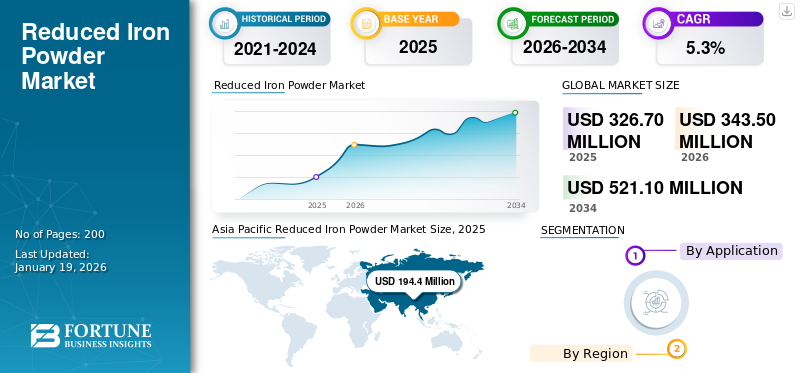
The global reduced iron powder market size was valued at USD 326.7 million in 2025. The market is projected to grow from USD 343.5 million in 2026 to USD 521.1 million by 2034, exhibiting a CAGR of 5.3% during the forecast period. Asia Pacific dominated the reduced iron powder market with a market share of 60.00% in 2025.
Reduced iron powder is a highly pure form of iron produced through the direct reduction of iron ore using gases such as hydrogen or carbon monoxide. It is widely used in powder metallurgy and chemical manufacturing due to its excellent compressibility and sintering ability. This market is growing steadily, driven by increased demand for lightweight, high-precision components and the rise of additive manufacturing. Producers are placing greater importance on research to innovate and advance sustainable and cost-effective production techniques, which is expected to boost market growth. Increasing product demand from the automotive, chemical, and electronics industries will significantly drive market growth.
The companies leading the market include JFE Steel Corporation, CNPC POWDER, INDUSTRIAL METAL POWDERS INDIA PVT.LTD., Höganäs AB, and Luode Powder Metallurgy Factory.
Download Free sample to learn more about this report.
Reduced Iron Powder Market Key Takeaways
 Global Market Size & Forecast
- 2025 Market Size: USD 326.7 million
- 2026 Market Size: USD 343.5 million
- 2034 Forecast Market Size: USD 521.1 million
- CAGR: 5.30% (2026–2034)
 Market Share
- Asia Pacific dominated the market with a 60.00% share in 2025.
- The Powder Metallurgy segment held the largest market share, driven by its high sintering efficiency and extensive use in manufacturing structural components.
- The Welding application remains a key demand segment, supported by the increasing use of reduced iron powder in welding electrodes to improve arc stability, deposition rates, and weld strength.
 Key Regional Highlights
Asia Pacific
Asia Pacific accounted for USD 194.4 million in 2025 and is projected to reach USD 205.1 million in 2026.
North America
North America recorded USD 37.7 million in 2025 and is projected to reach USD 39.4 million in 2026.
Europe
Europe generated USD 66.1 million in 2025 and is expected to grow to USD 69.3 million in 2026.
U.S.
The U.S. market is driven by ongoing investments in residential, commercial, and infrastructure development.
Japan
Japan continues to be a key market due to increasing demand from precision engineering, automotive manufacturing, and industrial applications.
Read More

REDUCED IRON POWDER MARKET TRENDS:
Growing Product Usage in Welding Applications Can Offer New Market Trends
The product is increasingly utilized in welding electrodes and brazing alloys due to its excellent reduction properties and high purity. It enhances arc stability, weld strength, and bonding in joining applications. As construction and heavy engineering industries expand globally, the demand for high-performance welding materials is also rising. The trend is especially prominent in Asia Pacific and the Middle East, where rapid urbanization and infrastructure projects are underway. Asia Pacific witnessed a growth from USD 204 million in 2023 to USD 209.4 million in 2024.
MARKET DYNAMICS
MARKET DRIVERS:
Increasing Product Demand from Automotive Sector Boosts Market Growth
The automotive industry is a major driver of the market due to its extensive use of powder metallurgy components. As automakers increasingly focus on producing lightweight, high-strength, and fuel-efficient vehicles, the product has emerged as an important raw material. It is used in sintered parts such as gears, bearings, and structural components, which offer superior dimensional accuracy and cost savings compared to conventionally manufactured parts. Hence, increasing product demand from the automotive industry is expected to drive the reduced iron powder market growth in the coming years.
MARKET RESTRAINTS:
Environmental Concerns Related to Traditional Manufacturing Methods Could Limit Market Expansion
Significant restraint in the reduced iron industry is the environmental concerns regarding traditional methods of producing the powder. Traditional manufacturing processes of making the product involve using carbon-rich reducing agents or fossil fuels, which emit significant amounts of harmful gases such as carbon dioxide. These emissions lead to air contamination and contribute to climate change, raising regulatory issues over the industry’s environmental footprint. Moreover, this type of production process generates heat and potentially harmful waste byproducts that must be managed responsibly.
MARKET OPPORTUNITIES:
Expansion in Chemical and Water Treatment Applications Could Bring Opportunity for Market
The significant opportunities in the reduced powder industry lie in the growing chemical and water treatment industries. In chemical processing, iron-based powder catalyzes various reactions. Its high surface area and reactive nature make it particularly effective for chemical applications. Additionally, in environmental engineering, the product is increasingly being used for groundwater remediation and wastewater treatment. As governments and industries place greater emphasis on environmental sustainability and stricter water quality standards, the demand for effective and reasonable treatment solutions is growing.
- According to the Development Aid article, in 2022, 42% of household wastewater was untreated, which means 113 billion cubic meters of water will go back into the environment, which is polluted. Around 4.4% of the world’s population in low-and middle-income nations do not have access to drinking water; this creates a better opportunity for the reduced iron powder industry as it is used in the treatment of wastewater.
MARKET CHALLENGES:
Instability in Raw Material Prices Could Pose a Challenge to Market
One of the significant challenges faced by the market is the volatility in raw material prices, especially iron ore and energy sources. Since the production of reduced iron powder heavily relies on high-purity iron ore and consistent energy supply, any fluctuation in these input costs directly affects overall production expenses and, ultimately, the profitability of manufacturers. Geopolitical tensions, supply chain disruptions, export restrictions, and market assumptions often cause unpredictable hikes in raw material prices.
Trade Protectionism
Trade protectionism has a notable impact on the market. Countries, including the U.S., have imposed anti-dumping tariffs on certain imports, including metal powders, to protect their domestic industries. These tariffs can affect the global flow of the market, potentially disturbing supply chains and driving up costs. Furthermore, such trade policies can influence the competitive landscape in various regional markets.
Download Free sample to learn more about this report.
Segmentation Analysis
By Application
Powder Metallurgy Segment Leads Market Due to Its High Sintering Efficiency
Based on application, the market is classified into powder metallurgy, welding, chemical synthesis, filtration, and others.
The powder metallurgy segment holds the largest reduced iron powder market share due to its high sintering efficiency. This method involves compacting iron powder into desired shapes and heating it to form solid parts without melting it. It is favored for producing structural components such as gears, bushings, and bearings due to its strength and wear resistance. Automotive, machinery, and consumer electronics sectors heavily utilize powder metallurgy for cost-effective and lightweight part production.
The product plays a crucial role in the welding industry, particularly in shielded metal arc welding and submerged arc welding. It is used in the formulation of welding electrodes to stabilize arcs, improve deposition rates, and enhance the mechanical strength of welds. The use of iron powder in welding electrodes ensures deeper penetration and better fusion between the base materials.
The product is also an effective reducing agent and catalyst in various chemical synthesis processes. Its high reactivity and surface area enable it to participate in reactions such as the reduction of nitro compounds to amines, a vital step in producing dyes, agrochemicals, and pharmaceuticals. The chemical industry relies on its ability to maintain stability under different processing conditions, enhancing safety and efficiency.
Reduced Iron Powder Market Regional Outlook
By region, the market is categorized into Asia Pacific, North America, Europe, Latin America, and the Middle East & Africa.
Asia Pacific
Asia Pacific Reduced Iron Powder Market Size, 2025 (USD Million)
To get more information on the regional analysis of this market, Download Free sample
In 2025, the Asia Pacific market stood at USD 194.4 million, representing 60.00% of global demand, and is projected to grow to USD 205.1 million in 2026, driven by fast industrialization and strong manufacturing bases in countries such as China, India, and Japan. China, being the largest maker and consumer of the product, significantly influences global demand, particularly in sectors such as automotive, construction, and electronics. Additionally, India’s growing infrastructure projects and expanding industrial base contribute to increased demand for welding and powder metallurgy applications.
North America
The market in North America reached USD 37.7 million in 2025, representing 12.00% of total market revenue, and is projected to reach USD 39.4 million in 2026. North America remains one of the important regions in the market due to its advanced manufacturing sector, which heavily relies on precision engineering and high-quality materials. The U.S. and Canada, in particular, have well-established industries in aerospace, automotive, and electronics, where the product is essential for powder metallurgy and additive manufacturing applications.
Europe
Europe contributed approximately USD 66.1 million to the global market in 2025, accounting for 20.00% share, and is expected to reach USD 69.3 million in 2026. Europe has seen an increasing demand for reduced iron powder, particularly in industries such as automotive, machinery, and environmental technologies. European manufacturers highlight sustainability, which makes the product an ideal material due to its recyclability and low environmental impact. The region’s robust automotive sector, especially in Germany and France, utilizes the product in powder metallurgy to produce durable parts, including gears and bearings.
Latin America
The Latin America market accounted for USD 16.2 million in 2025, representing 5.00% of the global industry, and is expected to reach USD 16.9 million in 2026. Latin America includes countries such as Brazil and Mexico, experiencing slow but steady growth in the market. The region benefits from the ongoing industrialization and the adoption of cutting-edge technologies in manufacturing.
Middle East & Africa
As global trade continues to expand, countries in the Middle East & Africa are increasingly turning to sustainable materials, including reduced iron powder, which is cost-effective and environmentally friendly. Heavy investment in infrastructure and industrial diversification is driving the product demand. Middle East & Africa maintained a strong presence in the global market, reaching USD 12.4 million in 2025, accounting for 4.00% share, and is expected to reach USD 12.9 million in 2026.
COMPETITIVE LANDSCAPE
Key Industry Players
Continuous Development and Introduction of New Products by Key Companies Resulted in Their Dominating Positions in Market
The market for reduced iron powder is highly competitive, with major players focusing on capacity expansion, sustainability, and mergers & acquisitions to strengthen their market presence. Key global companies include JFE Steel Corporation, CNPC POWDER, INDUSTRIAL METAL POWDERS INDIA PVT.LTD., Luode Powder Metallurgy Factory, and Höganäs AB, among others. These companies compete based on product innovation, cost efficiency, and regional dominance as the automotive and electronics industries are growing. While global leaders dominate in developed markets, regional players are expanding aggressively in emerging economies, intensifying competition in the industry.
LIST OF KEY REDUCED IRON POWDER COMPANIES PROFILED:
- JFE Steel Corporation (Japan)
- CNPC POWDER (Canada)
- INDUSTRIAL METAL POWDERS INDIA PVT.LTD. (India)
- Khorasan Powder Metallurgy Company (Iran)
- Luode Powder Metallurgy Factory (China)
- SLM Metal Private Limited. (India)
- Höganäs AB (Sweden)
- LWPM Co., LTD. (China)
- Shanghai Knowhow Powder-Tech Co., Ltd. (China)
- Sree Metaliks Ltd (India)
KEY INDUSTRY DEVELOPMENTS:
- March 2025: Höganäs AB and Porite TAIWAN Co., Ltd announced a strategic partnership to advance their sustainable manufacturing practices. As part of a partnership agreement, Höganäs will supply Porite TAIWAN Co., Ltd, its newly developed near-zero sponge iron powder, a product designed to achieve minimal carbon emissions during its production and lifecycle.
- May 2023: Sree Metaliks Ltd announced that it is doubling its iron ore mine production capacity from 0.702 Mt to 1.50 Mt to meet the increasing demand.
REPORT COVERAGE
The global reduced iron powder market analysis provides market size & forecast by all the segments included in the report. It includes details on the market dynamics and market trends expected to drive the market over the forecast period. It offers information about key regions/countries, key industry developments, new product launches, details on partnerships, mergers & acquisitions, and a number of reduced iron powder manufacturers in key countries. The report covers a detailed competitive landscape with information on the market share and profiles of key players.
Request for Customization to gain extensive market insights.
Report Scope & Segmentation
|
ATTRIBUTE |
DETAILS |
|
Study Period |
2021-2034 |
|
Base Year |
2025 |
|
Forecast Period |
2026-2034 |
|
Historical Period |
2021-2024 |
|
Growth Rate |
CAGR of 5.3% from 2026-2034 |
|
Unit |
Value (USD Million) Volume (Kilotons) |
|
Segmentation |
By Application and Region |
|
By Application |
|
|
By Region |
|
Frequently Asked Questions
Fortune Business Insights says that the global market value stood at USD 326.7 million in 2025 and is projected to reach USD 521.1 million by 2034.
In 2025, the market value stood at USD 37.7 million.
The market is expected to exhibit a CAGR of 5.3% during the forecast period of 2026-2034.
The powder metallurgy leads the market by application.
Increasing product demand from the automotive sector is expected to boost market expansion.
JFE Steel Corporation, CNPC POWDER, INDUSTRIAL METAL POWDERS INDIA PVT.LTD., Luode Powder Metallurgy Factory, and Höganäs AB. are some of the leading players in the market.
Asia Pacific dominated the market in 2025.
Increasing demand for lightweight, high-performance components for vehicles is one of the factors that is expected to favor product adoption.



- 2021-2034
- 2025
- 2021-2024
- 200
Get 30-60 hrs Free Customization
Expand Regional and Country Coverage, Segments Analysis, Company Profiles, Competitive Benchmarking, and End-user Insights.


















Related Reports
-
US +1 833 909 2966 ( Toll Free )
-
Get In Touch With Us