Remittance Market Size, Share & Industry Analysis, By Type (Inward Remittance and Outward Remittance), By Channel (Bank Transfers, Money Transfer Operators (MTOs) and Online/Digital Platforms), By End User (Individual Users, Commercial Users and Others), and Regional Forecast, 2026–2034
 Download Free Sample
KEY MARKET INSIGHTS
 Listen to Audio Version
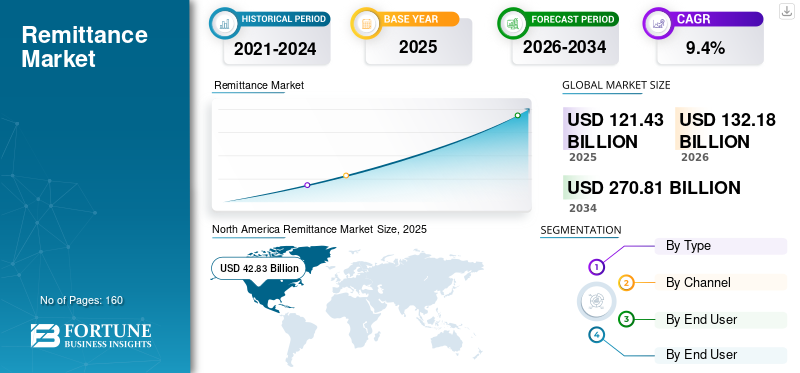
The global remittance market size was valued at USD 121.43 billion in 2025. The market is projected to grow from USD 132.18 billion in 2026 to USD 270.81 billion by 2034, exhibiting a CAGR of 9.4% during the forecast period. North America dominated the global remittance market with a share of 32.27% in 2025.
The remittance industry refers to the revenue generated from the transaction fees, foreign exchange margins, and service charges paid by service providers. Growing international migration, consistent demand across borders, technological advancements, fintech innovations and increasing access to banking solutions are few prominent factors driving market growth. Regulatory policies, social environment, and currency fluctuations influence the monetary transfer across regions. Strengthening of specific remittance corridors, such as U.S.-Mexico and others among the migrant population to further boost high-volume transactions driving market development.
- For instance, in September 2025, India launched a cross-border remittance framework with the Universal Postal Union (UPU) platform. This platform linkage helps users to transfer money across borders, connecting approximately 190 countries.
Western Union, MoneyGram, PayPal, and Wise are among the key players holding a significant share. A strong physical network, broad international remittances demand, seamless integration with online platforms and low-cost fees with minimal markups provide these companies with a competitive advantage in the market.
Download Free sample to learn more about this report.
REMITTANCE MARKET KEY TAKEAWAYS
 Market Size & Forecast
- 2025 Market Size: USD 121.43 Billion
- 2026 Market Size: USD 132.18 Billion
- 2034 Forecast Market Size: USD 270.81 Billion
- CAGR: 9.4% from 2026–2034
 Market Share
- North America dominated the remittance market with a 32.27% share in 2025.
- The outward remittance segment held the largest share by type in 2025.
- The bank transfers segment accounted for the leading share by channel in 2025.
 Key Regional Highlights
North America
North America generated USD 42.83 billion in revenue and led the global market in 2025.
Europe
Europe is witnessing steady growth, supported by labor migration and increasing adoption of digital remittance services.
Asia Pacific
Asia Pacific reached USD 26.25 billion in 2025, driven by large migrant workforces and rising digital payment adoption.
U.S.
The market is projected to reach USD 35.84 billion in 2026.
Japan
Growing digital payment adoption and cross-border money transfer activities are supporting remittance market growth.
Read More

REMITTANCE MARKET TRENDS
Growing Digital Payment Infrastructures is a Prominent Market Trend
Users are largely inclined toward digital payment transactions rather than cash-based and agent-driven transfers. Several digital platforms, such as portals, mobile apps, digital wallets and others, are gaining traction across regions owing to their low fees and transparent pricing. Increasing smartphone penetration, user preference for convenient transactions and improved internet access also leads to the remittance market growth. Key players are integrating with instant payment systems, APIs and automated settlement mechanisms to increase transaction times, improve customer experience and strengthen market competitiveness.
- For example, in July 2025, PayPal launched “PayPal World” for a cross-border payments platform. The new platform is integrating wallets and payment systems across countries.
Download Free sample to learn more about this report.
MARKET DYNAMICS
MARKET DRIVERS
Rising Migration and Digital Financial Inclusion Drives Market Growth
Increasing global migration, updates in international labour laws, and widespread adoption of smartphones are resulting in an enhanced volume of cross-border payments. Growing digitalization, extended financial services and demand for faster transactions are all driving the market growth for remittance. Strong economic ties between countries and growing income disparities between developed and developing countries act as key growth drivers for the market. Competitive pricing, faster and transparent exchange rates offered by fintech providers are also boosting adoption.
- For instance, in July 2025, NPCI announced that the UPI-PayNow remittance service would be expanded to 13 more Indian banks, including HDFC Bank, Bank of Baroda, Kotak Mahindra and other.
MARKET RESTRAINTS
Currency Volatility and Regulatory Barriers Limits Market Growth
Stringent regulatory policies and compliance requirements, such as KYC norms and operational complexity limits the market growth. Volatility in exchange rates and economic uncertainty in both sending and receiving countries can reduce remittance volumes. Limited access to digital infrastructure in rural or underbanked regions also restricts the adoption of formal remittance channels. Cybersecurity risks and fraud concerns can further limit the dependency on digital platforms for foreign transactions.
MARKET OPPORTUNITIES
Integration of Domestic Real Time Payment Systems Unlocks a New Growth Avenue for Market
Linking instant payment infrastructures enables faster, low-cost and seamless cross-border transactions, improving the overall user experience. This integration reduces reliance on intermediaries, lowers settlement times and enhances transparency in monetary transfers. It also supports greater financial inclusion by allowing users to send and receive funds directly through mobile apps and local bank accounts. For remittance service providers, this connectivity opens access to new corridors and customer segments. As governments and regulators increasingly support interoperable payment frameworks, this trend is expected to accelerate remittance adoption.
- For instance, in April 2021, Singapore’s PayNow and Thailand’s PromptPay enabled real-time cross-border payments between the countries.
MARKET CHALLENGES
Rising Security Risks Pose Significant Challenges to Market Growth
As remittance services become more digital and mobile-based, they are increasingly targeted by cybercriminals through phishing attacks, identity theft, account takeovers and malware. Fraudulent transactions or data breaches can lead to direct financial losses for users, making them hesitant to adopt or continue using digital remittance services. Rising cybersecurity threats and fraud risks significantly undermine consumer trust in digital remittance platforms by increasing concerns over the safety of personal and financial data.
Segmentation Analysis
By Type
Rising Number of Migrants Sending Money to Home Countries Drive the Outward Remittance Segment Growth
Based on the type, the market is divided into inward remittance and outward remittance.
Outward Remittance segment dominated the market in 2025. The rising number of migrant workers sending money to their home countries for household expenses, education, and healthcare drive the segment growth. Strong demand from developed economies with large expatriate populations continues to drive transaction volumes. Increasing adoption of digital and mobile-based remittance platforms has made outward transfers faster, more affordable, and transparent. Additionally, favorable regulations and competitive pricing by fintech providers are encouraging users to shift from informal to formal outward remittance channels, supporting higher growth rates.
- For instance, in 2025, Remitly, a fintech company, witnessed double-digit year-on-year revenue growth across every quarter of 2025. This double-digit growth showcases the growing demand for outward remittances.
Rising financial inclusion and improved access to banking and digital wallets are enabling recipients to receive remittances through formal channels. Government initiatives to promote digital payments and reduce cash dependency further support inward remittance growth. Inward remittance is expected to witness the considerable growth of about 9.7% during the forecast period.
By Channel
Strong Trust and Banking Infrastructure Driving the Dominance of Bank Transfers Segment
Based on channel, the market is segmented into Bank Transfers, Money transfer operators (MTOs), and Online / Digital Platforms.
Bank Transfers segment held the highest remittance market share. This is due to their strong trust, regulatory compliance and widespread global banking networks. Large migrant populations prefer banks for high-value and recurring transfers, supported by established correspondent banking relationships. Banks also benefit from deep customer bases and integration with domestic financial systems, ensuring secure and reliable cross-border transactions. Additionally, government-linked and salary-based remittances are largely routed through traditional banking channels.
- For instance, in late 2025, JPMorgan Chase, Bank of America, and Wells Fargo announced the expansion of digital payment network Zelle to international transfers.
Online and digital platforms segment are expected to witness the highest growth rate, driven by rapid smartphone penetration and increasing internet accessibility worldwide. Fintech players offer faster transfers, lower fees, real-time tracking and transparent exchange rates, attracting cost-conscious users. The convenience of app-based services and instant payments is accelerating adoption, particularly among younger and tech-savvy migrants. Continuous innovation, including AI-based fraud detection and blockchain-enabled transfers, further supports the segmental growth with around CAGR of 10.3% during the forecast period.
To know how our report can help streamline your business, Speak to Analyst
By End User
Rapid Digital Transformation and Innovation Demand Drives the Individual Users Segment
Based on End User, the market is segmented into Individual Users, Commercial Users, and Others.
Individual Users segment dominated the market, accounting for more than two-thirds of the market share. A large global migrant population is sending their money to families for daily expenses, education, healthcare, and savings. Personal remittances are consistent and recurring flow, especially from developed to developing economies. High trust in established remittance channels and increasing access to digital platforms further support strong product adoption among individuals. Additionally, emotional and social obligations ensure the stability and dominance of this segment.
Commercial users are expected to witness the highest growth rate of about 10.0%, supported by rising cross-border trade, globalization of small and medium-sized enterprises (SMEs) and international outsourcing activities. Businesses increasingly rely on remittance services for supplier payments, payroll for overseas workers and international settlements. The adoption of digital payment solutions offering faster processing, lower transaction costs, and improved transparency is accelerating commercial usage. Growing e-commerce and freelance economies further contribute to rapid growth in this segment.
Remittance Market Regional Outlook
By geography, the market is categorized into Europe, North America, Asia Pacific, South America, and the Middle East & Africa.
North America
North America Remittance Market Size, 2025 (USD Billion) To get more information on the regional analysis of this market, Download Free sample
North America dominates the market with over USD 42.83 billion revenue generated in 2025. The presence of advanced financial infrastructure and widespread adoption of digital remittance platforms further strengthens regional market dominance. High employment levels among immigrants and strong economic conditions in the U.S., Canada, and Mexico sustain consistent remittance volumes. Additionally, innovation by banks and fintech companies continues to enhance transaction speed and transparency.
U.S. Remittance Market
U.S. dominates the North American market with an expected revenue of about USD 35.84 billion in 2026, primarily driven by strong outbound remittance flows and high transaction volumes. Advanced banking infrastructure and widespread adoption of digital and mobile remittance platforms further support market leadership. Additionally, the presence of major banks and global fintech remittance providers enhances service accessibility, speed and transparency across remittance corridors.
Europe
The European market is primarily driven by ongoing labor migration within and outside the region. Countries such as Germany, the U.K., and France act as major remittance-sending hubs to Eastern Europe, Africa and Asia. Regulatory harmonization and the adoption of digital payment solutions support stable market expansion. Increasing use of online and mobile remittance services is further and enhancing the accessibility across the region.
U.K. Remittance Market
The U.K. market in 2026 is projected to secure a value of USD 6.55 billion, representing roughly 5.0% of global Remittance revenues.
Germany Remittance Market
Germany’s market is predicted to reach USD 8.28 billion in 2026, equivalent to around 6.3% of the global sales.
Asia Pacific
Asia Pacific reached USD 26.25 billion in 2025 in the global market. Rapid economic development, large migrant workforces, and increasing cross-border employment to drive the regional market during the forecast period. Rising smartphone penetration and digital payment adoption are accelerating the use of formal remittance channels. Government initiatives promoting financial inclusion further support strong regional growth.
China Remittance Market
China’s market is projected to remain dominant in the Asia Pacific region in 2026 revenues reached USD 9.34 billion, representing roughly 7.1% of global sales.
India Remittance Market
The Indian market, in 2026, is estimated to be valued at USD 6.62 billion, accounting for roughly 5.0% of the global market. Supportive government-led startup initiatives and increasing digital consumer base to propel the market growth in India.
ASEAN Remittance Market
The ASEAN market in 2026 is predicted to reach a value of USD 4.73 billion, accounting for roughly 3.6% of revenue.
South America and the Middle East & Africa
The South America and Middle East & Africa regions are expected to witness moderate growth in this market space owing to strong demand for outward remittances, gradual adoption of digital remittance platforms and improving digital payment ecosystems backed by government policies.
GCC Remittance Market
The GCC market is projected to reach USD 3.21 billion in 2026, representing roughly 2.4% of the global market.
COMPETITIVE LANDSCAPE
Key Industry Players
Focus on Emerging and Innovative Sectors to Scale Remittance Adoption
Key market players, such as Western Union, MoneyGram, PayPal/Xoom, Wise, and Remitly, are focusing on digital transformation to stay competitive by investing in mobile apps, real-time transfers and low-cost cross-border solutions to meet rising customer demand. Legacy operators are forming partnerships with fintech firms and banks to expand global reach and enhance service offerings, especially in underserved corridors.
Some providers are exploring blockchain and stablecoin solutions to reduce costs and speed up settlements, while consolidation through mergers and acquisitions helps strengthen market presence and operational scale. These strategies aim to balance traditional agent networks with innovative digital services, addressing both cost-sensitive and convenience-focused segments of the market.
- For instance, in 2025, Western Union is implementing the “Evolve 2025” strategy to boost the digital transaction volumes.
LIST OF KEY REMITTANCE COMPANIES PROFILED
- Western Union (U.S.)
- MoneyGram (U.S.)
- PayPal (U.S.)
- Wise (U.K.)
- Airwallex (Australia)
- Remitly (U.S.)
- Ria Money Transfer (U.S.)
- WorldRemit (U.K.)
- Payoneer (U.S.)
- ZEPZ (U.K.)
KEY INDUSTRY DEVELOPMENTS
- March 2025: WorldRemit expanded instant bank-transfer remittance services across the Middle East–Asia corridor, targeting high-volume migrant remittance flows.
- September 2024: India announced the integration of UPI with the Universal Postal Union (UPU) platform, enabling digital cross-border remittances through global postal networks.
- April 2024: Remitly launched enhanced real-time payout options in key South Asian and African markets, focusing on faster delivery and improved transparency for migrant workers.
- January 2024: PayPal expanded its Xoom remittance service into new Latin American corridors, offering faster digital payouts to bank accounts and mobile wallets.
- March 2023: Western Union expanded its digital remittance services across select African markets, strengthening mobile wallet and bank-transfer capabilities to reduce reliance on cash pickups.
- July 2023: Wise extended instant international transfers to additional European and Asia-Pacific corridors, improving transfer speed through direct integration with local payment systems.
REPORT COVERAGE
Request for Customization to gain extensive market insights.
Report Scope & Segmentation
|
ATTRIBUTE |
DETAILS |
|
Study Period |
2021-2034 |
|
Base Year |
2025 |
|
Estimated Year |
2026 |
|
Forecast Period |
2026-2034 |
|
Historical Period |
2021-2024 |
|
Growth Rate |
CAGR of 9.4% from 2026-2034 |
|
Unit |
Value (USD Billion) |
|
Segmentation |
By Type, Channel, End User, and Region |
|
By Type |
|
|
By Channel |
|
|
By End User |
|
|
By Region |
|
Frequently Asked Questions
According to Fortune Business Insights, the global market value stood at USD 121.43 billion in 2025 and is projected to reach USD 270.81 billion by 2034.
In 2025, the market value stood at USD 42.83 billion.
The market is expected to exhibit a CAGR of 9.4% during the forecast period of 2026-2034.
By Channel, the Money Transfer Operators (MTOs) to dominate the market.
Rising Global Migration and Digital Financial Inclusion Driving Growth in the Remittance Industry.
Western Union, MoneyGram, PayPal, Wise are the major players in the global market.
North America dominated the market in 2025.



- 2021-2034
- 2025
- 2021-2024
- 160
Get 30-60 hrs Free Customization
Expand Regional and Country Coverage, Segments Analysis, Company Profiles, Competitive Benchmarking, and End-user Insights.













Related Reports
-
US +1 833 909 2966 ( Toll Free )
-
Get In Touch With Us