Remote Desktop Software Market Size, Share & Industry Analysis, By Deployment (Cloud and On-Premise), By Enterprise Size (Small & Medium Enterprises and Large Enterprises), By End-User (BFSI, Healthcare, IT & Telecom, Government, Manufacturing, Education, and Others), and Regional Forecast, 2026-2034
 Download Free Sample
(Offer valid till 30th Sep 2026)

Remote Desktop Software Market Size
 Listen to Audio Version
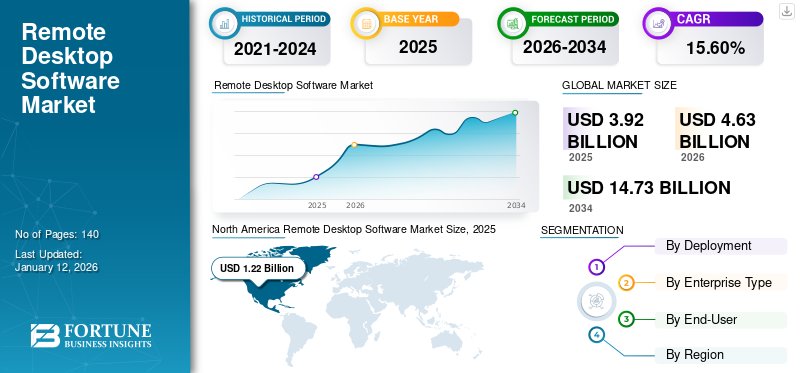
The global remote desktop software market size was valued at USD 3.92 billion in 2025. The market is projected to grow from USD 4.63 billion in 2026 to USD 19.36 billion by 2034, exhibiting a CAGR of 19.6% during the forecast period. North America dominated the remote desktop software market with a market share of 31.12% in 2025.
Remote desktop software enables users to access and control a remote computer’s desktop environment from a local device, providing secure and seamless access to files, applications, and systems. Unlike traditional on-premises solutions, remote desktop software can be installed on both local and remote machines, allowing users to securely log in to remote systems over the Internet. This software plays a crucial role in supporting remote work, especially in industries such as healthcare, education, IT, and telecom, where flexible work arrangements and access to critical data from remote locations are essential.
The growing adoption of work-from-home practices and "bring your own device" (BYOD) policies has significantly fueled the demand for the product. The increasing need for secure access to company resources and applications from various devices, coupled with the rise in remote work due to the COVID-19 pandemic, has further accelerated this trend. The software enables organizations to maintain business continuity and enhance productivity while ensuring secure access to enterprise systems.
Key players in the market, such as TeamViewer, Microsoft, Zoho, and AnyDesk, continue to innovate by introducing new features and expanding their product offerings to meet the growing demand for remote access solutions. These companies are increasingly focusing on enhancing security, ease of use, and performance, ensuring their solutions meet the needs of businesses and remote workers alike. Their commitment to providing reliable, scalable solutions is driving continued market growth, with an emphasis on improving user experience and addressing evolving remote work challenges.
Download Free sample to learn more about this report.
Remote Desktop Software Market Key Takeaways
 Global Market Size & Forecast
- 2025 Market Size: USD 3.92 billion
- 2026 Market Size: USD 4.63 billion
- 2034 Forecast Market Size: USD 19.36 billion
- CAGR: 19.6% from 2026–2034
 Market Share
- North America dominated the market with a 31.12% share in 2025.
- The IT & Telecom segment held the largest market share of 21.8% in 2025.
- The On-Premises segment is projected to grow at a CAGR of 17.1% during the forecast period.
 Key Regional Highlights
Asia Pacific
Asia Pacific reached USD 0.93 billion in 2025 and is expected to register the highest growth during the forecast period.
North America
North America reached USD 1.22 billion in 2025, supported by strong digital infrastructure and widespread enterprise adoption.
Europe
Europe generated USD 1.01 billion in 2025 and is projected to grow at a CAGR of 19.2% during the forecast period.
U.S.
U.S. market reached USD 0.91 billion in 2025.
Japan
Japan market reached USD 0.18 billion in 2025.
Read More

Remote Desktop Software Market Trends
Rising Adoption of Zero Trust Architectures to Fuel Market Expansion
Rising cybersecurity concerns in remote work environments are driving the widespread adoption of Zero Trust architectures within remote desktop software solutions. Organizations are moving away from traditional perimeter-based security models and embracing identity-based access controls to manage their distributed workforces. As part of this transition, remote desktop platforms are increasingly integrating features such as multi-factor authentication, device verification, and role-based access controls to bolster system security. For instance,
- According to Microsoft, over 80% of organizations are either adopting or planning to adopt Zero Trust strategies, signaling a clear shift toward security-first approaches in remote access environments globally.
Increasing regulatory requirements and data protection standards are also influencing the adoption of secure remote desktop solutions. Industries such as BFSI, healthcare, and government, which require stringent controls over user access, data handling, and system monitoring, are prioritizing solutions with built-in encryption, audit trails, and governance features. This growing emphasis on compliance and security is significantly impacting vendor selection and shaping product development strategies.
- For instance, Thales highlights that 45% of organizations have experienced cloud based data breaches in recent years, further emphasizing the urgency of adopting secure, compliant remote access solutions.
MARKET DYNAMICS
MARKET DRIVERS
Download Free sample to learn more about this report.
Increasing Shift to Hybrid Work Models is Propelling Market Growth
The ongoing transition to hybrid and remote work arrangements is significantly boosting remote desktop software market growth. Modern organizations are increasingly operating across home, office, and mobile environments, which makes remote desktop solutions crucial for ensuring business continuity. These solutions facilitate secure access to critical files, applications, and internal systems, eliminating the need for employees to be physically present in the office.
- For instance, as reported by Cisco’s Global Hybrid Work Study 2025, nearly 45% of the global workforce continues to work in hybrid settings, confirming the deep integration of flexible work models within business operations across various industries.
The shift to hybrid work models is also boosting workforce productivity, prompting organizations to invest more in remote access technologies. Employees benefit from reduced commuting time and improved work-life balance, while businesses achieve higher efficiency and operational continuity.
Remote desktop software plays a vital role by providing employees with continuous access to centralized systems and enterprise applications, regardless of the device they use.
- Additionally, a report from the U.S. Bureau of Labor Statistics shows that a 1% increase in remote work correlates with a 0.08% rise in productivity growth, demonstrating the direct impact of remote work on operational efficiency across industries.
MARKET RESTRAINTS
Data Security Challenges and Unauthorized Access Risks Hindering Market Growth
Concerns about data security and the potential for unauthorized access are significant barriers to product adoption. While these solutions provide critical remote access to business system access over the Internet, they can also increase vulnerability to cyber risks if not appropriately secured. This is especially true for organizations managing sensitive information, which are more cautious in embracing such tools due to the heightened risk. The financial impact of security breaches adds another layer of hesitation.
- For instance, in 2023, IBM reports that the global average cost of a data breach reached USD 4.45 million, illustrating the serious consequences of security failures and limiting the adoption of remote desktop solutions, particularly among risk-averse enterprises across various sectors.
Additionally, the growing sophistication of cyberattacks continues to hamper broader adoption of remote desktop software solutions. Threats such as ransomware, phishing, and credential theft often target remote access systems, making them attractive entry points for cybercriminals. Many organizations, especially those lacking advanced cybersecurity infrastructure remain reluctant to deploy these solutions due to concerns over protecting remote working environments.
- For instance, Verizon’s Data Breach Investigations Report indicates that more than 80% of breaches involve stolen or weak credentials, underscoring the critical importance of secure authentication and access management for remote access environments worldwide.
MARKET OPPORTUNITIES
Growing Shift Toward Cloud-Based Infrastructure to Fuel Market Growth
The increasing shift toward cloud-based infrastructure is presenting substantial growth opportunities for product providers. As more organizations migrate applications, workloads, enterprise operations to the cloud, they are seeking technologies that enhance scalability, flexibility, and operational efficiency. Cloud-based remote desktop solutions eliminate the need for extensive on-premise systems, enabling faster deployment and simplified system management. These solutions facilitate remote access across a range of devices and locations.
- For instance, Flexera’s 2025 State of the Cloud Report highlights that 87% of organizations have adopted multi-cloud strategies, underlining strong global demand for cloud-enabled remote access technologies.
Small and medium-sized enterprises (SMEs) are emerging as a growing segment for these solutions. With limited IT infrastructure, SMEs require cost-effective, easy-to-deploy tools to support remote work. Cloud platforms offer subscription-based pricing and scalability, making them ideal for SMEs and reducing upfront costs.
- For instance, the International Trade Administration reports that SMEs account for more than 90% of businesses worldwide, creating a large and growing market for remote desktop software providers.
Segmentation Analysis
By End-User
Expansion of 5G Networks Boosted IT & Telecom Segment Growth
Based on end-user, the market is divided into healthcare, BFSI, government, education, IT & telecom, manufacturing, and others.
The IT & telecom segment held the majority remote desktop software market share of 21.8% in 2025, as the industry relies on remote access for global service delivery and network management. Telecom providers, in particular, require secure access to complex infrastructure across distributed locations that often operate 24/7, thereby increasing demand for efficient and reliable remote desktop solutions. Additionally, with the rapid expansion of 5G networks and cloud services, IT & Telecom companies need to manage an increasing number of remote users and devices, driving the need for scalable, secure solutions to ensure operational continuity and enhanced customer support.
Education is expected to witness the highest CAGR of 24.0% during the forecast period.
To know how our report can help streamline your business, Speak to Analyst
By Deployment
Cloud Segment Led due to its Ability to Reduce Maintenance Costs
Based on deployment, the market is bifurcated into cloud and on-premise.
The cloud segment dominated the market, as organizations prefer cloud solutions that eliminate the need for extensive on-premises infrastructure and reduce maintenance costs. Cloud-based remote desktop solutions offer easy scalability to accommodate growing user bases and provide secure, remote access from anywhere, supporting the shift to hybrid and remote work models.
The on-premises segment is expected to witness the CAGR of 17.1% during the forecast period.
By Enterprise Size
Large Enterprises Segment Dominated as they have Complex IT Environments
Based on enterprise size, the market is categorized into small & medium enterprises and large enterprises.
Large enterprises held the majority market share, as they have extensive, complex IT environments that require secure, centralized management of a vast number of remote users. These organizations often operate across multiple regions and need remote desktop solutions to ensure secure, uninterrupted access to critical systems, applications, and data. Furthermore, large enterprises face greater regulatory and compliance pressures, making advanced security features such as multi-factor authentication and real-time monitoring essential.
Small & medium enterprises are expected to witness the highest CAGR of 20.9% during the forecast period.
Remote desktop software Market Regional Outlook
By region, the market is categorized into North America, South America, Europe, the Middle East & Africa, and Asia Pacific.
North America
North America Remote Desktop Software Market Size, 2025 (USD Billion)
To get more information on the regional analysis of this market, Download Free sample
North America market dominated the market, valuing at USD 1.22 billion in 2025. The growth is due to its strong technological infrastructure and early adoption of digital transformation initiatives. The U.S., in particular, is home to numerous large enterprises across industries such as IT, finance, healthcare, and telecommunications, all of which rely heavily on secure, scalable remote access solutions to support their distributed workforces. The region also has a high concentration of cloud service providers, which makes cloud-based remote desktop solutions more accessible.
Additionally, organizations across North America have rapidly implemented hybrid and remote work models, further driving demand for reliable remote access tools. Regulatory frameworks and a growing focus on cybersecurity have also encouraged to adopt advanced remote desktop solutions with enhanced security.
U.S. Remote desktop software Market
Given North America’s strong contribution and the U.S. dominance in the region, the U.S. market stood at around USD 0.91 billion in 2025, accounting for roughly 23.2% of global sales.
Europe
Europe is projected to grow at a CAGR of 19.2% over the coming years. The market reached a valuation of USD 1.01 billion in 2025, driven by its strong regulatory frameworks and ongoing digitalization across industries. The region's commitment to data privacy and security, particularly through regulations such as the GDPR, ensures that businesses continue to prioritize secure remote access solutions. Additionally, European enterprises, especially in sectors such as finance, healthcare, and manufacturing, are increasingly adopting hybrid work models, which is bolstering demand for remote desktop tools. Although growth in Europe is relatively more stable compared with some emerging markets, continued cloud adoption, operational efficiency imitative and regulatory compliance requirements are expected to support market growth.
U.K. Remote desktop software Market
The U.K. market in 2025 was valued at approximately USD 0.14 billion, accounting for roughly 3.6% of global revenues.
Germany Remote desktop software Market
Germany’s market reached approximately USD 0.17 billion in 2025, equivalent to around 4.3% of global sales.
Asia Pacific
Asia Pacific is expected to grow at the highest CAGR, reaching a valuation of USD 0.93 billion in 2025, driven by the region's rapid digital transformation. Many countries, particularly in Southeast Asia and India, are increasingly adopting cloud technologies and remote work models, driving demand for secure and scalable remote desktop solutions. The region is witnessing significant investments in IT infrastructure, with a focus on enhancing connectivity and cybersecurity, underscoring the need for reliable remote access tools. Additionally, the rise of small and medium-sized enterprises (SMEs) in the region is driving market growth, as these businesses seek cost-effective solutions to enable remote work and improve operational efficiency. With the growing focus on digital skills and online education, the adoption of remote desktop software is expected to accelerate across diverse industries in the region.
Japan Remote desktop software Market
The Japanese market in 2025 was valued at around USD 0.18 billion, accounting for roughly 4.6% of global revenues.
China Remote desktop software Market
China’s market is projected to be one of the largest worldwide, with 2025 revenues standing at around USD 0.24 billion, representing roughly 6.1% of global sales.
India Remote desktop software Market
The Indian market in 2025 stood at around USD 0.19 billion, accounting for roughly 4.8% of global sales.
South America and Middle East & Africa
The Middle East & Africa region is expected to grow at the second-highest CAGR in the market due to rapid digital transformation and increasing investments in IT infrastructure. Many countries in the region are embracing smart technologies and cloud solutions as part of their Vision 2030 plans, driving a surge in demand for secure, efficient remote access tools. The region's growing reliance on remote work and e-government initiatives is further accelerating the need for scalable remote desktop solutions. Additionally, the rise of small and medium-sized enterprises (SMEs) in MEA, which require cost-effective solutions, is contributing to industrys growth.
South America is expected to grow at a stable CAGR during the forecast period, driven by the region's gradual yet steady digital transformation. As businesses increasingly adopt cloud-based solutions and remote work models, the demand for the product is steadily rising. Many South American countries are investing in improving their IT infrastructure and internet connectivity, which facilitates the adoption of remote access tools.
GCC Remote desktop software Market
The GCC market reached approximately USD 0.18 billion in 2025, accounting for roughly 4.5% of global revenues.
Competitive Landscape
Key Industry Players
Key Players Focus on Partnerships to Strengthen Their Product Portfolios
Key players in the market are offering cloud-based software platforms and other services while expanding their market presence through strategic partnerships, collaborations, and acquisitions. Companies such as BeyondTrust Corporation, AnyDesk Software GmbH, VMware, Inc., TeamViewer Group, and Microsoft Corporation are increasingly focusing on partnership and collaboration strategies to strengthen their product portfolios, enhance remote access capabilities, and broaden their global customer base. In addition, strategic acquisitions enable companies to integrate advanced technologies, enhance security, and accelerate innovation in remote desktop and remote access solutions.
List of Key Remote Desktop Software Companies Profiled
- TeamViewer Group (Germany)
- Microsoft Corporation (U.S.)
- LogMeIn (GoTo) (U.S.)
- Omnissa (U.S.)
- Citrix Systems (Cloud Software Group) (U.S.)
- Jump Desktop (UAE)
- ConnectWise, LLC (U.S.)
- Zoho Corporation Pvt. Ltd. (India)
- AnyDesk Software GmbH (Germany)
- Splashtop Inc. (U.S.)
KEY INDUSTRY DEVELOPMENTS
- March 2026: SysAid partnered with Splashtop to integrate secure remote support into its AI-driven ITSM platform. The integration allows IT teams to launch attended and unattended remote sessions directly from SysAid tickets, leveraging AI to identify devices and streamline workflows. It supports cross-platform devices, ensures enterprise-grade security, and reduces resolution times, enhancing overall IT efficiency and customer satisfaction.
- January 2026: Splashtop announced a strategic partnership with KIWONTECH to integrate secure remote access, remote support, and autonomous endpoint management with advanced email security. The collaboration aimed to strengthen security, streamline IT operations, and support cloud-first and hybrid work environments.
- November 2025: TeamViewer introduced Agentless Access in its TeamViewer Tensor, enabling remote connections to industrial systems without installing software on devices. This simplifies access to machines such as PLCs and HMIs while reducing operational complexity.
- September 2025: Omnissa enhanced Horizon and Workspace ONE with AI-driven monitoring, automated remediation, and deeper infrastructure integrations. These updates improve virtual desktop performance, enable faster issue detection, and deliver apps more smoothly. Support for platforms such as Nutanix and NVIDIA further enhances scalability and supports graphics-intensive workloads.
- March 2025: Microsoft announced that the Windows Remote Desktop app from the Microsoft Store would no longer be supported after May 27, 2025. Users must transition to the new Windows App to continue accessing Windows 365, Azure Virtual Desktop, and Microsoft Dev Box.
REPORT COVERAGE
The remote desktop software report provides a detailed analysis of the market and focuses on key aspects, including leading companies, product types, and the leading applications of the product. Besides, it offers insights into the market trends and highlights key industry developments. In addition to the factors above, the market's growth in recent years was driven by several other factors.
Request for Customization to gain extensive market insights.
REPORT SCOPE & SEGMENTATION
| ATTRIBUTE | DETAILS |
| Study Period | 2021-2034 |
| Base Year | 2025 |
| Estimated Year | 2026 |
| Forecast Period | 2026-2034 |
| Historical Period | 2021-2024 |
| Growth Rate | CAGR of 19.6% from 2026-2034 |
| Unit | Value (USD Billion) |
| Segmentation | By Deployment, Enterprise Size, End-user, and Region |
| By Deployment |
|
| By Enterprise Size |
|
| By End-user |
|
| By Region |
|
Frequently Asked Questions
According to Fortune Business Insights, the global market value stood at USD 3.92 billion in 2025 and is projected to reach USD 19.36 billion by 2034.
In 2025, the market value stood at USD 1.22 billion.
The market is expected to grow at a CAGR of 19.6% over the forecast period.
By end-user, IT & Telecom segment led the market.
Increasing shift to hybrid work models propelling market growth.
TeamViewer Group, Microsoft Corporation, Zoho Pvt. Ltd., and AnyDesk Software GmbH are the major players in the global market.
North America dominated the market in 2025.



- 2021-2034
- 2025
- 2021-2024
- 120
-
(Offer valid till 30th Sep 2026)
Get 30-60 hrs Free Customization
Expand Regional and Country Coverage, Segments Analysis, Company Profiles, Competitive Benchmarking, and End-user Insights.




















Related Reports
-
US +1 833 909 2966 ( Toll Free )
-
Get In Touch With Us