 Download Free Sample



Get a Quote
Receive a tailored pricing based on your needs.
- Choose license type
- Multiple user options
- Custom scope & coverage
- Fast turnaround
"Designing Growth Strategies is in our DNA"
 Listen to Audio Version
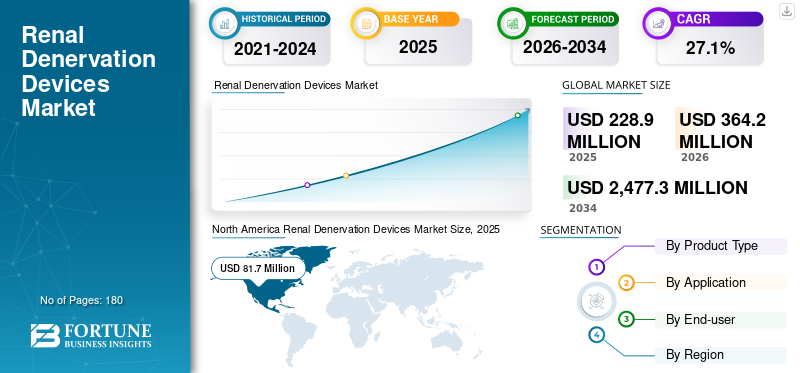
The renal denervation devices market size was valued at USD 228.9 million in 2025 and is projected to grow from USD 364.2 million in 2026 to USD 2,477.3 million by 2034, exhibiting a CAGR of 27.1% during the forecast period. North America dominated the renal denervation devices market with a market share of 35.69% in 2025.
The market covers catheter-based systems used to reduce renal sympathetic nerve activity in patients with uncontrolled or resistant hypertension. These devices are mainly based on radiofrequency energy and ultrasound energy, with emerging chemical/pharmacologic approaches still at an early stage. Renal denervation is gaining attention as hypertension remains one of the most difficult chronic conditions to manage globally, especially among patients who remain uncontrolled despite lifestyle changes and drug therapy.
Furthermore, Medtronic plc and Recor Medical, Inc. held the largest market share, driven by the limited presence of other players and consolidation.
Download Free sample to learn more about this report.
 Global Market Size & Forecast
 Market Share
 Key Regional Highlights
North America
North America held the largest market share, reaching USD 81.7 million in 2025.
Asia Pacific
Asia Pacific is projected to reach USD 91.6 million in 2026, ranking as the third-largest regional market.
Europe
Europe is projected to grow at 21.2%, reaching USD 95.7 million by 2026.
U.S.
U.S. market is forecasted to reach USD 132.6 million in 2026, accounting for 36.4% of global revenue.
Japan
Japan is projected to generate approximately USD 21.0 million in revenue by 2026, contributing nearly 5.8% to the global market.
Read More

Commercialization Shift from Clinical Validation to Center Activation and Procedure Ramp-Up is Emerging Market Trend
The key market trend is the transition from evidence-building to commercial execution. For many years, renal denervation was viewed cautiously due to earlier clinical uncertainty; however, newer-generation RF and ultrasound systems, improved trial designs, and regulatory approvals have reshaped the market. The approval of Paradise and Symplicity Spyral in the U.S. in 2023 created a major turning point as it gave physicians access to two differentiated device platforms. Medtronic’s RF-based platform and ReCor/Otsuka’s ultrasound-based platform are now shaping product competition, physician training, and hospital procurement discussions.
Another visible trend is the growing role of structured evidence programs. CMS coverage under CED encourages real-world data generation, which may help address payer questions and support broader coverage decisions over time. In Europe, guideline recognition is helping position renal denervation as a complementary option for selected uncontrolled or resistant hypertension patients. Overall, the market is moving toward a center-based adoption model, where procedure growth depends on training, referral development, patient identification, and proof of predictable outcomes.
Download Free sample to learn more about this report.
Rising Uncontrolled Hypertension Burden is Expanding the Need for Device-Based Treatment Options
The major driver for the renal denervation devices market growth is the increasing burden of uncontrolled and resistant hypertension, particularly among patients who do not achieve adequate blood pressure reduction with standard drug therapy. Hypertension is a long-term condition, but poor control significantly increases the risk of stroke, heart failure, kidney damage, and other cardiovascular complications. This creates a strong clinical need for additional treatment options beyond medication escalation. Renal denervation is being positioned as an adjunctive therapy rather than a replacement for drugs, which makes it relevant for patients who are already under physician care but continue to experience elevated blood pressure.
The market is also benefiting from better clinical confidence after newer-generation trials, regulatory approvals, and improved reimbursement visibility. In the U.S., CMS issued coverage for FDA-approved radiofrequency and ultrasound renal denervation under Coverage with Evidence Development for uncontrolled hypertension, which gives hospitals and physicians a clearer pathway for adoption. As reimbursement, referral pathways, and physician familiarity improve, procedure volumes are expected to rise steadily across advanced cardiovascular care settings.
|
Rank |
Market Driver |
Overall Impact |
CAGR Contribution |
Impact: 2026–2028 |
Impact: 2029–2031 |
Impact: 2032–2034 |
|
1 |
Large burden of uncontrolled and resistant hypertension creating strong unmet need for adjunctive device-based therapy |
High |
+8.4% |
High |
High |
High |
|
2 |
Improving regulatory, reimbursement, and guideline support for RF and ultrasound renal denervation systems |
High |
+7.2% |
High |
High |
Medium |
|
3 |
Commercial scale-up by approved RF and ultrasound platforms, supported by hospital center activation and physician training |
High |
+6.1% |
High |
High |
Medium |
|
4 |
Growing clinical evidence and real-world data generation are improving physician and payer confidence |
Medium-High |
+4.8% |
Medium |
High |
High |
|
5 |
Expansion across Asia Pacific and selected emerging markets due to large patient pools and improving cardiovascular infrastructure |
Medium |
+4.2% |
Medium |
Medium |
High |
|
6 |
Others, including product refinements, patient awareness, distributor expansion, adherence concerns with drug therapy, and broader specialist referrals |
Low |
+2.9% |
Low |
Low |
Medium |
|
Total Positive Driver Contribution |
+33.6% |
Limited Reimbursement, Strict Patient Selection, and Evidence Requirements May Slow Market Expansion
Despite strong clinical interest, the market still faces restraint from reimbursement complexity, cautious physician adoption, and strict patient-selection requirements. The procedure is not yet a routine first-line treatment for hypertension, and its use remains focused on carefully selected patients who continue to have uncontrolled blood pressure despite lifestyle and medication management. This narrows the immediately addressable patient pool compared with the overall hypertensive population.
In addition, many payers and health systems are expected to require real-world evidence on durability, safety, patient outcomes, and cost-effectiveness before supporting broad utilization. The 2024 ESC hypertension guidance supports renal denervation as an option for selected resistant or uncontrolled hypertension patients, but it also emphasizes shared decision-making, multidisciplinary assessment, and use in medium-to-high volume centers. This means adoption is likely to be concentrated in specialized hospitals and experienced interventional centers rather than spread evenly across all healthcare facilities. In emerging markets, the restraint is stronger due to limited procedural reimbursement, fewer trained operators, and lower awareness among referring physicians.
|
Rank |
Market Restraint |
Overall Impact |
Negative CAGR Impact |
Impact: 2026–2028 |
Impact: 2029–2031 |
Impact: 2032–2034 |
|
1 |
Limited long-term real-world outcomes and payer caution, especially where reimbursement depends on evidence-generation programs |
High |
-2.3% |
High |
High |
Medium |
|
2 |
Strict patient-selection requirements, complex referral pathways, and limited availability of trained procedural centers |
Medium-High |
-1.8% |
High |
High |
Medium |
|
3 |
High device/procedure cost and inconsistent reimbursement outside major developed markets |
Medium |
-1.5% |
Medium |
Medium |
Medium |
|
4 |
Others, including competition from optimized drug therapy, regulatory delays, safety perception issues, and catheterization-lab capacity limits |
Low |
-0.9% |
Low |
Low |
Low |
|
Total Negative Restraint Impact |
-6.5% |
Large Untreated Patient Pool Creates Long-Term Expansion Potential for Renal Denervation
A major opportunity for the market lies in converting the large pool of inadequately controlled hypertension patients into a structured referral base for interventional treatment. Although only a small fraction of eligible patients are as to receive renal denervation in the near term, the long-term opportunity is significant as hypertension is highly prevalent and often poorly controlled. Hospitals can develop dedicated hypertension pathways linking primary care, nephrology, cardiology, and interventional cardiology teams. This creates an opportunity for manufacturers to support physician education, patient screening tools, referral protocols, and real-world evidence programs. The opportunity is particularly attractive in the U.S., Europe, Japan, China, and selected private healthcare sectors, where advanced cardiovascular infrastructure already exists. As procedure experience increases, hospitals may become more comfortable offering renal denervation to patients who prefer an adjunctive device-based option or struggle with medication adherence and tolerability. Over time, broader guideline support, stronger reimbursement clarity, and longer-term outcome data could expand usage beyond early resistant hypertension cases into a wider uncontrolled hypertension population.
Referral Gaps, Physician Training, and Patient Awareness Challenges Market Growth
The main challenge for the market is not only regulatory approval, but also building a repeatable care pathway that moves suitable patients from diagnosis to treatment. Hypertension is often managed in primary care, internal medicine, nephrology, and cardiology settings, while renal denervation is performed by trained interventional specialists. This creates a referral gap as many uncontrolled patients may never reach a procedural center unless screening and referral protocols are actively built. Hospitals also need trained operators, catheterization lab capacity, patient-selection workflows, and follow-up systems to document outcomes.
Patient awareness is another challenge as many people with hypertension may not understand why a device-based procedure is needed when drug therapy is already available. In addition, physicians may remain cautious until more long-term real-world data are available across different patient groups. Emerging regions face added challenges, including limited reimbursement, uneven availability of advanced catheterization labs, and dependence on distributor-led product access. These factors can delay market penetration even where the clinical need is high.
RF-Based Renal Denervation Systems Lead as Commercial Availability and Physician Familiarity Support Faster Adoption
Based on product type, the market is segmented into radiofrequency (RF)-based renal denervation systems, ultrasound-based renal denervation systems, chemical/pharmacologic renal denervation systems, and others.
To know how our report can help streamline your business, Speak to Analyst
Radiofrequency-based renal denervation systems hold a highest renal denervation devices market share as RF ablation is already familiar to interventional cardiologists and vascular specialists through other catheter-based procedures. Medtronic’s Symplicity Spyral system has also provided strong commercial visibility for the RF category, particularly after U.S. FDA approval and immediate commercialization.
Additionally, the chemical/pharmacologic renal denervation systems segment is projected to grow at a CAGR of 58.3% during the forecast period.
Resistant Hypertension Leads Due to Early Adoption Focuses on the Most Difficult-to-Control Patients
By application, the market is classified into resistant hypertension, uncontrolled hypertension, and other cardiovascular & renal indications.
Resistant hypertension accounts for a high market share as renal denervation is initially being adopted among patients with persistent high blood pressure despite the use of multiple antihypertensive medicines. These patients are often managed by specialists and are more likely to be referred for advanced treatment evaluation. Moreover, the segment is projected to hold a 55.8% share in 2026.
Additionally, the uncontrolled hypertension segment is estimated to grow at a CAGR of 31.1% during the forecast period.
Hospitals Dominate as These Devices Require Interventional Infrastructure and Multidisciplinary Care
On the basis of end-user, the market is classified into hospitals, specialty clinics, and others.
Hospitals hold the highest market share as renal denervation is a catheter-based interventional procedure that typically requires catheterization lab infrastructure, imaging support, trained procedural teams, and emergency backup systems. Most early adoption is expected in tertiary hospitals, cardiovascular centers, and academic institutions that already manage complex hypertension and high-risk cardiovascular patients. Furthermore, the segment is set to hold a 79.1% share in 2026.
In addition, the specialty clinics segment is projected to grow at a CAGR of 33.5% during the forecast period.
Based on geography, the market is classified into North America, Europe, Asia Pacific, Latin America, and Middle East & Africa.
North America Renal Denervation Devices Market Size, 2025 (USD Million)
To get more information on the regional analysis of this market, Download Free sample
North America held the largest revenue share in 2024, at USD 35.0 million, and reached USD 81.7 million in 2025. North America is expected to grow strongly due to the clear commercialization and reimbursement pathway created in the U.S. after FDA approvals of both major RDN platforms. ReCor’s Paradise Ultrasound RDN System received FDA approval in November 2023, followed by Medtronic’s Symplicity Spyral RF-based RDN System, giving hospitals two approved device options for hypertension management. Growth is further supported by CMS coverage for FDA-approved radiofrequency and ultrasound renal denervation under Coverage with Evidence Development, which improves confidence among hospitals, interventional cardiologists, and payers.
In 2026, the U.S. market is forecasted to represent USD 132.6 million, capturing 36.4% of total global revenue.
Europe is expected to achieve a 21.2% growth rate in the coming years, the second-highest globally, reaching USD 95.7 million by 2026. Europe is expected to maintain steady growth as renal denervation had earlier clinical and commercial exposure in several European markets compared to North America. The region benefits from CE-marked product availability, experienced hypertension and interventional cardiology centers, and strong participation in clinical evidence generation.
The U.K. market is projected to reach USD 15.4 million by 2026, accounting for 4.2% of the global market revenue.
Germany's market is forecasted to reach about USD 23.6 million by 2026, representing roughly 6.5% of global revenue.
In 2026, the Asia Pacific market is predicted to be valued at USD 91.6 million, ranking as the third-largest globally. Asia Pacific is expected to be one of the fastest-growing regions due to a large uncontrolled hypertension burden, expanding interventional cardiology infrastructure, and recent country-level regulatory approvals. Australia and selected Southeast Asian markets are expected to contribute through private hospitals and advanced cardiovascular centers. Overall, the region’s growth is driven by large patient pools, improving specialist access, and phased commercial launches.
Japan is projected to generate approximately USD 21.0 million in revenue by 2026, contributing nearly 5.8% to the global market.
China's market is forecast to reach approximately USD 31.4 million by 2026, contributing about 8.6% to global revenues.
India is forecast to contribute approximately USD 8.7 million to the market by 2026, corresponding to about 2.4% of global revenues.
Both Latin America and the Middle East & Africa are anticipated to witness moderate market growth, with Latin America expected to reach around USD 22.9 million by 2026. Latin America is expected to grow from a small base, mainly through private hospitals, distributor-led commercialization, and advanced cardiovascular centers in Brazil, Mexico, and selected urban markets. The region has a meaningful hypertension burden, but adoption of renal denervation devices is likely to remain concentrated among patients who can access premium interventional care. The Middle East & Africa market is expected to expand gradually, led mainly by GCC countries and selected tertiary hospitals in South Africa. Growth is supported by rising awareness of hypertension-related cardiovascular risk, investment in advanced hospital infrastructure, and the availability of internationally approved renal denervation systems in premium care settings.
By 2026, the GCC is expected to generate approximately USD 7.2 million in the market, accounting for nearly 2.0% of global revenues.
Robust Product Innovation to Reinforce the Market Position of Prominent Players
The renal denervation devices market is highly concentrated and still in an early commercialization phase. The competitive landscape is led by Medtronic plc and Recor Medical, Inc. which together account for the majority of commercial revenue through two differentiated platforms: Medtronic’s Symplicity Spyral RF-based system and ReCor’s Paradise ultrasound-based system. Both have U.S. FDA approval, and their competitive positioning is strengthened by growing reimbursement clarity and real-world evidence generation.
Competition is mainly based on technology platform, clinical evidence, regulatory access, physician training, and center activation rather than price alone. RF-based systems currently hold a strong position due to physician familiarity with ablation procedures and Medtronic’s global commercial infrastructure. Ultrasound-based systems are also gaining share, supported by ReCor’s Paradise platform, which is FDA-approved, CE-marked, and approved in Japan.
The report provides an in-depth analysis of all market segments, highlighting key drivers, trends, opportunities, restraints, and challenges. It also provides insights into technological advancements, key industry developments, company market share analysis, and profiles of leading companies.
Request for Customization to gain extensive market insights.
| ATTRIBUTE | DETAILS |
| Study Period | 2021-2034 |
| Base Year | 2025 |
| Estimated Year | 2026 |
| Forecast Period | 2026-2034 |
| Historical Period | 2021-2024 |
| Growth Rate | CAGR of 27.1% from 2026-2034 |
| Unit | Value (USD Million) |
| Segmentation | By Product Type, Application, End-user, and Region |
| By Product Type |
|
| By Application |
|
| By End-user |
|
| By Geography |
|
Fortune Business Insights says that the global market value stood at USD 228.9 million in 2025 and is projected to reach USD 2,477.3 million by 2034.
In 2025, the North America market value stood at USD 81.7 million.
The market is expected to exhibit a CAGR of 27.1% during the forecast period of 2026-2034.
The radiofrequency (RF)-based renal denervation systems segment led the market by product type.
The key factors driving the market are the rising uncontrolled hypertension burden is expanding the need for device-based treatment options.
Medtronic plc and Recor Medical, Inc. are major players in the market.
North America dominated the market in 2025.

Get 30-60 hrs Free Customization
Expand Regional and Country Coverage, Segments Analysis, Company Profiles, Competitive Benchmarking, and End-user Insights.











.webp)






Related Reports
Get In Touch With Us
US +1 833 909 2966 ( Toll Free )
Receive a tailored pricing based on your needs.
Discuss your questions with our industry experts.
Have questions? Get quick answers before you purchase.

