Renewable Energy Integration in EV Charging Market Size, Share & Industry Analysis, By Energy Source (Solar-integrated EV, Wind-powered EV, Hybrid Renewable Energy, Renewable-integrated Charging), By Charging Type (AC Renewable, DC Fast, Ultra-fast, and Wireless), By Application (Commercial EV Charging Stations, Residential Charging Infrastructure, Fleet Charging Depots, Public Transportation Charging, and Highway Fast-charging Networks), By Installation Type (Grid-connected Renewable Charging Systems and Off-grid Renewable Charging Systems), and Regional Forecast, 2026-2034
 Download Free Sample
(Offer valid till 30th Sep 2026)

Renewable Energy Integration in EV Charging Market Size and Future Outlook
 Listen to Audio Version
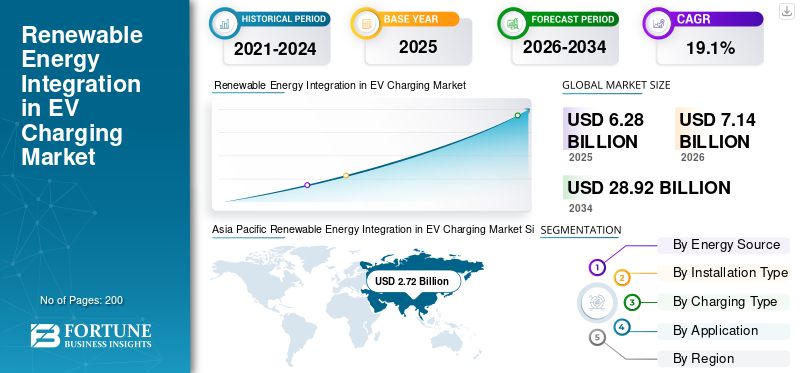
The global renewable energy integration in EV charging market size was valued at USD 6.28 billion in 2025. The market is projected to grow from USD 7.14 billion in 2026 to USD 28.92 billion by 2034, exhibiting a CAGR of 19.1% during the forecast period. Asia Pacific dominated the renewable energy integration in EV charging market with a market share of 43.31% in 2025.
The market refers to the deployment of EV charging infrastructure powered by renewable energy sources such as solar and wind and supported by smart charging, energy storage systems, and vehicle-to-grid (V2G) technology. The market growth is driven by rising electric vehicles (EVs) adoption, increasing clean energy investments, surging focus on reducing greenhouse gas emissions and carbon footprint, expanding EV charging stations, and advancements in charging technology and grid stability solutions.
Major players in the market include ABB Ltd., Siemens AG, Schneider Electric SE, Tesla, Inc., ChargePoint Holdings, Inc., and Delta Electronics. These companies are competing through smart charging technologies, vehicle-to-grid (V2G) technology, renewable energy integration, AI-enabled energy management systems, and advanced EV charging infrastructure solutions.
Download Free sample to learn more about this report.
Renewable Energy Integration in EV Charging Market Key Takeaways
 Global Market Size & Forecast
- 2025 Market Size: USD 6.28 billion
- 2026 Market Size: USD 7.14 billion
- 2034 Forecast Market Size: USD 28.92 billion
- CAGR: 19.1% (2026–2034)
 Market Share
- Asia Pacific dominated the market with a 43.31% share in 2025.
- The hybrid renewable energy charging segment is projected to grow at a 20.8% CAGR during the forecast period.
- The off-grid renewable charging systems segment is expected to register the fastest growth, expanding at a 22.4% CAGR during the forecast period.
 Key Regional Highlights
Asia Pacific
Asia Pacific held the largest market share in 2025 and is expected to register the fastest growth during the forecast period, driven by strong EV adoption.
North America
North America is expected to maintain the third-largest market share, supported by increasing EV adoption, expanding fast-charging infrastructure.
Europe
Europe is projected to remain the second-largest regional market, growing at a 16.5% CAGR during the forecast period.
U.S.
U.S. market is projected to reach USD 1.31 billion by 2026.
Japan
Japan market is projected to reach USD 0.16 billion by 2026.
Read More

RENEWABLE ENERGY INTEGRATION IN EV CHARGING MARKET TRENDS
Integration of Solar-powered EV Charging Stations Gains Significant Traction
The market is witnessing strong adoption of solar-integrated EV charging stations as businesses, residential complexes, and public charging operators seek sustainable energy alternatives. Solar panels installed at charging stations powered by renewable electricity help reduce operational expenses and dependency on conventional power grids. The increasing investments in distributed clean energy infrastructure and off-grid charging solutions are further supporting renewable energy integration in EV charging market trends. Companies are also integrating battery energy storage systems with solar charging infrastructure to improve charging reliability, manage intermittent renewable generation, and enhance long-term energy efficiency.
- In October 2025, the Government of Chandigarh, India, announced plans to develop India’s first fully solar-powered EV charging station at the IT Park. The project integrates a 500-kW solar setup with battery energy storage systems, supporting round-the-clock renewable-powered EV charging and reducing dependence on conventional power grids.
AI-enabled Energy Optimization and Smart Grid Integration to Emerge as Key Market Trends
Artificial intelligence and smart grid technologies are major trends in the market. AI-enabled systems optimize charging patterns, forecast energy demand, and improve the utilization of renewable energy sources during varying consumption cycles. Smart charging platforms integrated with energy management systems support real-time monitoring and efficient electricity distribution across EV charging stations. Utilities and charging network providers are increasingly investing in digital grid infrastructure to improve energy efficiency, minimize peak demand pressure, and ensure reliable integration of renewable energy into large-scale EV charging operations.
- In May 2024, the EU-funded I-NERGY project highlighted how AI-enabled energy management systems improve smart grid optimization, EV charging demand forecasting, and renewable energy integration. The initiative supports grid stability, predictive maintenance, and the efficient utilization of clean energy across sustainable EV charging infrastructure.
MARKET DYNAMICS
MARKET DRIVERS
Download Free sample to learn more about this report.
Rising EV Adoption and Clean Energy Targets to Accelerate Charging Infrastructure Expansion
The rapid adoption of electric vehicles (EVs) and increasing global focus on reducing greenhouse gas emissions are significantly driving the renewable energy integration in EV charging market growth. Governments and private companies are investing heavily in EV charging infrastructure supported by renewable energy sources such as solar and wind to support sustainable energy goals. Expanding charging stations powered by clean energy are helping reduce carbon footprint while improving grid stability. The growing public awareness regarding environmental sustainability and increasing demand for low-emission transportation are further supporting product demand worldwide.
- In 2025, according to the International Energy Agency (IEA), the global electric vehicle sales surpassed 21 million units, increasing by over 20% year-on-year.
Expansion of Smart Charging and Vehicle-to-grid Technologies to Strengthen Energy Management
The increasing deployment of smart charging systems and vehicle to grid (V2G) technology is driving market growth by improving energy management and optimizing power grid performance. Smart charging technology helps balance peak demand, reduces electricity costs, and supports efficient charging schedules for electric vehicles EVs. V2G technology allows EV batteries to supply electricity back to power grids during high-demand periods, improving grid stability and renewable energy utilization. The growing integration of AI-enabled energy management systems and battery storage technologies is further enhancing operational efficiency and supporting renewable-powered EV charging networks.
- In May 2026, Driivz partnered with Dunamis Charge to accelerate the expansion of EV charging infrastructure in the S. through smart energy management platforms, AI-enabled charging optimization, and scalable Level-2 and DC fast-charging deployments across commercial, residential, fleet, and public charging station networks nationwide.
MARKET RESTRAINTS
High Initial Infrastructure and Energy Storage Costs May Limit Large-scale Deployments
The market faces restraints due to the high capital investment required for renewable-powered charging infrastructure, advanced charging technology, and battery energy storage systems. Installing solar panels, wind-powered charging systems, and smart energy management platforms significantly increases project costs, particularly in developing regions with limited financial support. Additional expenses related to grid modernization, land acquisition, and system maintenance can also slow deployment rates. These financial barriers may restrict small operators and municipalities from implementing large-scale renewable EV charging infrastructure projects effectively.
MARKET OPPORTUNITIES
Growing Deployment of Highway Fast-Charging Networks Creates New Expansion Opportunities
The increasing development of highway fast-charging corridors presents major opportunities for renewable energy integration in EV charging. Governments and private charging companies are expanding ultra-fast EV charging stations across highways to support long-distance electric mobility. Integrating renewable energy sources such as solar and wind into these charging networks helps reduce operational costs and supports clean energy transportation initiatives. The rising adoption of commercial EV fleets and electric buses is also increasing the demand for high-capacity renewable-powered charging infrastructure along transportation corridors globally.
- In May 2026, Tata Power EV Charging Solutions expanded its ultra-fast EV charging network on the Delhi-Mumbai Expressway in partnership with Indian Oil Corporation. The company inaugurated 240 kW charging stations on the Haryana stretch, strengthening renewable-integrated EV charging infrastructure for personal and commercial electric vehicle users across India.
Increasing Investments in Energy Storage Systems to Open New Revenue Opportunities
Growing investments in energy storage systems are creating strong opportunities in the market. Battery storage technologies help store excess renewable electricity generated from solar and wind sources, ensuring continuous EV charging availability during fluctuating energy production periods. Energy storage systems also support peak demand management, improve grid reliability, and reduce electricity costs for charging operators. As renewable energy penetration increases globally, advanced storage integration is expected to become a critical component of sustainable EV charging infrastructure development.
- In May 2026, SunCharge Motors secured seed funding to accelerate solar-integrated EV mobility solutions in India. The investment would support the expansion of renewable-powered EV charging infrastructure, smart energy management technologies, and sustainable clean energy transportation solutions across emerging electric vehicle markets.
MARKET CHALLENGES
Intermittent Renewable Energy Generation and Grid Modernization Challenges to Impact Reliability
One of the major challenges in the market is managing the intermittent nature of renewable energy sources such as solar and wind. Variations in weather conditions can affect electricity generation consistency, impacting charging reliability and energy availability. In several developing regions, outdated power grids and limited smart grid infrastructure further complicate renewable energy integration. Ensuring a stable electricity supply, efficient energy management, and scalable charging operations while maintaining grid stability remains a critical challenge for market participants and utility providers.
Segmentation Analysis
By Energy Source
Rising Deployment of Solar Panels to Drive Solar-integrated EV Charging Segment Growth
Based on energy source, the market is segmented into solar-integrated EV charging, wind-powered EV charging, hybrid renewable energy charging, and other renewable-integrated charging systems.
The solar-integrated EV charging segment dominates the market due to increasing deployment of solar panels at EV charging stations and strong government support for clean energy infrastructure. Solar-powered charging systems help reduce electricity costs, lower carbon footprint, and improve sustainable energy utilization across residential, commercial, and highway charging networks. The soaring adoption of electric vehicles EVs, advancements in smart charging technology, and rising investments in energy storage systems are further supporting market growth. The ability to improve grid stability while integrating renewable energy efficiently continues to strengthen the demand for solar-integrated solutions globally.
- In June 2025, India launched its first solar-powered EV charging station integrated with second-life battery storage near Bengaluru Airport. The project combines solar panels, battery energy storage systems, and fast EV charging infrastructure to improve grid stability and support sustainable clean energy transportation.
The hybrid renewable energy charging segment is projected to expand at a CAGR of 20.8% during the forecast period. The increasing integration of solar and wind energy sources with battery storage systems improves charging reliability, supports peak demand management, and enhances renewable energy utilization for large-scale EV charging infrastructure deployment.
To know how our report can help streamline your business, Speak to Analyst
By Installation Type
Soaring Investments in Renewable Energy Integration to Boost Grid-connected Renewable Charging Systems Segment Growth
Based on installation type, the market is segmented into grid-connected renewable charging systems and off-grid renewable charging systems.
The grid-connected renewable charging systems segment holds the largest market share due to strong integration with existing power grids, improving charging reliability and energy distribution efficiency. These systems support large-scale EV charging infrastructure deployment across commercial, residential, and highway charging networks while enabling smart charging and vehicle-to-grid (V2G) technology integration. The growing investments in grid modernization, renewable energy integration, and energy management systems are further supporting segment growth. Additionally, grid-connected infrastructure helps manage peak demand and enhances the stable utilization of renewable energy sources such as solar and wind.
- In May 2026, the IEA highlighted the growing adoption of vehicle-to-grid (V2G) technology to improve grid stability, reduce peak demand, and optimize renewable energy integration. Expanding smart charging systems and bidirectional EV charging infrastructure are creating new revenue opportunities for electric vehicle owners globally.
The off-grid renewable charging systems segment is expected to expand at a CAGR of 22.4% during the forecast period. The increasing deployment in remote locations, rising demand for sustainable energy solutions, and surging adoption of solar-powered EV charging stations with battery energy storage systems are accelerating segment growth globally.
By Charging Type
Increasing Rapid Charging Solutions Demand to Propel DC Fast Renewable EV Chargers Segment Growth
Based on charging type, the market is segmented into AC renewable EV chargers, DC fast renewable EV chargers, ultra-fast renewable charging systems, and wireless renewable EV charging.
The DC fast renewable EV chargers segment holds a dominant renewable energy integration in EV charging market share due to the rising demand for rapid charging solutions across commercial EV charging stations, highway fast-charging networks, and public transportation infrastructure. These charging systems significantly reduce vehicle charging time while supporting large-scale electric vehicles EVs adoption. Integration with renewable energy sources such as solar and wind, along with advanced energy storage systems, further enhances charging efficiency and grid stability. Growing investments in smart charging infrastructure and increasing deployment of renewable-powered charging stations are also strengthening segment growth globally.
- In December 2025, Guangzhou Max Power New Energy Technology highlighted the growing adoption of solar-powered EV charging stations integrated with energy storage systems and intelligent energy management software, supporting sustainable energy, grid reliability, smart charging infrastructure, and reduced operational costs for commercial electric vehicle charging networks globally.
The ultra-fast renewable charging systems segment is projected to expand at a CAGR of 22.1% during the forecast period. Increasing long-distance EV travel demand, expansion of high-capacity charging corridors, and rising adoption of advanced charging technology integrated with clean energy and smart energy management systems are accelerating segment growth.
By Application
Expanding Renewable-powered Charging Infrastructure Deployment to Impel Commercial EV Charging Stations Segment Growth
Based on application, the market is segmented into commercial EV charging stations, residential charging infrastructure, fleet charging depots, public transportation charging, and highway fast-charging networks.
The commercial EV charging stations segment dominates the market due to the increasing deployment of renewable-powered EV charging infrastructure across shopping centers, offices, public parking spaces, and urban charging hubs. The rising electric vehicle adoption, growing investments in smart charging technology, and increasing demand for reliable, clean energy charging solutions are supporting segment growth. Commercial charging operators are increasingly integrating renewable energy sources such as solar and wind along with energy storage systems to improve grid stability, reduce operational costs, and support sustainable energy transportation infrastructure worldwide.
The highway fast-charging networks segment is anticipated to expand at a CAGR of 24.8% during the forecast period. The rising long-distance EV travel, increasing government investments in corridor charging infrastructure, and growing deployment of ultra-fast charging stations powered by renewable energy are significantly accelerating the expansion of the segment globally.
- In May 2026, Uttar Pradesh accelerated EV mobility infrastructure expansion ahead of the Jewar Airport launch by strengthening expressway-based EV charging networks. The initiative supports renewable-powered charging stations, sustainable transportation, smart charging infrastructure, and improved electric vehicle connectivity across major transportation corridors.
Renewable Energy Integration in EV Charging Market Regional Outlook
By geography, the market is categorized into Europe, North America, Asia Pacific, South America, and the Middle East & Africa.
Asia Pacific
Asia Pacific Renewable Energy Integration in EV Charging Market Size, 2025 (USD Billion)
To get more information on the regional analysis of this market, Download Free sample
Asia Pacific holds the largest market share and is the fastest-growing region due to strong electric vehicle adoption, expanding EV charging infrastructure, and significant government investments in clean energy projects. Countries such as China, Japan, South Korea, and India are rapidly deploying solar-integrated charging stations, smart charging systems, and vehicle-to-grid V2G technology. The increasing renewable energy capacity, growing urbanization, and large-scale public transportation electrification projects are further accelerating market growth and strengthening the regional demand for sustainable energy charging solutions.
- In February 2026, Bolt.Earth emphasized the growing importance of smart charging, energy storage systems, and vehicle-to-grid V2G readiness in renewable-powered EV charging infrastructure. The company highlighted challenges related to grid stability, renewable variability, and load balancing while supporting scalable clean energy transportation solutions in India.
China Renewable Energy Integration in EV Charging Market
The China market is estimated to touch a value of around USD 2.34 billion in 2026, accounting for roughly 32.7% of the global market revenues. China dominates due to large-scale EV adoption, strong renewable energy investments, rapid smart charging deployment, and expanding solar-powered highway charging infrastructure supported by government clean energy policies.
Japan Renewable Energy Integration in EV Charging Market
The Japan market is estimated to reach around USD 0.16 billion in 2026, accounting for roughly 2.2% of the global market revenues. The market growth in the country is driven by smart grid modernization, vehicle-to-grid V2G technology adoption, energy-efficient charging systems, and increasing renewable-powered EV charging deployment across urban transportation networks.
India Renewable Energy Integration in EV Charging Market
The India market is estimated to reach a value of around USD 0.21 billion in 2026, accounting for roughly 2.9% of global market revenues. India is the fastest-growing market due to rising EV adoption, government clean energy initiatives, solar-integrated charging expansion, and increasing investments in sustainable transportation infrastructure development.
Europe
Europe represents the second-largest market and is projected to expand at a CAGR of 16.5% during the forecast period. Strong carbon neutrality targets, rising investments in renewable energy sources, and supportive government regulations are driving market demand across the region. Countries including Germany, the Netherlands, France, and the Nordic nations are actively deploying renewable-powered EV charging stations integrated with smart grids and energy storage systems. The increasing focus on reducing greenhouse gas emissions, improving grid stability, and integrating renewable energy into transportation infrastructure continues to support regional market growth.
- In May 2026, the EBRD announced an investment of approximately USD 39.8 million as part of a USD 128.5 million financing package for GreenWay to expand renewable-powered EV charging infrastructure across Poland, the Slovak Republic, and Croatia, supporting sustainable mobility and reducing greenhouse gas emissions in central Europe.
Germany Renewable Energy Integration in EV Charging Market
The Germany market is estimated to reach a value of around USD 0.31 billion in 2026, accounting for roughly 4.3% of global market revenues. The market growth is supported by strong renewable energy integration policies, expanding EV charging infrastructure, battery storage deployment, and increasing focus on reducing greenhouse gas emissions.
U.K. Renewable Energy Integration in EV Charging Market
The U.K. market is estimated to hit a valuation of around USD 0.29 billion in 2026, accounting for roughly 4.1% of global market revenues. The increasing investments in renewable-powered charging stations, smart charging technologies, and nationwide net-zero transportation strategies are driving market demand across the country.
North America
North America accounts for the third-largest market share due to the increasing adoption of electric vehicles EVs, expanding fast-charging infrastructure, and rising investments in renewable energy integration technologies. The U.S. and Canada are witnessing the growing deployment of solar-powered charging stations, battery energy storage systems, and AI-enabled energy management platforms. Increasing partnerships between utilities, renewable energy companies, and EV charging providers are further supporting infrastructure expansion. Government incentives promoting clean energy transportation and advancements in charging technology are also contributing significantly to market demand across the region.
- In May 2026, ChargePoint partnered with OBE Power to deploy nearly 2,500 EV charging ports across multifamily residential properties in North America. The initiative supports expanding EV charging infrastructure, improving residential charging access, and accelerating sustainable electric mobility adoption with advanced charging technology solutions.
U.S. Renewable Energy Integration in EV Charging Market
The U.S. market is estimated to reach a value of around USD 1.31 billion in 2026, accounting for roughly 18.4% of global market revenues. The market growth is driven by expanding highway fast-charging networks, renewable energy investments, advanced energy management systems, and increasing deployment of solar-powered EV charging stations nationwide.
South America
The South America market is experiencing steady market growth driven by increasing renewable energy investments and the gradual expansion of EV charging infrastructure across major urban centers. Countries such as Brazil, Chile, and Colombia are focusing on integrating solar and wind energy into public charging networks to support sustainable mobility initiatives. Rising government efforts to reduce carbon footprint and improve clean energy adoption are creating opportunities for renewable-integrated EV charging systems. Additionally, the growing interest in public transportation electrification and off-grid renewable charging solutions is supporting regional market development.
- In September 2025, Winline Technology showcased next-generation EV charging and energy storage solutions at The Smarter E South America 2025 in Brazil. The company introduced AI-enabled DC fast chargers, V2G-compatible power modules, and smart energy management technologies supporting renewable-powered EV charging infrastructure expansion globally.
Middle East & Africa
The Middle East & Africa represents the fourth-largest market, supported by increasing investments in renewable energy infrastructure and smart city development projects. Countries including the UAE, Saudi Arabia, and South Africa are expanding EV charging stations powered by solar energy to support sustainable transportation goals. The rising adoption of clean energy technologies, improving charging infrastructure, and growing focus on reducing dependence on fossil fuels are driving market demand. Furthermore, the increasing deployment of off-grid renewable charging systems in remote areas is supporting long-term regional market growth.
- In February 2026, DEWA accelerated Dubai’s sustainable mobility transition by expanding its EV Green Charger network to over 1,860 charging points. Strategic partnerships and regulatory support are strengthening smart charging infrastructure, reducing greenhouse gas emissions, and supporting growing electric vehicle adoption across the emirate.
COMPETITIVE LANDSCAPE
Key Industry Players
Companies Focus on Smart Charging, Renewable Integration, and Energy Management Innovations to Secure an Edge over Competitors
The renewable energy integration in EV charging market is moderately fragmented, with global energy technology providers, EV charging companies, and renewable infrastructure developers competing through smart charging platforms, vehicle-to-grid V2G technology, and integrated energy management systems. Key players including ABB Ltd., Siemens AG, Schneider Electric SE, Tesla, Inc., ChargePoint Holdings, Inc., and Delta Electronics focus on renewable-powered EV charging stations, AI-enabled grid optimization, and advanced energy storage systems. Companies are strengthening competitive edge through strategic partnerships, renewable integration projects, localized infrastructure expansion, and software-driven charging solutions. Increasing investments in solar-powered charging networks and smart grid connectivity continue shaping competitive intensity globally.
- In May 2025, ABB launched Battery Energy Storage Systems-as-a-Service (BESS-as-a-Service) to accelerate renewable energy adoption and support sustainable EV charging infrastructure. The solution helps businesses improve energy storage, reduce peak demand charges, strengthen grid stability, and integrate clean energy without upfront capital investment.
LIST OF KEY RENEWABLE ENERGY INTEGRATION IN EV CHARGING COMPANIES PROFILED
- ABB Ltd. (Switzerland)
- Siemens AG (Germany)
- Schneider Electric SE (France)
- Tesla, Inc. (U.S.)
- ChargePoint Holdings, Inc. (U.S.)
- Delta Electronics, Inc. (Taiwan)
- EVBox (Netherlands)
- Wallbox N.V. (Spain)
- Blink Charging Co. (U.S.)
- Eaton Corporation plc (Ireland)
- Shell Recharge Solutions (U.S.)
- bp pulse (U.K.)
- Enel X Way (Italy)
- Tritium DCFC Limited (Australia)
- Alfen N.V. (Netherlands)
KEY INDUSTRY DEVELOPMENTS
- May 2026: Siemens unveiled a 1.25 MW solar-plus-storage microgrid at its North Carolina facility, integrating battery energy storage systems, smart energy management, and EV charging infrastructure. The project supports renewable energy integration, grid stability, carbon-neutral operations, and sustainable electric vehicle charging using solar-generated clean energy.
- April 2026: Schneider Electric launched Schneider Boost Pro in the U.K., introducing advanced battery energy storage systems for smart energy management and renewable-powered EV charging infrastructure. The solution supports grid stability, peak demand management, carbon footprint reduction, and sustainable charging for commercial buildings, buses, and trucks.
- April 2026: Tesla announced plans to expand its EV charging infrastructure, service centers, and bodyshop network across India. The company is developing charging corridors connecting major cities, strengthening smart charging accessibility, and supporting long-term electric mobility and sustainable transportation growth nationwide.
- October 2025: Schneider Electric launched Schneider Boost Pro across Europe, introducing advanced battery energy storage systems for renewable-powered EV charging infrastructure and smart energy management. The solution supports grid stability, peak demand reduction, energy storage optimization, and sustainable charging for commercial buildings, buses, trucks, and highway charging networks.
- June 2025: Wallbox and ENSOL EV expanded their partnership to deploy Supernova DC fast chargers across Texas, Florida, and Georgia. The initiative integrates solar energy and battery storage systems with fast EV charging infrastructure, supporting smart charging, clean energy adoption, and sustainable electric mobility growth.
- February 2024: Siemens launched Gridscale X software to support autonomous grid management, improve distributed energy resource visibility, and strengthen grid stability. The platform helps utilities accelerate renewable energy integration, smart charging infrastructure expansion, and digital transformation for sustainable energy and EV charging networks.
- September 2022: Schneider Electric launched the world’s first smart home EV charger integrated with a home energy management system. The EVlink Home Smart Charger supports renewable energy integration, smart charging, CO2 emission monitoring, and optimized electricity consumption to reduce energy bills and carbon footprint.
REPORT COVERAGE
The global renewable energy integration in EV charging market analysis provides an in-depth study of the market size and forecast by all the market segments included in the market report. It includes details on the market dynamics and trends expected to drive the market over the forecast period. It offers information on technological advancements, new product launches, key automotive industry developments, and details on partnerships, mergers, and acquisitions. The market report scope also encompasses a detailed competitive landscape with information on the market share and profiles of key operating players.
Request for Customization to gain extensive market insights.
Report Scope & Segmentation
| ATTRIBUTE | DETAILS |
| Study Period | 2021-2034 |
| Base Year | 2025 |
| Estimated Year | 2026 |
| Forecast Period | 2026-2034 |
| Historical Period | 2021-2024 |
| Growth Rate | CAGR of 19.1% from 2026-2034 |
| Unit | Value (USD Billion) |
| Segmentation | By Energy Source, By Installation Type, By Charging Type, By Application, and By Region |
| By Energy Source |
|
| By Installation Type |
|
| By Charging Type |
|
| By Application |
|
| By Region |
|
Frequently Asked Questions
Fortune Business Insights says that the global market value stood at USD 6.28 billion in 2025 and is projected to reach USD 28.92 billion by 2034.
In 2025, the Asia Pacific market value stood at USD 2.72 billion.
The market is expected to exhibit a CAGR of 19.1% during the forecast period of 2026-2034.
The solar-integrated EV charging segment leads the market by energy source.
The rising EV adoption and clean energy targets are key factors driving the market.
Key players including ABB Ltd., Siemens AG, Schneider Electric SE, Tesla, Inc., ChargePoint Holdings, Inc., and Delta Electronics dominate the market.
Asia Pacific holds the largest share of the market.



- 2021-2034
- 2025
- 2021-2024
- 200
-
(Offer valid till 30th Sep 2026)
Get 30-60 hrs Free Customization
Expand Regional and Country Coverage, Segments Analysis, Company Profiles, Competitive Benchmarking, and End-user Insights.




















Related Reports
-
US +1 833 909 2966 ( Toll Free )
-
Get In Touch With Us