Respiratory Syncytial Virus (RSV) Therapeutics Market Size, Share & Industry Analysis, By Drug Class (Prophylaxis and Treatment), By End-user (Hospital Pharmacy, Retail Pharmacy, and Online Pharmacy) and Regional Forecast, 2026-2034
 Download Free Sample
Respiratory Syncytial Virus Therapeutics Market Size and Industry Overview
 Listen to Audio Version
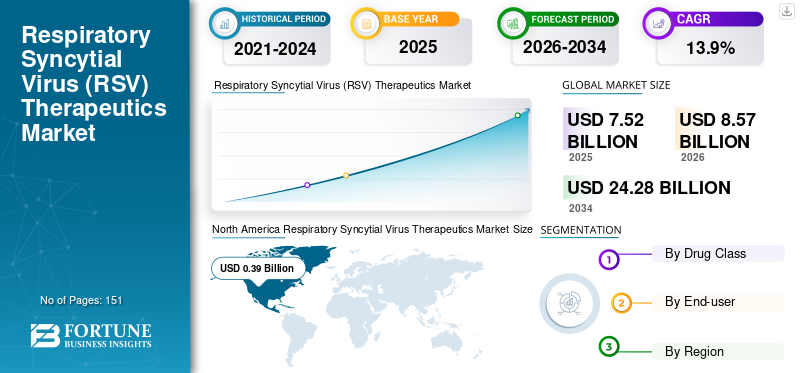
The global respiratory syncytial virus therapeutics market size was valued at USD 7.52 billion in 2025. The market is projected to grow from USD 8.57 billion in 2026 to USD 24.28 billion by 2034, exhibiting a CAGR of 13.90% during the forecast period. North America dominated the respiratory syncytial virus therapeutics market with a market share of 35.63% in 2025.
The respiratory syncytial virus is one of the major causative organisms for Lower Respiratory Tract Infection (LRTI) among infants. It is estimated that there are around 33 million RSV infections in children below the age of 5 years, which leads to around 3.3 million hospitalizations and 60,000 deaths globally every year. Combined with this, there is a huge unmet need for RSV drugs and vaccines in the market. Currently, there are only two approved drugs for the prevention and treatment of RSV infection. The rising prevalence of the RSV infection, combined with the potential launch of new therapies, is estimated to augment RSV therapeutics market growth in the coming years.
Clinical Trials and R&D Activities to Get Affected due to COVID-19 Pandemic
The sudden emergence of the pandemic has disrupted the pharma companies regarding the day-to-day activities and shifted the focus on minimizing the effects caused. In July 2020, the representatives of Sanofi remarked that the outbreak of COVID-19 had disrupted the clinical trials for the study of nirsevimab. The challenges include patient recruitment and patient retention during the trials. The company also stated that the COVID-19 outbreak could also impact the RSV infection season, making it difficult to evaluate the drug's efficacy during clinical trials.
Download Free sample to learn more about this report.
Respiratory Syncytial Virus Therapeutics Market Key Takeaways
 Global Market Size & Forecast
- 2025 Market Size: USD 7.52 billion
- 2026 Market Size: USD 8.57 billion
- 2034 Forecast Market Size: USD 24.28 billion
- CAGR: 13.90% from 2026–2034
 Market Share
- North America dominated the market with a 35.63% share in 2025.
- The Prophylaxis segment dominated the market, supported by maternal vaccine approvals and launches.
- The Hospital Pharmacy segment held the largest share among end-users due to healthcare professional-administered therapies.
 Key Regional Highlights
Asia Pacific
Asia Pacific is expected to record considerable growth due to improving healthcare infrastructure and increasing RSV treatment adoption.
North America
North America leads the market owing to the high prevalence of RSV infections and broad access to treatment and preventive therapies.
Europe
Europe is witnessing steady growth, supported by advanced healthcare infrastructure, government RSV surveillance programs, and strong reimbursement systems.
U.S.
High RSV disease burden, with approximately 2.1 million outpatient visits annually among children under five, continues to drive market demand.
Japan
Advanced healthcare infrastructure and higher penetration of RSV therapeutics are supporting market expansion.
Read More

Respiratory Syncytial Virus Therapeutics Market Trends
Persistent Focus on Reducing RSV Infection Treatment Cost to Become a Vital Trend
Investing in the development of a novel mechanism to enhance efficacy and reduce the drug's cost is one of the key trends exhibited by the market players. Nirsevimab, which is slated to launch in 2023, is estimated to be priced at USD 600 compared to a whopping USD 6,000 price tag of palivizumab. A collaborative approach towards discovering the treatment and preventative therapeutics for RSV infection is among the predominant trends experienced in the market. In addition, key players are focusing on partnerships to increase their chances for discovery of the treatment and capture the unmet demand from the infected population.
Download Free sample to learn more about this report.
DRIVING FACTORS
Strategic Acquisitions and Collaborations among Industry Players to Spur Market Opportunities
Collaborative efforts of key players aim at launching a cost-effective and efficacious molecule to treat the RSV disease. The aforementioned factor is anticipated to positively impact the market value during the forecast duration. Additionally, the healthcare landscape has significantly changed owing to the collaborative approach between the non-traditional and the existing traditional players to innovate more efficient and cost-effective treatment for RSV.
For instance, in January 2019, Swedish Orphan Biovitrum Ab (Sobi) acquired distribution rights of Synagis, an RSV prophylactic drug from AstraZeneca, for a whopping USD 1.5 billion. As per the terms and conditions of the agreement, Sobi also gained 50% rights to the future revenues generated by MEDI8896, a drug currently under clinical trials and sponsored by AstraZeneca.
Strong Pipeline of Products Showing Promising Results to Propel Unmet Demand
The use of monoclonal antibodies in infants to cause passive immunization is one of the key approaches being pursued by the pharmaceutical companies in their fight against RSV. The pipeline products offer significant benefits over Synagis and the other approach of vaccinating pregnant mothers to provide passive immunization to infants. Factors, such as novel mechanisms, lower cost, and protection for the entire season through one injection and immediate protection against the disease are estimated to augment market growth.
For instance, Nirsevimab, which is being developed jointly by Sanofi and AstraZeneca, is proving to be the most promising candidate among these pipeline products. Phase 2 results showed around 70% reduction in medically attended RSV-associated LRTI and around 78% reduction in RSV-associated LRTI related hospitalizations. Hence, the focus of companies to develop new drugs to treat and prevent RSV infection is driving the market growth.
RESTRAINING FACTORS
Failure of Pipeline Products in Clinical Trials to Hamper Growth
Pharmaceutical companies have faced significant challenges in the development of drugs for the treatment of RSV, which is evident from the approval of only one product, i.e. Synagis, in the past two decades. A large number of monoclonal antibody and vaccine candidates have failed to meet the required efficacy and suffered severe setbacks in the late stage of development. Last stage clinical failure of such drugs has negatively impacted the growth of the RSV therapeutics market.
For instance, In July 2019, Ablynx terminated a Phase 2 clinical trial of its investigational drug named ALX-0171 that was indicated to treat RSV infection in infants younger than two years. The manufacturer decided to discontinue the trials due to a lack of evidence supporting the efficacy of the drug in treating the disease.
Segmentation Analysis
By Drug Class Analysis
To know how our report can help streamline your business, Speak to Analyst
Prophylaxis Segment Held the Highest Market Share in 2019
Based on drug type, the market is categorized into prophylaxis and treatment. The prophylaxis segment dominated the market in 2019. Potential approvals and the launch of maternal vaccines by Pfizer and GSK are estimated to propel the segment growth in the foreseen years.
The treatment segment holds a smaller share in the global RSV therapeutics market. An increase in research and development to develop drugs indicated to treat RSV infection is estimated to propel the global market during the forecast duration.
By End-user Analysis
Hospital Pharmacy Segment Ruled the Market in 2019
Based on end-user, the market is segmented into hospital pharmacy, retail pharmacy, and online pharmacy. Among the end-users, the hospital pharmacy segment dominated the global market. The growth of the segment is influenced by the factor that the existing treatment and prevention options require administration of the molecule by a healthcare professional. Hence, the segment is also estimated to have the highest CAGR in the coming years.
REGIONAL INSIGHTS
North America Respiratory Syncytial Virus Therapeutics Market Size, 2021-2034 (USD Billion)
To get more information on the regional analysis of this market, Download Free sample
North America
The North America respiratory syncytial virus therapeutics market and will tremendously grow throughout the forecast period. The growth is attributable to the higher prevalence of RSV infection as well as larger access for the treatment of the disease. According to the Center for Disease Control and Prevention (CDC), RSV infection leads to almost 2.1 million outpatient visits among children younger than five years of age annually in the U.S. alone.
Europe
The growth of the market in Europe is attributable to various factors such as developed healthcare infrastructure, an active government initiative to track RSV seasons, and a well-established reimbursement system for hospitals, among others. In addition, Public Health England is actively updating the burden of RSV infection in the country and linking it to economic burden, statistical modeling, and calculating the cost-effectiveness of vaccinations. Such studies will encourage the market growth in the region.
Asia Pacific
On the other hand, the Asia Pacific market is anticipated to showcase considerable growth during the forecast duration. The region includes countries with diverse economic and financial statuses with varying trends in the RSV market. Countries including Japan and Australia have advanced healthcare infrastructure combined with higher penetration of treatment for RSV. The varying ethnicity and climate create a difference in the prevalence of RSV in various countries of Asia Pacific.
Latin America and The Middle East and Africa
Considerable growth in the RSV therapeutics market is anticipated during the forecast years in the countries of Latin America and the Middle East and Africa, enabling significant expansion opportunities for the market players. Even though the governments in these regions are emphasizing increasing healthcare accessibility, there is significant room for growth.
KEY INDUSTRY PLAYERS
Key Companies Focus on Launching Cost-effective Treatment Options
The global market is highly consolidated with two major players accounting for more than 90% of the market share. AbbVie Inc. dominates the market with the largest share followed by Swedish Orphan Biovitrum AB (Sobi). However, the competitive landscape of the RSV therapeutics market is estimated to shift due to the potential launch of prophylaxis and treatment drugs in the coming years tremendously. AstraZeneca aims to capture the predominant share in the coming years by introducing cost-effective nirsevimab into the market by 2023.
LIST OF KEY COMPANIES PROFILED:
- AstraZeneca (U.K)
- Bausch Health Companies Inc. (U.S)
- AbbVie (U.S)
- Johnson and Johnson Services Inc. (U.S)
- Sanofi (France)
- Merck & Co., Inc. (U.S)
- Celltrion Inc. (South Korea)
- mAbxience (Spain)
- Enanta Pharmaceuticals, Inc (U.S)
KEY INDUSTRY DEVELOPMENTS:
- June 2021– AstraZeneca announced that they have received positive safety and tolerability results for their long acting antibody drug of nirsevimab developed for the treatment of infants suffering from high risk of respiratory syncytial virus (RSV) during the MEDLEY Phase II/III trial.
- October 2020: Moderna, Inc. announced that they have regained the rights to the respiratory syncytial virus (RSV) vaccine (mRNA-1172) from Merck & Co., Inc. The pipeline candidate of mRNA-1172, which uses a Merck lipid nanoparticle for delivery, entered Phase 1 development in 2019.
- September 2019: The Janssen Pharmaceutical Companies, a subsidiary of Johnson & Johnson announced that they have been granted the Breakthrough Therapy Designation (BTD) for their investigational prophylactic vaccine of JNJ-64400141. This vaccine is being developed to treat adults who are 60 years and older suffering from RSV mediated lower respiratory tract diseases.
REPORT COVERAGE
The respiratory syncytial virus therapeutics market report provides qualitative and quantitative insights on the RSV therapeutics industry and a detailed analysis of market size and growth rate for all possible segments in the market. Along with this, the report provides an elaborative analysis of the market dynamics and competitive landscape. Various key insights provided in the report are the prevalence of RSV infections by key regions, key industry trends, pipeline analysis, and analysis of COVID-19 on the global market, the number of patients prescribed, and palivizumab among others.
Request for Customization to gain extensive market insights.
Report Scope & Segmentation
|
ATTRIBUTE |
DETAILS |
|
Study Period |
2021–2034 |
|
Base Year |
2025 |
|
Forecast Period |
2026-2034 |
|
Historical Period |
2021–2024 |
|
Unit |
Value (USD million) |
|
Segmentation |
By Drug Class
|
|
By End User
|
|
|
By Geography
|
Frequently Asked Questions
According to Fortune Business Insights, the global Respiratory Syncytial Virus (RSV) therapeutics market size was USD 8.57 billion in 2026 and is projected to reach USD 24.28 billion by 2034.
In 2019, the North American market stood at USD 396.0 million.
The market will exhibit a stunning growth of 13.9% during the forecast period (2026-2034).
The prophylaxis drug type segment dominated the global market in 2019.
The market is driven by the rising global incidence of RSV infections, especially in infants and older adults. A strong pipeline of monoclonal antibodies and vaccines, along with regulatory support and strategic collaborations among pharmaceutical companies, are accelerating market expansion.
Major players include AbbVie Inc., AstraZeneca, Sanofi, Swedish Orphan Biovitrum AB (Sobi), and Johnson & Johnson.
North America dominated the market in terms of share in 2025.
The increased unmet need for RSV prevention and treatment is expected to drive the adoption of RSV therapeutics.



- 2021-2034
- 2025
- 2021-2024
- 151
Get 30-60 hrs Free Customization
Expand Regional and Country Coverage, Segments Analysis, Company Profiles, Competitive Benchmarking, and End-user Insights.













.webp)






-
US +1 833 909 2966 ( Toll Free )
-
Get In Touch With Us