Reusable E-commerce Packaging Market Size, Share & Industry Analysis, By Material (Paper & Paperboard, Plastic, Metal, and Others), By Product Type (Boxes & Containers, Mailers & Envelopes, Bags, Pallets & Crates, and Others), By End-use Industry (Food & Beverages, Pharmaceuticals, Personal Care & Cosmetics, Electronics & Electricals, and Others), and Regional Forecast, 2026-2034
 Download Free Sample
(Offer valid till 31st Aug 2026)
Reusable E-commerce Packaging Market Size and Future Outlook
 Listen to Audio Version
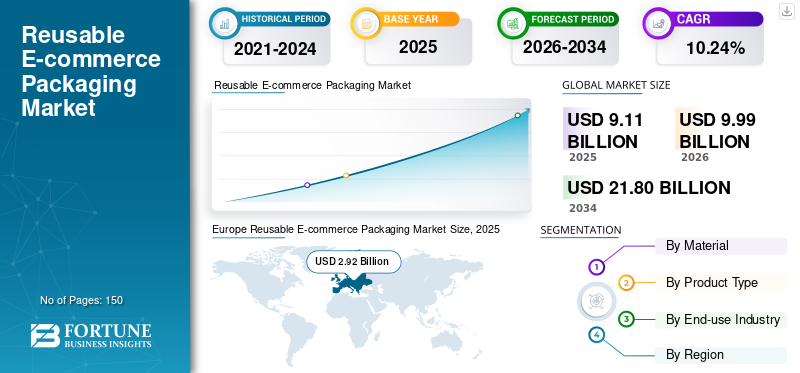
The global reusable e-commerce packaging market size was valued at USD 9.11 billion in 2025. The market is projected to grow from USD 9.99 billion in 2026 to USD 21.80 billion by 2034, exhibiting a CAGR of 10.24% during the forecast period. Europe dominated the reusable e-commerce packaging market with a market share of 32.05% in 2025.
The global reusable e-commerce packaging sector is dedicated to the design, production, and provision of robust packaging solutions, including reusable boxes, mailers, totes, and containers, tailored specifically for online retail logistics. The increasing demand to minimize packaging waste and carbon emissions is propelling the uptake of reusable solutions for e-commerce packaging.
Furthermore, many key industry players, such as DS Smith, Smurfit Kappa, and Mondi, operating in the market are focusing on developing innovative products and conducting R&D, contributing to the global market expansion.
Download Free sample to learn more about this report.
Reusable E-commerce Packaging Market Key Takeaways
 Global Market Size & Forecast
- 2025 Market Size: USD 9.11 billion
- 2026 Market Size: USD 9.99 billion
- 2034 Forecast Market Size: USD 21.80 billion
- CAGR: 10.24% from 2026–2034
 Market Share
- Europe dominated the reusable e-commerce packaging market with a 32.05% share in 2025.
- The paper & paperboard segment accounted for the largest market share in 2025.
- The boxes & containers segment dominated the global market in 2025.
 Key Regional Highlights
Europe
Europe led the global market with a valuation of USD 2.92 billion in 2025 and is projected to register the highest regional CAGR of 9.89% through 2034.
North America
North America held the second-largest regional market, reaching a value of USD 2.27 billion in 2025.
Asia Pacific
Asia Pacific ranked as the third-largest regional market, valued at USD 1.93 billion in 2025.
U.S.
U.S. The market reached a value of approximately USD 1.85 billion in 2025.
Japan
Japan The market reached a value of approximately USD 0.35 billion in 2025.
Read More

REUSABLE E-COMMERCE PACKAGING MARKET TRENDS
Adoption of Circular Packaging Systems in E-Commerce to Emerge as a Key Market Trend
A significant trend influencing the global market is the rising implementation of circular packaging systems. Retailers and logistics companies are increasingly testing packaging for multiple delivery cycles, facilitated by return logistics and digital tracking technologies such as QR codes and RFID. Collaborations among retailers, packaging suppliers, and reverse logistics companies are increasingly prevalent. This trend signals a broader shift toward circular economy principles, which aim to reduce environmental impact and enhance resource efficiency in global e-commerce.
MARKET DYNAMICS
MARKET DRIVERS
Download Free sample to learn more about this report.
Rising Pressure to Reduce Packaging Waste and Carbon Emissions to Surge Market Growth
A primary factor propelling the reusable e-commerce packaging market growth is the mounting pressure from governments, consumers, and corporate sustainability pledges to minimize packaging waste and carbon emissions. The swift expansion of online retail has notably heightened the demand for single-use packaging materials, including cardboard boxes and plastic mailers. Furthermore, regulatory measures aimed at addressing plastic waste and implementing extended producer responsibility (EPR) are motivating companies to transition toward more sustainable packaging solutions, thereby rendering reusable packaging a compelling choice for achieving long-term environmental and operational objectives.
MARKET RESTRAINTS
High Initial Investment and Reverse Logistics Complexity May Impede Market Growth
Despite the sustainability benefits, the market for reusable e-commerce packaging faces limitations due to high initial costs and operational complexities. Creating robust packaging that endures multiple shipping cycles requires the use of superior materials and more sophisticated designs, which increase production costs compared to single-use options. Building these infrastructure networks can be costly and operationally demanding, especially for firms operating across multiple regions or international markets. In the absence of well-established return systems and active consumer involvement, the financial advantages of reusable packaging may take longer to materialize, hindering adoption rates among smaller e-commerce enterprises.
MARKET OPPORTUNITIES
Integration of Smart Tracking Technologies in Reusable Packaging to Offer Growth Opportunities
A significant opportunity exists in the global market, particularly through the adoption of advanced tracking technologies such as RFID tags, QR codes, and IoT-based monitoring systems. As supply chains continue to evolve with digitization, the combination of reusable packaging with smart tracking can facilitate scalable circular logistics systems. Furthermore, this technological integration helps businesses demonstrate quantifiable sustainability results, which are becoming increasingly vital for regulatory compliance and corporate environmental, social, and governance (ESG) obligations.
MARKET CHALLENGES
Consumer Participation and Return Compliance are Major Challenges for Market Growth
A significant challenge in the market for reusable e-commerce packaging is ensuring consistent consumer engagement in returning the packaging after delivery. Reusable packaging systems depend heavily on customers returning mailers, boxes, or containers via designated collection points or courier pickups. Nevertheless, issues related to convenience, insufficient awareness, or minimal incentives can lead to low return rates. If packaging is not returned cost effectively, the economic and environmental advantages of reuse diminish considerably. Addressing behavioral obstacles among consumers is essential to expanding reusable packaging initiatives across broad e-commerce markets.
Segmentation Analysis
By Material
Sustainability Advantages, Cost Efficiency, and Strong Recycling Infrastructure to Drive Paper & Paperboard Segmental Dominance
Based on material, the market is divided into paper & paperboard, plastic, metal, and others.
The paper & paperboard segment is expected to account for the largest reusable e-commerce packaging market share. This dominance is driven by their robust sustainability profile, cost-effectiveness, and established recycling systems. These materials are readily accessible, lightweight, and comparatively affordable compared with durable plastics or composite options, making them ideal for extensive e-commerce operations. As e-commerce businesses emphasize environmentally friendly packaging solutions, paper and paperboard remain the material of choice for their renewability, biodegradability, and alignment with circular packaging initiatives.
The plastic segment is expected to grow at a CAGR of 9.87% over the forecast period.
By Product Type
Versatility, Structural Strength, and Compatibility with E-Commerce Logistics to Drive the Dominance of Boxes & Containers
Based on product type, the market is segmented into boxes & containers, mailers & envelopes, bags, pallets & crates, and others.
In 2025, the boxes & containers segment dominated the global market. This is due to their versatility, durability, and strong compatibility with modern logistics and fulfillment systems. This packaging type offers exceptional structural integrity and safeguard products during storage, handling, and transportation, making them ideal for a wide range of items, including electronics, clothing, groceries, and consumer goods. As e-commerce businesses focus on protective, scalable, and reusable packaging, boxes and containers remain the most commonly used format.
The mailers & envelopes segment is projected to grow at a CAGR of 10.36% over the forecast period.
By End-use Industry
To know how our report can help streamline your business, Speak to Analyst
High Delivery Volumes and Sustainability Commitments to Drive Food & Beverages Segment’s Dominance
Based on end-use industry, the market is segmented into food & beverages, pharmaceuticals, personal care & cosmetics, electronics & electricals, and others.
The food & beverages segment is expected to hold a dominant market share over the forecast period. This is driven by the substantial volume of online grocery deliveries and the necessity for dependable packaging that safeguards perishable items. Moreover, food retailers face growing pressure to reduce single-use plastic waste and adopt sustainable packaging practices. Consequently, reusable packaging solutions are extensively utilized in online grocery logistics and food delivery supply chains.
The pharmaceuticals segment is projected to grow at a CAGR of 9.66% over the forecast period.
Reusable E-commerce Packaging Market Regional Outlook
By geography, the market is categorized into Europe, North America, Asia Pacific, Latin America, and the Middle East & Africa.
North America
Europe Reusable E-commerce Packaging Market Size, 2025 (USD Billion)
To get more information on the regional analysis of this market, Download Free sample
North America held the second-largest share in 2024 with a value of USD 2.06 billion and reached a valuation of USD 2.27 billion in 2025. The market in North America is primarily driven by significant sustainability pledges from leading e-commerce retailers as well as growing regulatory demand to reduce waste.
U.S. Reusable E-commerce Packaging Market
Based on North America's strong contribution and the U.S. dominance within the region, the U.S. market reached a value of around USD 1.85 billion in 2025, accounting for roughly 20.30% of global sales. In the U.S., the market is influenced by corporate sustainability objectives, consumer preferences for eco-friendly packaging, and trial initiatives by leading e-commerce retailers. Businesses are increasingly allocating resources to reusable packaging systems connected to reverse logistics networks, aiming to reduce packaging waste and enhance supply chain efficiency.
Europe
The Europe market is projected to grow at a CAGR 9.89% over the forecast period, the highest among regions. The region led the market with a valuation of USD 2.92 billion in 2025. The regional market growth is primarily influenced by strict environmental regulations, which encompass extended producer responsibility (EPR) policies and objectives for waste reduction. Both governments and retailers are vigorously advocating for models of reusable and circular packaging. Additionally, the heightened consumer awareness of sustainability and the reduction of plastic waste significantly drives the adoption of reusable packaging systems in e-commerce.
U.K. Reusable E-commerce Packaging Market
The U.K. market touched a value of USD 0.51 billion in 2025, representing approximately 5.58% of global revenues.
Germany Reusable E-commerce Packaging Market
The Germany market reached approximately USD 0.72 billion in 2025, equivalent to around 7.95% of global sales.
Asia Pacific
Asia Pacific reached a value of USD 1.93 billion in 2025 and secured the position of the third-largest regional market. In the Asia Pacific region, the swift expansion of e-commerce and the growth of urban consumer populations are significant factors. Major online marketplaces and logistics firms are investigating reusable packaging options to tackle the increasing issue of packaging waste.
Japan Reusable E-commerce Packaging Market
The Japanese market reached around USD 0.35 billion in 2025, accounting for roughly 3.84% of global revenues. Robust waste-management policies, heightened consumer awareness of environmental issues, and a sophisticated logistics infrastructure are driving Japan's market. Businesses focus on effective packaging design, material reuse, and compact delivery systems, thereby facilitating the adoption of durable, reusable packaging formats within the nation's well-structured e-commerce distribution network.
China Reusable E-commerce Packaging Market
The China market is projected to be one of the largest markets worldwide. The 2025 revenue in the country touched around USD 0.60 billion, representing roughly 6.63% of global sales.
India Reusable E-commerce Packaging Market
The India market reached a value of around USD 0.50 billion in 2025, accounting for roughly 5.53% of global markets.
Latin America
The Latin America region is expected to witness moderate growth in this market during the forecast period. The Latin America market reached a valuation of USD 1.25 billion in 2025. In Latin America, the market is mainly propelled by the growth of e-commerce platforms and the rising awareness of sustainable packaging. Retailers and logistics firms are increasingly adopting reusable packaging models to reduce operational costs and minimize packaging waste, especially in urban delivery networks, where reverse logistics systems can be more readily established.
Middle East & Africa
In the Middle East & Africa, South Africa reached USD 0.21 billion in 2025. The growth observed in the region is primarily driven by the development of e-commerce infrastructure and an increasing interest in sustainable packaging solutions. Retailers and logistics providers are investigating reusable packaging as part of broader environmental initiatives and waste-management strategies, particularly in rapidly evolving urban markets.
Saudi Arabia Reusable E-commerce Packaging Market
The Saudi Arabia market reached USD 0.25 billion in 2025, accounting for roughly 2.76% of global revenues.
COMPETITIVE LANDSCAPE
Key Industry Players
Emphasis on Product Launches and Collaborations among Pivotal Players to Propel Market Progress
The global market has a semi-consolidated structure, with leading players being DS Smith, Smurfit Kappa, and Mondi. The significant shares of these packaging players can be attributed to a range of strategic initiatives, including collaborations focused on research advancement.
- For instance, in March 2024, DS Smith unveiled Shop.able Carriers, a collection of reusable grocery boxes. The company introduced "Shop.able Carriers," a series of reusable, fiber-based boxes designed for grocery and e-commerce deliveries. These boxes are constructed from renewable materials and feature a moisture-resistant Greencoat coating to enhance durability across multiple delivery cycles.
Other notable companies in the market include Stora Enso, Orbis Corporation, and Amatech Inc. These companies are expected to prioritize strategic partnerships and new product launches to enhance their global market share during the analysis period.
LIST OF KEY REUSABLE E-COMMERCE PACKAGING COMPANIES PROFILED
- DS Smith (U.K.)
- Smurfit Kappa (Ireland)
- Mondi (U.K.)
- Stora Enso (Finland)
- Orbis Corporation (U.S.)
- Amatech Inc. (U.S.)
- IPL Schoeller (Ireland)
- Brambles (Australia)
- RepeatPack Ltd (U.K.)
- Nilkamal Bubbleguard (India)
- Movopack (Italy)
- Corplex (U.K.)
- IFCO Systems (Germany)
- EcoPackables (U.S.)
- THIMM (Germany)
KEY INDUSTRY DEVELOPMENTS
- June 2025: DS Smith partnered with the Matas Group, located in Denmark, to introduce Wavebag, an envelope made of paper and designed with padding specifically for e-commerce deliveries. This innovative packaging substitutes traditional plastic bubble-wrap mailers with a structure of corrugated cardboard padding, ensuring the protection of delicate items such as cosmetics, eyewear, and pharmaceuticals throughout the shipping process.
- June 2025: Stora Enso collaborated with the ventilation technology firm Lindab to develop reusable corrugated packaging solutions as alternatives to conventional single-use transport boxes. This innovative packaging system enables the boxes to be folded flat and reused multiple times across Lindab's distribution network, thereby minimizing packaging waste and reducing transportation emissions.
- September 2024: Smurfit Kappa broadened its range of sustainable e-commerce packaging solutions tailored for reusable, recyclable shipping. The company launched new corrugated box designs optimized for durability, space efficiency, and multiple logistics cycles. These packaging systems facilitate reverse logistics models, allowing boxes to be returned, folded, and reused within distribution centers.
- July 2024: Mondi introduced a series of paper-based e-commerce mailers intended to replace conventional plastic mailing envelopes used for online retail deliveries. These mailers are manufactured from responsibly sourced kraft paper and are designed to endure multiple handling cycles within logistics networks. Mondi created this packaging to ensure durability, tear resistance, and protection, all while preserving recyclability within current paper recycling systems.
- April 2024: DS Smith entered into a strategic partnership agreement with the Swedish packaging manufacturer Jonsac to expedite the implementation of paper-based e-commerce bags throughout European markets. This collaboration aims to replace plastic mailing bags used for online retail shipments with fiber-based alternatives made from FSC-certified raw materials.
REPORT COVERAGE
The market analysis includes a comprehensive study of market size & forecast across all market segments included in the market report. It contains details on the market dynamics and market trends expected to drive the market over the forecast period. It provides information on key aspects, including technological advancements, pipeline candidates, the regulatory environment, and product launches. Additionally, it details partnerships, mergers, and acquisitions, and key industry developments, along with their regional prevalence. The global market research report also provides a detailed competitive landscape, including market share and profiles of key operating players.
Request for Customization to gain extensive market insights.
Report Scope & Segmentation
| ATTRIBUTE | DETAILS |
| Study Period | 2021-2034 |
| Base Year | 2025 |
| Estimated Year | 2026 |
| Forecast Period | 2026-2034 |
| Historical Period | 2021-2024 |
| Growth Rate | CAGR of 10.24% from 2026-2034 |
| Unit | Value (USD Billion) |
| Segmentation | By Material, Product Type, End-use Industry, and Region |
| By Material |
|
| By Product Type |
|
| By End-use Industry |
|
| By Region |
|
Frequently Asked Questions
According to Fortune Business Insights, the global market value stood at USD 9.11 billion in 2025 and is projected to reach USD 21.80 billion by 2034.
In 2025, the Europe market value stood at USD 2.92 billion.
The market is growing at a CAGR of 10.24% over the forecast period of 2026-2034.
In terms of material, the paper & paperboard segment is expected to lead the market.
Rising pressure to reduce packaging waste and carbon emissions is a key factor driving market growth.
DS Smith, Smurfit Kappa, Mondi, Stora Enso, Orbis Corporation, and Amatech Inc. are the major players in the global market.
Europe dominated the market in 2025.



- 2021-2034
- 2025
- 2021-2024
- 150
-
(Offer valid till 31st Aug 2026)
Get 30-60 hrs Free Customization
Expand Regional and Country Coverage, Segments Analysis, Company Profiles, Competitive Benchmarking, and End-user Insights.










-
US +1 833 909 2966 ( Toll Free )
-
Get In Touch With Us