RF Interconnect Market Size, Share & Industry Analysis, By Type (RF Cable, RF Cable Assembly, RF Coaxial Adapter, and RF Connector), By Frequency (Sub-6 GHz, 6-18 GHz, 18-40 GHz, 40-67 GHZ, and Above 67 GHz), By End-user (Aerospace & Defense, Medical, Industrial, Telecommunication, and Others (Automotive, etc.)), and Regional Forecast, 2026-2034
 Download Free Sample
KEY MARKET INSIGHTS
 Listen to Audio Version
The global RF interconnect market size was valued at USD 36.30 billion in 2025 and is projected to grow from USD 38.81 billion in 2026 to USD 67.09 billion by 2034, exhibiting a CAGR of 7.10% during the forecast period. Asia Pacific dominated the RF Interconnect Market with a market share of 48.00% in 2025.
A RF interconnect is a component or system used to electrically connect different parts of an electronic circuit while maintaining the high frequency signal’s integrity. Because of the high frequencies involved, RF interconnects are designed to minimize signal loss, interference, and noise.
The market is witnessing rapid growth, largely fueled by the expansion of 5G networks, the growth of IoT, and the increased demand for rapid data transmission in numerous applications. Significant areas of applications driving growth include communications, aerospace & defense, consumer electronics and self-driving cars.
Some of the leading firms working in the industry cover Amphenol RF, TE Connectivity, Molex LLC, Corning Incorporated, Flann Microwave Ltd., and HUBER+SUHNER.
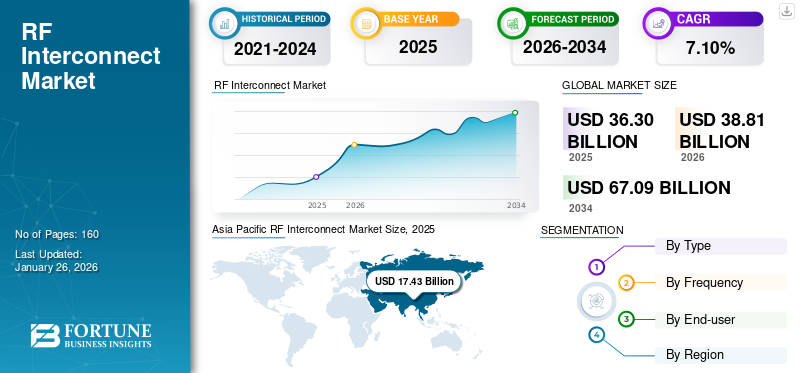
Download Free sample to learn more about this report.
RF INTERCONNECT MARKET KEY TAKEAWAYS
 Market Size & Forecast
- 2025 Market Size: USD 36.30 Billion
- 2026 Market Size: USD 38.81 Billion
- 2034 Forecast Market Size: USD 67.09 Billion
- CAGR: 7.10% from 2026–2034
 Market Share
- Asia Pacific dominated the RF Interconnect Market with a market share of 48.00% in 2025.
- Sub-6 GHz is the dominant frequency segment, holding 65.87% share in 2026.
- Telecommunication is the largest end-user segment, contributing 54.13% of the market in 2026.
 Key Regional Highlights
North America
North America contributed 27.30% to the global market in 2025, with a valuation of USD 9.92 billion, and is projected to reach USD 10.75 billion in 2026.
Europe
Europe accounted for USD 5.08 billion in 2025, representing 14.00% of the global market share, and is projected to reach USD 5.34 billion in 2026.
Asia Pacific
The Asia Pacific market was valued at USD 17.43 billion in 2025, capturing 48.00% of global revenue, and is estimated to reach USD 18.65 billion in 2026.
U.S.
The U.S. remained the leading market in North America, fueled by strong demand from telecommunications, aerospace, defense, and IoT applications.
Japan
Japan continues to be a key contributor in Asia Pacific, supported by technological advancements, high-speed connectivity requirements, and growing industrial automation initiatives.
Read More

Impact of Reciprocal Tariffs
Reciprocal Tariffs Increased the Cost of Imported Critical Components
Reciprocal tariffs have a profound impact on the market by increasing the price of imported critical components. This tariff impact contributes to higher overall production and sourcing costs, which are subsequently passed on to manufacturers and ultimately to consumers. Increased cost pressure often halts supply chains as companies wait for shipments of necessary materials and assemblies. Additionally, industries involving a range of technologies, including 5G infrastructure, defense, and aerospace, may find that project rollout phases are slowed, making it difficult to scale and deploy positive outcomes. The lack of clarity around tariff policy means firms do not invest or plan for the long-term future, resulting in a negative impact on innovation and overall market size for RF interconnect in important global regions.
MARKET DYNAMICS
Market Drivers
Surge in Next-Gen Wireless Infrastructure Drive Market Growth
The global market for RF interconnect is experiencing strong growth primarily as a result of rapid growth of next-generation wireless networks such as 5G, as well as, the early research momentum toward 6G. These systems are dependent on performance-driven RF interconnect solutions with high-speed data capacities, and reliability across complex network architectures. Telecom service providers and equipment providers are upgrading base stations, millimeter-wave (mmWave) systems, and small cell technologies to meet demand, hence the need for low loss and high reliability interconnect solutions also increases. This demand is further driven by the desire for seamless connectivity and ultra-low latency with high bandwidth applications from smart cities to autonomous vehicles. Innovation in materials and engineering design continue to improve connector, cable, and adapter performance, and RF interconnects have become a key enabler for future communication ecosystems.
On March 2023, the "Bharat 6G Vision" document was unveiled, expressing a vision for India to be a frontline contributor in the design, development, and deployment of 6G technology by 2030. Next-generation 6G networks will operate in spectrum bands that are significantly higher, and will require more advanced and complex RF interconnects, to handle immense data speeds and an unprecedented number of device connections.
Market Restraints
High Cost of Advanced Materials and Precision Manufacturing Hinder Growth
The development of the RF interconnect market is constrained by the high price of advanced materials and precision manufacturing. Cables and connecters often use low-loss dielectrics, precious metal coatings such as gold, or specialty alloys to provide the highest signal integrity and durability. This elevated the costs of materials. In addition, the high tolerances, miniaturized format, and complex, manufacturing techniques required to achieve performance and the modern RF standard further increase the cost of production and draw manufacturers away from cost-competitiveness and higher production volumes, ultimately restricting larger market footprint and introduction of novel RF technology.
Market Opportunities
Growing Adoption of Automotive Connectivity and Autonomous Systems Create Opportunities
The growing adoption of advanced automotive technologies such as ADAS, V2X communication, and in-vehicle radar systems offer significant growth opportunities in the RF interconnect market. These systems rely on high speed data transfer and ensure signal integrity, thus requiring high frequency and durability in the RF interconnect solutions. As vehicles become connected and automated, reliable products capable of withstanding tough automotive conditions are in demand. This creates a trend pushing manufacturers toward new interconnected designs that support performance, safety, and efficiency in the next-generation mobility systems and overall market growth in the long term.
RF INTERCONNECT MARKET TRENDS
Industry 4.0 and Smart Manufacturing Emerges as a Major Trend
The RF interconnect market is experiencing considerable growth, driven by Industry 4.0 and rapid growth of smart manufacturing. As manufacturing facilities adopt more complex forms of automation, robotics, Industrial Internet of Things (IIoT) systems, the need for long-lasting, high-performing RF interconnect solutions has increased. These parts are critical for high-speed data transfer and signal integrity for an industrial environment with high exposure to vibration, heat, and electromagnetic interference. Manufacturers are focusing more of their budgets on their durability and high performance to facilitate next-generation industrial applications and communication between connected devices to improve operational efficiency and overall production reliability.
Download Free sample to learn more about this report.
SEGMENTATION ANALYSIS
By Type
RF Cable Assembly Segment Leads Market Due to Their Critical Role in Connecting Devices
Based on the type, the market is segmented into RF cable, RF cable assembly, RF coaxial adapter, and RF connector.
The RF cable assembly segment held the largest share of 45.10% in the overall global market in the year 2026. The increase in revenue is driven by their critical role in connecting devices with low signal loss and high reliability.
Of all the segments, RF cable assembly holds the highest CAGR of 8.2% in the global market. The growth is mainly due to the increasing demand for customized, high-performance cable solutions across industries.
By Frequency
Sub- 6 GHz Segment Leads Market as it Supports Widespread 4G and Early 5G Deployments.
Based on frequency, the market is divided into Sub-6 GHz, 6-18 GHz, 18-40 GHz, 40-67 GHZ, and Above 67 GHz.
The Sub- 6 GHz segment is expected to lead the market, contributing 65.87% in 2026. The segment continues to generate the major revenue as it supports widespread 4G and early 5G deployments globally.
Above 67 GHz holds the highest CAGR of 15.7% in the global market. The segment’s growth is mainly due its ability to emerging applications in 6G and high-capacity wireless communications
By End-user
To know how our report can help streamline your business, Speak to Analyst
Massive Infrastructure Investments Augments the Telecommunication Segment Growth
Based on the end-user, the market is divided into aerospace & defense, medical, industrial, telecommunication, and others (automotive, etc.).
The telecommunication segment is expected to lead the market, contributing 54.13% in 2026. The growth is due to massive infrastructure investments and ongoing 5G rollout.
Aerospace & defense represent the largest CAGR at 12.1% in the global market. The segment’s growth is attributable to modernization efforts and the need for high-reliability.
RF INTERCONNECT MARKET REGIONAL OUTLOOK
Geographically the market is segmented into North America, Europe, Asia Pacific, South America and Middle East & Africa.
Asia Pacific
The Asia Pacific market was valued at USD 17.43 billion in 2025, capturing 48.00% of global revenue, and is estimated to reach USD 18.65 billion in 2026. The growth is due to rapid industrialization and telecom infrastructure expansion.
India, China and Japan are major contributors to the RF interconnect market growth with an expected revenue share of USD 2.52 billion, USD 7.42 billion, and USD 2.14 Billion respectively by 2026.
Asia Pacific RF Interconnect Market Size, 2025 (USD Billion) To get more information on the regional analysis of this market, Download Free sample
North America
North America contributed 27.30% to the global market in 2025, with a valuation of USD 9.92 billion, and is projected to reach USD 10.75 billion in 2026. This growth is propelled by innovation in 5G, defense technologies, and advanced manufacturing. The U.S. is at the forefront of the North American market, with expected revenue of USD 9.44 billion in 2026. The growth is attributable to demand from the aerospace, defense, and telecommunications sectors, including the rollout of 5G networks and IoT devices.
Europe
Europe accounted for USD 5.08 billion in 2025, representing 14.00% of the global market share, and is projected to reach USD 5.34 billion in 2026. This growth is due to expansion of 5G infrastructure and a rising need for high-performance connectivity in industries including aerospace, defense, and automotive. The U.K., Germany, and France are some of the leading contributors to the growth in the market, with the required revenue stake of USD 0.8 billion, USD 0.96 billion in 2026, and USD 0.94 billion in 2025.
South America and Middle East & Africa
The markets of South America and Middle East & Africa are growing with an expected share of USD 1.40 billion and USD 2.47 billion respectively in 2025 due to investments in 5G network expansion, telecommunications infrastructure, and rising demand across automotive and IoT sectors. GCC countries are predicted to have a market share of USD 1.03 billion by 2025. The market in Middle East & Africa reached USD 17.43 billion in 2025, representing 6.80% of total market revenue, and is projected to reach USD 18.65 billion in 2026.
Latin America
In 2025, the Latin America market stood at USD 1.4 billion, representing 3.90% of global demand, and is projected to grow to USD 1.45 billion in 2026.
COMPETITIVE LANDSCAPE
Key Industry Players
Key Players Focus On Partnerships and Acquisitions to Lead the Industry
The key players in the industry include Amphenol RF, TE Connectivity, Molex LLC, Corning Incorporated, Flann Microwave Ltd., and HUBER+SUHNER. They are employing strategies such as acquisitions, innovation, and partnerships to capitalize on growth drivers such as 5G networks, autonomous vehicles, and the demand for miniaturization. These strategies include developing more compact and high-performance interconnects, expanding product portfolios through M&A, and forming collaborations with OEMs to accelerate product development.
LIST OF KEY RF INTERCONNECT COMPANIES PROFILED
- Amphenol RF (U.S.)
- TE Connectivity (Switzerland)
- Molex LLC (U.S.)
- Corning Incorporated (U.S.)
- Flann Microwave Ltd. (U.K)
- HUBER+SUHNER (Switzerland)
- Radiall SA (France)
- Samtec (U.S.)
- Rosenberger (Germany)
- Smith’s Interconnect (U.K.)
- L. Gore & Associates, Inc. (U.S.)
- ETL Systems Ltd (U.K.)
KEY INDUSTRY DEVELOPMENTS
- October 2025- Molex, a leading global electronics connectivity innovator, announced that it has signed an agreement to acquire Smiths Interconnect. Smiths Interconnect, a subsidiary of U.K.-based Smiths Group plc, is a leading manufacturer of high-reliability connectivity products and solutions serving the aerospace and defense, medical, semiconductor test and industrial sectors.
- October 2025- PEI-Genesis announced it offerings of Trompeter Space-Rated Subminiature RF Connectors from Cinch Connectivity Solutions worldwide. Trompeter connectors have been integral to mission-critical programs, including communications satellites, GPS navigation satellites, and rovers. These high-reliability connectors are specifically designed to perform in the most demanding environments where failure is not an option.
- July 2025- HUBER+SUHNER introduced an all-new VITA 67.3 interconnect portfolio designed for use with its proprietary solderless MINIBEND® radio frequency (RF) cable termination technology. This new connectivity portfolio is a game-changer for the ever-evolving minimization needs of the global aerospace and defense markets.
- February 2025- Molex launched a comprehensive lineup of Electromagnetic Interference (EMI) Filtered interconnects and Radio Frequency (RF) components to improve signal integrity and electromagnetic compatibility for mission-critical aerospace and defense applications.
- January 2025- Teledyne Storm Microwave, a leading provider of high-performance flexible and semi-rigid RF/Microwave cables and cable assemblies, announced a new franchise agreement with Richardson RFPD, an Arrow Electronics Company. Under this agreement, Richardson RFPD will distribute Teledyne Storm Microwave’s broad portfolio of RF/MW products worldwide.
REPORT COVERAGE
The global report provides a detailed analysis of the market and focuses on key aspects such as prominent companies, deployment modes, types, and end users of the product. Besides this, it offers insights into the RF interconnect market trends and highlights key industry developments and market share analysis for key companies. In addition to the aforementioned factors, the report encompasses several factors that have contributed to the growth of the market over recent years.
Request for Customization to gain extensive market insights.
Report Scope & Segmentation
|
ATTRIBUTE |
DETAILS |
|
Study Period |
2021-2034 |
|
Base Year |
2025 |
|
Estimated Year |
2026 |
|
Forecast Period |
2026-2034 |
|
Growth Rate |
CAGR of 7.10% from 2026-2034 |
|
Historical Period |
2021-2024 |
|
Unit |
Value (USD Billion) |
|
Segmentation |
By Type, Frequency, End-user, and Region |
|
By Type |
· RF Cable · RF Cable Assembly · RF Coaxial Adapter · RF Connector |
|
By Frequency |
· Sub-6 GHz · 6-18 GHz · 18-40 GHz · 40-67 GHZ · Above 67 GHz |
|
By End-user |
· Aerospace & Defense · Medical · Industrial · Telecommunication · Others (Automotive, etc.) |
|
By Region |
· North America (By Type, Frequency, End-user and Country/Sub-region) o U.S. (By End User) o Canada (By End User) o Mexico (By End User) · Europe (By Type, Frequency, End-user and Country/Sub-region) o U.K. (By End User) o Germany (By End User) o France (By End User) o Italy (By End User) o Spain (By End User) o Russia (By End User) o Benelux (By End User) o Nordics (By End User) o Rest of Europe · Asia Pacific (By Type, Frequency, End-user and Country/Sub-region) o China (By End User) o India (By End User) o Japan (By End User) o South Korea (By End User) o ASEAN (By End User) o Oceania (By End User) o Rest of Asia Pacific · South America (By Type, Frequency, End-user and Country/Sub-region) o Argentina (By End User) o Brazil (By End User) o Rest of South America · Middle East & Africa (By Type, Frequency, End-user and Country/Sub-region) o Turkey (By End User) o Israel (By End User) o GCC (By End User) o North Africa (By End User) o South Africa (By End User) o Rest of the Middle East & Africa |
Frequently Asked Questions
Fortune Business Insights says that the global market stood at USD 38.81 billion in 2026 and is projected to reach USD 67.09 billion by 2034.
The market is expected to exhibit steady growth at a CAGR of 7.10% during the forecast period.
Surge in next-gen wireless infrastructure is speeding up the market growth.
Amphenol RF, TE Connectivity, Molex LLC, Corning Incorporated, Flann Microwave Ltd., and HUBER+SUHNER are some of the top players in the market.
The Asia Pacific region held the largest market share.
Asia Pacific dominated the RF Interconnect Market with a market share of 48.00% in 2025.



- 2021-2034
- 2025
- 2021-2024
- 160
Get 30-60 hrs Free Customization
Expand Regional and Country Coverage, Segments Analysis, Company Profiles, Competitive Benchmarking, and End-user Insights.




















-
US +1 833 909 2966 ( Toll Free )
-
Get In Touch With Us