Rice Seeds Market Size, Share & Industry Analysis, By Type (Open-pollinated and Hybrid), By Grain Size (Long Grain, Medium Grain, and Short Grain), By Treatment (Treated and Untreated), and Regional Forecast, 2026-2034
 Download Free Sample
(Offer valid till 30th Sep 2026)

Rice Seeds Market Size and Future Outlook
 Listen to Audio Version
The global rice seeds market size was valued at 7.51 billion in 2025 and is projected to grow from USD 7.92 billion in 2026 to USD 12.32 billion by 2034, exhibiting a CAGR of 5.67% during the forecast period.
Rice seeds are the starchy edible grains of the Oryza sativa/Oryza glaberrima grass species, which form the staple food for more than half of the world’s population. These seeds possess stress tolerance, resistance to pests and disease, and high genetic purity. Moreover, seeds comprise a diverse array of varieties, including open-pollinated and hybrid varieties, which are used to improve grain quality and yield. With respect to its culinary usage, rice is mainly used in preparing risotto, rice pudding, stir-fries, and sushi. Moreover, it is used in the preparation of sake, horchata, and rice milk. In terms of advantages, rice is a quick source of energy and supports digestive health. Moreover, it is rich in micronutrients such as folic acid and iron, and is a suitable option for gluten-free consumers. Additionally, the Asia Pacific and the Middle East & Africa are the leading consumers globally.
The growing adoption of hybrid seeds and improved farmer awareness are key factors driving the market’s growth. Some of the major players include BASF SE, BAYER AG, Syngenta AG, and UPL Limited.
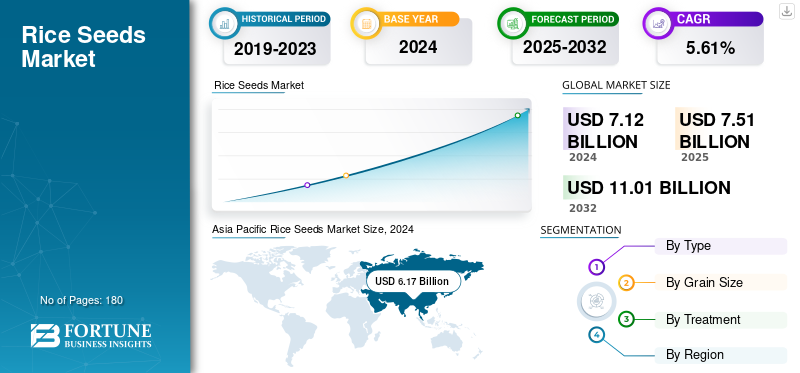
Download Free sample to learn more about this report.
Rice Seeds Market Takeaways
 Global Market Size & Forecast
- 2025 Market Size: USD 7.51 billion
- 2026 Market Size: USD 7.92 billion
- 2034 Forecast Market Size: USD 12.32 billion
- CAGR: 5.67% from 2026–2034
 Market Share
- Asia Pacific captured 86.73% of the global market in 2025.
- Open-pollinated varieties led the market with 68.29% share in 2026.
- Long grain rice seeds led the market with a 58.14% share in 2026.
 Key Regional Highlights
North America
North America witnessed moderate growth, contributing USD 0.17 billion in revenue in 2025 and accounting for a 2.22% market share.
Europe
Europe represented 1.09% of global demand in 2025, with the market valued at USD 0.08 billion and expected to grow steadily during the forecast period.
Asia Pacific
Asia Pacific held the leading position in the global rice seeds market, generating USD 6.52 billion in revenue in 2025 and projected to reach USD 6.88 billion in 2026.
U.S.
The U.S. rice seeds market is projected to reach USD 0.16 billion by 2026, supported by steady demand for improved seed varieties.
Japan
The Japan rice seeds market is expected to experience stable growth, driven by the adoption of advanced agricultural practices and demand for quality rice varieties.
Read More

MARKET DYNAMICS
MARKET DRIVERS
Surging Demand for Rice Bolsters Use of Seeds
The growing demand for rice is a key driver strengthening the market’s expansion. As the population continues to grow, particularly in Asian and African countries, where rice is a staple food, the overall need for rice increases. This demand simultaneously fuels the seed usage in the agriculture sector. In more than half of the population’s diet, rice is a staple item, offering essential nutrients such as iron, selenium, B vitamins, and magnesium. Moreover, it is an appealing option for consumers who have gluten sensitivities. Coupled with nutrients, it supports heart health and nervous system function. Moreover, rice is rich in antioxidants and boosts digestion. Along with this, government subsidies, support, and advanced breeding technology fuel the consumption rate. Thus, this high consumption of rice drives the global utilization of rice seeds.
MARKET RESTRAINTS
Pests and Disease Vulnerability and Lack of Farmer Knowledge Restrict Market’s Growth
One of the crucial hurdles in the market is susceptibility to pests and diseases. Globally, rice seeds are prone to seed-borne diseases, including sheath blight, bacterial blight, and rice blast. These seed-borne bacteria or fungi attack minimize seedling vigor, early plant growth, and germination rate. Moreover, pest feeding can result in damaged and discolored grains, which substantially reduces the market value of the seeds and the resulting crop. Additionally, the affected pests can easily carry pathogens into storage, further increasing the risk of contamination and losses. As a result, the aforementioned factor impedes the global rice seeds market share.
Limited farmer knowledge is another challenge in the global industry. In the current scenario, most farmers are unaware of the advantages of rice seeds and the proper techniques for their production. Thus, this factor hinders the market’s momentum.
MARKET OPPORTUNITIES
Technological Advancements in Seeds Market Open Growth Possibilities
The utilization of modern techniques in the global market creates lucrative growth opportunities. To check seed authenticity, the companies can use near-infrared spectroscopy, which aids in assessing seed integrity and identifying varieties. Moreover, direct seed equipment is another technique that regulates seed rate and allows accurate seed placement to enhance mechanical weeding. Additionally, third-generation hybrid rice technology can be utilized to develop efficient systems, particularly for hybrid seed production. In addition, the alternate wetting and drying irrigation technique can be utilized by enterprises to minimize water utilization in paddy fields. Additionally, machine learning and machine vision systems can also be utilized by firms to analyze damage and improve the quality of seeds.
RICE SEEDS MARKET TRENDS
Surging Inclination Toward Biofortified Rice is a Current Trend
The global industry is experiencing a remarkable and evolving trend of biofortified rice. In today’s era, many individuals suffer from micronutrient deficiencies, particularly in developing countries. This spike in deficiency is primarily due to lifestyle choices, eating patterns, and environmental factors. In order to overcome such challenges, consumers are turning toward biofortified rice, which provides essential nutrients to individuals whose diets mainly depend on staple crops. This rice helps enhance cognitive function, combat hidden hunger, and minimize the risk of infections. Moreover, it is recognized as a mode of providing natural nutrition, unlike synthetically fortified rice. By seeing such advantages, the seed companies are aiming to launch biofortified seeds that can fulfill the rising consumer needs.
Download Free sample to learn more about this report.
Segmentation Analysis
By Type
Open-pollinated Dominated Market Due to Lower Cost
On the basis of type, the market is distributed into open-pollinated and hybrid.
The open-pollinated varieties will lead the market share with 68.29% in 2026. In comparison to hybrid seeds, open-pollinated seeds are economical to produce and have minimal reliance on chemical inputs, such as pesticides and fertilizers. Moreover, these seeds mostly produce plants with consistent flavor and characteristics. Additionally, seed saving and self-sufficiency are other major advantage which influences farmers to adopt this variety. As a result, such benefits bolster the segment’s growth.
The hybrid varieties segment is expected to flourish at a CAGR of 5.84% during the study period.
By Grain Size
Long Grain Size Led in Market Owing to Its High Yield
Depending on the grain size, the market is segmented into long grain, medium grain, and short grain.
The long grain segment will lead the market with sahre of 58.14% in 2026. The long grain is low in fat and has a low glycemic index, with an aromatic flavor that appeals to a wide consumer base. Moreover, this grain variety is bred especially for high yield and is highly resistant to bacterial blight/rice blast diseases. Moreover, they are adaptable to certain growing and climatic conditions, and can be utilized in culinary preparations such as stir-fries and others.
The short grain segment is expected to flourish at a CAGR of 6.41% during the study period.
To know how our report can help streamline your business, Speak to Analyst
By Treatment
Untreated Seeds Led Industry Owing to their Cost-Effectiveness
Based on the treatment, the market is segmented into treated and untreated.
The untreated category will lead the market with share of 59.78% in 2026. Untreated rice is comparatively economical than treated rice, which captivates farmers’ attention, who have limited budgets. Moreover, it is recognized as a natural option for minimal-input/organic farming systems. Additionally, untreated seeds have a prolonged shelf life and require negligible use of chemicals, further appealing to eco-conscious farmers. As a result, the above-mentioned factors are responsible for bolstering the global rice seeds market growth.
The treated segment is anticipated to grow at a high CAGR of 5.75% during the study period.
Rice Seeds Market Regional Outlook
On the basis of regions, the market is segmented into North America, Europe, Asia Pacific, South America, and the Middle East & Africa.
Asia Pacific
The Asia Pacific region captured 86.73% of the global market in 2025, generating USD 6.52 Billion in revenue, and is projected to reach USD 6.88 Billion in 2026. In comparison to other countries, Asian countries are the biggest consumers of rice as it is recognized as a staple in their daily diet. The strong government support for boosting rice cultivation is another factor that fuels its acceptance rate. Moreover, the growing population increases the rate of production, creating a high demand for seeds, which can help fulfill the need for rice. Additionally, advancements in technologies such as hybridization and genetic breeding further bolster the production of premium rice seeds. In addition, the improved disposable income influences consumers to purchase high-grade rice, ultimately driving the seeds market. Coupled with this, the rise of e-commerce and sustainable agricultural practices is also supporting market expansion. As a result, such factors can propel the Asia Pacific’s market growth. The China market is projected to reach USD 2.38 billion by 2026, and the India market is projected to reach USD 2 billion by 2026.
Asia Pacific Rice Seeds Market Size, 2025 (Billion) To get more information on the regional analysis of this market, Download Free sample
Middle East & Africa and South America
Other regions, such as the Middle East & Africa and South America, are predicted to witness considerable growth in the future. In 2025, Middle East & Africa generated USD 0.49 Billion, contributing 6.52% to global market revenue, and is projected to grow to USD 0.52 Billion in 2026. During the forecast period, the Middle East & Africa is anticipated to record a growth rate of 5.54%, the second-highest among all regions. The rising use of rice in the HoReCa sector and improved household usage are key factors fueling the market’s growth. South America contributed 3.43% to the global market in 2025, with a valuation of USD 0.26 Billion, and is projected to reach USD 0.27 Billion in 2026. After the Middle East & Africa, South America ranked third in the global industry in 2025. The growing awareness of rice seeds and enhanced trade facilities are likely to facilitate the growth
North America & Europe
Over the forecast period, North America and Europe are predicted to witness moderate growth. North America contributed approximately USD 0.17 Billion to the global market in 2025, accounting for 2.22% share, and is expected to reach USD 0.17 Billion in 2026. The surging awareness of gluten-free diets and technological adoption drives the region’s potential. In 2025, the Europe market stood at USD 0.08 Billion, representing 1.09% of global demand, and is projected to grow to USD 0.08 Billion in 2026. Among all the American countries, the U.S. leads in the North America region, followed by Canada and Mexico. The increasing expatriate population and high usage of rice in preparing recipes augment the nation’s momentum. After North America, Europe experienced a gradual growth, driven by the evolving vegan trend and a robust e-commerce network. The U.S. market is projected to reach USD 0.16 billion by 2026. The Spain market is projected to reach USD 21.25 billion by 2026, while the Italy market is projected to reach USD 41.15 billion by 2026.
COMPETITIVE LANDSCAPE
Key Industry Players
Active Players are Concentrating on New Launches to Boost their Footprints in Market
Major players in the market include BAYER AG, BASF SE, Syngenta AG, UPL Limited, and others. All seed companies are aiming for new launches of rice seeds, which help produce high-grade rice varieties. Via such launches, the players can enhance their position and image in the market.
List of Key Rice Seeds Companies Profiled:
- BAYER AG (Germany)
- Syngenta AG (Switzerland)
- Nuziveedu Seeds Limited (India)
- RiceTec Inc. (U.S.)
- Horizon Ag, LLC (U.S.)
- SL Agritech Corporation (Philippines)
- UPL Limited (India)
- Hefei Hefeng Seed Co., Ltd. (China)
- National Seeds Corporation (India)
- Mahyco Private Limited (India)
KEY INDUSTRY DEVELOPMENTS:
- July 2025: BASF Sdn. Bhd., a Malaysian-based subsidiary, entered into a partnership with the Malaysian Agricultural Research and Development Institute to release Clearfield rice varieties. This rice seed was launched at an event held in Malaysia, conducted by Datuk Seri Haji Mohamad Bin Sabu, Minister of Agriculture and Food Security.
- May 2025: The International Rice Research Institute (IRRI), a Philippine-based agricultural research organization, hosted a gathering of stakeholders at the Seed Accelerator Meet in Hyderabad. This event aims to enhance the rice seed delivery ecosystem in India.
- November 2024: Nuziveedu Seeds, an Indian agricultural innovation enterprise, introduced its new paddy seed variety “NP-8912.” This seed produces high-quality rice grains and is an ideal option for farmers in Karnataka, Telangana, and other regions.
- April 2024: IPB University, an agricultural university in Indonesia, unveiled the IPB 9 Garuda (9G) climate-smart rice seed variety. This seed can minimize the use of fertilizer by 25% and water use by 20%.
- June 2023: The Indian Institute of Rice Research launched four rice varieties, including DRR Dhan 55, DRR Dhan 53, and DRR Dhan 56, in Tamil Nadu, Odisha, Andhra Pradesh, Maharashtra, and Gujarat.
REPORT COVERAGE
The market report includes quantitative and qualitative insights into the market. It also offers a detailed global rice seeds market analysis of sizing and growth rate for all possible market segments. Various key insights presented in the market research report are an overview of related markets, competitive landscape, recent industry developments such as mergers & acquisitions, the regulatory scenario in critical countries, and global rice seeds market trends.
Request for Customization to gain extensive market insights.
Report Scope & Segmentation
|
Global Rice Seeds Market Scope |
|
|
Study Period |
2021-2034 |
|
Base Year |
2025 |
|
Forecast Period |
2026-2034 |
|
Historical Period |
2021-2024 |
|
Unit |
Value (USD Billion) |
|
Growth Rate |
CAGR of 5.67% from 2026 to 2034 |
|
Segmentation |
By Type
|
|
By Grain Size
|
|
|
By Treatment
|
|
|
By Region
|
|
Frequently Asked Questions
Fortune Business Insights says that the global market size was valued at USD 7.51 billion in 2025.
The market is expected to grow at a CAGR of 5.67% during the global rice seeds market forecast period (2026-2034).
By treatment, the untreated segment led the market.
Surging demand for rice bolsters the use of seeds.
BASF SE, Bayer AG, and Syngenta AG are among the top players in the market.
Asia Pacific held the highest share of the market.
Technological advancements in the seeds market open growth possibilities.



- 2021-2034
- 2025
- 2021-2024
- 180
-
(Offer valid till 30th Sep 2026)
Get 30-60 hrs Free Customization
Expand Regional and Country Coverage, Segments Analysis, Company Profiles, Competitive Benchmarking, and End-user Insights.














Related Reports
-
US +1 833 909 2966 ( Toll Free )
-
Get In Touch With Us