Robotic Dentistry Market Size, Share & Industry Analysis By Product (Hardware [Instruments {Robotic Assisted Systems and Standalone Robots} and Consumables] and Software), By Application (Implantology, Endodontics, Prosthodontics, and Others), By End User (Solo Practices, DSO/Group Practices, and Others), and Regional Forecast, 2026-2034
 Download Free Sample
KEY MARKET INSIGHTS
 Listen to Audio Version
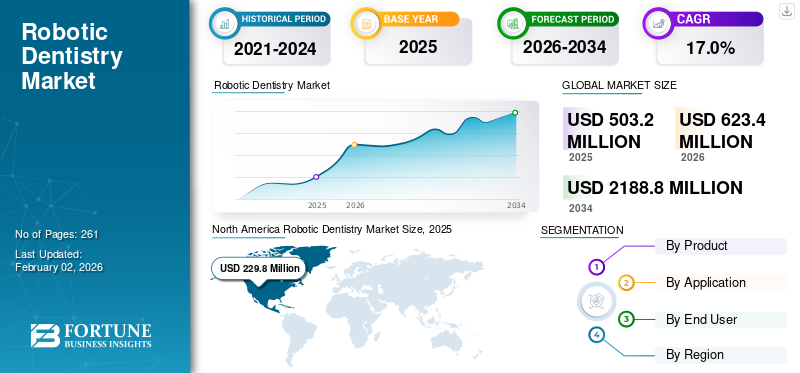
The global robotic dentistry market size was valued at USD 503.2 million in 2025 and is projected to grow from USD 623.4 million in 2026 to USD 2,188.8 billion by 2034, exhibiting a CAGR of 17.0% during the forecast period. North America dominated the global robotic dentistry market with a market share of 45.7% in 2025.
Robotic dentistry refers to the integration of computer-aided systems, artificial intelligence, and robotics into dentistry for designing, executing, and assisting with various oral health-related conditions. The increasing prevalence of dental disorders is leading to a growing patient pool in healthcare settings. The increasing patient admissions and technological advancements in dental instruments and software are thereby supporting the adoption rate of these devices and software in the market.
- For instance, according to the 2023 statistics published by Wiley, approximately 3.5 billion people suffer from one or the other form of oral disease globally.
Additionally, the increasing adoption of precision medicine and growing investments in research and development are also prominent factors contributing to the demand for these products in the market.
Download Free sample to learn more about this report.
Robotic Dentistry Market Takeaways
 Global Market Size & Forecast
- 2025 Market Size: USD 503.2 million
- 2026 Market Size: USD 623.4 million
- 2034 Forecast Market Size: USD 2,188.8 billion
- CAGR: 17.0% from 2026–2034
 Market Share
- North America dominated the global robotic dentistry market with a market share of 45.7% in 2025.
- The hardware segment held the largest revenue share in 2025.
- The implantology segment held the share of 44.8% in 2025.
 Key Regional Highlights
North America
The North America robotic dentistry market held the dominant share in 2024, valued at USD 182.4 million, and also took the leading share in 2025 with USD 229.8 million.
Europe
Europe is projected to record a growth rate of 14.3% and reach the valuation of USD 149.3 million in 2026.
Asia Pacific
After Europe, the market in the Asia Pacific is estimated to reach USD 27.0 million in 2026 and secure the position of the third-largest region in the market.
U.S.
In 2026, the U.S. market is estimated to reach USD 262.5 million.
Japan
Increasing advancement in dental clinics and hospitals, growing development of cutting-edge technologies and medical robotics are driving the market growth in Japan.
Read More

Market Dynamics
Market Drivers
Increasing Prevalence of Dental Disorders to Drive Market Growth
The increasing prevalence of dental disorders such as dental caries, edentulism, and others is contributing to the growing demand for advanced robotic dentistry devices and software among the patient population, subsequently boosting the adoption rate of these systems in the market.
- For instance, according to 2021 statistics published by the GUM, over 1 billion individuals were living with periodontitis globally.
The increasing prevalence of oral conditions has led to a rise in demand for precision-driven treatments, including implantology and minimally invasive procedures. Robotic-assisted systems improve accuracy, reduce procedural variability, improve implant placement, and improve long-term treatment outcomes, further supporting their demand in the market. Therefore, the factors above, along with the growing focus of key companies on the development and introduction of novel products, are expected to boost the adoption rate, thereby contributing to the global market size.
Other Prominent Drivers
- Rising global demand for dental implants, cosmetic dentistry, and complex restorative procedures.
Market Restraints
Exorbitant Cost Linked with Robotic Dental Systems to Restraint Market Growth
There is an increasing demand for technologically advanced robotic systems globally. However, the high cost associated with these advanced devices is anticipated to limit the adoption rate for these devices, especially in developing countries, including India, Mexico, and others.
Additionally, robotic platforms require high capital investment, which exceeds the financial budget capabilities of small and mid-sized dental practices. Moreover, investment in digital imaging systems, staff training, workflow integration, and periodic software upgrades further adds to the overall operational burden.
- For instance, according to 2024 data published by the Global Medical Equipment, it was reported that the cost of Neocis Yomi dental implant navigation robotic guidance system is about USD 33,500.
Market Opportunities
Expansion of Dental Testing in Emerging Nations to Create Market Opportunity
There is an increasing demand for advanced dental procedures owing to their distinct benefits, including improved accuracy and others, among the patient population. Growing awareness of oral health, rising per capita health expenditure, and the increasing availability of dental clinics equipped with advanced technology in developing economies are boosting the demand for precision-based diagnostics and treatment for these conditions. Moreover, improving reimbursement frameworks, expansion of private dental practices, and initiatives among governmental organizations to promote early diagnosis of disorders are anticipated to contribute to the adoption rate of these products in the market.
- According to 2025 statistics published by the International Trade Administration (ITA), the healthcare expenditure of Brazil is USD 135.0 billion.
Market Challenges
Lack of Reimbursement for Dental Procedures to Hamper Market Growth
There is a growing demand for minimally invasive dental procedures globally. The inadequate reimbursement policies for dental procedures present a major challenge hindering the adoption rate of advanced robotic dentistry technologies. The dental procedures, such as robotic-assisted implant placement and prosthodontic procedures, are often classified as elective services, which increases the out-of-pocket costs among the patient population.
Furthermore, limited healthcare expenditure, limited adoption of advanced devices and software, along with limited expertise among dental practitioners, particularly in emerging markets, are some of the vital factors resulting in limited access to dental practices among the patient population.
- For instance, according to 2021 data published by the Organisation for Economic Co-operation and Development (OECD), dental care represented 14% of out-of-pocket spending on health.
Other Prominent Challenges
- Concerns about system reliability, downtime, and integration with existing digital equipment.
- Regulatory requirements and evidence generation are needed to demonstrate safety, efficacy, and economic value.
Robotic Dentistry Market Trends
Technological Advancements in these Devices to Fuel Product Demand
There is an increasing emphasis on the incorporation of technological advancements in these products, such as real-time imaging integration, and others that improve workflow automation and precision, and efficiency in dental procedures. The prominent players are focusing on research and development initiatives to develop advanced systems with innovative features.
Advanced robotic systems offer enhanced ergonomics, higher accuracy in implant placement, and enhanced recovery times, enhancing the widespread adoption of robotic dentistry products. The integration of CBCT, CAD/CAM software, artificial intelligence, and other novel platforms has created a fully automated ecosystem that improves procedural accuracy, further reduces human error.
- In November 2025, Neocis, Inc., launched its next-generation robotic platform, Yomi S, powered by advanced artificial intelligence software YomiPlan, to deliver high-quality patient outcomes.
Other Prominent Trends
- Increasing focus on robot-assisted dental implant placement to improve the accuracy of drilling and implant positioning.
- Development of compact, chairside-compatible robotic platforms tailored specifically for dental clinics and outpatient settings.
- Rising use of navigation and haptic feedback technologies that guide clinicians while maintaining human control over procedures.
- Expansion of training and education programs in digital and robotic dentistry within dental schools and continuing education.
- Enhanced patient marketing around the precision, safety, and predictability of robot-assisted procedures.
Download Free sample to learn more about this report.
SEGMENTATION ANALYSIS
By Product
Increasing Product Launches to Drive Hardware Segment Dominance
Based on the product, the market is classified into hardware and software. Hardware is further divided into instruments and consumables. Additionally, instruments are further bifurcated into robotic-assisted systems and standalone robots.
To know how our report can help streamline your business, Speak to Analyst
The hardware segment held the largest revenue share in 2025. The growth is due to the increasing prevalence of dental conditions among patients, resulting in a growing demand for advanced robotic systems globally. This, along with the rising focus of key players toward research and development activities to launch novel systems, is further anticipated to support the global robotic dentistry market growth.
- In January 2025, Dental Innovation Alliance (DIA), launched the Perceptive intraoral scanner, which enables dentists to see beneath the gums and inside the tooth.
The software segment is expected to grow at a CAGR of 17.4% over the forecast period.
By Application
Increasing Number of Dental Implant Procedures Led to Dominance of Implantology Segment
Based on application, the market is classified into implantology, endodontics, prosthodontics, and others.
The implantology segment dominated the global market in 2025. By application, the implantology segment held the share of 44.8% in 2025. The growth is owing to the growing prevalence of dental disorders which is resulting in a growing demand for dental implant placements, thereby supporting the number of procedures among the patient population in the market.
- For instance, according to the 2025 data published by Neocis, Inc., the company reported that more than 70,000 dental implants had been placed using the robot.
The segment of prosthodontics is set to flourish with a growth rate of 17.2% across the forecast period.
By End-user
Increasing Number of Solo Practitioners Led to Solo Practices Segmental Dominance
Based on end-user, the market is segregated into solo practices, DSO/Group Practices, and others.
The solo practices segment dominated the market in 2025. One of the major factors is the increasing number of solo dental professionals offering these services among the patient population. The increasing number of solo practitioners is further supporting the adoption of these products, thereby favoring the growth of the segment. Furthermore, the segment is set to hold a 48.0% share in 2026.
- For instance, according to a 2023 ORTHODONTIC PRACTICE SURVEY, revealed that approximately 68% of orthodontists practice solo.
In addition, DSO/Group Practices’ end users are projected to grow at a 17.6% CAGR during the forecast period.
Robotic Dentistry Market Regional Outlook
Based on region, the market has been studied across North America, Europe, Asia Pacific, Latin America, and the Middle East & Africa.
North America
North America Robotic Dentistry Market Size, 2025 (USD Million) To get more information on the regional analysis of this market, Download Free sample
The North America robotic dentistry market held the dominant share in 2024, valued at USD 182.4 million, and also took the leading share in 2025 with USD 229.8 million. The prevalence of dental conditions, high adoption of digital dentistry, strong presence of early-innovator companies, growing demand from implant-focused practices and academic centers, and emphasis on technological differentiation are driving the widespread adoption of robotic dentistry. In 2026, the U.S. market is estimated to reach USD 262.5 million.
- For instance, according to a 2023 study published by the Indian Journal of Orthodontics and Dentofacial Research, among 133 students, it was reported that about 30% of people had normal malocclusion in the U.S.
Europe and Asia Pacific
Other regions, such as Europe and the Asia Pacific, are expected to witness considerable growth during the forecast period. During the study period, the European region is projected to record a growth rate of 14.3% and reach the valuation of USD 149.3 million in 2026. This is due to a growing aging population, strong development in dental academic and research institutions, improvement in regulatory approvals, reimbursement policies, and integration with existing digital workflows. Additionally, high-growth potential in markets such as Japan, South Korea, China, and Australia, increasing advancement in dental clinics and hospitals, growing development of cutting-edge technologies and medical robotics are some of the factors driving the growth of the Asia Pacific market. Backed by these factors, countries such as the U.K. are expected to record the valuation of USD 29.0 million, Germany to record USD 32.3 million, and France to record USD 22.5 million in 2026. After Europe, the market in the Asia Pacific is estimated to reach USD 27.0 million in 2026 and secure the position of the third-largest region in the market. In the region, India is estimated to reach USD 22.4 million while China is estimated to reach USD 51.0 million in 2025.
Latin America and Middle East & Africa
Over the forecast period, the Latin America and Middle East & Africa regions are expected to witness considerable growth in this market. The Latin America market in 2026 is set to record USD 23.8 million as its valuation. Increasing installations in premium urban clinics and teaching hospitals, economic development and expansion of private dental hospitals and clinics, and others are some of the factors supporting the growth of the market in the region. In the Middle East & Africa, GCC is set to attain the value of USD 10.0 million in 2025.
Competitive Landscape
Key Industry Players
Increasing Partnerships Among Prominent Players to Support their Dominance
A significant devices and software portfolio, along with a strong geographical presence, is one of the major factors supporting the dominance of these companies in the market. Dentsply Sirona and Planmeca Oy are crucial companies in the market in 2025. Additionally, the increasing focus of prominent companies on the expansion of their product portfolio is likely to support the global robotic dentistry market share.
- For instance, in October 2025, Planmeca Oy collaborated with The Aspen Group (TAG), a retail healthcare business with an aim to improve patient experiences at Aspen Dental in the U.S.
Other key players, including Neocis Inc., and others, are also growing in the market, primarily due to their increasing focus on research and development activities to strengthen their brand presence in the market.
List of Key Robotic Dentistry Companies Profiled
- Dentsply Sirona (U.S.)
- Neocis Inc. (U.S.)
- Planmeca Oy (Finland)
- Align Technology, Inc. (U.S.)
- Image Navigation, Ltd. (Israel)
- Zimmer Biomet (U.S.)
- Institut Straumann AG (Switzerland)
- X-Nav Technologies (U.S.)
- ClaroNav (Canada)
- IO (U.S.)
KEY INDUSTRY DEVELOPMENTS
- October 2025: Neocis Inc., announced new clinical data highlighting the significant efficiency benefits of its Yomi Robotic System, the FDA-cleared robotic platform for dental implant
- July 2024: Perceptive announced the completion of the fully automated dental procedure on a human using its advanced robotic dentistry system. This helped the company in increasing its brand presence.
- March 2023: ClaroNav launched Navident EVO, the advanced dental navigation system with an aim to strengthen its product portfolio.
- August 2022: Neocis Inc., launched YomiPlan Go the newest robotic workflow enabled by the Yomi system with an aim to strengthen its presence.
- September 2022: Image Navigation Ltd., launched its second-generation Image Guided Implantology (IGI) system during the EAO Congress in Geneva. This helped the company in strengthening its presence.
REPORT COVERAGE
The market report provides a detailed global robotic dentistry market analysis and focuses on key aspects such as leading companies, product, application, and end user. Besides this, the global report offers insights into the market growth trends and highlights key industry developments. In addition to the aforementioned factors, the report encompasses several factors that have contributed to the growth and advancement of the market over recent years.
Request for Customization to gain extensive market insights.
Report Scope & Segmentation
|
ATTRIBUTE |
DETAILS |
|
Study Period |
2021-2034 |
|
Base Year |
2025 |
|
Estimated Year |
2026 |
|
Forecast Period |
2026-2034 |
|
Historical Period |
2021-2024 |
|
Growth Rate |
CAGR of 17.0% from 2026-2034 |
|
Unit |
Value (USD Million) |
|
Segmentation |
By Product Application, End User, and Region |
|
By Product |
· Hardware o Instruments § Robotic Assisted Systems § Standalone Robots o Consumables · Software & Services |
|
By Application |
· Implantology · Endodontics · Prosthodontics · Others |
|
By End User |
· Solo Practices · DSO/Group Practices · Others |
|
By Region |
· North America (By Product, By Application, By End User, and by Country) o U.S. (By Application) o Canada (By Application) · Europe (By Product, By Application, By End User, and by Country/Sub-region) o U.K. (By Application) o Germany (By Application) o France (By Application) o Italy (By Application) o Spain (By Application) o Scandinavia (By Application) o Rest of Europe (By Application) · Asia Pacific (By Product, By Application, By End User, and by Country/Sub-region) o China (By Application) o Japan (By Application) o India (By Application) o Australia (By Application) o Southeast Asia (By Application) o Rest of Asia Pacific (By Application) · Latin America (By Product, By Application, By End User, and by Country/Sub-region) o Brazil (By Application) o Mexico (By Application) o Rest of Latin America (By Application) · Middle East & Africa (By Product, By Application, By End User, and by Country/Sub-region) o GCC (By Application) o South Africa (By Application) o Rest of the Middle East & Africa (By Application) |
Frequently Asked Questions
Fortune Business Insights says that the global market size was USD 503.2 million in 2025 and is projected to reach USD 2,188.8 million by 2034.
In 2025, the North America regional market value stood at USD 229.8 million.
Growing at a CAGR of 17.0%, the market will exhibit steady growth over the forecast period (2026-2034).
By product, the hardware segment is the leading segment in this market.
The introduction of novel robotic dentistry products is one of the major factors driving the markets growth.
Dentsply Sirona and Planmeca Oy are the major players in the global market.
North America dominated the market share in 2025.
The growing prevalence of dental disorders, the increasing number of product launches, among others, are some of the crucial factors anticipated to boost the adoption of these products worldwide.



- 2021-2034
- 2025
- 2021-2024
- 261
Get 30-60 hrs Free Customization
Expand Regional and Country Coverage, Segments Analysis, Company Profiles, Competitive Benchmarking, and End-user Insights.













.webp)






Related Reports
-
US +1 833 909 2966 ( Toll Free )
-
Get In Touch With Us