Robotic Painting & Surface Treatment Systems Market Size, Share & Industry Analysis, By Offering (Hardware, Software, and Services), By Application (Painting and Surface Treatment), By End User (Automotive, Aerospace & Defense, Industrial Manufacturing, and Others), and Regional Forecast, 2026-2034
 Download Free Sample
Robotic Painting & Surface Treatment Systems Market Size and Future Outlook
 Listen to Audio Version
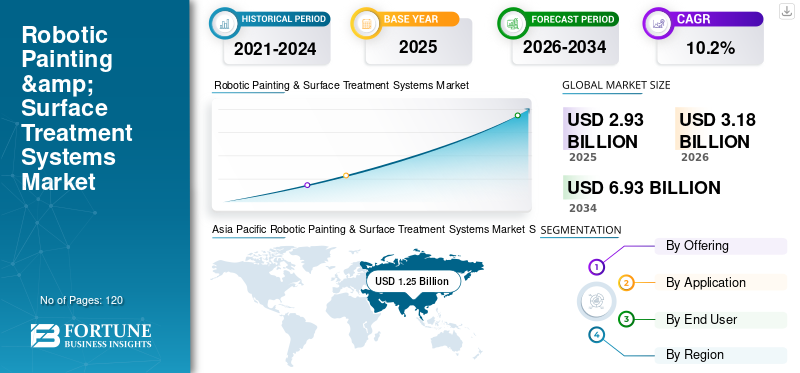
The global robotic painting & surface treatment systems market size was valued at USD 2.93 billion in 2025. The market is projected to grow from USD 3.18 billion in 2026 to USD 6.93 billion by 2034, exhibiting a CAGR of 10.2% during the forecast period. Asia Pacific dominated the robotic painting & surface treatment systems market with a market share of 42.66% in 2025.
The market is experiencing steady growth as manufacturers increasingly adopt automation to achieve high precision and consistent coating performance across production lines. Robotic systems are widely deployed in the automotive sector, where maintaining high-quality finishes and uniform coating thickness is critical to brand standards and durability requirements. Rising demand for painting robots is driven by the need to optimize painting processes, reduce material waste, and enhance worker safety in hazardous environments. These systems enable cost-effective and repeatable industrial painting operations while improving throughput and minimizing defects.
Key players such as ABB, FANUC, KUKA, Yaskawa, and Dürr continue to expand advanced robotic painting solutions to support sustainable, automated finishing across automotive, aerospace, and industrial manufacturing applications.
Download Free sample to learn more about this report.
Robotic Painting & Surface Treatment Systems Market Takeaways
 Global Market Size & Forecast
- 2025 Market Size: USD 2.93 billion
- 2026 Market Size: USD 3.18 billion
- 2034 Forecast Market Size: USD 6.93 billion
- CAGR: 10.2% from 2026–2034
 Market Share
- Asia Pacific dominated the market with a 42.66% share in 2025.
- The software segment is projected to grow at the highest 11.0% CAGR during the forecast period.
- The surface treatment segment is expected to expand at a 10.5% CAGR over the forecast period.
 Key Regional Highlights
North America
North America is expected to attain a market size of USD 0.72 billion by 2026, driven by increasing deployment of robotic finishing systems.
Europe
Europe is projected to reach a market valuation of USD 0.85 billion by 2026, supported by growing manufacturing automation investments.
Asia Pacific
Asia Pacific maintained its leadership with a market value of USD 1.25 billion in 2025, driven by strong industrial automation adoption.
U.S.
The market is estimated to reach USD 0.61 billion by 2026, supported by strong demand for advanced industrial robotics.
Japan
The market is estimated to reach USD 0.26 billion by 2026, accounting for approximately 8.2% of global revenue.
Read More

ROBOTIC PAINTING & SURFACE TREATMENT SYSTEMS MARKET TRENDS
Expansion of Automated Finishing Cells to Improve Environmental Compliance is a Key Market Trend
The market is witnessing increased adoption of automated finishing cells across automotive, aerospace, and industrial manufacturing sectors. Manufacturers are integrating robotic spray systems, powder coating robots, and surface preparation robots into fully automated production lines to enhance coating consistency and reduce material waste. The growing focus on environmental compliance and the reduction of volatile organic compound emissions is encouraging the shift toward automated powder coating and optimized spray systems. In addition, integration of advanced motion control, digital simulation tools, and process monitoring software is improving coating uniformity and operational efficiency across high-volume production facilities.
- Leading robotics manufacturers continue to introduce intelligent painting systems with real-time path correction and material flow optimization capabilities.
Download Free sample to learn more about this report.
MARKET DYNAMICS
MARKET DRIVERS
Rising Demand for Automation in Hazardous and Repetitive Finishing Processes is Driving Market Growth
One of the primary drivers of the market is the need to automate hazardous and repetitive finishing processes. Painting and abrasive surface preparation involve exposure to chemicals, dust, and repetitive motion, making robotic systems a safer and more reliable alternative. Additionally, increasing automotive production, particularly of electric vehicles, requires high-quality surface finishing with consistent coating thickness and reduced defects. Automation improves throughput, reduces rework, and lowers long-term labor costs. As manufacturers aim to enhance production efficiency while meeting strict quality and safety standards, demand for robotic finishing systems continues to rise.
- Automotive OEMs are increasingly deploying robotic coating lines to maintain uniform quality and improve cycle times.
MARKET RESTRAINTS:
High Capital Investment and Cyclical Automotive Demand May Limit Market Expansion
Despite strong adoption trends, the market faces restraints related to high initial capital expenditure and economic cyclicality. Robotic painting systems require significant investment in robotic arms, spray equipment, enclosures, ventilation systems, and integration services. Smaller manufacturers may delay automation investments due to budget constraints. Furthermore, the automotive industry accounts for a large share of robotic painting demand, making the market sensitive to fluctuations in vehicle production volumes. These factors may moderate short-term growth in certain regions.
- Industry stakeholders often cite capital intensity and long replacement cycles as key considerations in automation investment decisions.
MARKET OPPORTUNITIES:
Integration of AI-Driven Process Optimization and Expansion into Non-Automotive Industries Creates Growth Opportunities
Emerging opportunities lie in integrating artificial intelligence and advanced software analytics into robotic finishing systems. AI-enabled path planning, predictive maintenance, and adaptive coating control can significantly enhance performance and reduce material waste. Additionally, robotic surface treatment systems are expanding beyond automotive into industrial machinery, consumer goods, renewable energy components, and metal fabrication. As manufacturing sectors increasingly prioritize automation and quality control, robotic finishing systems are expected to experience broader industry penetration over the long term.
- Robotics providers are developing intelligent coating systems capable of real-time adjustment based on surface geometry and environmental conditions.
Segmentation Analysis:
By End User:
Automotive Segment Leads the Market Due to High Production Volume and Quality Requirements
Based on the end user, the market is segmented into automotive, aerospace and defense, industrial manufacturing, and others.
In 2025, the automotive segment accounted for the highest robotic painting & surface treatment systems market share. Automotive production lines rely heavily on robotic painting systems to ensure consistent coating quality and high throughput. The transition toward electric vehicles and lightweight materials further increases the need for precise surface finishing. Automated coating systems also help automotive manufacturers meet environmental and safety standards while maintaining production efficiency.
The industrial manufacturing segment is expected to grow at a CAGR of 10.8% over the forecast period.
To know how our report can help streamline your business, Speak to Analyst
By Offering:
Hardware Holds the Largest Share Due to High Capital Intensity and Cost of Robotic Platforms
Based on the offering, the market is divided into hardware, software, and services.
In 2025, the hardware segment accounted for the largest share of the market. Hardware includes robotic arms, spray guns, powder coating equipment, abrasive tools, enclosures, and control hardware. Since robotic painting systems are typically deployed as complete automated cells, hardware accounts for the largest share of system value. High capital intensity and the cost of integrated robotic platforms contribute to hardware’s dominant revenue share. Although software and services are expanding, hardware remains the core revenue component across all regions.
The software segment is anticipated to rise with a CAGR of 11.0% over the forecast period.
By Application:
Painting Dominates due to Extensive Adoption in Automotive and Industrial Production
Based on the application, the market is bifurcated into painting and surface treatment processes.
In 2025, the painting segment held the largest market share. Painting applications such as spray painting and powder coating are widely automated in automotive manufacturing, where consistent coating thickness, color uniformity, and surface finish are critical. Robotic spray painting systems enable high-speed, high-precision application while reducing overspray and material waste. Powder coating automation is also expanding due to environmental compliance and efficiency benefits. The maturity of robotic painting in automotive assembly lines contributes to its leading market position compared to surface preparation processes.
The surface treatment segment is expected to grow at a CAGR of 10.5% over the forecast period.
Robotic Painting & Surface Treatment Systems Market Regional Outlook
By region, the market is categorized into Europe, North America, Asia Pacific, South America, and the Middle East & Africa.
Asia Pacific
Asia Pacific Robotic Painting & Surface Treatment Systems Market Size, 2025 (USD Billion)
To get more information on the regional analysis of this market, Download Free sample
Asia Pacific held a dominant position in the market in 2024 and maintained its leading share in 2025, with a market valuation of USD 1.25 billion. The region has the largest share in the market due to its strong automotive manufacturing base, expanding electronics production, and increasing industrial automation adoption. Countries such as China, Japan, and South Korea continue to invest in advanced robotic production lines to enhance manufacturing efficiency and quality standards. The rapid expansion of electric vehicle manufacturing and infrastructure development further supports demand for automated finishing systems.
Japan Robotic Painting & Surface Treatment Systems Market
The Japanese market in 2026 is estimated at around USD 0.26 billion, accounting for roughly 8.2% of global revenue.
China Robotic Painting & Surface Treatment Systems Market
The Chinese market in 2026 is estimated at around USD 0.53 billion, accounting for roughly 16.5% of global revenue.
India Robotic Painting & Surface Treatment Systems Market
The Indian market in 2026 is estimated at around USD 0.14 billion, accounting for roughly 4.4% of the global market.
North America
North America is set to record a market valuation of USD 0.72 billion in 2026. The market is driven by automotive production, aerospace manufacturing, and investments in industrial automation. The U.S. accounts for the majority of regional revenue due to advanced manufacturing capabilities and widespread adoption of robotic automation technologies.
U.S Robotic Painting & Surface Treatment Systems Market
The U.S. market in 2026 is estimated at around USD 0.61 billion. The country’s advanced manufacturing ecosystem and early integration of robotics into production lines have accelerated the deployment of high-precision spray painting and surface finishing robots. Additionally, increasing investments in electric vehicle production and the reshoring of manufacturing activities are further strengthening demand for automated painting cells and surface treatment systems across U.S. industrial facilities.
Europe
Europe is expected to reach a market valuation of USD 0.85 billion in 2026. The region benefits from strong automotive and industrial machinery manufacturing, as well as stringent environmental regulations encouraging automated coating technologies. Germany, Italy, and France are key contributors to regional demand. Robotic powder coating and precision surface finishing systems are increasingly deployed to support sustainable manufacturing initiatives.
U.K Robotic Painting & Surface Treatment Systems Market
The U.K. market in 2026 is estimated at around USD 0.11 billion, representing roughly 3.4% of global revenues.
Germany Robotic Painting & Surface Treatment Systems Market
Germany’s market is projected to reach USD 0.25 billion in 2026, equivalent to around 7.7% of global sales.
South America and the Middle East & Africa
The South America and Middle East & Africa regions are expected to witness moderate growth in this market space during the forecast period. South America is projected to reach a market valuation of USD 0.15 billion in 2026. The development of the robotic painting & surface treatment systems market in the region is supported primarily by automotive production in Brazil and by gradual industrial modernization initiatives. The Middle East & Africa market is expected to reach USD 0.09 billion in 2026. Industrial diversification initiatives and infrastructure development projects support the robotic painting & surface treatment systems market growth.
GCC Robotic Painting & Surface Treatment Systems Market
The GCC market is projected to reach around USD 0.04 billion in 2026, representing roughly 1.2% of the global market.
COMPETITIVE LANDSCAPE
Key Industry Players
Focus on Integrated Paint Cells, Overspray-Reduction Technologies, and Turnkey Automation to Strengthen Market Position
The market for robotic painting & surface treatment systems is moderately consolidated, with global manufacturers of robots (OEMs) and specialists in automating paint shops leading the competition by supplying complete robotic finishing cells. The largest players that make up the largest share of the market are ABB, FANUC, KUKA, Yaskawa (Motoman), and Kawasaki Robotics; each of whom has their own unique portfolio of explosion-proof paint robots, precise repeatable motion control, and large established customer bases in both the automotive and industrial finishing industries. Likewise, Dürr continues to be a leading supplier of paint-shop automation, providing complete integrated paint robots, as well as atomizers and turn-key systems, which are designed for OEM paint lines. Over the past few years, companies competing in this space have focused on differentiating themselves from their competition based on their ability to provide consistent processes, reduce material waste, provide faster color changes, and deliver sustainable solutions, such as decreasing overspray and increasing paint transfer efficiency. In addition, more recently, paint manufacturers have begun to seek competitive advantages through digital paint solutions and by teaming up with partners to accelerate the installation of integrated coating solutions for production lines across the OEMs who utilize these products.
LIST OF KEY ROBOTIC PAINTING & SURFACE TREATMENT SYSTEMS COMPANIES PROFILED
- ABB Ltd. (Switzerland)
- FANUC Corporation (Japan)
- KUKA AG (Germany)
- Yaskawa Electric Corporation (Japan)
- Kawasaki Heavy Industries, Ltd. (Japan)
- Dürr AG (Germany)
- Comau S.p.A. (Italy)
- Nachi-Fujikoshi Corp. (Japan)
- Staubli International AG (Switzerland)
- Axalta Coating Systems (U.S.)
KEY INDUSTRY DEVELOPMENTS
- December 2025: FANUC published details on its new mid-size paint robot P-55, positioned for a wide range of paint applications and shown for the December exhibition, with mass production start noted for March 2026.
- May 2025: Dürr announced the delivery of its 19,000th painting robot delivery for BYD’s first European plant, using EcoBell3 rotary atomizer technology to support quality and sustainable production.
- May 2025: ABB reported deployment of its PixelPaint technology at the Mercedes-Benz Sindelfingen plant to enable precise, resource-saving application of intricate paint designs and customized finishes.
- January 2025: Axalta and Dürr announced a partnership to provide a digital paint solution, combining Axalta NextJet technology with Dürr robotics integration for light vehicle OEM applications.
- January 2025: Dürr announced it would supply more than 120 robots and painting technology for BYD’s first European passenger car plant, including EcoBell3 atomizers and modular paint supply technology.
REPORT COVERAGE
Request for Customization to gain extensive market insights.
Report Scope & Segmentation
| Attribute | Details |
| Study Period | 2021-2034 |
| Base Year | 2025 |
| Forecast Period | 2026-2034 |
| Historical Period | 2021-2024 |
| Growth Rate | CAGR of 10.2% from 2026-2034 |
| Unit | Value (USD Billion) |
| Segmentation | By Offering, Application, End User, and Region |
| By Offering |
|
| By Application |
Painting
Surface Treatment
|
| By End User |
|
| By Region |
North America (By Offering, Application, End User, and Country)
Europe (By Offering, Application, End User, and Country)
Asia Pacific (By Offering, Application, End User, and Country)
South America (By Offering, Application, End User, and Country)
Middle East & Africa (By Offering, Application, End User, and Country)
|
Frequently Asked Questions
According to Fortune Business Insights, the global market value stood at USD 2.93 billion in 2025 and is projected to reach USD 6.93 billion by 2034.
In 2025, the market value stood at USD 1.25 billion.
The market is expected to exhibit a CAGR of 10.2% during the forecast period.
By end user, the automotive segment is expected to lead the market.
Rising automation in hazardous coating processes and growing automotive production are driving demand for robotic finishing systems.
ABB, FANUC, KUKA, Yaskawa, and Dürr are the major players in the global market.
Asia Pacific dominated the market in 2025.



- 2021-2034
- 2025
- 2021-2024
- 120
Get 30-60 hrs Free Customization
Expand Regional and Country Coverage, Segments Analysis, Company Profiles, Competitive Benchmarking, and End-user Insights.













-
US +1 833 909 2966 ( Toll Free )
-
Get In Touch With Us