Rubber Track Market Size, Share & Industry Analysis, By Application (Agriculture, Construction, Mining, and Others), By Track Type (Continuous Rubber Tracks and Rubber Track Pads), By Tread Pattern (C-Lug Pattern, Straight Bar Pattern, Multi-Bar Pattern, Zig-Zag Pattern, and Others), By Sales Channel (OEM and Aftermarket), and Regional Forecast, 2026-2034
 Download Free Sample
(Offer valid till 30th Sep 2026)

Rubber Track Market Size and Future Outlook
 Listen to Audio Version
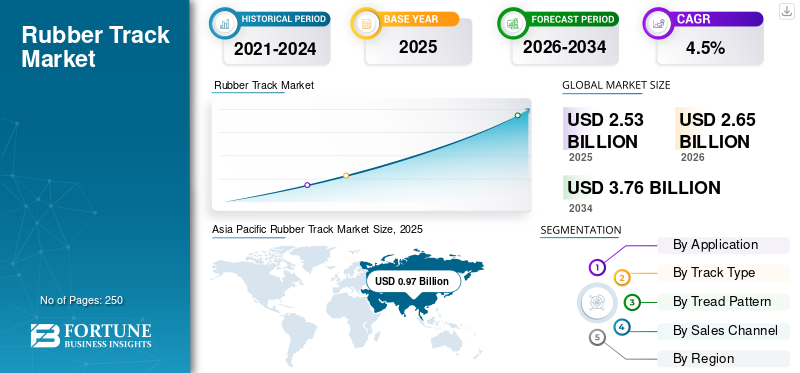
The global rubber track market size was valued at USD 2.53 billion in 2025 and is projected to grow from USD 2.65 billion in 2026 to USD 3.76 billion by 2034, exhibiting a CAGR of 4.5% during the forecast period. Asia Pacific dominated the rubber track market with a market share of 38.3% in 2025.
The global rubber track market refers to the industry involved in the production, distribution, and sale of rubber tracks used in tracked systems vehicles, such as construction machinery, agricultural equipment, and military vehicles. These tracks provide enhanced traction, reduced ground pressure, and improved durability compared to steel tracks or tires. Market growth is driven by increasing mechanization, infrastructure development, and demand for efficient, low-maintenance mobility solutions across diverse terrains and applications.
Key drivers of the market include rising demand for construction and agricultural machinery, increasing infrastructure development, and growing mechanization in emerging economies. Advantages such as better traction, lower ground damage, and improved fuel efficiency also boost adoption. Additionally, technological advancements and expanding applications across industries further support the market growth.
Major players in the market include Bridgestone Corporation, Camso (Michelin), Continental AG, Trelleborg AB, and Zhejiang Yuan Chuang Rubber Track Co., Ltd., competing through product durability, advanced rubber compounds, customization, and strong aftermarket distribution networks, along with continuous innovation to enhance performance, longevity, and efficiency across construction and agricultural applications.
Download Free sample to learn more about this report.
Rubber Track Market Key Takeaways
 Market Size & Forecast
- 2025 Market Size: USD 2.53 billion
- 2026 Market Size: 2.65 billion
- 2034 Forecast Market Size: USD 3.76 billion
- CAGR: 4.5% from 2026–2034
 Market Share
- Asia Pacific dominated the rubber track market with a 38.3% share in 2025.
- The rubber track pads segment held a significant market share and is projected to grow at a CAGR of 3.3% during the forecast period.
- The straight bar pattern segment is expected to register the fastest growth with a CAGR of 5.7% over the study period.
 Key Regional Highlights
Asia Pacific
Asia Pacific remained the leading regional market in 2025, supported by rapid urbanization, expanding construction activities, and strong agricultural mechanization demand.
Europe
Europe held the second-largest market share, driven by advanced farming practices, infrastructure modernization, and strict environmental regulations promoting soil-friendly equipment.
North America
North America ranked as the third-largest market due to strong demand from the construction, forestry, and agriculture sectors along with a well-established aftermarket network.
U.S.
The U.S. rubber track market in 2026 is estimated at around USD 0.63 billion, supported by infrastructure investments and high equipment utilization rates.
Japan
Japan’s rubber track market in 2026 is estimated at around USD 0.15 billion, driven by advanced machinery adoption and strong OEM presence across agriculture and compact construction equipment sectors.
Read More

RUBBER TRACK MARKET TRENDS
Advancements in Material Technology and Design to Shape Market Trends
Technological advancements in material science and product design are emerging as a key trend in the market. Manufacturers are increasingly utilizing advanced rubber compounds, hybrid materials, and reinforced structures to enhance durability, wear resistance, and load-bearing capacity. Innovations such as anti-vibration designs, improved tread patterns, and lightweight constructions are improving machine performance and operator comfort. Additionally, the integration of smart technologies, including sensors for wear monitoring and predictive maintenance, is gaining traction. These advancements not only extend the lifespan of rubber tracks but also reduce downtime and operational costs. As end users prioritize efficiency and reliability, continuous innovation in materials and design will remain a defining trend in the market.
MARKET DYNAMICS
MARKET DRIVERS
Rising Infrastructure Development and Mechanization to Drive Rubber Track Demand
Rapid infrastructure development and increasing mechanization across the construction and agriculture sectors are key drivers of global rubber track market growth. Governments worldwide are investing heavily in roads, railways, and urban development projects, boosting demand for compact track loaders, excavators, and other tracked machinery. Simultaneously, the shift toward mechanized farming practices, particularly in emerging economies, is driving the adoption of rubber-tracked equipment to improve productivity and efficiency. Rubber tracks offer advantages such as reduced soil compaction, enhanced traction, and smoother operation, making them ideal for a wide range of terrains. As construction and agricultural activities expand globally, demand for durable, high-performance rubber tracks are expected to grow significantly.
Download Free sample to learn more about this report.
MARKET RESTRAINTS
Limited Suitability in Extreme Operating Conditions to Restrict Adoption
Rubber tracks, while offering multiple advantages, face limitations in extreme operating environments, which can restrain their adoption. In highly abrasive terrains, such as rocky, debris-filled, or mining-intensive applications, rubber tracks are more prone to cuts, punctures, and accelerated wear than steel tracks. Additionally, exposure to extreme temperatures, both very high and very low, can degrade rubber properties, reducing flexibility and durability over time. These limitations make rubber tracks less suitable for certain heavy-duty or specialized applications where robustness is critical. As a result, end users operating in such harsh conditions may prefer alternative solutions, thereby restricting the overall market penetration of rubber tracks in specific use cases.
MARKET OPPORTUNITIES
Expansion of Aftermarket Services and Custom Solutions to Create Growth Opportunities
The growing demand for aftermarket services and customized rubber track solutions presents significant market opportunities. As the global fleet of tracked machinery expands, the need for timely replacement, maintenance, and performance upgrades is increasing. Manufacturers and service providers are focusing on offering tailored rubber track solutions based on equipment type, application, and operating conditions. This includes variations in tread patterns, rubber compounds, and reinforcement technologies. Additionally, the rise of e-commerce platforms and digital distribution channels is making aftermarket products more accessible to end users worldwide. Companies that invest in strong distribution networks and value-added services, such as predictive maintenance and installation support, can capitalize on this expanding aftermarket landscape. Thus, the rising demand for rubber tracks drives the market growth.
MARKET CHALLENGES
Supply Chain Volatility and Raw Material Price Fluctuations as a Major Market Challenge
Volatility in raw material prices and supply chain disruptions pose significant challenges for the rubber track market. The production of rubber tracks relies heavily on natural rubber, synthetic rubber, steel cords, and other petrochemical-based inputs, all of which are subject to price fluctuations driven by geopolitical factors, climate conditions, and changes in global supply and demand. Additionally, disruptions in logistics and transportation networks can lead to delays and increased costs for manufacturers. These uncertainties make it difficult for companies to maintain stable pricing and profit margins. Smaller players, in particular, may struggle to absorb cost variations. Addressing these challenges requires strategic sourcing, supplier diversification, and efficient inventory management practices.
Segmentation Analysis
By Application
Extensive Infrastructure Projects and Equipment Utilization to Drive Construction Segment Dominance
Based on the application, the market is divided into agriculture, construction, mining, and others.
The construction segment dominates the market due to extensive global infrastructure development and high utilization of compact track loaders, excavators, and skid steer loaders. These machines require durable rubber tracks for superior traction, reduced ground damage, and stable operation across varied terrains. Continuous equipment usage in urban and road construction projects ensures frequent replacement cycles, supporting sustained demand for high-performance rubber tracks.
The agriculture segment held the second-largest share of the rubber track market in 2025. The segment is set to grow with a CAGR of 4.1% during the forecast period. Increasing farm mechanization and demand for soil-friendly equipment are driving adoption, as rubber tracks minimize compaction while enhancing traction and operational efficiency in diverse field conditions.
To know how our report can help streamline your business, Speak to Analyst
By Track Type
High Durability and Superior Performance to Drive Continuous Rubber Tracks Segment Dominance
By track type, the market is divided into continuous rubber tracks and rubber track pads.
Continuous rubber tracks dominate the market due to their widespread use in construction and agricultural machinery requiring enhanced traction, stability, and load distribution. These tracks offer greater durability, reduced vibration, and improved performance on uneven and sensitive terrain. Their ability to minimize ground pressure while supporting heavy equipment ensures consistent demand. Frequent usage in high-intensity applications leads to steady replacement cycles, further strengthening segmental dominance.
The rubber track pads segment held a significant market share in 2025. The segment is set to grow with a CAGR of 3.3% during the forecast period. Increasing demand for cost-effective retrofitting solutions and for improved mobility on paved surfaces is driving adoption, particularly in applications that require a balance between protection and operational flexibility.
By Tread Pattern
Enhanced Traction and Versatility Across Terrains to Drive C-Lug Pattern Dominance
Based on the tread pattern, the market is segmented into c-lug pattern, straight bar pattern, multi-bar pattern, zig-zag pattern, and others.
The C-Lug pattern segment dominates the market due to its superior traction, self-cleaning properties, and adaptability across diverse terrains, including mud, soft soil, and uneven construction sites. Widely used in both construction and agricultural equipment, this pattern ensures stability, reduced slippage, and improved operational efficiency. Its balanced design supports heavy loads while minimizing wear, resulting in consistent demand and frequent replacement cycles in high-usage applications.
The straight bar pattern segment is the fastest-growing during the forecast period. The segment is set to grow with a CAGR of 5.7% during the forecast period. The increasing demand for smoother ride quality and enhanced performance on hard or paved surfaces is driving adoption, particularly in urban construction and material-handling applications.
By Sales Channel
Large Installed Base and Frequent Replacement Cycles to Drive Aftermarket Segment Dominance
Based on sales channel, the market is bifurcated into OEM and aftermarket.
The aftermarket segment dominates the market due to the large installed base of tracked machinery and the regular need for track replacement. Rubber tracks experience continuous wear under demanding operating conditions, leading to recurring demand across construction and agricultural equipment. End users prefer aftermarket solutions for cost efficiency, wider availability, and compatibility with multiple equipment brands, thereby ensuring steady, sustained revenue generation.
The OEM segment held a significant market share in 2025. The segment is set to grow with a CAGR of 3.9% during the forecast period. Rising production of new construction and agricultural machinery, along with the increasing adoption of advanced rubber-track technologies, is supporting demand through direct integration at the manufacturing stage.
Rubber Track Market Regional Outlook
By region, the market is categorized into Europe, North America, Asia Pacific, and the Rest of the World.
Asia Pacific
Asia Pacific Rubber Track Market Size, 2025 (USD Billion)
To get more information on the regional analysis of this market, Download Free sample
Asia Pacific dominates the market due to rapid infrastructure development, expanding construction activities, and increasing agricultural mechanization across countries such as China, India, and Japan. Strong demand for compact construction equipment and crawler machinery, coupled with government investments in transportation and rural development projects, drives consistent adoption. Additionally, the presence of key manufacturers and cost-effective production capabilities supports regional supply. Growing urbanization and rising equipment utilization further strengthen aftermarket demand, reinforcing the region’s leading position.
China Rubber Track Market
The Chinese market in 2026 is estimated at around USD 0.42 billion. Rapid urbanization, expanding construction projects, and expanding domestic rubber track manufacturing capabilities are key factors driving strong, sustained market growth.
Japan Rubber Track Market
The Japanese market in 2026 is estimated at around USD 0.15 billion. The adoption of advanced machinery supports growth, the strong presence of OEMs, and consistent demand from the agriculture and compact construction equipment segments.
Europe
Europe holds the second-largest share in the market, supported by advanced agricultural practices and steady infrastructure modernization initiatives. Countries such as Germany, France, and the U.K. demonstrate strong demand for high-performance machinery equipped with durable rubber tracks. Strict environmental regulations promote the use of equipment that minimizes soil damage and emissions, thereby favoring the adoption of rubber tracks. Additionally, the region’s well-established aftermarket ecosystem and focus on precision farming contribute to stable growth, with a projected CAGR of 4.6% over the forecast period.
U.K. Rubber Track Market
The U.K. market in 2026 is estimated at around USD 0.07 billion. Infrastructure upgrades, the adoption of compact equipment, and strong aftermarket demand across construction and landscaping applications drive growth.
Germany Rubber Track Market
The German market in 2026 is estimated at around USD 0.12 billion of the global market revenues. Advanced agricultural mechanization, precision farming practices, and demand for high-performance construction equipment across industrial and commercial sectors support expansion.
North America
North America is the third-largest market, driven by strong demand from the construction, agriculture, and forestry sectors. The U.S. and Canada exhibit high adoption of advanced machinery, including compact track loaders and excavators, which rely heavily on rubber tracks. Increasing investments in infrastructure repair and residential construction further support demand. Additionally, a strong focus on operational efficiency and equipment performance encourages the use of durable rubber track solutions. The region also benefits from a mature aftermarket network, ensuring consistent replacement demand.
U.S. Rubber Track Market
The U.S. market in 2026 is estimated at around USD 0.63 billion. Growth is fueled by large-scale infrastructure investments, high equipment utilization, and a well-established aftermarket supporting frequent replacement cycles.
Rest of the World
The Rest of the World market, including Latin America, the Middle East, and Africa, is witnessing gradual growth driven by expanding construction activities and improving agricultural mechanization. Infrastructure development projects, particularly in the Middle East, and rising demand for efficient farming equipment in Latin America support market expansion. However, growth remains moderate due to limited access to advanced machinery and cost constraints. Increasing foreign investment and government initiatives to modernize infrastructure and agriculture are expected to create future growth opportunities.
COMPETITIVE LANDSCAPE
Key Industry Players
Rising Product Innovation and OEM Partnerships is Strengthening the Market Position
The global rubber track market is moderately consolidated, with key players such as Bridgestone Corporation, Camso (Michelin), Continental AG, Trelleborg AB, and Zhejiang Yuan Chuang Rubber Track Co., Ltd. focusing on product innovation and durability enhancement. Companies compete by developing advanced rubber compounds, reinforced structures, and optimized tread patterns to improve performance across diverse applications. Strategic partnerships with OEMs and expansion of manufacturing capabilities enable players to strengthen market presence and meet rising demand from the construction and agriculture sectors.
Additionally, aftermarket dominance has intensified competition, prompting manufacturers to expand distribution networks and offer cost-effective replacement solutions. Regional players, particularly in the Asia Pacific, compete through competitive pricing and large-scale production. Global companies emphasize brand reputation, quality assurance, and technological advancements to differentiate their offerings. Continuous investment in R&D, along with a focus on customization and application-specific solutions, remains critical for sustaining competitiveness and capturing emerging growth opportunities in the market.
LIST OF KEY RUBBER TRACK COMPANIES PROFILED
- Bridgestone Corporation (Japan)
- Michelin (Camso) (France)
- Continental AG (Germany)
- Trelleborg AB (Sweden)
- Zhejiang Yuan Chuang Rubber Track Co., Ltd. (China)
- Soucy International Inc. (Canada)
- DRB Holding Co., Ltd. (South Korea)
- McLaren Industries (U.S.)
- Mattracks Inc. (U.S.)
- Chermack Machine Inc.(U.S.)
KEY INDUSTRY DEVELOPMENTS
- February 2026: Bridgestone Corporation expanded its rubber track production capacity in the Asia Pacific, aiming to meet rising demand from construction equipment manufacturers while enhancing supply chain efficiency and reducing delivery timelines across key regional markets.
- January 2026: Michelin’s subsidiary Camso introduced a new range of high-durability rubber tracks designed for compact track loaders, focusing on extended lifespan and improved traction for heavy-duty construction and agricultural applications.
- December 2025: Continental AG launched an advanced rubber track solution integrating wear-resistant compounds to improve operational efficiency and reduce downtime for construction machinery operating in abrasive environments.
- October 2025: Zhejiang Yuan Chuang Rubber Track Co., Ltd. increased its export capacity to Europe and North America, strengthening its global distribution network to cater to growing aftermarket demand.
- February 2025: Bridgestone and Komatsu launch a PoC to extend tire life and improve the efficiency of mining trucks. The new program works by exchanging and analyzing real-time tire data from Bridgestone's advanced tire monitoring system for mining vehicles, Bridgestone iTrack *1, and vehicle data from Komatsu's large mining equipment monitoring system, Komtrax Plus.
- October 2024: Trelleborg introduced its first Agriculture Rubber Track, ART1000, at Italy’s EIMA exhibition, along with a wide selection of products and services designed for modern farming.
- March 2024: Camso (Michelin) expanded its aftermarket service network globally, improving accessibility and support for rubber track replacement across key regions.
REPORT COVERAGE
The global rubber track market analysis provides an in-depth study of the market size & forecast by all the market segments included in the report. It includes details on the market dynamics and trends expected to drive the market in the forecast period. It offers information on the technological advancements, new product launches, key industry developments, and details on partnerships, mergers & acquisitions. The market research report also encompasses a detailed competitive landscape, including market share and profiles of key operating players.
Request for Customization to gain extensive market insights.
Report Scope & Segmentation
| ATTRIBUTE | DETAILS |
| Study Period | 2021-2034 |
| Base Year | 2025 |
| Estimated Year | 2026 |
| Forecast Period | 2026-2034 |
| Historical Period | 2021-2024 |
| Growth Rate | CAGR of 4.5% from 2026-2034 |
| Unit | Value (USD Billion) |
| Segmentation | By Application, By Track Type, By Tread Pattern, By Sales Channel, and By Region |
| By Application |
|
| By Track Type |
|
| By Tread Pattern |
|
| By Sales Channel |
|
| By Region |
|
Frequently Asked Questions
Fortune Business Insights says that the global market value stood at USD 2.53 billion in 2025 and is projected to reach USD 3.76 billion by 2034.
In 2025, the market value stood at USD 0.97 billion.
The market is expected to exhibit a CAGR of 4.5% during the forecast period.
The construction segment led the market by application.
Rising infrastructure development and mechanization to drive rubber track demand.
Asia Pacific dominated the market in 2025.



- 2021-2034
- 2025
- 2021-2024
- 250
-
(Offer valid till 30th Sep 2026)
Get 30-60 hrs Free Customization
Expand Regional and Country Coverage, Segments Analysis, Company Profiles, Competitive Benchmarking, and End-user Insights.




















Related Reports
-
US +1 833 909 2966 ( Toll Free )
-
Get In Touch With Us